TEK (TEK tyrosine kinase, endothelial)
2012-04-01 Mohammad B Hossain , Nahir Cortes-Santiago , Dan Liu , Vanesa Martin , Candelaria Gomez-Manzano AffiliationIdentity
HGNC
LOCATION
9p21.2
LOCUSID
ALIAS
CD202B,GLC3E,TIE-2,TIE2,VMCM,VMCM1
FUSION GENES
DNA/RNA
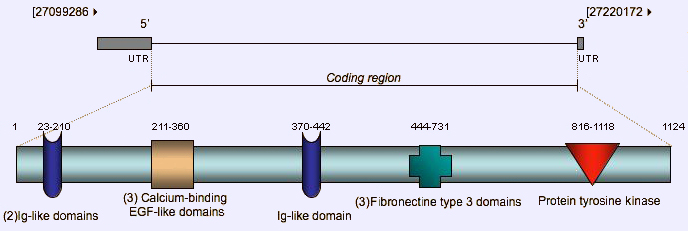
Schematic representation of TEK gene, coding region and protein. UTR, untranslated region; Ig, immunoglobulin; EGF, epithelial growth factor.
Description
Tie2 DNA contains 121025 bp, which has 23 coding exons, in plus strand.
Transcription
mRNA contains 4817 bp transcribed in centromeric to telomeric orientation; 2 other transcripture structures by alternative splicing have been predicted. The mRNA contains a long (442 bp) 5-UTR with 5 upstream ORFs and 1 IRES that allows the RNA to be translated under hypoxic conditions.
Proteins
Description
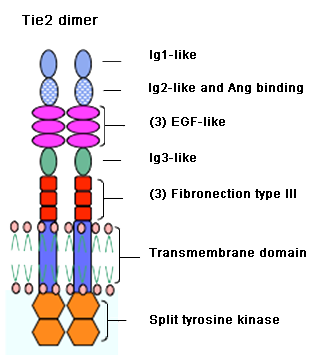
Tie2 contains 1124 amino acids and belongs to the protein kinase superfamily, Tyr protein kinase family, Tie subfamily. Tie2 receptor contains three epidermal growth factor (EGF)-like domains flanked by three Ig-like (immunoglobulin-like) domains, followed by three fibronectin type-III domains in the extracellular domain. Tie2 possesses one intracellular split tyrosine kinase domain, which is highly conserved between the Tie members sharing a 76% sequence homology. It also contains a single transmembrane domain.
Expression
TEK/Tie2 is predominantly expressed by vascular endothelial cells: It is detectable in the critical process of new vessels formation during early development, and in the adult in response to cyclic hormonal stimulation in the ovary and uterus, as well as in healing skin wounds. High levels of expression of TEK are found in placenta, lung, spleen, and heart tissues. Hematopoietic stem cells, progenitor and mature pericytes, neural progenitor cells, and a subpopulation of monocytes (Tie2-expressing monocytes) also express Tie2/TEK. In addition, its expression might be induced in response to other pathological conditions as described bellow.
Localisation
Cell membrane.
Function
TEK/Tie2 is a tyrosine-kinase transmembrane receptor involved in signaling pathways upon stimuli by angiopoietins (natural ligands). It guides the proper patterning of endothelial cells during blood vessel formation and also plays role in vessel remodeling, cell survival, cell migration, and cell-to-matrix and cell-to-cell adhesion. TEK/Tie2 signaling pathway is also involved in Toll-like receptor 2 and integrin signaling.
Homology
H. sapiens: TEK;
P. troglodytes: TEK;
B. Taurus: TEK;
M. musculus: Tek;
D. rerio: tie2;
R. novergicus: Tek;
G. gallus: TEK.
P. troglodytes: TEK;
B. Taurus: TEK;
M. musculus: Tek;
D. rerio: tie2;
R. novergicus: Tek;
G. gallus: TEK.
Mutations
Germinal
Heterozygous TEK substitutions: R849W (10 of 17 families with hereditary mucocutaneous venous malformation, VMCM), Y897S, Y897C, R915H, R918C, V1919L, A925C, K1100N. These mutations result in in vitro ligand-independent hyperphosphorylation.
Somatic
Several somatic mutations have been identified related to non-inherited vascular anomalies:
1) del-Tie2 mutant, consists in an in-frame deletion of 129bp, corresponding to a loss of exon 3 and part of exon 4 (amino acid 122-165 of extracellular Ig-like ligand-binding domain, 43 aa deletion in Ig-like domain);
2) Mutations in exon 17 of TEK/Tie2 in 49,1% (28 of 57 individuals): two somatic TEK mutations (Y897C, R915C) in vascular tumors, and seven somatic TEK mutations in vascular malformations (Y897H, Y897C, L914F, R915C, S917I, R918C, R918H).
In patients with human intramuscular haemangioma, the following Tie2 mutations have been described: G833D, Q837H.
1) del-Tie2 mutant, consists in an in-frame deletion of 129bp, corresponding to a loss of exon 3 and part of exon 4 (amino acid 122-165 of extracellular Ig-like ligand-binding domain, 43 aa deletion in Ig-like domain);
2) Mutations in exon 17 of TEK/Tie2 in 49,1% (28 of 57 individuals): two somatic TEK mutations (Y897C, R915C) in vascular tumors, and seven somatic TEK mutations in vascular malformations (Y897H, Y897C, L914F, R915C, S917I, R918C, R918H).
In patients with human intramuscular haemangioma, the following Tie2 mutations have been described: G833D, Q837H.
Implicated in
Entity name
Various cancers
Note
Cancer: acute myeloid leukemia and chronic myelogenous leukemia, and solid tumors, such as malignant gliomas, breast cancer, thyroid cancer, gastric cancer, bladder cancer, endometrial carcinoma.
Present in both the vasculature and cancer cells of several solid tumors.
Present in both the vasculature and cancer cells of several solid tumors.
Disease
Overexpressed in the vasculature of several tumors, as breast cancer, non-small cell lung cancer, hepatocellular carcinoma, prostate cancer, Kaposis sarcoma, and astrocytoma.
Overexpressed in the cancer cells -outside of the vascular compartment- in Acute and Chronic Myeloid Leukemia, and solid tumors, such as Malignant Astrocytomas, Breast Cancer, Thyroid Cancer, Gastric Cancer, Endometrial Adenocarcinoma.
Overexpressed in brain tumor stem cells and leukemic blasts.
Overexpressed in the cancer cells -outside of the vascular compartment- in Acute and Chronic Myeloid Leukemia, and solid tumors, such as Malignant Astrocytomas, Breast Cancer, Thyroid Cancer, Gastric Cancer, Endometrial Adenocarcinoma.
Overexpressed in brain tumor stem cells and leukemic blasts.
Prognosis
Correlation of TEK/Tie2 expression and malignancy in Gliomas. Tie2 activation results in increased levels of expression of ABC transporter, and eventually chemoresistance of malignant gliomas. Tie2 regulates migration and invasion of these tumors.
Cellular Tie2 and soluble Tie2 expression might be associated to a higher risk of metastasis in patients with breast and bladder cancer, respectively.
Cellular Tie2 and soluble Tie2 expression might be associated to a higher risk of metastasis in patients with breast and bladder cancer, respectively.
Entity name
Sporadic and inherited forms of mucocutaneous venous malformations (VMCM) and intramuscular haemangioma
Disease
Venous malformations are vascular masses composed of dilated channels lined by endothelial cells, with a reduced coverage by pericytes, leading to functionally low resistance vessels.
See Mutation section for description of TEK/Tie2 mutations related with these diseases. Some of these mutations affect TEK/Tie2 activity and/or response to ligand.
Prognosis
Not determined.
Entity name
Systemic sclerosis: microangiopathies
Disease
Systemic sclerosis (SSc) is an autoimmune disease characterized by altered angiogenesis that precede fibrosis of skin and internal organs. The abnormal angiogenesis is one of the major causes of microangiopathies.
Prognosis
Report suggesting that soluble Tie2 in serum samples from patients with systemic sclerosis is related to the development of vascular abnormalities of this disease (nailfold bleeding and pulmonary arterial hypertension).
Cytogenetics
Not determined.
Entity name
Wide range of diseases with a vascular and/or inflammatory component, such as psoriasis, pulmonary hypertension, rheumatoid arthritis
Disease
Psoriatic lesions are characterized by elongation and dilatation of papillary dermis. Tie2 transgenic mice showed epidermal hyperproliferation, inflammatory cell accumulation, and altered dermal angiogenesis, mimicking the phenotype present in human psoriasis.
Pulmonary hypertension is characterized by high pulmonary arterial pressure. Increased levels of activated TEK/Tie2 and Angiopoietin1 have been reported.
Rheumatoid arthritis is characterized by chronic inflammatory changes in synovial tissue and pathological angiogenesis. Tie2 has been shown to be upregulated in synovial tissue of patients with rheumatoid arthritis and to mediate pathological angiogenesis and invasion within affected synovial tissue.
Pulmonary hypertension is characterized by high pulmonary arterial pressure. Increased levels of activated TEK/Tie2 and Angiopoietin1 have been reported.
Rheumatoid arthritis is characterized by chronic inflammatory changes in synovial tissue and pathological angiogenesis. Tie2 has been shown to be upregulated in synovial tissue of patients with rheumatoid arthritis and to mediate pathological angiogenesis and invasion within affected synovial tissue.
Prognosis
Not determined.
Cytogenetics
Not determined.
Entity name
Cerebrovascular disease: stroke
Disease
In stroke, arterial occlusion of one or more arteries in the brain leads to focal or global ischemia and tissue damage and eventual death. Expression of activated Tie2 and Ang1 lead to enhanced neovascularization, vessel stabilization and improved recovery.
Prognosis
Reports suggest that activation of Tie2-mediated pathway is essential in initiation of survival responses in neural progenitor cells against cerebral ischemia and hypoxia.
Cytogenetics
Not determined.
Article Bibliography
| Pubmed ID | Last Year | Title | Authors |
|---|---|---|---|
| 15260986 | 2004 | Tie2/angiopoietin-1 signaling regulates hematopoietic stem cell quiescence in the bone marrow niche. | Arai F et al |
| 19409199 | 2009 | An Ang1-Tie2-PI3K axis in neural progenitor cells initiates survival responses against oxygen and glucose deprivation. | Bai Y et al |
| 18544044 | 2009 | Increasing Ang1/Tie2 expression by simvastatin treatment induces vascular stabilization and neuroblast migration after stroke. | Chen J et al |
| 18711749 | 2009 | Nitric oxide donor up-regulation of SDF1/CXCR4 and Ang1/Tie2 promotes neuroblast cell migration after stroke. | Cui X et al |
| 16169466 | 2005 | Tie2 identifies a hematopoietic lineage of proangiogenic monocytes required for tumor vessel formation and a mesenchymal population of pericyte progenitors. | De Palma M et al |
| 13130465 | 2003 | Tie2 receptor tyrosine kinase, a major mediator of tumor necrosis factor alpha-induced angiogenesis in rheumatoid arthritis. | DeBusk LM et al |
| 12571257 | 2003 | Signaling molecules in nonfamilial pulmonary hypertension. | Du L et al |
| 16225862 | 2006 | Tie receptors and their angiopoietin ligands are context-dependent regulators of vascular remodeling. | Eklund L et al |
| 11283723 | 2001 | Tie receptors: new modulators of angiogenic and lymphangiogenic responses. | Jones N et al |
| 21849906 | 2011 | Do serum angiopoietin-1, angiopoietin-2, and their receptor Tie-2 and 4G/5G variant of PAI-1 gene have a role in the pathogenesis of preeclampsia? | Kamal M et al |
| 11348459 | 2001 | Altered expression of angiopoietins and Tie2 endothelium receptor in psoriasis. | Kuroda K et al |
| 17189382 | 2006 | Expression of the receptor tyrosine kinase Tie2 in neoplastic glial cells is associated with integrin beta1-dependent adhesion to the extracellular matrix. | Lee OH et al |
| 19079259 | 2009 | Somatic mutations in angiopoietin receptor gene TEK cause solitary and multiple sporadic venous malformations. | Limaye N et al |
| 21321379 | 2010 | Tie2/TEK modulates the interaction of glioma and brain tumor stem cells with endothelial cells and promotes an invasive phenotype. | Liu D et al |
| 15718307 | 2005 | Analysis of concerted expression of angiogenic growth factors in acute myeloid leukemia: expression of angiopoietin-2 represents an independent prognostic factor for overall survival. | Loges S et al |
| 16849318 | 2006 | Structure of the extracellular domain of Tie receptor tyrosine kinases and localization of the angiopoietin-binding epitope. | Macdonald PR et al |
| 18366015 | 2008 | Tie2: a journey from normal angiogenesis to cancer and beyond. | Martin V et al |
| 19421150 | 2009 | Tie2-mediated multidrug resistance in malignant gliomas is associated with upregulation of ABC transporters. | Martin V et al |
| 15753992 | 2005 | Comparison of the prognosis indication of VEGFR-1 and VEGFR-2 and Tie2 receptor expression in breast carcinoma. | Meunier-Carpentier S et al |
| 11916292 | 2002 | Tie-2 and angiopoietin-1 expression in human thyroid tumors. | Mitsutake N et al |
| 11755466 | 2002 | Expression of angiopoietin-1 and its receptor TEK in hematopoietic cells from patients with myeloid leukemia. | Müller A et al |
| 21366713 | 2011 | Serum Tie2 levels: clinical association with microangiopathies in patients with systemic sclerosis. | Noda S et al |
| 16457819 | 2006 | The Tie2 5' untranslated region is inhibitory to 5' end-mediated translation initiation. | Park EH et al |
| 9459145 | 1998 | Expression of Tie2/Tek in breast tumour vasculature provides a new marker for evaluation of tumour angiogenesis. | Peters KG et al |
| 21858161 | 2011 | Toll-like receptor 2 induced angiogenesis and invasion is mediated through the Tie2 signalling pathway in rheumatoid arthritis. | Saber T et al |
| 18425119 | 2008 | Angiopoietins assemble distinct Tie2 signalling complexes in endothelial cell-cell and cell-matrix contacts. | Saharinen P et al |
| 17295646 | 2007 | Angiogenic factors in normal endometrium and endometrial adenocarcinoma. | Saito M et al |
| 16956819 | 2006 | Expression of angiopoietins and their receptor Tie2 in the bone marrow of patients with acute myeloid leukemia. | Schliemann C et al |
| 12010571 | 2002 | Differential expression of the angiogenic Tie receptor family in arthritic and normal synovial tissue. | Shahrara S et al |
| 11080633 | 2000 | Structure of the Tie2 RTK domain: self-inhibition by the nucleotide binding loop, activation loop, and C-terminal tail. | Shewchuk LM et al |
| 11992402 | 2002 | Tumor-infiltrating endothelial cells and endothelial precursor cells in inflammatory breast cancer. | Shirakawa K et al |
| 18807212 | 2009 | Serum levels of angiogenic factors and their prognostic relevance in bladder cancer. | Szarvas T et al |
| 14991531 | 2004 | Autocrine/paracrine role of the angiopoietin-1 and -2/Tie2 system in cell proliferation and chemotaxis of cultured fibroblastic synoviocytes in rheumatoid arthritis. | Takahara K et al |
| 8980225 | 1996 | Vascular dysmorphogenesis caused by an activating mutation in the receptor tyrosine kinase TIE2. | Vikkula M et al |
| 15377998 | 2004 | Transformation of vascular endothelial cells by a point mutation in the Tie2 gene from human intramuscular haemangioma. | Wang H et al |
| 16185665 | 2005 | Expressions and clinical significances of angiopoietin-1, -2 and Tie2 in human gastric cancer. | Wang J et al |
| 21962923 | 2011 | Somatic mutations in exon 17 of the TEK gene in vascular tumors and vascular malformations. | Ye C et al |
| 14742253 | 2004 | Targeting the Tie2/Tek receptor in astrocytomas. | Zadeh G et al |
Other Information
Locus ID:
NCBI: 7010
MIM: 600221
HGNC: 11724
Ensembl: ENSG00000120156
Variants:
dbSNP: 7010
ClinVar: 7010
TCGA: ENSG00000120156
COSMIC: TEK
RNA/Proteins
Expression (GTEx)
Pathways
Protein levels (Protein atlas)
References
| Pubmed ID | Year | Title | Citations |
|---|---|---|---|
| 38195021 | 2024 | TIE2 expression in hypertensive ICH and its therapeutic modulation with AKB-9778: Implications for brain vascular health. | 0 |
| 38195021 | 2024 | TIE2 expression in hypertensive ICH and its therapeutic modulation with AKB-9778: Implications for brain vascular health. | 0 |
| 36876965 | 2023 | Expression of Tie2 (angiopoietin receptor) on the monocyte subpopulations from ischemic stroke patients: Histological and flowcytometric studies. | 0 |
| 36949696 | 2023 | [Expression of Tyrosine Kinase Receptor 2 in Oral Squamous Cell Carcinoma and the Effect on Cell Proliferation and Migration and Epithelial-Mesenchymal Transition Process]. | 0 |
| 37005879 | 2023 | Hsa_circ_0070661 inhibits cancer progression through miR-556-5p/TEK axis in lung adenocarcinoma. | 1 |
| 37249455 | 2023 | Polymorphisms in TIE2 and ANGPT-1 genes are associated with protection against diabetic retinopathy in a Brazilian population. | 0 |
| 37658401 | 2023 | Somatic mutation spectrum of a Chinese cohort of pediatrics with vascular malformations. | 0 |
| 37819742 | 2023 | METTL3-Mediated RNA m6A Modification Regulates the Angiogenic Behaviors of Retinal Endothelial Cells by Methylating MMP2 and TIE2. | 0 |
| 38162654 | 2023 | Type I Interferons induce endothelial destabilization in Systemic Lupus Erythematosus in a Tie2-dependent manner. | 0 |
| 36876965 | 2023 | Expression of Tie2 (angiopoietin receptor) on the monocyte subpopulations from ischemic stroke patients: Histological and flowcytometric studies. | 0 |
| 36949696 | 2023 | [Expression of Tyrosine Kinase Receptor 2 in Oral Squamous Cell Carcinoma and the Effect on Cell Proliferation and Migration and Epithelial-Mesenchymal Transition Process]. | 0 |
| 37005879 | 2023 | Hsa_circ_0070661 inhibits cancer progression through miR-556-5p/TEK axis in lung adenocarcinoma. | 1 |
| 37249455 | 2023 | Polymorphisms in TIE2 and ANGPT-1 genes are associated with protection against diabetic retinopathy in a Brazilian population. | 0 |
| 37658401 | 2023 | Somatic mutation spectrum of a Chinese cohort of pediatrics with vascular malformations. | 0 |
| 37819742 | 2023 | METTL3-Mediated RNA m6A Modification Regulates the Angiogenic Behaviors of Retinal Endothelial Cells by Methylating MMP2 and TIE2. | 0 |
Citation
Mohammad B Hossain ; Nahir Cortes-Santiago ; Dan Liu ; Vanesa Martin ; Candelaria Gomez-Manzano
TEK (TEK tyrosine kinase, endothelial)
Atlas Genet Cytogenet Oncol Haematol. 2012-04-01
Online version: http://atlasgeneticsoncology.org/gene/42517/tek
Historical Card
2009-01-01 TEK (TEK tyrosine kinase, endothelial) by Dan Liu,Vanesa Martin,Candelaria Gomez-Manzano Affiliation
Department Neuro-Oncology, Genetics, The University of Texas M.D. Anderson Cancer Center, Houston, TX, USA
