Baculoviral IAP Repeat Containing 8,Inhibitor of Apoptosis-Like Protein 2,IAP-Like Protein 2,Baculoviral IAP Repeat-Containing Protein 8,Testis-Specific Inhibitor of Apoptosis,ILP-2,BIRC8
Abstract
BIRC8, also known as ILP-2, is a homologous protein of BIRC4, however, its function has seldom been addressed. Despite the similarity with other Inhibitory Apoptosis Proteins (IAPs), there is evidence that BIRC8 acts in a peculiar manner, by impeding apoptosis induced by BAX without directly inhibiting the activity of caspases. BIRC8 expression has been detected in testis and lymphoblastic normal cells and, furthermore, it has been reported in different cancers, including breast carcinoma, hematological neoplasms, hepatocellular carcinoma, nasopharyngeal carcinoma, and neuroblastoma. However, the specific implications of such protein for treatment and prognosis must be further evaluated. In this review, current data on RNA, DNA, protein and the association of BIRC8 in cancer are presented.
DNA/RNA
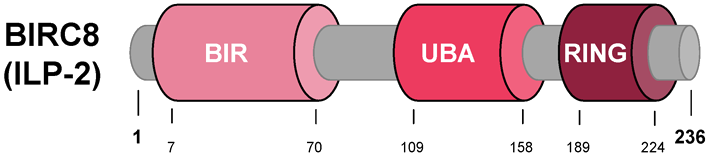
Figure 1. BIRC8 structure. BIRC8 (also kwon as ILP-2) protein structure presents 236 aa and is composed of a Baculovirus IAP Repeat (BIR) domain, an Ubiquitin-associated (UBA) domain, and a RING finger domain.
Description
The entire BIRC8 gene is approximately 2 kb (start: 53289601 and end: 53291622 bp; orientation: Minus strand). The BIRC8 cDNA contains 1 exon, 2022 bases and generates a protein with 236 amino acids. Two additional transcripts are deposited in Ensembl (http://www.ensembl.org/): one processed transcript (1826 bases) and one transcribed processed pseudogene (1468), however, neither generated protein.
Proteins
Expression
In normal tissues, BIRC8 (ILP-2) expression has only been detected in the cytoplasm of testis and lymphoblastoid cells (Richter et al., 2001; Lagacé et al., 2001). On the other hand, when assessed in cancer cells, BIRC8 was shown to be aberrantly expressed.
Function
BIRC8 is known to protect cells against intrinsic apoptosis induced by BAX and caspase 9, however, the function of this IAP has not been completely elucidated. Nevertheless, it has been shown that BIRC8 may not operate independently and requires cooperation with yet unidentified cellular proteins (Shin et al, 2005). Moreover, BIRC8 seems to play a role in immune-related functions due to its multiple leukocyte Ig-like receptors, natural killer cells, ICAMs and Fc receptors (FcRs) (Saleem et al., 2013).
Furthermore, BIRC8 undertakes a role in transformation and progression of different cancers, by protecting cells from BAX-mediated apoptosis (Chuturgoon et al., 2015; Glodkowska-Mrowka et al., 2013; Zhu et al., 2018).
Homology
At the amino acid sequence level, BIRC8 presents 80% identity and 95% homology with BIRC4. There are only a few data deposited on BIRC8 homology among different species. Still, it has been shown that there is 98.3% and 98.6% identity in BIRC8 protein and DNA, respectively, between Homo sapiens and Pan troglodytes (http://www.ncbi.nlm.nih.gov/homologene).
Description
The coding sequence of ILP-2 (BIRC8) is very similar to that of XIAP (ILP-1 or BIRC4), with 80% identity (95% homology) at the amino acid level (Richter et al., 2001). When analyzing the genomic organization of the BIRC4 locus, Lagacé et al. (2001) identified a cross-reactive band that encodes a gene that expressed a 2 kb novel transcript, homologous to BIRC4, called BIRC8. The same study demonstrated that overexpression of this gene protects cells against BAX-induced apoptosis. Additionally, it contains a putative open reading frame (ORF) that is homologous to the carboxy-terminal end of BIRC4 (Lagacé et al., 2001). However, such similarity does not follow the biochemical interaction with caspases, supported by the fact that the putative caspase 9 interaction domain is a weak inhibitor and conformationally unstable, thus leading to an inability of BIRC8 to independently inhibit CASP9 (caspase 9) (Shih et al., 2005).
Mutations
Somatic
Among the 148 mutations reported in COSMIC (Catalogue of Somatic Mutations in Cancer; http://cancer.sanger.ac.uk/cancergenome/projects/cosmic) for BIRC8, 77.03% are missense substitutions, 17.57% synonymous substitutions, and 8.11% nonsense substitutions. Similar findings are reported in cBioPortal (http://www.cbioportal.org): among the 52666 cancer samples accessed, somatic mutations in BIRC8 occur in 0.3% of the tested samples (corresponding to 145 mutations, of which 127 are missense substitutions, 17 truncated genes, and 1 other mutation).
Implicated in
Entity name
Breast cancer
Note
BIRC8 expression was evaluated in serum samples from patients with breast cancer and compared to that of either healthy women, women bearing galactophore hyperplasia, patients, with other types of cancer, or to post-breast cancer surgery patients. Increased expression was observed in patients with breast cancer when compared to those bearing other cancers or other breast pathologies, indicating that serum levels of BIRC8 may be a biomarker for breast cancer (Xiang et al., 2012).
BIRC8 overexpression was also observed in 59 tissue paraffin-embedded blocks, which including 35 breast cancer tissues and 24 galactophore hyperplasia tissues and in the breast cancer cell lines HCC-1937, MX-1 and MCF-7. Still, to verify the precise role of BIRC8, silencing experiments revealed that inhibition of BIRC8 induced apoptosis, corroborating to its pro-survival function in breast cancer cells. Additionally, BIRC8 depletion led to reduced breast cell migration, demonstrating that this gene is not only involved in sustaining breast cancer, but also in supporting the cells migratory capacity (Zhu et al., 2018).
BIRC8 expression was evaluated in chronic myeloid leukemia (CML) patients and, opposite to what is expected for BIRC genes in tumor progression, a significant decrease in BIRC8 expression was observed following the development of tyrosine kinase inhibitor resistance in chronic phase CML patients. Such observation allows for speculation that BIRC8 does not display a classical apoptosis inhibition function in leukemia cells (Glodkowska-Mrowka et al., 2013).
Entity name
Hepatocellular carcinoma
Note
Liver cancer induced by the mycotoxin fumonisin B1 (FB1), produced by Fusarium sp., leads to apoptosis resistance in the HepG2 cell line. A panel of 84 apoptosis-associated genes was evaluated after HepG2 cell exposure to FB1 and increased BIRC8 mRNA (5.7 fold) and protein (2.3 fold) expressions were detected, implying that BIRC8 contributes to liver tumorigenesis (Chuturgoon et al., 2015).
Entity name
Myelodysplastic syndrome
Note
BIRC8 levels, along with Apallon and BIRC7, were significantly increased in bone marrow cells of myelodysplastic syndromes, even when compared to leukemia cells. Such feature may suggest that these BIRC proteins are transiently overexpressed at the very early stage of leukemia transformation, acting as a trigger for the expression of other IAPs members, like BIRC5 and BIRC4 (Abe et al., 2005).
Entity name
Nasopharyngeal Carcinoma
Note
BIRC8 expression mediated by an up-regulation of the Rho-guanine nucleotide exchange factor 3 gene, ARHGEF3, contributed to the onset and progression of nasopharyngeal carcinoma. The factor ARHGEF3 plays a key role in the growth of such cancer. It has been demonstrated that depletion of ARHGEF3, using siRNA, induced apoptosis by a 5-fold down-regulation of BIRC8 expression in nasopharyngeal carcinoma cell lines (Liu et al., 2016).
Entity name
Neuroblastoma
Note
BIRC8 was inhibited in neuroblastoma xenograft models after treatment with Azadirachta indica extract, contributing to radiosensitization and leading to cell death. This action was caused through the activation of pro-apoptotic signaling and inhibition of antiapoptotic genes, including the IAP members NAIP, BIRC6, and BIRC8 (Veeraraghavan et al., 2011).
Bone marrow cells of myelodysplastic syndromes exhibit significant expression of apollon, livin and ILP-2 with reduction after transformation to overt leukemia.
Differential expression of BIRC family genes in chronic myeloid leukaemia--BIRC3 and BIRC8 as potential new candidates to identify disease progression.
Differential expression of BIRC family genes in chronic myeloid leukaemia--BIRC3 and BIRC8 as potential new candidates to identify disease progression.
Differential expression of BIRC family genes in chronic myeloid leukaemia--BIRC3 and BIRC8 as potential new candidates to identify disease progression.
Please, confirm that you want to generate a PDF file of this page. This
may take some seconds once process has started. Then it will be opened automatically.