MUC6 (mucin 6, oligomeric mucus/gel-forming)
2009-12-01 Lara Cobler , Marta Garrido , Carme de Bolós AffiliationPrograma de Recerca en Cancer, IMIM-Hospital del Mar, Dr Aiguader, 88, 08003, Barcelona, Spain
Identity
HGNC
LOCATION
11p15.5
IMAGE

LEGEND
Location of MUC6 gene.
LOCUSID
ALIAS
MUC-6
FUSION GENES
DNA/RNA
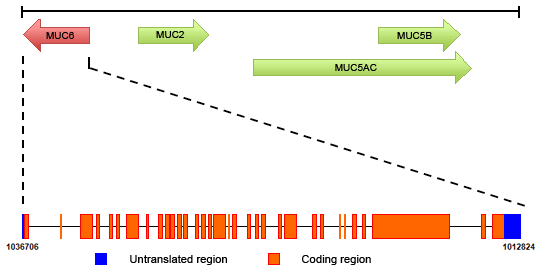
Genomic organization of MUC6 gene (not to scale).
Description
MUC6 gene approximately extends 24 kb-long on the chromosome 11 in the region p15.5. The central region has sequences repeated in tandem (TR) with a consensus motif composed of 507 pb. The variable number of TR (VNTR) diverges between 15 and 26, and the difference in distinct alleles is 5 kb long. Some data suggest that short MUC6 alleles are associated with Helicobacter pylori infection and gastric cancer.
Transcription
MUC6 gene is composed of 33 exons and the mRNA length is approximately 8 kb. The 5 flanking region of the MUC6 gene contains a TATA box at -35/-29 and potential transcription factor binding sites are described for NFkappaB and Sp family members.
Although MUC6 promoter contains a high percentage of CpG dinucleotides (up to 75%) and a CpG island, its regulation is not influenced by epigenetics.
At present no splice variants forms have been reported.
Although MUC6 promoter contains a high percentage of CpG dinucleotides (up to 75%) and a CpG island, its regulation is not influenced by epigenetics.
At present no splice variants forms have been reported.
Proteins

Schematic representation of MUC6 peptide structure (not to scale).
Description
At the N-terminal region D1, D2, D and D3 domains similar to von Willebrand factor (vWF) are present.
The TR domain composes the central region. The 169 amino acid consensus sequence has a high content of Thr-Ser-Pro containing numerous potential O-glycosilation sites.
The C-terminal region consists in two distinct regions. One with a high Thr-Ser-Pro content (STP domain), very similar to the tandem repeat region in amino acid composition, and the other region that has a high content of cystein residues. This domain has approximately 25% similarity to the CK domain of the 11p15 human mucins MUC2, MUC5AC, MUC5B and the vWF.
The TR domain composes the central region. The 169 amino acid consensus sequence has a high content of Thr-Ser-Pro containing numerous potential O-glycosilation sites.
The C-terminal region consists in two distinct regions. One with a high Thr-Ser-Pro content (STP domain), very similar to the tandem repeat region in amino acid composition, and the other region that has a high content of cystein residues. This domain has approximately 25% similarity to the CK domain of the 11p15 human mucins MUC2, MUC5AC, MUC5B and the vWF.
Expression
MUC6 was initially isolated from a gastric cDNA library, and it is expressed in the deep gland cells. It is the only mucin produced by acinar cells of the duodenal Brüners glands and it is also expressed in pancreas, endocervix and gallbladder.
Under pathological conditions, MUC6 expression can be altered, as it is reported below.
Under pathological conditions, MUC6 expression can be altered, as it is reported below.
Function
MUC6, together with MUC5AC, is the major component of the protective layer over the gastric surface where it acts as a selective diffusion barrier for HCl. Furthermore, the O-glycans found in the MUC6 TR have antimicrobial activity against Helicobacter pylori, inhibiting the biosynthesis of cholesteryl-alpha-D-glucopyranoside, a major cell wall component.
Homology
Several orthologues of MUC6 have been identified in Mus musculus, Rattus norvegicus, Pan troglodytes and Equus caballus. The chicken and mouse Muc6 have similar domain structures with human MUC6. Furthermore, the tissue-specific expression is conserved in murine organisms.
Implicated in
Entity name
Gastric cancer
Disease
Gastric cancer remains the second leading cause related death and the fourth most common cancer in the world, although its incidence is gradually decreasing.
Prognosis
MUC6 is highly expressed in gastric mucosa and in intestinal metaplasia MUC6 levels are decreased: In incomplete metaplasia and type I complete metaplasia MUC6 is not detected, whereas it is found in type II and type III complete intestinal metaplasia. MUC6 expression is lower in intestinal-type of gastric carcinomas than in adenomas or normal mucosa suggesting that the downregulation of MUC6 may contribute to the malignant transformation of gastric epithelial cells.
MUC6 is expressed in diffuse-type gastric carcinoma and its levels are greater in early carcinomas than in advanced carcinomas, showing no relationship with the depth of the carcinoma cells invasion.
MUC6 is expressed in diffuse-type gastric carcinoma and its levels are greater in early carcinomas than in advanced carcinomas, showing no relationship with the depth of the carcinoma cells invasion.
Entity name
Colon cancer
Disease
Colorectal cancer is one of the commonest cancers and the third leading cause of cancer death. However, its incidence has decreased due to a most effective intervention and life-style changes in the western countries.
Prognosis
Although in normal colon mucosa MUC6 is not expressed, it is upregulated through the adenoma-carcinoma sequence, together with the downregulation of MUC2.
Entity name
Salivary glands tumors
Disease
Salivary gland tumors are relatively uncommon. However, mucoepidermoid carcinoma is the most frequent malignant tumor of salivary glands.
Prognosis
Normal salivary glands do not express MUC6 whereas in mucoepidermoid carcinomas MUC6 is detected preferentially in mucous cells.
Entity name
Esophagus adenocarcinoma
Disease
The frequency of adenocarcinoma of the esophagus is increasing in the western world from a result of a higher prevalence in Barretts mucosa.
Prognosis
MUC6 showed a decrease in expression with progression from Barretts esophagus to dysplasia and to adenocarcinoma.
Entity name
Pancreatic cancer
Disease
Pancreas cancer is a very aggressive tumor with a 5-year survival of less than 5%, and approximately 85% of them correspond to ductal adenocarcinomas.
Prognosis
In normal pancreatic epithelium MUC6 is only expressed in ductal and in a minority of centroacinar cells. However, it is upregulated at early stages of pancreatic carcinogenesis and in pancreatic cancer. MUC6 expression has been related to clinicopathological factors and patient prognosis and survival in invasive ductal carcinoma.
Entity name
Biliary tract cancer
Disease
Biliary tract carcinomas are uncommon tumors that include cholangiocarcinomas and gallbladder carcinomas. These tumors have a poor prognosis: more than 80% of the patients are unresectable with a 6-9 month survival, and this rate is increased to 5 year after surgery.
Prognosis
MUC6 is expressed in normal gallbladder mucosa. However in adenomas, dysplasias and carcinomas, MUC6 tends to decrease and its expression is related to non-invasive growth. MUC6 is expressed frequently in pseudopyloric gland metaplasia as well as dysplasia and carcinoma.
Entity name
Lung cancer
Disease
Lung cancer is the leading cause of cancer-related mortality worldwide. Despite of this its incidence is decreasing.
Prognosis
MUC6 is not expressed in normal respiratory epithelium, but it has been focally detected in normal and distal epithelium from cancer patients. MUC6 levels increase significantly in the progression from atypical adenomatous hyperplasia, through bronchio alveolar carcinoma, to adenocarcinoma with mixed subtypes, suggesting that its expression might be associated with the progression of the lung adenocarcinoma. No expression of MUC6 is found in squamous lesions.
Entity name
Breast cancer
Disease
Breast cancer is the most common cancer worldwide and the leading cause of cancer mortality in women.
Prognosis
MUC6 is generally not detected in normal breast epithelium but it is overexpressed in benign breast disease (fibrocystic disease without atypia and atypical fibrocystic disease) and in breast carcinoma.
Entity name
Endometrial adenocarcinoma
Disease
Endometrial carcinoma is the most common malignant neoplasm of the female genital tract in developed countries, and it occurs predominantly after menopause.
Prognosis
MUC6 is not expressed in normal endometrial epithelium. However during endometrial neoplasia transformation, increased levels of MUC6 are detected: from simple hyperplasia, to complex hyperplasia, and in endometrial adenocarcinomas a MUC6 upregulation is found.
Entity name
Uterine cervix adenocarcinoma
Disease
Adenocarcinoma is the second most common malignancy of the uterine cervix. Its incidence has been increasing and constitutes 10-20% of invasive cervical cancers.
Prognosis
Although MUC6 is not expressed in normal cervical epithelium, in adenocarcinomas from uterine cervix; MUC6 can be detected at different levels associated to the histological type.
Article Bibliography
| Pubmed ID | Last Year | Title | Authors |
|---|---|---|---|
| 17197898 | 2007 | Mucin genes (MUC2, MUC4, MUC5AC, and MUC6) detection in normal and pathological endometrial tissues. | Alameda F et al |
| 15897748 | 2005 | Expression of membrane-bound mucins (MUC1 and MUC4) and secreted mucins (MUC2, MUC5AC, MUC5B, MUC6 and MUC7) in mucoepidermoid carcinomas of salivary glands. | Alos L et al |
| 16487661 | 2006 | Regulation of mucin expression: mechanistic aspects and implications for cancer and inflammatory diseases. | Andrianifahanana M et al |
| 15151204 | 2004 | Expression of MUC1, MUC2, MUC5AC, and MUC6 in atypical adenomatous hyperplasia, bronchioloalveolar carcinoma, adenocarcinoma with mixed subtypes, and mucinous bronchioloalveolar carcinoma of the lung. | Awaya H et al |
| 10209489 | 1998 | The MUC6 secretory mucin gene is expressed in a wide variety of epithelial tissues. | Bartman AE et al |
| 1448168 | 1992 | Viscous fingering of HCl through gastric mucin. | Bhaskar KR et al |
| 11101634 | 2000 | Developmental mucin gene expression in the gastroduodenal tract and accessory digestive glands. I. Stomach. A relationship to gastric carcinoma. | Buisine MP et al |
| 17401217 | 2007 | Mucin expression profile in Barrett's, dysplasia, adenocarcinoma sequence in the esophagus. | Burjonrappa SC et al |
| 15260848 | 2004 | Phenotypic alterations of mucins and cytokeratins during gallbladder carcinogenesis. | Chang HJ et al |
| 11274635 | 2001 | Mucinous bronchioloalveolar carcinomas display a specific pattern of mucin gene expression among primary lung adenocarcinomas. | Copin MC et al |
| 7657100 | 1995 | MUC6 apomucin shows a distinct normal tissue distribution that correlates with Lewis antigen expression in the human stomach. | De Bolós C et al |
| 14984930 | 2004 | The mouse secreted gel-forming mucin gene cluster. | Escande F et al |
| 9419405 | 1997 | MUC6 gene polymorphism in healthy individuals and in gastric cancer patients from northern Portugal. | Garcia E et al |
| 16803685 | 2006 | CDX2 expression is increased in gastric cancers with less invasiveness and intestinal mucin phenotype. | Ha Kim G et al |
| 15235131 | 2003 | Expression of MUC5AC and MUC6 in invasive ductal carcinoma of the pancreas and relationship with prognosis. | Jinfeng M et al |
| 15310903 | 2004 | Natural antibiotic function of a human gastric mucin against Helicobacter pylori infection. | Kawakubo M et al |
| 16887038 | 2006 | An inventory of mucin genes in the chicken genome shows that the mucin domain of Muc13 is encoded by multiple exons and that ovomucin is part of a locus of related gel-forming mucins. | Lang T et al |
| 11152646 | 2001 | Mucins as differentiation markers in bronchial epithelium. Squamous cell carcinoma and adenocarcinoma display similar expression patterns. | López-Ferrer A et al |
| 15143335 | 2004 | Gastrointestinal immunophenotype in adenocarcinomas of the uterine cervix and related glandular lesions: a possible link between lobular endocervical glandular hyperplasia/pyloric gland metaplasia and 'adenoma malignum'. | Mikami Y et al |
| 14623937 | 2003 | Expression of gastric gland mucous cell-type mucin in normal and neoplastic human tissues. | Nakajima K et al |
| 17009402 | 2006 | Short mucin 6 alleles are associated with H pylori infection. | Nguyen TV et al |
| 19639217 | 2009 | Expression of MUC1, MUC2, MUC5AC and MUC6 in cholangiocarcinoma: prognostic impact. | Park SY et al |
| 11253133 | 2001 | Immunohistochemical study of the expression of MUC5AC and MUC6 in breast carcinomas and adjacent breast tissues. | Pereira MB et al |
| 8975711 | 1996 | Human mucin genes assigned to 11p15.5: identification and organization of a cluster of genes. | Pigny P et al |
| 10681391 | 2000 | Immunohistochemical study of the expression of MUC6 mucin and co-expression of other secreted mucins (MUC5AC and MUC2) in human gastric carcinomas. | Reis CA et al |
| 15979574 | 2005 | Upregulation of MUC6 mucin gene expression by NFkappaB and Sp factors. | Sakai H et al |
| 10227723 | 1999 | Expression of MUC2, MUC5AC and MUC6 apomucins in carcinoma, dysplasia and non-dysplastic epithelia of the gallbladder. | Sasaki M et al |
| 9195947 | 1997 | The carboxyl-terminal sequence of the human secretory mucin, MUC6. Analysis Of the primary amino acid sequence. | Toribara NW et al |
| 9544852 | 1998 | Variable number tandem repeat polymorphism of the mucin genes located in the complex on 11p15.5. | Vinall LE et al |
| 17471237 | 2007 | Epigenetic regulation (DNA methylation, histone modifications) of the 11p15 mucin genes (MUC2, MUC5AC, MUC5B, MUC6) in epithelial cancer cells. | Vincent A et al |
| 16456183 | 2006 | Regulation of mucin genes in chronic inflammatory airway diseases. | Voynow JA et al |
| 16807756 | 2006 | MUC6 down-regulation correlates with gastric carcinoma progression and a poor prognosis: an immunohistochemical study with tissue microarrays. | Zheng H et al |
| 11578953 | 2001 | Regulation of mucin and glycoconjugate expression: from normal epithelium to gastric tumors. | de Bolos C et al |
Other Information
Locus ID:
NCBI: 4588
MIM: 158374
HGNC: 7517
Ensembl: ENSG00000184956
Variants:
dbSNP: 4588
ClinVar: 4588
TCGA: ENSG00000184956
COSMIC: MUC6
RNA/Proteins
| Gene ID | Transcript ID | Uniprot |
|---|---|---|
| ENSG00000184956 | ENST00000421673 | Q6W4X9 |
| ENSG00000184956 | ENST00000525923 | E9PJC5 |
| ENSG00000184956 | ENST00000527242 | H0YEZ6 |
| ENSG00000184956 | ENST00000532016 | H0YDA7 |
Expression (GTEx)
Pathways
Protein levels (Protein atlas)
References
| Pubmed ID | Year | Title | Citations |
|---|---|---|---|
| 36367122 | 2023 | Evaluation of MUC1, MUC2, MUC5AC, and MUC6 Expression Differences in Lung Adenocarcinoma Subtypes by Using a Final Immunoreactivity Score (FIRS). | 0 |
| 37057870 | 2023 | Pattern of MUC6 expression across 119 different tumor types: A tissue microarray study on 15 412 tumors. | 2 |
| 36367122 | 2023 | Evaluation of MUC1, MUC2, MUC5AC, and MUC6 Expression Differences in Lung Adenocarcinoma Subtypes by Using a Final Immunoreactivity Score (FIRS). | 0 |
| 37057870 | 2023 | Pattern of MUC6 expression across 119 different tumor types: A tissue microarray study on 15 412 tumors. | 2 |
| 34808019 | 2022 | Glycosylation of MUC6 by α1,4-linked N-acetylglucosamine enhances suppression of pancreatic cancer malignancy. | 7 |
| 35353213 | 2022 | MUC6 expression is a preferable prognostic marker for invasive mucinous adenocarcinoma of the lung. | 1 |
| 34808019 | 2022 | Glycosylation of MUC6 by α1,4-linked N-acetylglucosamine enhances suppression of pancreatic cancer malignancy. | 7 |
| 35353213 | 2022 | MUC6 expression is a preferable prognostic marker for invasive mucinous adenocarcinoma of the lung. | 1 |
| 33024306 | 2021 | Diffuse expression of MUC6 defines a distinct clinicopathological subset of pulmonary invasive mucinous adenocarcinoma. | 11 |
| 33657658 | 2021 | Calponin and MUC6 complement inhibin as diagnostic immunomarkers of serous cystadenoma in endoscopic ultrasound-guided aspiration/biopsy specimens. | 3 |
| 34672134 | 2021 | Regulation of MUC6 Methylation Correlates with Progression of Gastric Cancer. | 6 |
| 33024306 | 2021 | Diffuse expression of MUC6 defines a distinct clinicopathological subset of pulmonary invasive mucinous adenocarcinoma. | 11 |
| 33657658 | 2021 | Calponin and MUC6 complement inhibin as diagnostic immunomarkers of serous cystadenoma in endoscopic ultrasound-guided aspiration/biopsy specimens. | 3 |
| 34672134 | 2021 | Regulation of MUC6 Methylation Correlates with Progression of Gastric Cancer. | 6 |
| 31748784 | 2020 | Alzheimer Disease Pathology-Associated Polymorphism in a Complex Variable Number of Tandem Repeat Region Within the MUC6 Gene, Near the AP2A2 Gene. | 15 |
Citation
Lara Cobler ; Marta Garrido ; Carme de Bolós
MUC6 (mucin 6, oligomeric mucus/gel-forming)
Atlas Genet Cytogenet Oncol Haematol. 2009-12-01
Online version: http://atlasgeneticsoncology.org/gene/44115
