ASH2L (ash2 (absent, small, or homeotic)-like (Drosophila))
2011-08-01 Paul F South , Scott D Briggs AffiliationDepartment of Biochemistry, Purdue University Center for Cancer Research, Purdue University, West Lafayette, Indiana 47907, USA
Identity
HGNC
LOCATION
8p11.23
IMAGE

LEGEND
Figure 1. Map of chromosome 8 with region 8p11.2 highlighted as the location of the gene ASH2L.
LOCUSID
ALIAS
ASH2,ASH2L1,ASH2L2,Bre2
FUSION GENES
DNA/RNA
Description
16 exons spanning over 34218 base pairs.
Transcription
mRNA is 2368 base pairs long.
Proteins
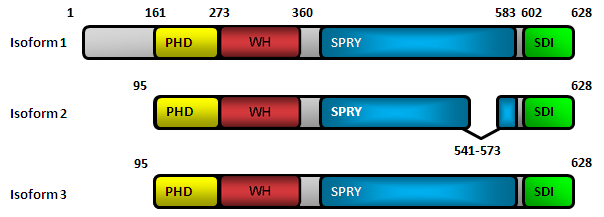
Figure 2. Schematic model of the three known isoforms of ASH2L and the amino acid sequence changes compared to the canonical isoform 1 (aa 1-628). The positions of known domains within ASH2L are displayed. PHD finger (aa 95-161), WH motif (aa 162-273), SPRY domain (aa 360-583), and SDI domain (aa 602-628). Isoform 2 and 3 are numbered according to isoform 1.
Description
There are three known isoforms of ASH2L (Wang et al., 2001). Isoform 1 is considered the canonical sequence and consists of 628 amino acids (Wang et al., 2001). Isoform 2 is missing amino acids 1-94 and 541-573 from isoform 1 (Wang et al., 2001). Isoform 3 is missing the amino acids 1-94 from isoform 1 (figure 2) (Wang et al., 2001). There are four identified domains within ASH2L which include a N-terminus containing a PHD finger and a winged helix motif (WH) and the C-terminus containing a SPRY domain and the Sdc1 DPY-30 Interacting domain (SDI) (figure 2) (Chen et al., 2011; Roguev et al., 2001; Sarvan et al., 2011; South et al., 2010; Wang et al., 2001). The largest of the three identified domains within ASH2L is the SPRY domain, which is also conserved from yeast to humans. SPRY domains were originally named after the SPIa kinase and the RYanodine receptor proteins in which it was first identified (Rhodes et al., 2005). Crystal structures of SPRY domain containing proteins show primarily a beta-sandwich structure with extending loops (Filippakopoulos et al., 2010; Kuang et al., 2009; Simonet et al., 2007; Woo et al., 2006b). The SPRY domain is thought to be a specific protein-protein interaction domain with specific partners, but instead of recognizing a particular motif or interaction domain the SPRY domain binds to interaction partners using non-conserved binding loops (Filippakopoulos et al., 2010; Woo et al., 2006a; Woo et al., 2006b). Recent work has shown that the C-terminus of ASH2L that contains the SPRY domain and the SDI domain are able to interact with the other MLL complex member RBBP5 in vitro (Avdic et al., 2011).
ASH2L also contains a putative Plant Homeo Domain (PHD) finger in its N-terminus (Wang et al., 2001). The structure of PHD fingers shows that conserved cysteine and histidine residues bind to Zn2+ ions (Champagne et al., 2008; Champagne and Kutateladze, 2009; van Ingen et al., 2008). There is no known function attributed to the PHD finger in ASH2L, though in conjunction with the winged helix motif it may be necessary for DNA binding.
The N-terminal winged helix (WH) motif was recently discovered when the crystal structure of the N-terminus of ASH2L was solved (Chen et al., 2011; Sarvan et al., 2011). Using in vitro DNA binding analyses as well as chromatin immunoprecipitation, it was determined that ASH2L can bind DNA at the HS2 promoter region and the beta-globin locus as well as non-specific DNA sequence (Chen et al., 2011; Sarvan et al., 2011).
The last identifiable domain within ASH2L is the SDI domain. There is no structural information on the SDI domain but the functional importance was determined biochemically. The function of the SDI domain was determined using in vitro binding experiments. ASH2L was shown to directly interact with DPY-30 without any additional MLL or Set1 complex components (South et al., 2010). The function of the SDI domain is conserved from yeast to humans because the yeast ASH2L homolog Bre2 was also shown to interact with the DPY-30 homolog Sdc1 (South et al., 2010). There are conserved hydrophobic residues in both the SDI domain of ASH2L and the Dpy-30 domain of DPY-30 that are important for binding, which suggests that the interaction between the SDI domain of ASH2L and the DPY-30 domain of DPY-30 is through hydrophobic interactions (South et al., 2010).
ASH2L also contains a putative Plant Homeo Domain (PHD) finger in its N-terminus (Wang et al., 2001). The structure of PHD fingers shows that conserved cysteine and histidine residues bind to Zn2+ ions (Champagne et al., 2008; Champagne and Kutateladze, 2009; van Ingen et al., 2008). There is no known function attributed to the PHD finger in ASH2L, though in conjunction with the winged helix motif it may be necessary for DNA binding.
The N-terminal winged helix (WH) motif was recently discovered when the crystal structure of the N-terminus of ASH2L was solved (Chen et al., 2011; Sarvan et al., 2011). Using in vitro DNA binding analyses as well as chromatin immunoprecipitation, it was determined that ASH2L can bind DNA at the HS2 promoter region and the beta-globin locus as well as non-specific DNA sequence (Chen et al., 2011; Sarvan et al., 2011).
The last identifiable domain within ASH2L is the SDI domain. There is no structural information on the SDI domain but the functional importance was determined biochemically. The function of the SDI domain was determined using in vitro binding experiments. ASH2L was shown to directly interact with DPY-30 without any additional MLL or Set1 complex components (South et al., 2010). The function of the SDI domain is conserved from yeast to humans because the yeast ASH2L homolog Bre2 was also shown to interact with the DPY-30 homolog Sdc1 (South et al., 2010). There are conserved hydrophobic residues in both the SDI domain of ASH2L and the Dpy-30 domain of DPY-30 that are important for binding, which suggests that the interaction between the SDI domain of ASH2L and the DPY-30 domain of DPY-30 is through hydrophobic interactions (South et al., 2010).
Expression
Northern blot analysis from multiple tissues revealed that ASH2L expression is expressed in 14 different tissue types with the highest expression in fetal liver and testes (Lüscher-Firzlaff et al., 2008). ASH2L transcripts were also found to be expressed higher in various Leukemia cell lines, such as K562, Hel, and Dami cells (Lüscher-Firzlaff et al., 2008).
Localisation
Nucleus.
Function
Biochemical data has shown that ASH2L is found in a methyltransferase core complex composed of ASH2L, RBBP5, DPY30, WDR5, and the catalytic SET domain containing protein. This core complex is highly conserved and similar to the budding yeast Set1 complex that consists of Set1 (MLL/SET1), Bre2 (ASH2L), Swd1 (RBBP5), Swd3 (WDR5), Swd2 (WDR82), Sdc1 (DPY-30), Spp1 (CFP1/CGBP). ASH2L is also known to associate with numerous additional factors. Many of these additional factors are thought to associate with ASH2L and the H3K4 methyltransferase complexes to target the complex to specific sites within the genome (Cho et al., 2007; Dou et al., 2006; Hughes et al., 2004; Steward et al., 2006; Stoller et al., 2010). Knock-down of ASH2L using siRNA globally decreases H3K4 trimethylation (Dou et al., 2006; Steward et al., 2006). ASH2L and H3K4 methylation both appear to play a key role in oncogenesis (Hess, 2006). ASH2L is found to be over abundant in many cancer cell lines and knock-down of ASH2L by siRNA can prevent tumorigenesis (Lüscher-Firzlaff et al., 2008). Recent work has suggested that ASH2L in combination with WDR5 and RBBP5 exhibits H3K4 methyltransferase activity (Cao et al., 2010; Patel et al., 2009; Patel et al., 2011). In addition, this catalytic activity is not dependent on the SET domain containing proteins such as MLL1 (Cao et al., 2010; Patel et al., 2009; Patel et al., 2011).
Alternative to ASH2Ls function in H3K4 methylation ASH2L may also be playing a role in endosomal trafficking (Xu et al., 2009). ASH2L, DPY-30 and WDR5 were originally implicated in endosomal trafficking when siRNA knock-down of these genes increased the amount of internalized CD8-CIMPR and overexpression increased the amount of cells displaying a altered CIMPR distribution (Xu et al., 2009).
Alternative to ASH2Ls function in H3K4 methylation ASH2L may also be playing a role in endosomal trafficking (Xu et al., 2009). ASH2L, DPY-30 and WDR5 were originally implicated in endosomal trafficking when siRNA knock-down of these genes increased the amount of internalized CD8-CIMPR and overexpression increased the amount of cells displaying a altered CIMPR distribution (Xu et al., 2009).
Homology
ASH2L has homologs in eukaryotes from yeast to humans.
Implicated in
Entity name
Various cancers
Note
ASH2L mRNA expression does not appear to be misregulated in human cancer cell or primary cell lines. However, expression of ASH2L protein is increased in many cancer cell lines as well as tumor samples (Lüscher-Firzlaff et al., 2008). There was detectable increased staining in the nucleus of ASH2L protein in a wide array of tumors including squamous cell carcinoma of the larynx and the cervix, melanomas, adenocarcinoma of the pancreas, and acinar and ductal breast cancers (Lüscher-Firzlaff et al., 2008). ASH2L protein appears to be more stable in cancer cell lines compared to the normal cell line counterparts and knockdown of ASH2L can prevent tumerogenesis suggesting a role in tumor cell proliferation (Lüscher-Firzlaff et al., 2008).
Article Bibliography
| Pubmed ID | Last Year | Title | Authors |
|---|---|---|---|
| 21220120 | 2011 | Structural and biochemical insights into MLL1 core complex assembly. | Avdic V et al |
| 21124902 | 2010 | An Ash2L/RbBP5 heterodimer stimulates the MLL1 methyltransferase activity through coordinated substrate interactions with the MLL1 SET domain. | Cao F et al |
| 19442115 | 2009 | Structural insight into histone recognition by the ING PHD fingers. | Champagne KS et al |
| 21660059 | 2011 | Crystal structure of the N-terminal region of human Ash2L shows a winged-helix motif involved in DNA binding. | Chen Y et al |
| 17500065 | 2007 | PTIP associates with MLL3- and MLL4-containing histone H3 lysine 4 methyltransferase complex. | Cho YW et al |
| 16878130 | 2006 | Regulation of MLL1 H3K4 methyltransferase activity by its core components. | Dou Y et al |
| 20561531 | 2010 | Structural basis for Par-4 recognition by the SPRY domain- and SOCS box-containing proteins SPSB1, SPSB2, and SPSB4. | Filippakopoulos P et al |
| 14992727 | 2004 | Menin associates with a trithorax family histone methyltransferase complex and with the hoxc8 locus. | Hughes CM et al |
| 19154741 | 2009 | SPRY domain-containing SOCS box protein 2: crystal structure and residues critical for protein binding. | Kuang Z et al |
| 18245475 | 2008 | The human trithorax protein hASH2 functions as an oncoprotein. | Lüscher-Firzlaff J et al |
| 19556245 | 2009 | On the mechanism of multiple lysine methylation by the human mixed lineage leukemia protein-1 (MLL1) core complex. | Patel A et al |
| 21106533 | 2011 | A novel non-SET domain multi-subunit methyltransferase required for sequential nucleosomal histone H3 methylation by the mixed lineage leukemia protein-1 (MLL1) core complex. | Patel A et al |
| 16313355 | 2005 | Relationship between SPRY and B30.2 protein domains. Evolution of a component of immune defence? | Rhodes DA et al |
| 11742990 | 2001 | The Saccharomyces cerevisiae Set1 complex includes an Ash2 homologue and methylates histone 3 lysine 4. | Roguev A et al |
| 21642971 | 2011 | Crystal structure of the trithorax group protein ASH2L reveals a forkhead-like DNA binding domain. | Sarvan S et al |
| 17967446 | 2007 | Antagonistic functions of SET-2/SET1 and HPL/HP1 proteins in C. elegans development. | Simonet T et al |
| 19897479 | 2010 | A conserved interaction between the SDI domain of Bre2 and the Dpy-30 domain of Sdc1 is required for histone methylation and gene expression. | South PF et al |
| 16892064 | 2006 | Molecular regulation of H3K4 trimethylation by ASH2L, a shared subunit of MLL complexes. | Steward MM et al |
| 20463296 | 2010 | Ash2l interacts with Tbx1 and is required during early embryogenesis. | Stoller JZ et al |
| 11466562 | 2001 | ASH2L: alternative splicing and downregulation during induced megakaryocytic differentiation of multipotential leukemia cell lines. | Wang J et al |
| 16498413 | 2006 | Structural and functional insights into the B30.2/SPRY domain. | Woo JS et al |
| 17189197 | 2006 | Structural basis for protein recognition by B30.2/SPRY domains. | Woo JS et al |
| 19651892 | 2009 | A role of histone H3 lysine 4 methyltransferase components in endosomal trafficking. | Xu Z et al |
| 18682226 | 2008 | Structural insight into the recognition of the H3K4me3 mark by the TFIID subunit TAF3. | van Ingen H et al |
Other Information
Locus ID:
NCBI: 9070
MIM: 604782
HGNC: 744
Ensembl: ENSG00000129691
Variants:
dbSNP: 9070
ClinVar: 9070
TCGA: ENSG00000129691
COSMIC: ASH2L
RNA/Proteins
Expression (GTEx)
Pathways
Protein levels (Protein atlas)
References
| Pubmed ID | Year | Title | Citations |
|---|---|---|---|
| 37262949 | 2023 | ASH2L, a COMPASS core subunit, is involved in the cell invasion and migration of triple-negative breast cancer cells through the epigenetic control of histone H3 lysine 4 methylation. | 0 |
| 37262949 | 2023 | ASH2L, a COMPASS core subunit, is involved in the cell invasion and migration of triple-negative breast cancer cells through the epigenetic control of histone H3 lysine 4 methylation. | 0 |
| 33964939 | 2021 | CircASH2L facilitates tumor-like biologic behaviours and inflammation of fibroblast-like synoviocytes via miR-129-5p/HIPK2 axis in rheumatoid arthritis. | 7 |
| 34012049 | 2021 | Mechanism for DPY30 and ASH2L intrinsically disordered regions to modulate the MLL/SET1 activity on chromatin. | 13 |
| 33964939 | 2021 | CircASH2L facilitates tumor-like biologic behaviours and inflammation of fibroblast-like synoviocytes via miR-129-5p/HIPK2 axis in rheumatoid arthritis. | 7 |
| 34012049 | 2021 | Mechanism for DPY30 and ASH2L intrinsically disordered regions to modulate the MLL/SET1 activity on chromatin. | 13 |
| 31870784 | 2020 | Glucocorticoids uncover a critical role for ASH2L on BCL-X expression regulation in leukemia cells. | 3 |
| 32071397 | 2020 | Cancer-derived UTX TPR mutations G137V and D336G impair interaction with MLL3/4 complexes and affect UTX subcellular localization. | 14 |
| 32279431 | 2020 | ASH2L is involved in promotion of endometrial cancer progression via upregulation of PAX2 transcription. | 15 |
| 33257682 | 2020 | ASH2L drives proliferation and sensitivity to bleomycin and other genotoxins in Hodgkin's lymphoma and testicular cancer cells. | 6 |
| 31870784 | 2020 | Glucocorticoids uncover a critical role for ASH2L on BCL-X expression regulation in leukemia cells. | 3 |
| 32071397 | 2020 | Cancer-derived UTX TPR mutations G137V and D336G impair interaction with MLL3/4 complexes and affect UTX subcellular localization. | 14 |
| 32279431 | 2020 | ASH2L is involved in promotion of endometrial cancer progression via upregulation of PAX2 transcription. | 15 |
| 33257682 | 2020 | ASH2L drives proliferation and sensitivity to bleomycin and other genotoxins in Hodgkin's lymphoma and testicular cancer cells. | 6 |
| 31718694 | 2019 | Circ-ASH2L promotes tumor progression by sponging miR-34a to regulate Notch1 in pancreatic ductal adenocarcinoma. | 49 |
Citation
Paul F South ; Scott D Briggs
ASH2L (ash2 (absent, small, or homeotic)-like (Drosophila))
Atlas Genet Cytogenet Oncol Haematol. 2011-08-01
Online version: http://atlasgeneticsoncology.org/gene/44404/ash2l-(ash2-(absent-small-or-homeotic)-like-(drosophila))
