PFKFB3 (6-phosphofructo-2-kinase/fructose-2,6-biphosphatase 3)
2013-03-01 Laura Novellasdemunt , Àurea Navarro-Sabaté , Anna Manzano , Ana Rodríguez-García , Ramon Bartrons AffiliationDepartament de Ciencies Fisiologiques, Campus de Ciencies de la Salut, Universitat de Barcelona, Feixa Llarga s\\\/n, E-08907, LHospitalet de Llobregat, Barcelona, Spain
Identity

DNA/RNA
Description
Transcription
Pseudogene
Proteins
Description
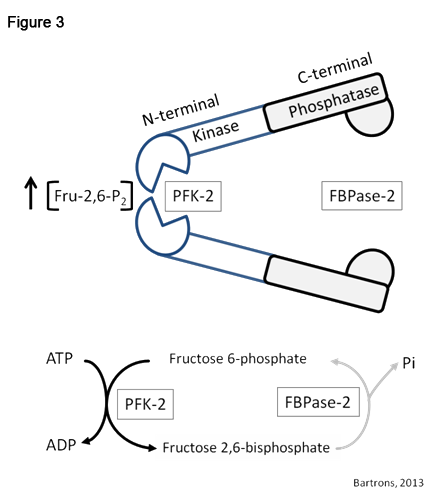
Different PFK-2/FBPase-2 isoenzymes have been described, sharing high sequence similarity (85%). PFKFB3 isoenzyme has some structural differences with the other isoforms. The conformations of the substrate loops in the kinase domain are different from those of other isoforms (Hasemann et al., 1996; Lee et al., 2003), giving a structural explanation for the higher kinase activity. Moreover, the N-terminus binds to the bisphosphatase domain to produce a conformational change in the active pocket to enhance inhibitory binding of product (Kim et al., 2006). Residues 4-15 of the kinase domain form a β-hairpin structure and the rest is used as an arm connecting the hairpin to the bisphosphatase domain. Additionally, the contacting area of the bisphosphatase domain is functionally very sensitive due to the residues critical for binding of both product and substrate are located very close (Kim et al., 2006). The low bisphosphatase activity of PFKFB3, which is lower than that of other isoforms by an order of magnitude, is due to the presence of a serine at residue 302 instead of an arginine as conserved in the other isoforms. This residue is said to interact with the 2-phosphate and further stabilizes the transitions state (Cavalier et al., 2012; Kim et al., 2006).
Expression
PFKFB3 gene has been found to be expressed in different cell systems. During C2C12 myogenic cell differentiation, the 6-phosphofructo-2-kinase isoenzyme, product of the PFKFB3 gene, is downregulated, being the PFKFB3 isoenzyme degraded through the ubiquitin-proteasome proteolytic pathway (Riera et al., 2003). In neurons, PFKFB3 is constantly subjected to proteasome degradation after ubiquitylation by the E3 ubiquitin ligase APC/C-Cdh1. The activity of this complex is determinant in controlling the protein levels of PFKFB3 and hence the rate of glucose consumption through glycolysis. The function of APC/C is strictly dependent on the presence of Cdh1, which is very abundant in these cells. In contrast, astrocytes express very low Cdh1 levels and therefore APC/C activity is negligible. Accordingly, PFKFB3 protein levels are high and glycolysis is active in astrocytes owing to the low levels of Cdh1. In fact, overexpression of Cdh1 in astrocytes destabilizes PFKFB3 and concomitantly decreases the rate of glycolysis (Fernandez-Fernandez et al., 2012). The later finding that the activity of the PFKFB3 isoenzyme is regulated in cancer cells by APC/C-Cdh1 (Almeida et al., 2010) led to the identification of the role of this ubiquitin ligase in the metabolic regulation of the cell cycle and therefore of cell proliferation (Moncada et al., 2012).
The regulatory component of this complex, Cdh1, has been shown to be downregulated during malignant progression and tumor formation. A decrease in the activity of APC/C-Cdh1 in mid-to-late G1 phase, that has been described as the nutrient-sensitive restriction point and is responsible for the transition from G1 to S, leads to the accumulation of PFKFB3 and enhances the glycolytic flux in malignant cells. PFKFB3 is also a substrate at the onset of S-phase for the ubiquitin ligase SCF (Skp1/cullin/F-box)-β-TrCP (β-transducin repeat-containing protein), so that the activity of PFKFB3 is short-lasting, coinciding with a peak in glycolysis in mid-to-late G1, demonstrating that proliferation and the induction of aerobic glycolysis are both essential components of neoplastic transformation (Moncada et al., 2012).
PFKFB3 has also been found in testis. In adult testes both PFKFB3 and PFKFB4 isoenzymes are present. PFKFB3 is located across the seminiferous epithelium, whereas expression of PFKFB4 is restricted to the spermatogenic cells, being the only one present in mature spermatozoa (Gomez et al., 2005). This differential distribution supports the idea that the cell-specific isoenzymes are able to adapt their kinetic and regulatory enzymatic properties to the metabolic demand of a particular tissue or cell status. Thus, in parallel with spermatogenesis and spermiogenesis, PFKFB isoenzyme expression switches from PFKFB3, which is required during the proliferative phase, to the testis isoform PFKFB4, which is germ cell specific (Gomez et al., 2012; Gomez et al., 2009).
In mouse hypothalami, PFKFB3 mRNA levels are increased by 10-fold in response to re-feeding. In the hypothalamus, re-feeding also decreases the phosphorylation of AMP-activated protein kinase (AMPK) (Thr172) and the mRNA levels of agouti-related protein (AgRP), and increases the mRNA levels of cocaine-amphetamine-related transcript (CART). In addition, knockdown of PFKFB3 in N-43/5 neurons causes a decrease in rates of glycolysis, which is accompanied by increased AMPK phosphorylation, increased AgRP mRNA levels and decreased CART mRNA levels. In contrast, overexpression of PFKFB3 in N-43/5 neurons causes an increase in glycolysis, which was accompanied by decreased AMPK phosphorylation and decreased AgRP mRNA levels and increased CART mRNA levels. Together, these results suggest that PFKFB3 responds to re-feeding, which in turn stimulates hypothalamic glycolysis and decreases hypothalamic AMPK phosphorylation and alters neuropeptide expression in a pattern that is associated with suppression of food intake (Li et al., 2012).
Recent results have shown that the tumour suppressor PTEN promotes APC/C-Cdh1 activity (Song et al., 2011) and that cells from mice overexpressing PTEN exhibit reduced glucose and glutamine uptake and are resistant to oncogenic transformation (Garcia-Cao et al., 2012). Studies on the possible connection between APC/C-Cdh1 and the metabolic effects of other tumour suppressors such as p53 (Feng and Levine, 2010) or known proto-oncogenes such as c-Myc (Morrish et al., 2008) and Akt (Matheny and Adamo, 2009) are also likely to be highly relevant.
Localisation
Function
- Kinase catalytic activity: ATP + D-fructose-6-phosphate = ADP + beta-D-fructose-2,6-bisphosphate
- Phosphatase catalytic activity: Beta-D-fructose-2,6-bisphosphate + H2O = D-fructose-6-phosphate + phosphate
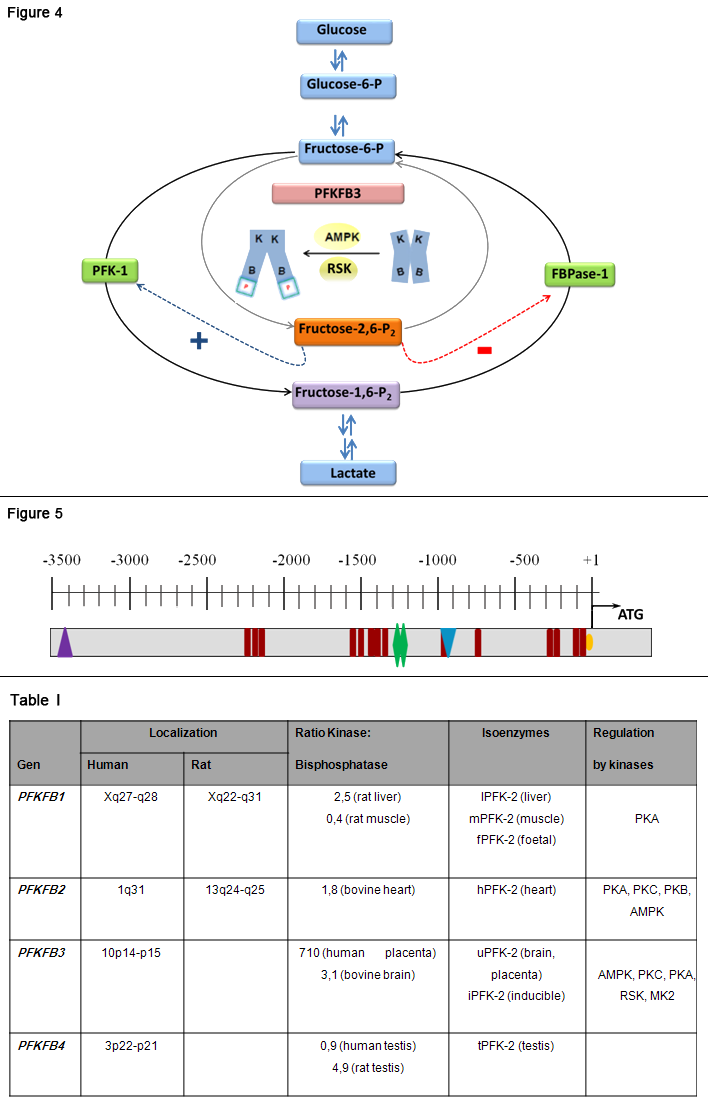
The rate of glycolytic flux is controlled at different levels and by different mechanisms: substrate availability, enzyme concentrations, allosteric effectors and covalent modification on regulatory enzymes. One of the critically modulated steps is that catalysed by 6-phosphofructo-1-kinase (PFK-1), with fructose-2,6-bisphosphate (Fru-2,6-P2) being its most powerful allosteric activator (Okar and Lange, 1999; Rider et al., 2004; Van Schaftingen, 1987). Fru-2,6-P2 relieves ATP inhibition and acts synergistically with AMP, and in addition it inhibits fructose 1,6-bisphosphatase (Van Schaftingen, 1987). These properties confer to this metabolite a key role in the control of fructose-6-P/fructose-1,6-P2 substrate cycle and hence critically regulate carbohydrate metabolism (Figure 4).
PFKFB genes
In mammals, there are four PFKFB genes (PFKFB1, PFKFB2, PFKFB3 and PFKFB4) which code for the different PFK-2/FBPase-2 isoenzymes, characterized by their cellular expression patterns. These isoforms share highly conserved core catalytic domains (85%) but differ greatly in their kinetic properties and responses to regulatory signals (Okar et al., 2001). These differences are mostly due to highly divergent N- and C-terminal regulatory domains; however, a few but significant sequence differences in the catalytic domains that constitute the secondary residue shells surrounding the active sites also contribute to the kinetic differences (Cavalier et al., 2012).
These isoforms show differences in their distribution and kinetic properties in response to allosteric effectors, hormonal, and growth factor signals (Okar et al., 2001). The expression of these genes is dependent on tissue and on development stage (Goren et al., 2000). Importantly, tissue- and cell-specific isoenzymes are not totally exclusive and several cells express more than one isoenzyme (Calvo et al., 2006; Minchenko et al., 2005a; Minchenko et al., 2005b; Telang et al., 2006). This pattern of expression suggests that each isoenzyme plays a key role under different physiological conditions or in response to different stimuli. Although the PFKFB isoenzymes have the same enzymatic activities and share the same substrates, indicating functional redundancy, their biological function and regulation is different in the specific cells (Table I).
PFKFB1 is mainly expressed in liver and skeletal muscle, PFKFB2 in heart tissue, PFKFB3 is expressed ubiquitously in several tissue and proliferating cells, and PFKFB4 was originally found in testis (Okar et al., 2001).
PFKFB3 has a uniquely large 6-phosphofructo-2-kinase to fructose-2,6-bisphosphatase activity ratio compared to other isoforms (Sakakibara et al., 1997). This isoform, which has a native activity ratio of roughly 700-fold kinase-to-phosphatase activity, dramatically increases upon phosphorylation of Ser461 by protein kinase A (PKA), AMP-dependent protein kinase (AMPK) or other kinases. The low bisphosphatase activity of PFKFB3, which is lower than that of other isoforms by an order of magnitude, is solely due to the presence of a serine at residue 302 instead of an arginine as conserved in the other isoforms (Cavalier et al., 2012; Kim et al., 2006). PFKFB3 gene was cloned from a fetal brain library (Manzano et al., 1998; Ventura et al., 1995), human placenta (Sakai et al., 1996) and breast cancer cells (Hamilton et al., 1997).
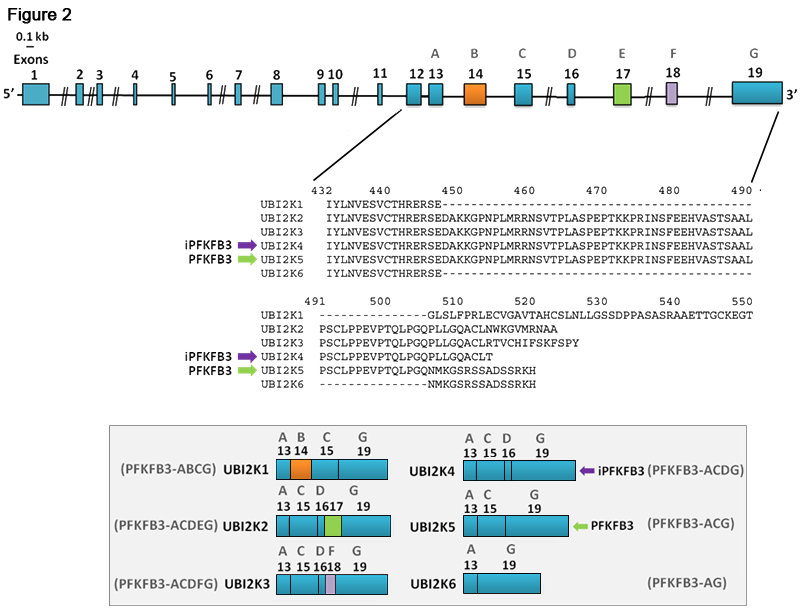
PFKFB3 is expressed ubiquitously and it is present in proliferating tissues, transformed cells and in tumours (Almeida et al., 2010; Atsumi et al., 2002; Bando et al., 2005; Calvo et al., 2006; Chesney et al., 1999; Duran et al., 2008a; Duran et al., 2009; Kessler et al., 2008; Novellasdemunt et al., 2012; Riera et al., 2002; Yalcin et al., 2009b). An inducible PFK-2/FBPase-2 (iPFK-2) with proto-oncogenic features was cloned from cancer cell lines (Chesney et al., 1999). The iPFK-2 represents a splice product of the PFKFB3 gene, as does the ubiquitous PFK-2/FBPase-2 (uPFK-2) (Navarro-Sabate et al., 2001). In human brain, have been demonstrated the occurrence of six alternatively spliced PFKFB3 transcripts, designated UBI2K1-6 splice isoforms of ubiquitous 6-phosphofructo-2-kinase/fructose-2,6-bisphosphatase (Kessler and Eschrich, 2001).
Regulation:
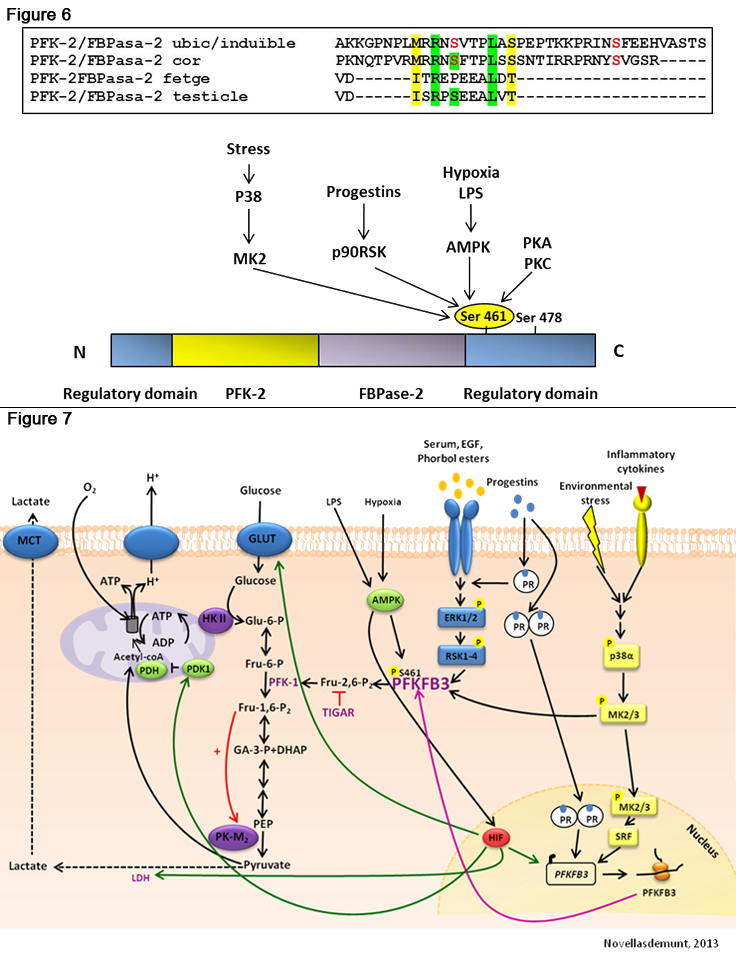
PFKFB3 gene is regulated by different mechanisms. Induction of its expression has been reported in response to different stimuli, amongst these are hypoxia (Bartrons and Caro, 2007; Minchenko et al., 2002; Obach et al., 2004) and progestins (Hamilton et al., 1997; Novellasdemunt et al., 2012), through HIF (Hypoxia Inducible Factor) and PR (progesterone receptor) interactions within their binding to the consensus HRE (Hypoxia response element) and PRE (progesterone response element) sites located at PFKFB3 promoter, respectively. Growth factors such as insulin (Riera et al., 2002) and pro-inflammatory molecules (Chesney et al., 1999) such as IL-6 (Ando et al., 2010), LPS and adenosine (Ruiz-Garcia et al., 2011) or in response to stress stimuli (NaCl, H2O2, UV radiation or anisomycin) through SRF (Serum Response Factor) and its binding to SRE (Serum response element) site (Novellasdemunt et al., 2013) (Figure 5). The proinflammatory cytokine interleukin (Il-6) enhances glycolysis through activation of PFKFB3 as a consequence of the STAT3 activation (Ando et al., 2010). PFKFB3 is also a target gene of PPARγ. Additionally, PFKFB3 is involved in the antidiabetic effect of PPARγ activation, at least, by suppressing excessive fatty acid oxidation-related reactive oxygen species (ROS) production and inflammatory responses in adipose tissue/adipocytes (Huo et al., 2010).
The product of the PFKFB3 gene, the bifunctional enzyme 6-phosphofructo-2-kinase/ fructose-2,6-bisphosphatase, is also controlled by different mechanisms. In addition to the gene expression regulation, the C-terminal domain can be phosphorylated at Ser461 by different protein kinases, such as AMP-activated protein kinase (AMPK) (Bando et al., 2005; Marsin et al., 2002), RSK (Novellasdemunt et al., 2012) and MK2 (Novellasdemunt et al., 2013) (Figure 6).
Ser461 can also be phosphorylated by PKC and PKA making it responsive to multiple external signals (Okamura and Sakakibara, 1998). Phosphorylated PFKFB3 kinetics shows an increase in Vmax of the kinase activity and a decreased Km for Fru-6-P (Marsin et al., 2002; Novellasdemunt et al., 2012). Furthermore, the PFKFB3 isoenzyme was found to be regulated through the PI3K (phosphoinositide 3-kinase)/Akt/mTOR (mammalian target of rapamycin) pathway, turning it into a target of growth factors signalling (Duran et al., 2009; Garcia-Cao et al., 2012) (Figure 7).
Furthermore, the mRNAs of all PFKFB3 isoforms contain multiple copies of the AUUUA instability motif in its 30 untranslated region (30UTR) (Chesney et al., 1999). AU-rich elements (AREs) target them RNAs of proto-oncogenes and pro-inflammatory cytokines for rapid degradation and regulate the efficiency of their translation into proteins (Chen and Shyu, 1995).
Also, PFKFB3 isoenzyme is regulated by modulation of its protein stability. Thus, it is degraded through the ubiquitin/proteasome proteolytic pathway (Riera et al., 2003). PFKFB3 but not the other isoenzymes, contains a recognition signal composed of a K-E-N box (KENXXXN), where K is lysine, E is glutamate and N is asparagine, that is recognized by the anaphase-promoting complex/cyclosome (APC/Cdh1), an E3 ubiquitin ligase complex that plays an essential role in G1 phase and mitosis through the degradation of several cell cycle proteins and PFKFB3 (Almeida et al., 2010).
Homology
The N-terminal PFK-2 domain is sequentially and structurally homologous to several nucleotide binding proteins, primarily that of adenylate kinase of E. coli.
Mutations
Note
Germinal
Somatic
Implicated in
PFKFB3 has also been identified, using loss-of-function screen, as a gene required for cell growth and proliferation in CD44+CD24- human breast cancer cells (Marotta et al., 2011).
The study of the different PFKFB isoenzymes showed that the splice variant UBI2K4 impeded the tumour cell growth and might serve as a tumour suppressor in astrocytic tumours (Zscharnack, 2009). In this sense, loss of heterozygocity on 10p14-p15 was detected in 55% of glioblastomas and the allelic deletion of PFKFB3 splice variant UBI2K4 was associated with a poor prognosis (Fleischer et al., 2011).
Increased expression of HIF- 1α, as well as its target genes, VEGF, and PFKFB3 in both major depressive and bipolar disorder patients have been found in a depressive state compared to healthy control subjects. The data suggest that altered expression of HIF-1 and its target genes mRNA in peripheral blood cells are associated - mainly in a state-dependent manner - with mood disorders. In addition, altered expression of HIF-1 and its target genes may be associated with the pathophysiology of depression (Shibata et al., 2013).
Pfkfb3 gene expression is increased in streptozotocin-induced diabetic mouse liver. During streptozotocin-induced diabetes, phosphorylation of both p38 mitogen-activated protein kinase and Akt was detected, together with the overexpression of the proliferative markers cyclin D and E2F. These findings indicate that PFKFB3 induction is coupled to enhanced hepatocyte proliferation in streptozotocin-induced diabetic mouse liver. Expression decreased when hepatocytes were treated with either rapamycin or LY 294002, suggesting that PFKFB3 regulation is phosphoinositide 3-kinase-Akt-mammalian target of rapamycin dependent (Duran et al., 2009).
The proinflammatory cytokine interleukin (IL)-6 enhanced glycolysis in mouse embryonic fibroblasts and human cell lines through STAT3 activation which enhanced the expression of the glycolytic PFKFB3 isoenzyme (Ando et al., 2010). Furthermore, cooperation of adenosine with macrophage Toll-4 receptor agonists leads to increased glycolytic flux through the enhanced expression of PFKFB3 gene, showing that, in macrophages, endogenously generated adenosine cooperates with bacterial components to increase PFKFB3 isoenzyme activity, resulting in greater Fru-2,6-P2 accumulation. This process enhances the glycolytic flux and favours ATP generation helping to develop and maintain the long term defensive and reparative functions of the macrophages (Ruiz-Garcia et al., 2011).
Clinical development of PFKFB3 inhibitors as chemotherapeutic agents has been published (Clem et al., 2008, Seo et al., 2011). For example, a cell-permeable dipyridinyl-propenone (3PO) compound that selectively blocks PFK-2 (6-phosphofructo-2-kinase) activity has been found (Telang et al., 2006). 3PO decreases Fru-2,6-P2 and lactate production, arresting proliferation of transformed cells and suppressing tumor growth in several xenograft mouse models (Telang et al., 2006, Clem et al., 2008). In addition, other small molecule inhibitors (N4A, YN1) have been identified. When tested on cultured cancer cells both, N4A and YN1, inhibited PFKFB3, decreasing Fru-2,6-P2 concentration and glycolysis and, ultimately, led to cell death (Seo et al., 2011).
A transgenic mouse model that overexpressed pfkfb3 and which was subjected to diet-induced obesity revealed production of high Fru-2,6-P2 levels and changes in hepatic gene expression profiles of key gluconeogenic and lipogenic enzymes, as well as an accumulation of lipids in periportal cells, and weight gain (Duran et al., 2008b).
Article Bibliography
| Pubmed ID | Last Year | Title | Authors |
|---|---|---|---|
| 22115192 | 2012 | Progestins activate 6-phosphofructo-2-kinase/fructose-2,6-bisphosphatase 3 (PFKFB3) in breast cancer cells. | Novellasdemunt L et al |
| 20080744 | 2010 | E3 ubiquitin ligase APC/C-Cdh1 accounts for the Warburg effect by linking glycolysis to cell proliferation. | Almeida A et al |
| 20453422 | 2010 | Interleukin 6 enhances glycolysis through expression of the glycolytic enzymes hexokinase 2 and 6-phosphofructo-2-kinase/fructose-2,6-bisphosphatase-3. | Ando M et al |
| 12384552 | 2002 | High expression of inducible 6-phosphofructo-2-kinase/fructose-2,6-bisphosphatase (iPFK-2; PFKFB3) in human cancers. | Atsumi T et al |
| 16306349 | 2005 | Expression of inducible 6-phosphofructo-2-kinase/fructose-2,6-bisphosphatase/PFKFB3 isoforms in adipocytes and their potential role in glycolytic regulation. | Atsumi T et al |
| 16115917 | 2005 | Phosphorylation of the 6-phosphofructo-2-kinase/fructose 2,6-bisphosphatase/PFKFB3 family of glycolytic regulators in human cancer. | Bando H et al |
| 17661163 | 2007 | Hypoxia, glucose metabolism and the Warburg's effect. | Bartrons R et al |
| 17143338 | 2006 | Hypoxic regulation of PFKFB-3 and PFKFB-4 gene expression in gastric and pancreatic cancer cell lines and expression of PFKFB genes in gastric cancers. | Bobarykina AY et al |
| 16698023 | 2006 | PFKFB3 gene silencing decreases glycolysis, induces cell-cycle delay and inhibits anchorage-independent growth in HeLa cells. | Calvo MN et al |
| 22275052 | 2012 | Molecular basis of the fructose-2,6-bisphosphatase reaction of PFKFB3: transition state and the C-terminal function. | Cavalier MC et al |
| 8578590 | 1995 | AU-rich elements: characterization and importance in mRNA degradation. | Chen CY et al |
| 10077634 | 1999 | An inducible gene product for 6-phosphofructo-2-kinase with an AU-rich instability element: role in tumor cell glycolysis and the Warburg effect. | Chesney J et al |
| 15845370 | 2005 | Targeted disruption of inducible 6-phosphofructo-2-kinase results in embryonic lethality. | Chesney J et al |
| 16912547 | 2006 | 6-phosphofructo-2-kinase/fructose-2,6-bisphosphatase and tumor cell glycolysis. | Chesney J et al |
| 18202014 | 2008 | Small-molecule inhibition of 6-phosphofructo-2-kinase activity suppresses glycolytic flux and tumor growth. | Clem B et al |
| 19648290 | 2009 | Common and different genetic background for rheumatoid arthritis and coeliac disease. | Coenen MJ et al |
| 18191036 | 2008 | Characterization of a new liver- and kidney-specific pfkfb3 isozyme that is downregulated by cell proliferation and dedifferentiation. | Duran J et al |
| 17991424 | 2008 | Overexpression of ubiquitous 6-phosphofructo-2-kinase in the liver of transgenic mice results in weight gain. | Duran J et al |
| 19645723 | 2009 | Pfkfb3 is transcriptionally upregulated in diabetic mouse liver through proliferative signals. | Duran J et al |
| 6282846 | 1982 | Regulation of rat liver fructose 2,6-bisphosphatase. | El-Maghrabi MR et al |
| 20399660 | 2010 | The regulation of energy metabolism and the IGF-1/mTOR pathways by the p53 protein. | Feng Z et al |
| 22417747 | 2012 | Antioxidant and bioenergetic coupling between neurons and astrocytes. | Fernandez-Fernandez S et al |
| 21987444 | 2011 | LOH on 10p14-p15 targets the PFKFB3 gene locus in human glioblastomas. | Fleischer M et al |
| 22401813 | 2012 | Systemic elevation of PTEN induces a tumor-suppressive metabolic state. | Garcia-Cao I et al |
| 22811469 | 2012 | Sertoli-secreted FGF-2 induces PFKFB4 isozyme expression in mouse spermatogenic cells by activation of the MEK/ERK/CREB pathway. | Gómez M et al |
| 19595670 | 2009 | Switches in 6-phosphofructo-2-kinase isoenzyme expression during rat sperm maturation. | Gómez M et al |
| 10648897 | 2000 | 6-Phosphofructo-2-kinase/fructose-2,6-bisphosphatase expression in rat brain during development. | Goren N et al |
| 16385451 | 2006 | A scan of chromosome 10 identifies a novel locus showing strong association with late-onset Alzheimer disease. | Grupe A et al |
| 9092801 | 1997 | Identification of PRG1, a novel progestin-responsive gene with sequence homology to 6-phosphofructo-2-kinase/fructose-2,6-bisphosphatase. | Hamilton JA et al |
| 8805587 | 1996 | The crystal structure of the bifunctional enzyme 6-phosphofructo-2-kinase/fructose-2,6-bisphosphatase reveals distinct domain homologies. | Hasemann CA et al |
| 19948719 | 2010 | Disruption of inducible 6-phosphofructo-2-kinase ameliorates diet-induced adiposity but exacerbates systemic insulin resistance and adipose tissue inflammatory response. | Huo Y et al |
| 10958932 | 2000 | Structure, function, and evolution of phosphoglycerate mutases: comparison with fructose-2,6-bisphosphatase, acid phosphatase, and alkaline phosphatase. | Jedrzejas MJ et al |
| 18180783 | 2008 | Association analysis of positional obesity candidate genes based on integrated data from transcriptomics and linkage analysis. | Jiao H et al |
| 17805487 | 2008 | 6-Phosphofructo-2-kinase/fructose-2,6-bisphosphatase (PFKFB3) is up-regulated in high-grade astrocytomas. | Kessler R et al |
| 11245921 | 2001 | Splice isoforms of ubiquitous 6-phosphofructo-2-kinase/fructose-2,6-bisphosphatase in human brain. | Kessler R et al |
| 16316985 | 2006 | Crystal structure of the hypoxia-inducible form of 6-phosphofructo-2-kinase/fructose-2,6-bisphosphatase (PFKFB3): a possible new target for cancer therapy. | Kim SG et al |
| 7646523 | 1995 | Evolutionary reengineering of the phosphofructokinase active site: ARG-104 does not stabilize the transition state in 6-phosphofructo-2-kinase. | Kurland I et al |
| 12379646 | 2003 | Tissue-specific structure/function differentiation of the liver isoform of 6-phosphofructo-2-kinase/fructose-2,6-bisphosphatase. | Lee YH et al |
| 23246158 | 2013 | A role for inducible 6-phosphofructo-2-kinase in the control of neuronal glycolysis. | Li H et al |
| 1328239 | 1992 | Hepatic 6-phosphofructo-2-kinase/fructose-2,6-bisphosphatase. The role of surface loop basic residues in substrate binding to the fructose-2,6-bisphosphatase domain. | Li L et al |
| 1313012 | 1992 | Glu327 is part of a catalytic triad in rat liver fructose-2,6-bisphosphatase. | Lin K et al |
| 10072580 | 1998 | Molecular cloning, expression, and chromosomal localization of a ubiquitously expressed human 6-phosphofructo-2-kinase/ fructose-2, 6-bisphosphatase gene (PFKFB3). | Manzano A et al |
| 21633165 | 2011 | The JAK2/STAT3 signaling pathway is required for growth of CD44⁺CD24⁻ stem cell-like breast cancer cells in human tumors. | Marotta LL et al |
| 12065600 | 2002 | The stimulation of glycolysis by hypoxia in activated monocytes is mediated by AMP-activated protein kinase and inducible 6-phosphofructo-2-kinase. | Marsin AS et al |
| 19596822 | 2009 | Current perspectives on Akt Akt-ivation and Akt-ions. | Matheny RW Jr et al |
| 11744734 | 2002 | Hypoxia-inducible factor-1-mediated expression of the 6-phosphofructo-2-kinase/fructose-2,6-bisphosphatase-3 (PFKFB3) gene. Its possible role in the Warburg effect. | Minchenko A et al |
| 16025159 | 2005 | Expression and hypoxia-responsiveness of 6-phosphofructo-2-kinase/fructose-2,6-bisphosphatase 4 in mammary gland malignant cell lines. | Minchenko OH et al |
| 22835215 | 2012 | Fulfilling the metabolic requirements for cell proliferation. | Moncada S et al |
| 18414044 | 2008 | The oncogene c-Myc coordinates regulation of metabolic networks to enable rapid cell cycle entry. | Morrish F et al |
| 11245987 | 2001 | The human ubiquitous 6-phosphofructo-2-kinase/fructose-2,6-bisphosphatase gene (PFKFB3): promoter characterization and genomic structure. | Navarro-Sabaté A et al |
| 15466858 | 2004 | 6-Phosphofructo-2-kinase (pfkfb3) gene promoter contains hypoxia-inducible factor-1 binding sites necessary for transactivation in response to hypoxia. | Obach M et al |
| 9836440 | 1998 | A common phosphorylation site for cyclic AMP-dependent protein kinase and protein kinase C in human placental 6-phosphofructo-2-kinase/fructose-2,6-bisphosphatase. | Okamura N et al |
| 10475585 | 1999 | Fructose-2,6-bisphosphate and control of carbohydrate metabolism in eukaryotes. | Okar DA et al |
| 11165514 | 2001 | PFK-2/FBPase-2: maker and breaker of the essential biofactor fructose-2,6-bisphosphate. | Okar DA et al |
| 7574501 | 1995 | 6-Phosphofructo-2-kinase/fructose-2,6-bisphosphatase: a metabolic signaling enzyme. | Pilkis SJ et al |
| 21860432 | 2012 | The JAK2V617F oncogene requires expression of inducible phosphofructokinase/fructose-bisphosphatase 3 for cell growth and increased metabolic activity. | Reddy MM et al |
| 15170386 | 2004 | 6-phosphofructo-2-kinase/fructose-2,6-bisphosphatase: head-to-head with a bifunctional enzyme that controls glycolysis. | Rider MH et al |
| 8198521 | 1994 | Site-directed mutagenesis of rat muscle 6-phosphofructo-2-kinase/fructose-2,6-bisphosphatase: role of Asp-130 in the 2-kinase domain. | Rider MH et al |
| 12007784 | 2002 | Insulin induces PFKFB3 gene expression in HT29 human colon adenocarcinoma cells. | Riera L et al |
| 12935880 | 2003 | Regulation of ubiquitous 6-phosphofructo-2-kinase by the ubiquitin-proteasome proteolytic pathway during myogenic C2C12 cell differentiation. | Riera L et al |
| 21464136 | 2011 | Cooperation of adenosine with macrophage Toll-4 receptor agonists leads to increased glycolytic flux through the enhanced expression of PFKFB3 gene. | Ruiz-García A et al |
| 8830046 | 1996 | Cloning of cDNA encoding for a novel isozyme of fructose 6-phosphate, 2-kinase/fructose 2,6-bisphosphatase from human placenta. | Sakai A et al |
| 9404080 | 1997 | Human placental fructose-6-phosphate,2-kinase/fructose-2,6-bisphosphatase: its isozymic form, expression and characterization. | Sakakibara R et al |
| 8334986 | 1993 | Three-dimensional structure of rat acid phosphatase. | Schneider G et al |
| 21957443 | 2011 | Structure-based development of small molecule PFKFB3 inhibitors: a framework for potential cancer therapeutic agents targeting the Warburg effect. | Seo M et al |
| 23333658 | 2013 | The alteration of hypoxia inducible factor-1 (HIF-1) and its target genes in mood disorder patients. | Shibata T et al |
| 21241890 | 2011 | Nuclear PTEN regulates the APC-CDH1 tumor-suppressive complex in a phosphatase-independent manner. | Song MS et al |
| 2168419 | 1990 | Hepatic 6-phosphofructo-2-kinase/fructose-2,6-bisphosphatase. Use of site-directed mutagenesis to evaluate the roles of His-258 and His-392 in catalysis. | Tauler A et al |
| 16715124 | 2006 | Ras transformation requires metabolic control by 6-phosphofructo-2-kinase. | Telang S et al |
| 3028056 | 1987 | Fructose 2,6-bisphosphate. | Van Schaftingen E et al |
| 7733968 | 1995 | Cloning and expression of a catalytic core bovine brain 6-phosphofructo-2-kinase/fructose-2,6-bisphosphatase. | Ventura F et al |
| 6115412 | 1981 | Structure and activity of phosphoglycerate mutase. | Winn SI et al |
| 22992777 | 2012 | Detection of significant pathways in osteoporosis based on graph clustering. | Xiao H et al |
| 19473963 | 2009 | Nuclear targeting of 6-phosphofructo-2-kinase (PFKFB3) increases proliferation via cyclin-dependent kinases. | Yalcin A et al |
| 19454274 | 2009 | Regulation of glucose metabolism by 6-phosphofructo-2-kinase/fructose-2,6-bisphosphatases in cancer. | Yalcin A et al |
| 19490427 | 2009 | The PFKFB3 splice variant UBI2K4 is downregulated in high-grade astrocytomas and impedes the growth of U87 glioblastoma cells. | Zscharnack K et al |
Other Information
Locus ID:
NCBI: 5209
MIM: 605319
HGNC: 8874
Ensembl: ENSG00000170525
Variants:
dbSNP: 5209
ClinVar: 5209
TCGA: ENSG00000170525
COSMIC: PFKFB3
RNA/Proteins
Expression (GTEx)
Pathways
Protein levels (Protein atlas)
References
| Pubmed ID | Year | Title | Citations |
|---|---|---|---|
| 37820851 | 2024 | PFKFB3 promotes endometriosis cell proliferation via enhancing the protein stability of β-catenin. | 0 |
| 38097102 | 2024 | IL1R2 promotes retinal angiogenesis to participate in retinopathy of prematurity by activating the HIF1α/PFKFB3 pathway. | 1 |
| 38113141 | 2024 | An ERK5-PFKFB3 axis regulates glycolysis and represents a therapeutic vulnerability in pediatric diffuse midline glioma. | 0 |
| 38200582 | 2024 | Targeting the SphK1/S1P/PFKFB3 axis suppresses hepatocellular carcinoma progression by disrupting glycolytic energy supply that drives tumor angiogenesis. | 0 |
| 38305290 | 2024 | Down-Regulation of CPEB4 Alleviates Preeclampsia through the Inhibition of Ferroptosis by PFKFB3. | 0 |
| 38404271 | 2024 | [Effect of PFKFB3 on inflammatory activation of polymorphonuclear myeloid-derived suppressor cell in acute myocardial infarction]. | 0 |
| 38622715 | 2024 | Multi-omics and immunogenomics analysis revealed PFKFB3 as a targetable hallmark and mediates sunitinib resistance in papillary renal cell carcinoma: in silico study with laboratory verification. | 0 |
| 38640731 | 2024 | PFKFB3-mediated glycolysis in hepatic stellate cells promotes liver regeneration. | 0 |
| 38640982 | 2024 | PFKFB3 regulates breast cancer tumorigenesis and Fulvestrant sensitivity by affecting ERα stability. | 0 |
| 38705396 | 2024 | MiR-106a-5p targets PFKFB3 and improves sepsis through regulating macrophage pyroptosis and inflammatory response. | 0 |
| 37820851 | 2024 | PFKFB3 promotes endometriosis cell proliferation via enhancing the protein stability of β-catenin. | 0 |
| 38097102 | 2024 | IL1R2 promotes retinal angiogenesis to participate in retinopathy of prematurity by activating the HIF1α/PFKFB3 pathway. | 1 |
| 38113141 | 2024 | An ERK5-PFKFB3 axis regulates glycolysis and represents a therapeutic vulnerability in pediatric diffuse midline glioma. | 0 |
| 38200582 | 2024 | Targeting the SphK1/S1P/PFKFB3 axis suppresses hepatocellular carcinoma progression by disrupting glycolytic energy supply that drives tumor angiogenesis. | 0 |
| 38305290 | 2024 | Down-Regulation of CPEB4 Alleviates Preeclampsia through the Inhibition of Ferroptosis by PFKFB3. | 0 |
Citation
Laura Novellasdemunt ; Àurea Navarro-Sabaté ; Anna Manzano ; Ana Rodríguez-García ; Ramon Bartrons
PFKFB3 (6-phosphofructo-2-kinase/fructose-2,6-biphosphatase 3)
Atlas Genet Cytogenet Oncol Haematol. 2013-03-01
Online version: http://atlasgeneticsoncology.org/gene/45932/pfkfb3-(6-phosphofructo-2-kinase-fructose-2-6-biphosphatase-3)
