SMYD3 (SET and MYND domain containing 3)
2010-07-01 Xue-Gang Luo , Shu Guo , Tong-Cun Zhang AffiliationCollege of Bioengineering, Tianjin University of Science, Technology, Tianjin, China
Identity
HGNC
LOCATION
1q44
LOCUSID
ALIAS
KMT3E,ZMYND1,ZNFN3A1,bA74P14.1
FUSION GENES
DNA/RNA
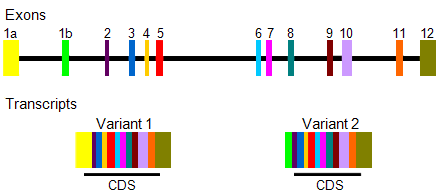
Genomic organization of SMYD3. The SMYD3 gene is comprised of 12 exons and encodes for two alternatively transcript variants that use different first exon and promoter.
Description
The SMYD3 gene is comprised of 12 exons, spanning 757.8 kb on chromosome 1q44. Two transcript variants were encoded using different first exon and promoter.
A variable number of tandem repeats (VNTR) polymorphism in E2F-1-binding element in the promoter region of SMYD3 transcript variant 1 has been shown to be significantly associated with an increased risk of colorectal cancer, hepatocellular carcinoma and breast cancer in Japanese population (Tsuge et al., 2005). It is also shown that this VNTR polymorphism might be a susceptibility factor for human esophageal squamous cell carcinoma in relation to tobacco smoking (Wang H et al., 2008). However, it seemed that this polymorphism was not associated with the cancer risk in all the races in the world (Frank et al., 2006; Wang et al., 2007).
A copy-number variation (CNV) on chromosome 1 was observed to be proximal to SMYD3 that displayed high expression in the lymphoblastoid cell lines, and this CNV was significantly associated with 1-beta-D-arabinofuranosylcytosine cytotoxicity (Kalari et al., 2010).
A variable number of tandem repeats (VNTR) polymorphism in E2F-1-binding element in the promoter region of SMYD3 transcript variant 1 has been shown to be significantly associated with an increased risk of colorectal cancer, hepatocellular carcinoma and breast cancer in Japanese population (Tsuge et al., 2005). It is also shown that this VNTR polymorphism might be a susceptibility factor for human esophageal squamous cell carcinoma in relation to tobacco smoking (Wang H et al., 2008). However, it seemed that this polymorphism was not associated with the cancer risk in all the races in the world (Frank et al., 2006; Wang et al., 2007).
A copy-number variation (CNV) on chromosome 1 was observed to be proximal to SMYD3 that displayed high expression in the lymphoblastoid cell lines, and this CNV was significantly associated with 1-beta-D-arabinofuranosylcytosine cytotoxicity (Kalari et al., 2010).
Transcription
The SMYD3 gene mainly has two transcript variants of 1641 and 1469 bp, each comprising 12 exons. They differ for the alternative usage of the different first exon and promoter. The variant 2 is shorter at the N-terminus, compared to the variant 1. Besides, there was a report showed that another SMYD3 transcript variant, termed SMYD3-NY, was detected in adult human testis and spermatozoa using the methods of hybridization with a human cDNA microarray (Zhou et al., 2005). However, SMYD3-NY has not been further confirmed with experimental evidence yet.
Pseudogene
Not yet described.
Proteins

Protein domains of SMYD3. SMYD3 has two isoforms. The isoform 2 (369 amino acids) just lacks 59 amino acid at the N-terminus of the isoform 1 (428 amino acids).
Description
The 1641 bp transcript variant 1 encodes a 428 amino acids protein containing a zf-MYND domain (49-87) and a SET domain (148-239), the transcript variant 2 uses a downstream translational start codon and encodes a 369 amino acids protein which is 100% identical with the 60-428 region of the isoform 1.
It has been shown that human cancer cells also express a cleaved form of SMYD3 lacking the 34 amino acids in the N-terminal region of the full-length SMYD3 isoform 1. It seems that the N-terminal region of SMYD3 isoform 1 plays an important role for the regulation of its methyltransferase activity, and the cleavage of 34 amino acids in the N-terminal region or interaction with heat shock protein 90 alpha (HSP90alpha) may enhance the histone methyltransferase (HMTase) activity compared to the full-length protein (Silva et al., 2008).
It has been shown that human cancer cells also express a cleaved form of SMYD3 lacking the 34 amino acids in the N-terminal region of the full-length SMYD3 isoform 1. It seems that the N-terminal region of SMYD3 isoform 1 plays an important role for the regulation of its methyltransferase activity, and the cleavage of 34 amino acids in the N-terminal region or interaction with heat shock protein 90 alpha (HSP90alpha) may enhance the histone methyltransferase (HMTase) activity compared to the full-length protein (Silva et al., 2008).
Expression
SMYD3 is frequently up-regulated in colorectal carcinoma, hepatocellular carcinoma and breast cancer (Hamamoto et al., 2004; Hamamoto et al., 2006). miR-124 can down-regulate SMYD3 through binding to 3 UTR of SMYD3 protein (Furuta et al., 2010).
Localisation
The SMYD3 protein is located mainly in the cytoplasm when the cells are arrested at G0/G1, but accumulated in the nuclei at S phase and G2/M (Hamamoto et al., 2004).
Function
SMYD3 is a SET-domain-containing lysine histone methyltransferase which has been regarded as an important factor in carcinogenesis. Formed a complex with RNA polymerase II through an interaction with the RNA helicase HELZ, SMYD3 specifically methylates histone H3 at lysine 4 and activates the transcription of a set of downstream genes (including of Nkx2.8, hTERT, WNT10B, VEGFR1, c-Met, etc) containing a "5 - CCCTCC - 3" or "5 - GGAGGG - 3" sequence in the promoter region, and these activities require protein cofactors HSP90alpha (Hamamoto et al., 2004; Liu et al., 2007; Hamamoto et al., 2006; Kunizaki et al., 2007; Zou et al., 2009). Enhanced expression of SMYD3 is essential for the growth of many cancer cells (such as colorectal carcinoma, hepatocellular carcinoma, breast cancer, etc), and it also could stimulate cell adhesion and migration, whereas suppression of SMYD3 by RNAi or other reagents induces apoptosis and inhibits cell proliferation and migration (Hamamoto et al., 2004; Hamamoto et al., 2006; Luo et al., 2007; Wang SZ et al., 2008; Zou et al., 2009; Chen et al., 2007; Luo et al., 2010).
SMYD3 may be an important coactivator of estrogen receptor (ER) in the estrogen signal pathway. It can directly interact with the ligand binding domain of ER, in turn augments ER target gene expression via histone H3-K4 methylation (Kim et al., 2009). Besides, it has been shown that SMYD3 could interact with Jab1 in yeast cells and in vitro, and might be required for Jab1-mediated enhancement of hemotopoietic progenitors cells (Mori et al., 2008).
SMYD3 may be an important coactivator of estrogen receptor (ER) in the estrogen signal pathway. It can directly interact with the ligand binding domain of ER, in turn augments ER target gene expression via histone H3-K4 methylation (Kim et al., 2009). Besides, it has been shown that SMYD3 could interact with Jab1 in yeast cells and in vitro, and might be required for Jab1-mediated enhancement of hemotopoietic progenitors cells (Mori et al., 2008).
Mutations
Note
Not yet described. A VNTR polymorphism in the 5 flanking region of SMYD3 has been reported as we mentioned in the "DNA Description" section.
Implicated in
Entity name
Colorectal carcinoma
Note
SMYD3 expression is markedly elevated in colorectal cancers, and this upregulation enhances the growth of tumor cells (Hamamoto et al., 2004).
Entity name
Hepatocellular carcinoma
Note
SMYD3 was found to be overexpressed in human hepatocarcinoma cells, and silencing of SMYD3 by RNAi could inhibit cell proliferation and migration (Hamamoto et al., 2004; Zou et al., 2009; Chen et al., 2007). miR-124, usually be epigenetically silenced in hepatocarcinoma cells, could downregulate SMYD3 expression and inhibit cell growth (Furuta et al., 2010). Hepatitis B virus X protein could upregulate SMYD3 expression in HepG2 hepatocellular carcinoma cell lines, and this effect might promote the progress of hepatoma (Yang et al., 2009).
Entity name
Breast cancer
Note
SMYD3 overexpression was observed in the great majority of breast cancer tissues, and suppression of SMYD3 by RNAi or other reagents could inhibit cell proliferation and migration (Hamamoto et al., 2006; Luo et al., 2010). Furthermore, SMYD3 was identified as a new coactivator for ER and was required in estrogen signal pathway (Kim et al., 2009).
Entity name
Cervical carcinoma
Note
Suppression of SMYD3 by RNAi could reduce cell proliferation, colony formation and migration/invasion activity, and induces apoptosis in Hela cervical carcinoma cells (Wang SZ et al., 2008).
Entity name
Note
Triptolide, an antitumor Chinese herb extracted ingredient, could decrease the expression of SMYD3 and inhibit the proliferation of multiple myeloma cell line U266 in a time- and dose-dependent manner (Zhao et al., 2010).
Entity name
Esophageal squamous cell carcinoma
Note
A VNTR polymorphism in E2F-1-binding element in the promoter region of SMYD3 transcript variant 1 was observed to be a susceptibility factor for human esophageal squamous cell carcinoma in relation to tobacco smoking (Wang H et al., 2008).
Article Bibliography
| Pubmed ID | Last Year | Title | Authors |
|---|---|---|---|
| 20509907 | 2010 | Derivative chromosome 1 and GLUT1 deficiency syndrome in a sibling pair. | Aktas D et al |
| 17963297 | 2007 | Silencing SMYD3 in hepatoma demethylates RIZI promoter induces apoptosis and inhibits cell proliferation and migration. | Chen LB et al |
| 16381023 | 2006 | Variable number of tandem repeats polymorphism in the SMYD3 promoter region and the risk of familial breast cancer. | Frank B et al |
| 19843643 | 2010 | miR-124 and miR-203 are epigenetically silenced tumor-suppressive microRNAs in hepatocellular carcinoma. | Furuta M et al |
| 16441421 | 2006 | Enhanced SMYD3 expression is essential for the growth of breast cancer cells. | Hamamoto R et al |
| 20525348 | 2010 | Copy number variation and cytidine analogue cytotoxicity: a genome-wide association approach. | Kalari KR et al |
| 19509295 | 2009 | Requirement of histone methyltransferase SMYD3 for estrogen receptor-mediated transcription. | Kim H et al |
| 18006819 | 2007 | The lysine 831 of vascular endothelial growth factor receptor 1 is a novel target of methylation by SMYD3. | Kunizaki M et al |
| 17363582 | 2007 | The telomerase reverse transcriptase (hTERT) gene is a direct target of the histone methyltransferase SMYD3. | Liu C et al |
| 17609160 | 2007 | SET and MYND domain-containing protein 3 decreases sensitivity to dexamethasone and stimulates cell adhesion and migration in NIH3T3 cells. | Luo XG et al |
| 20039369 | 2010 | Novobiocin decreases SMYD3 expression and inhibits the migration of MDA-MB-231 human breast cancer cells. | Luo XG et al |
| 18667426 | 2008 | Stable form of JAB1 enhances proliferation and maintenance of hematopoietic progenitors. | Mori M et al |
| 17998933 | 2008 | Enhanced methyltransferase activity of SMYD3 by the cleavage of its N-terminal region in human cancer cells. | Silva FP et al |
| 16155568 | 2005 | A variable number of tandem repeats polymorphism in an E2F-1 binding element in the 5' flanking region of SMYD3 is a risk factor for human cancers. | Tsuge M et al |
| 18294291 | 2008 | Association of the variable number of tandem repeats polymorphism in the promoter region of the SMYD3 gene with risk of esophageal squamous cell carcinoma in relation to tobacco smoking. | Wang H et al |
| 18452649 | 2008 | Knockdown of SMYD3 by RNA interference inhibits cervical carcinoma cell growth and invasion in vitro. | Wang SZ et al |
| 17431393 | 2007 | SMYD3 tandem repeats polymorphism is not associated with the occurrence and metastasis of hepatocellular carcinoma in a Chinese population. | Wang XQ et al |
| 19082926 | 2009 | Hepatitis B virus X protein upregulates expression of SMYD3 and C-MYC in HepG2 cells. | Yang L et al |
| 20547150 | 2010 | Role of triptolide in cell proliferation, cell cycle arrest, apoptosis and histone methylation in multiple myeloma U266 cells. | Zhao F et al |
| 16081583 | 2005 | SMYD3-NY, a novel SMYD3 mRNA transcript variant, may have a role in human spermatogenesis. | Zhou Z et al |
| 19321255 | 2009 | Knockdown of SMYD3 by RNA interference down-regulates c-Met expression and inhibits cells migration and invasion induced by HGF. | Zou JN et al |
Other Information
Locus ID:
NCBI: 64754
MIM: 608783
HGNC: 15513
Ensembl: ENSG00000185420
Variants:
dbSNP: 64754
ClinVar: 64754
TCGA: ENSG00000185420
COSMIC: SMYD3
RNA/Proteins
Expression (GTEx)
Pathways
| Pathway | Source | External ID |
|---|---|---|
| Chromatin organization | REACTOME | R-HSA-4839726 |
| Chromatin modifying enzymes | REACTOME | R-HSA-3247509 |
| PKMTs methylate histone lysines | REACTOME | R-HSA-3214841 |
Protein levels (Protein atlas)
References
| Pubmed ID | Year | Title | Citations |
|---|---|---|---|
| 38148333 | 2024 | SMYD3: a new regulator of adipocyte precursor proliferation at the early steps of differentiation. | 0 |
| 38664231 | 2024 | THAP3 recruits SMYD3 to OXPHOS genes and epigenetically promotes mitochondrial respiration in hepatocellular carcinoma. | 0 |
| 38148333 | 2024 | SMYD3: a new regulator of adipocyte precursor proliferation at the early steps of differentiation. | 0 |
| 38664231 | 2024 | THAP3 recruits SMYD3 to OXPHOS genes and epigenetically promotes mitochondrial respiration in hepatocellular carcinoma. | 0 |
| 36127410 | 2023 | SMYD3 regulates gastric cancer progression and macrophage polarization through EZH2 methylation. | 2 |
| 37237385 | 2023 | Histone lysine methyltransferase SMYD3 promotes oral squamous cell carcinoma tumorigenesis via H3K4me3-mediated HMGA2 transcription. | 2 |
| 37463106 | 2023 | SMYD3 represses tumor-intrinsic interferon response in HPV-negative squamous cell carcinoma of the head and neck. | 3 |
| 38037054 | 2023 | The SMYD3-dependent H3K4me3 status of IGF2 intensifies local Th2 differentiation in CRSwNP via positive feedback. | 0 |
| 36127410 | 2023 | SMYD3 regulates gastric cancer progression and macrophage polarization through EZH2 methylation. | 2 |
| 37237385 | 2023 | Histone lysine methyltransferase SMYD3 promotes oral squamous cell carcinoma tumorigenesis via H3K4me3-mediated HMGA2 transcription. | 2 |
| 37463106 | 2023 | SMYD3 represses tumor-intrinsic interferon response in HPV-negative squamous cell carcinoma of the head and neck. | 3 |
| 38037054 | 2023 | The SMYD3-dependent H3K4me3 status of IGF2 intensifies local Th2 differentiation in CRSwNP via positive feedback. | 0 |
| 35819319 | 2022 | SMYD3 Impedes Small Cell Lung Cancer Sensitivity to Alkylation Damage through RNF113A Methylation-Phosphorylation Cross-talk. | 8 |
| 36057625 | 2022 | SMYD3 promotes aerobic glycolysis in diffuse large B-cell lymphoma via H3K4me3-mediated PKM2 transcription. | 4 |
| 36222132 | 2022 | SMYD3 regulates the abnormal proliferation of non-small-cell lung cancer cells via the H3K4me3/ANO1 axis. | 1 |
Citation
Xue-Gang Luo ; Shu Guo ; Tong-Cun Zhang
SMYD3 (SET and MYND domain containing 3)
Atlas Genet Cytogenet Oncol Haematol. 2010-07-01
Online version: http://atlasgeneticsoncology.org/gene/46100/smyd3-(set-and-mynd-domain-containing-3)
