PEA15 (phosphoprotein enriched in astrocytes 15)
2012-05-01 Chandra Bartholomeusz , Jangsoon Lee , Naoto T Ueno AffiliationSection of Translational Breast Cancer Research, Department of Breast Medical Oncology, The University of Texas MD Anderson Cancer Center, Houston, Texas 77030, USA
Identity
HGNC
LOCATION
1q23.2
LOCUSID
ALIAS
HMAT1,HUMMAT1H,MAT1,MAT1H,PEA-15,PED,PED-PEA15,PED/PEA15
FUSION GENES
DNA/RNA
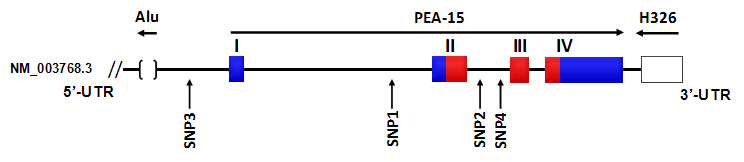
Structure of the human PEA15 gene. Red box: PEA15 coding region; blue box: PEA15 non-coding region; white box: 3 end of H326 region; SNP position: indicated by vertical arrows; Alu element (AA491823) 5 of PEA15: represented by brackets (Wolford et al., 2000, license permission no.: 2907741403264).
Description
According to Entrez Gene, PEA15 maps to NC_000001.10 and spans a region of 10042 bases. PEA15 consists of four exons. Exon 1 and the beginning of exon 2 contain untranslated sequences. The end of exon 2, exon 3, and the beginning of exon 4 contain the coding sequence.
Transcription
Two transcripts, with lengths of 2,5 and 1,7 kb, have been identified. They are identical except for the length of their 3 UTRs.
Pseudogene
No pseudogene of PEA15 known.
Proteins
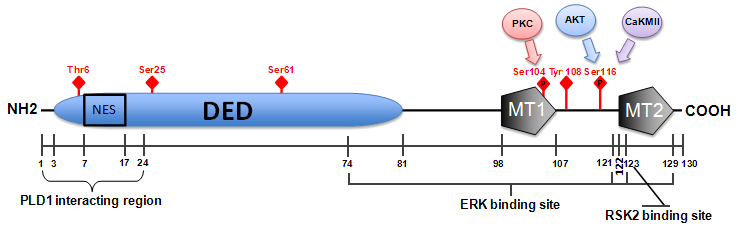
DED: death effector domain, amino acid region 3-81, Pfam: PF01335 (Sanger); NES: leucine-rich nuclear export sequence, amino acid region 7-17; MT: microtubule-binding region, amino acid region 98-107, and 122-129; PLD-1 binding region: phospholipase D1 binding site, amino acid region 1-24; ERK binding site: amino acid position 74, 121, 123, and 129; RSK2 binding site: amino acid position 123; Serine 104: phosphorylation site by PKC; Serine 116: phosphorylation site by AKT or CaKMII.
Description
PEA-15 is a 130-amino-acid protein with a predicted molecular mass of 15054 daltons and a calculated isoelectric point of 5.12.
Expression
Ovary, breast, brain, placenta, liver, eye, lung, heart, endothelial cells, pancreas, testis, uterus, adrenal gland, prostate gland, kidney, spleen, and astrocytes.
Localisation
Cytoplasm. PEA-15 has a leucine-rich nuclear export sequence (NES), which is required for predominantly localizing in the cytoplasm (Formstecher et al., 2001).
Function
PEA-15 is a ubiquitously expressed protein that exists in non-phosphorylated, mono-phosphorylated, and double-phosphorylated forms (Danziger et al., 1995). PEA-15 does not have an enzymatic domain but serves as a binding molecule in protein complexes. PEA-15 is an endogenous substrate that depends on two distinct serine sites: Ser104, which is phosphorylated by protein kinase C (PKC) (Kubes et al., 1998), and Ser116, which is phosphorylated by Ca2+/calmodulin kinase II (CaMKII) (Kubes et al., 1998) or by AKT (Trencia et al., 2003). At its NH2 terminus, PEA-15 has a PLD-interacting region, which enhances PLD 1 stability and activity (Zhang et al., 2000), and a death effector domain (DED), which enables interaction with DED-containing signaling proteins, including Fas-associated protein with death domain (FADD) and FADD-like IL-1β-converting enzyme (Peter et al., 1999). At its COOH terminus, PEA-15 has a microtubule-binding region, which regulates the stability of tubulins (Danziger et al., 1995).
ERK inhibition. PEA-15 can bind to ERK and sequester it in the cytoplasm. The resulting inhibition of ERKs translocalization into the nucleus blocks ERK-dependent transcriptional activity and cell proliferation (Formstecher et al., 2001).
Apoptosis and anti-apoptosis. PEA-15 interacts with different DED-containing proteins such as FADD and FLICE and inhibits Fas/TNFR1-induced apoptosis by preventing formation of the death-inducing signaling complex (DISC) (Condorelli et al., 1999; Song et al., 2006). On the other hand, under different cellular stresses, PEA-15 acts as a substrate of Omi/HtrA2, which is a proapoptotic mitochondrial serine protease; it results in reducing anti-apoptotic action of Omi/HtrA2 and triggering apoptotic programs (Trencia et al., 2004).
Metabolism. In skeletal muscle and adipose cells, PEA-15 binds to PLD1 and enhances PKC-α activity, thereby inducing resistance to insulin action in glucose uptake (Condorelli et al., 1998).
Invasion. A high expression level of PEA-15 is correlated with low invasive behavior of breast cancer (Glading et al., 2007). PEA-15s prevention of ERKs nuclear localization results in reduced invasion capability in breast cancer.
Tumorigenicity. In human breast cancers, low levels of PEA-15 expression correlated with high nuclear grade and with negative hormone receptor status. Overexpression of PEA-15 in breast cancer cells resulted in growth inhibition, reduction in DNA synthesis, and onset of caspase-8-dependent apoptosis (Bartholomeusz et al., 2010). In transgenic mice with overexpression of PEA-15, its expression level had a significant impact on skin tumor development upon chemically induced skin carcinogenesis (Formisano et al., 2005). In in vitro studies, PEA-15 enhanced Ras-MAPK/ERK signaling in the presence of constitutively active H-Ras and drove transformation of kidney epithelial cells (Sulzmaier et al., 2012; Ramos et al., 2000).
ERK inhibition. PEA-15 can bind to ERK and sequester it in the cytoplasm. The resulting inhibition of ERKs translocalization into the nucleus blocks ERK-dependent transcriptional activity and cell proliferation (Formstecher et al., 2001).
Apoptosis and anti-apoptosis. PEA-15 interacts with different DED-containing proteins such as FADD and FLICE and inhibits Fas/TNFR1-induced apoptosis by preventing formation of the death-inducing signaling complex (DISC) (Condorelli et al., 1999; Song et al., 2006). On the other hand, under different cellular stresses, PEA-15 acts as a substrate of Omi/HtrA2, which is a proapoptotic mitochondrial serine protease; it results in reducing anti-apoptotic action of Omi/HtrA2 and triggering apoptotic programs (Trencia et al., 2004).
Metabolism. In skeletal muscle and adipose cells, PEA-15 binds to PLD1 and enhances PKC-α activity, thereby inducing resistance to insulin action in glucose uptake (Condorelli et al., 1998).
Invasion. A high expression level of PEA-15 is correlated with low invasive behavior of breast cancer (Glading et al., 2007). PEA-15s prevention of ERKs nuclear localization results in reduced invasion capability in breast cancer.
Tumorigenicity. In human breast cancers, low levels of PEA-15 expression correlated with high nuclear grade and with negative hormone receptor status. Overexpression of PEA-15 in breast cancer cells resulted in growth inhibition, reduction in DNA synthesis, and onset of caspase-8-dependent apoptosis (Bartholomeusz et al., 2010). In transgenic mice with overexpression of PEA-15, its expression level had a significant impact on skin tumor development upon chemically induced skin carcinogenesis (Formisano et al., 2005). In in vitro studies, PEA-15 enhanced Ras-MAPK/ERK signaling in the presence of constitutively active H-Ras and drove transformation of kidney epithelial cells (Sulzmaier et al., 2012; Ramos et al., 2000).
Homology
The mouse and human sequences are conserved. In both species, the 3 UTR of the 2,5-kb PEA15 cDNA contains the proto-oncogene MAT1 (Tsukamoto et al., 2000).
Mutations
Note
No known mutations have been reported.
Implicated in
Entity name
Breast cancer
Note
See above "Invasion" and "Tumorigenicity" sections.
Entity name
Ovarian cancer
Prognosis
In ovarian cancer, women with high PEA-15-expressing tumors survive longer than those with low PEA-15-expressing tumors, indicating that PEA-15 is a good prognostic marker (Bartholomeusz et al., 2008).
Entity name
Astrocytic tumors
Prognosis
In astrocytic tumors, decreased PEA-15 expression level was correlated with poor overall survival in patients with high-grade astrocytoma (Watanabe et al., 2010).
Entity name
Neuroblastoma
Prognosis
High levels of PEA-15 expression correlated with increased survival of patients with neuroblastoma (Gawecka et al., 2012).
Entity name
Skin tumors
Oncogenesis
PEA-15 increases the susceptibility to chemically induced skin cancer in transgenic mice (Formisano et al., 2005).
Article Bibliography
| Pubmed ID | Last Year | Title | Authors |
|---|---|---|---|
| 20215547 | 2010 | PEA-15 inhibits tumorigenesis in an MDA-MB-468 triple-negative breast cancer xenograft model through increased cytoplasmic localization of activated extracellular signal-regulated kinase. | Bartholomeusz C et al |
| 10442631 | 1999 | PED/PEA-15: an anti-apoptotic molecule that regulates FAS/TNFR1-induced apoptosis. | Condorelli G et al |
| 7861130 | 1995 | Cellular expression, developmental regulation, and phylogenic conservation of PEA-15, the astrocytic major phosphoprotein and protein kinase C substrate. | Danziger N et al |
| 8662970 | 1996 | The major astrocytic phosphoprotein PEA-15 is encoded by two mRNAs conserved on their full length in mouse and human. | Estellés A et al |
| 16044159 | 2005 | Raised expression of the antiapoptotic protein ped/pea-15 increases susceptibility to chemically induced skin tumor development. | Formisano P et al |
| 11702783 | 2001 | PEA-15 mediates cytoplasmic sequestration of ERK MAP kinase. | Formstecher E et al |
| 22213050 | 2012 | PEA15 impairs cell migration and correlates with clinical features predicting good prognosis in neuroblastoma. | Gawecka JE et al |
| 17308092 | 2007 | PEA-15 inhibits tumor cell invasion by binding to extracellular signal-regulated kinase 1/2. | Glading A et al |
| 9721757 | 1998 | Endothelin induces a calcium-dependent phosphorylation of PEA-15 in intact astrocytes: identification of Ser104 and Ser116 phosphorylated, respectively, by protein kinase C and calcium/calmodulin kinase II in vitro. | Kubes M et al |
| 9950028 | 1999 | The death receptors. | Peter ME et al |
| 10982386 | 2000 | Death effector domain protein PEA-15 potentiates Ras activation of extracellular signal receptor-activated kinase by an adhesion-independent mechanism. | Ramos JW et al |
| 16554480 | 2006 | Human astrocytes are resistant to Fas ligand and tumor necrosis factor-related apoptosis-inducing ligand-induced apoptosis. | Song JH et al |
| 16061647 | 2005 | PED mediates AKT-dependent chemoresistance in human breast cancer cells. | Stassi G et al |
| 22105357 | 2012 | PEA-15 potentiates H-Ras-mediated epithelial cell transformation through phospholipase D. | Sulzmaier FJ et al |
| 15328349 | 2004 | Omi/HtrA2 promotes cell death by binding and degrading the anti-apoptotic protein ped/pea-15. | Trencia A et al |
| 12808093 | 2003 | Protein kinase B/Akt binds and phosphorylates PED/PEA-15, stabilizing its antiapoptotic action. | Trencia A et al |
| 10737714 | 2000 | Expression of MAT1/PEA-15 mRNA isoforms during physiological and neoplastic changes in the mouse mammary gland. | Tsukamoto T et al |
| 20455002 | 2010 | Expression of phosphoprotein enriched in astrocytes 15 kDa (PEA-15) in astrocytic tumors: a novel approach of correlating malignancy grade and prognosis. | Watanabe Y et al |
| 10607908 | 2000 | Molecular characterization of the human PEA15 gene on 1q21-q22 and association with type 2 diabetes mellitus in Pima Indians. | Wolford JK et al |
| 10926929 | 2000 | Regulation of expression of phospholipase D1 and D2 by PEA-15, a novel protein that interacts with them. | Zhang Y et al |
Other Information
Locus ID:
NCBI: 8682
MIM: 603434
HGNC: 8822
Ensembl: ENSG00000162734
Variants:
dbSNP: 8682
ClinVar: 8682
TCGA: ENSG00000162734
COSMIC: PEA15
RNA/Proteins
| Gene ID | Transcript ID | Uniprot |
|---|---|---|
| ENSG00000162734 | ENST00000360472 | Q15121 |
| ENSG00000162734 | ENST00000360472 | B1AKZ4 |
| ENSG00000162734 | ENST00000368076 | Q15121 |
| ENSG00000162734 | ENST00000368077 | B1AKZ5 |
Expression (GTEx)
Pathways
Protein levels (Protein atlas)
References
| Pubmed ID | Year | Title | Citations |
|---|---|---|---|
| 34907034 | 2022 | Transcription Factor FOSL1 Enhances Drug Resistance of Breast Cancer through DUSP7-Mediated Dephosphorylation of PEA15. | 6 |
| 34997083 | 2022 | PEA-15 engages in allosteric interactions using a common scaffold in a phosphorylation-dependent manner. | 2 |
| 34907034 | 2022 | Transcription Factor FOSL1 Enhances Drug Resistance of Breast Cancer through DUSP7-Mediated Dephosphorylation of PEA15. | 6 |
| 34997083 | 2022 | PEA-15 engages in allosteric interactions using a common scaffold in a phosphorylation-dependent manner. | 2 |
| 34241740 | 2021 | Nonphosphorylatable PEA15 mutant inhibits epithelial-mesenchymal transition in triple-negative breast cancer partly through the regulation of IL-8 expression. | 1 |
| 34615962 | 2021 | Proteomics analysis identifies PEA-15 as an endosomal phosphoprotein that regulates α5β1 integrin endocytosis. | 1 |
| 34241740 | 2021 | Nonphosphorylatable PEA15 mutant inhibits epithelial-mesenchymal transition in triple-negative breast cancer partly through the regulation of IL-8 expression. | 1 |
| 34615962 | 2021 | Proteomics analysis identifies PEA-15 as an endosomal phosphoprotein that regulates α5β1 integrin endocytosis. | 1 |
| 32102425 | 2020 | Non-Phosphorylatable PEA-15 Sensitises SKOV-3 Ovarian Cancer Cells to Cisplatin. | 5 |
| 33246486 | 2020 | ZNF703 promotes tumor progression in ovarian cancer by interacting with HE4 and epigenetically regulating PEA15. | 11 |
| 32102425 | 2020 | Non-Phosphorylatable PEA-15 Sensitises SKOV-3 Ovarian Cancer Cells to Cisplatin. | 5 |
| 33246486 | 2020 | ZNF703 promotes tumor progression in ovarian cancer by interacting with HE4 and epigenetically regulating PEA15. | 11 |
| 30317603 | 2019 | EA15, MIR22, LINC00472 as diagnostic markers for diabetic kidney disease. | 11 |
| 30569123 | 2019 | PEA‑15 contributes to the clinicopathology and AKT‑regulated cisplatin resistance in gastric cancer. | 7 |
| 30317603 | 2019 | EA15, MIR22, LINC00472 as diagnostic markers for diabetic kidney disease. | 11 |
Citation
Chandra Bartholomeusz ; Jangsoon Lee ; Naoto T Ueno
PEA15 (phosphoprotein enriched in astrocytes 15)
Atlas Genet Cytogenet Oncol Haematol. 2012-05-01
Online version: http://atlasgeneticsoncology.org/gene/46286/pea15
