PARVB (parvin, beta)
2010-04-01 Cameron N Johnstone AffiliationCancer Metastasis Laboratory, Research Division, Peter MacCallum Cancer Centre, 2 St Andrews Place, East Melbourne, 3002, Victoria, Australia
DNA/RNA
Note
Genethon marker D22S1171 is located at the 5 end of the gene (Mongroo et al., 2004). Genethon marker D22S1171 is located between exon 2 and exon 1A of the PARVB gene.
The PARVA gene is located at 11p15.3.
The PARVA gene is located at 11p15.3.
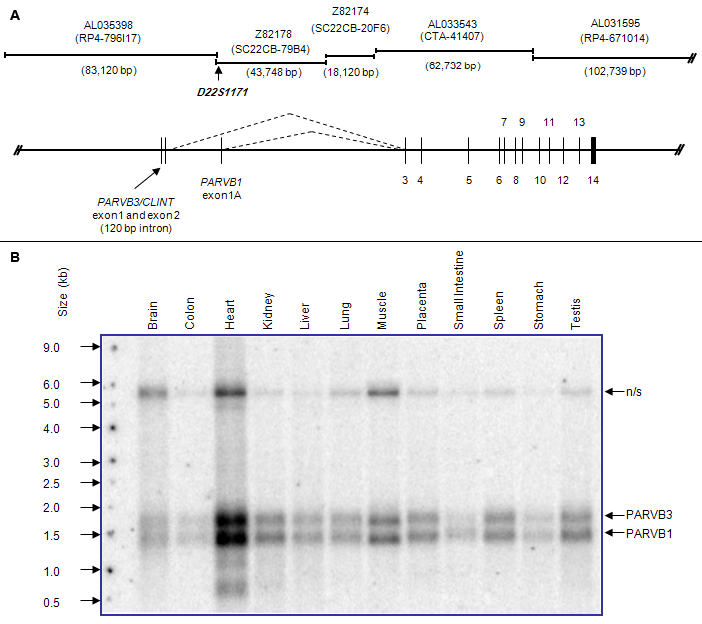
Figure A. Generation of transcript diversity by alternative promoter usage. Horizontal lines above the gene structure indicate human genomic DNA BAC clones. The NCBI accession numbers of the clones, and clone names (in brackets) are shown. Figure adapted from Mongroo et al., 2004.
Figure B. Human polyA+ RNA Multiple Tissue Northern blot (Origene) probed with full-length PARVB1 cDNA probe radiolabeled to a specific activity of > 5 x 10⁸ cpm / mg (Johnstone C.N., unpublished). The two PARVB mRNA transcripts are indicated. The higher M.W. band most likely corresponds to non-specific hybridization (n/s).
Description
PARVB3/CLINT, which encodes the longer Parvin-beta protein isoform is transcribed from promoter 1 and contains two additional 5 exons (exons 1 and 2) not present in PARVB1, and comprises 14 exons in total. PARVB1 encodes the shorter Parvin-beta protein isoform, is transcribed from promoter 1A, and comprises 13 exons in total. Both promoters contain CpG islands that span the transcription start sites. PARVB3/CLINT contains 70 unique N-terminal amino acids not present in the short isoform. (See figure A).
Transcription
As with PARVA, human PARVB mRNA expression is highest in heart, followed by skeletal muscle, where it localises to the sarcolemma (Yamaji et al., 2001; Matsuda et al., 2005). Both PARVB mRNA transcripts are essentially ubiquitously expressed (Korenbaum et al., 2001), but with lower expression in gastrointestinal tissues (stomach, small intestine, colon). (See figure B).
Proteins

Depiction of functional domains of Parvin-beta(long) and Parvin-beta(short). NLS, nuclear localization sequence; ABS, actin binding sequence; CH, calponin homology. Adapted from Sepulveda and Wu, 2006.
Description
The major functional domains of Parvin-beta are two atypical calponin homology (CH) domains, termed CH1 (106 amino acids) and CH2 (107 amino acids). Each CH domain contains two actin binding sequences (ABS), although Parvin-beta has not been shown to bind actin directly (Korenbaum et al., 2001; Sepulveda and Wu, 2006). Parvin-beta physically interacts with Dysferlin and ARHGEF6 (alpha-PIX) through the CH1 domain (Matsuda et al., 2005; Rosenberger et al., 2003) and with ILK and alpha-actinin through the CH2 domain (Yamaji et al., 2001; Yamaji et al., 2004). Parvin-beta was also recently reported to directly interact with AKT (Kimura et al., 2010).
Expression
PARVB is essentially ubiquitously expressed.
Localisation
Parvin-beta localises to focal adhesions but also to the nucleus, which is most likely due to NLS motifs in the N-terminal region (Mongroo et al., 2004; Johnstone et al., 2008). Parvin-beta is incorporated into focal adhesions as part of the heterotrimeric IPP complex. The ternary complex contains 1 molecule of integrin linked kinase (ILK), 1 Parvin isoform, and 1 PINCH (LIMS) isoform, (Legate et al., 2006). Binding of Parvin-alpha and Parvin-beta to the kinase domain of ILK is mutually exclusive (Zhang et al., 2004). Formation of the IPP complex also dictates total protein levels of each component, as any excess ILK, Parvin, or PINCH not incorporated into IPP is degraded in a proteasome-dependent manner (Fukuda et al., 2003).
Function
Parvin-beta participates in focal adhesion dynamics through involvement in the IPP complex. The high expression levels in cardiac and skeletal muscle suggest important function(s) in these organs. In skeletal muscle, it binds dysferlin at the sarcolemma and thus may be involved with membrane repair (Yamaji et al., 2001; Matsuda et al., 2005; Legate et al., 2006). Parvin-beta and Parvin-alpha appear to negatively regulate the expression of each other (Zhang et al., 2004; Johnstone et al., 2008). Parvin-beta may modulate signalling through ILK as overexpression of Parvin-beta reduced AKT (S473) and GSK3beta (S9) phosphorylation in response to EGF stimulation (Mongroo et al., 2004). Parvin-beta was recently reported to directly interact with AKT (Kimura et al., 2010), which may explain its effects on AKT phosphorylation. Parvin-beta interacts with ARHGEF6 (alpha-PIX), an exchange factor for RAC1, thus implicating Parvin-beta in regulation of RAC signalling downstream of integrin engagement (Rosenberger et al., 2003). Finally, Parvin-beta may affect metabolic pathways through promotion of CDK9-mediated phosphorylation and activation of PPARgamma transcriptional activity in the nucleus (Johnstone et al., 2008). Interestingly, Parvb knockout mice were recently generated. Whilst constitutive Parva null mice feature kidney and cardiovascular defects and die between E10.5 and E14.5 (Lange et al., 2009; Montanez et al., 2009), constitutive Parvb null mice are viable (Wickström et al., 2010), although a detailed phenotypic analysis has not yet been described.
Homology
Human Parvin-beta is most closely related to Parvin-alpha [75% identity with Parvin-beta(short) and 67% identity with Parvin-beta(long)] and more distantly to Parvin-gamma [41% identity with both Parvin-beta(short) and Parvin-beta(long)].
Mutations
Note
No mutations reported to date.
Germinal
Germline SNPs are identified in the PARVB gene by direct sequencing of PCR products amplified from cDNA prepared from 16 primary ductal adenocarcinomasand adjacent normal mammary gland from the same patient. Two non-synonymous SNPs were identified, W37R, and E175K (Johnstone et al., manuscript in preparation).
† Relative to transcription start site
‡ Relative to translation start site
^ Occur as a haplotype
** Relative to splice site
| Name | Alleles | Location | Base Position† | Amino Acid Position‡ | Amino Acid change | No. of Alleles |
| A98C | A/C | Intron 1 | 98** | n/a | n/a | 3/8 |
| W37R | T/C | Exon 2 | 252 | 37 | W>R | 3/8 |
| D150D | C/T | Exon 5 | 593 | 150 | D>D | 2/32 |
| E175K | G/A | Exon 6 | 666 | 175 | E>K | 2/32 |
| A223A | C/T | Exon 7 | 812 | 223 | A>A | 2/32 |
| G316G^ | C/T | Exon 12 | 1097 | 318 | G>G | 2/32 |
| F354F^ | C/T | Exon 13 | 1205 | 354 | F>F | 2/32 |
‡ Relative to translation start site
^ Occur as a haplotype
** Relative to splice site
Somatic
No somatic mutations were found in an analysis of 16 breast adenocarcinomas as presented above (Johnstone et al., manuscript in preparation). According to the C.O.S.M.I.C. online database (Forbes et al., 2008), 171 unique cancer samples have been analysed for alterations in the PARVB gene, with no somatic changes found. A breakdown of the samples analysed is given below.
| Cancer Type | No. of Specimens | Reference |
| Breast | 11 | Sjöblom et al., 2006 |
| Glioma | 23 | Parsons et al., 2008 |
| Clear Cell Renal | 101 | Dalgliesh et al., 2010 |
| Colon | 12 | Sjöblom et al., 2006 |
| Lung (cell lines) | 11 | N/A |
| Pancreas (cell lines) | 1 | N/A |
| Mesothelioma (cell lines) | 1 | N/A |
| Melanoma (cell lines) | 6 | N/A |
| Urinary tract (cell lines) | 2 | N/A |
| HNSCC (cell lines) | 3 | N/A |
Implicated in
Entity name
Breast cancer
Note
Parvin-beta mRNA levels are reduced in primary human ductal adenocarcinoma compared with adjacent normal mammary gland. PARVB mRNA levels are also reduced in MDA-MB-231 and MDA-MB-453 cell lines. Post-transcriptional downregulation of protein expression may also occur in cancer cells such as MCF7 (Mongroo et al., 2004). Ectopic Parvin-beta expression in MDA-MB-231 metastatic breast cancer cells increased adhesion and reduced invasion. Ectopic expression also reduced tumorigenicity of the same cell line in nude mice in vivo. Parvin-beta expression did not affect proliferation of the cells in vitro, but reduced Ki-67 staining was observed in Parvin-beta transfectants in vivo (Johnstone et al., 2008). Parvin-beta overexpression was also reported to promote apoptosis in HeLa cervical cancer cells (Zhang et al., 2004).
Prognosis
Association with prognosis has not been studied to date.
Article Bibliography
| Pubmed ID | Last Year | Title | Authors |
|---|---|---|---|
| 20054297 | 2010 | Systematic sequencing of renal carcinoma reveals inactivation of histone modifying genes. | Dalgliesh GL et al |
| 18428421 | 2008 | The Catalogue of Somatic Mutations in Cancer (COSMIC). | Forbes SA et al |
| 14551191 | 2003 | PINCH-1 is an obligate partner of integrin-linked kinase (ILK) functioning in cell shape modulation, motility, and survival. | Fukuda T et al |
| 17998334 | 2008 | Parvin-beta inhibits breast cancer tumorigenicity and promotes CDK9-mediated peroxisome proliferator-activated receptor gamma 1 phosphorylation. | Johnstone CN et al |
| 20164304 | 2010 | Functional molecular imaging of ILK-mediated Akt/PKB signaling cascades and the associated role of beta-parvin. | Kimura M et al |
| 11722847 | 2001 | Genomic organization and expression profile of the parvin family of focal adhesion proteins in mice and humans. | Korenbaum E et al |
| 19829382 | 2009 | Integrin-linked kinase is an adaptor with essential functions during mouse development. | Lange A et al |
| 16493410 | 2006 | ILK, PINCH and parvin: the tIPP of integrin signalling. | Legate KR et al |
| 15835269 | 2005 | Dysferlin interacts with affixin (beta-parvin) at the sarcolemma. | Matsuda C et al |
| 15467740 | 2004 | Beta-parvin inhibits integrin-linked kinase signaling and is downregulated in breast cancer. | Mongroo PS et al |
| 19798050 | 2009 | Alpha-parvin controls vascular mural cell recruitment to vessel wall by regulating RhoA/ROCK signalling. | Montanez E et al |
| 18772396 | 2008 | An integrated genomic analysis of human glioblastoma multiforme. | Parsons DW et al |
| 12499396 | 2003 | Interaction of alphaPIX (ARHGEF6) with beta-parvin (PARVB) suggests an involvement of alphaPIX in integrin-mediated signaling. | Rosenberger G et al |
| 16314921 | 2006 | The parvins. | Sepulveda JL et al |
| 16959974 | 2006 | The consensus coding sequences of human breast and colorectal cancers. | Sjöblom T et al |
| 20033063 | 2010 | The ILK/PINCH/parvin complex: the kinase is dead, long live the pseudokinase! | Wickström SA et al |
| 15159419 | 2004 | Affixin interacts with alpha-actinin and mediates integrin signaling for reorganization of F-actin induced by initial cell-substrate interaction. | Yamaji S et al |
| 15284246 | 2004 | Distinct roles of two structurally closely related focal adhesion proteins, alpha-parvins and beta-parvins, in regulation of cell morphology and survival. | Zhang Y et al |
Other Information
Locus ID:
NCBI: 29780
MIM: 608121
HGNC: 14653
Ensembl: ENSG00000188677
Variants:
dbSNP: 29780
ClinVar: 29780
TCGA: ENSG00000188677
COSMIC: PARVB
RNA/Proteins
Expression (GTEx)
Pathways
Protein levels (Protein atlas)
References
| Pubmed ID | Year | Title | Citations |
|---|---|---|---|
| 26343796 | 2016 | Association of rs5764455 and rs6006473 polymorphisms in PARVB with liver damage of nonalcoholic fatty liver disease in Han Chinese population. | 4 |
| 26343796 | 2016 | Association of rs5764455 and rs6006473 polymorphisms in PARVB with liver damage of nonalcoholic fatty liver disease in Han Chinese population. | 4 |
| 25422907 | 2015 | PARVB overexpression increases cell migration capability and defines high risk for endophytic growth and metastasis in tongue squamous cell carcinoma. | 20 |
| 25776890 | 2015 | Targeted-bisulfite sequence analysis of the methylation of CpG islands in genes encoding PNPLA3, SAMM50, and PARVB of patients with non-alcoholic fatty liver disease. | 38 |
| 26115385 | 2015 | Focal Adhesion Proteins α- and β-Parvin are Overexpressed in Human Colorectal Cancer and Correlate with Tumor Progression. | 7 |
| 26549231 | 2015 | 24-Methylenecycloartanyl ferulate, a major compound of γ-oryzanol, promotes parvin-beta expression through an interaction with peroxisome proliferator-activated receptor-gamma 2 in human breast cancer cells. | 4 |
| 25422907 | 2015 | PARVB overexpression increases cell migration capability and defines high risk for endophytic growth and metastasis in tongue squamous cell carcinoma. | 20 |
| 25776890 | 2015 | Targeted-bisulfite sequence analysis of the methylation of CpG islands in genes encoding PNPLA3, SAMM50, and PARVB of patients with non-alcoholic fatty liver disease. | 38 |
| 26115385 | 2015 | Focal Adhesion Proteins α- and β-Parvin are Overexpressed in Human Colorectal Cancer and Correlate with Tumor Progression. | 7 |
| 26549231 | 2015 | 24-Methylenecycloartanyl ferulate, a major compound of γ-oryzanol, promotes parvin-beta expression through an interaction with peroxisome proliferator-activated receptor-gamma 2 in human breast cancer cells. | 4 |
| 24621583 | 2014 | Targeted next-generation sequencing and fine linkage disequilibrium mapping reveals association of PNPLA3 and PARVB with the severity of nonalcoholic fatty liver disease. | 8 |
| 24621583 | 2014 | Targeted next-generation sequencing and fine linkage disequilibrium mapping reveals association of PNPLA3 and PARVB with the severity of nonalcoholic fatty liver disease. | 8 |
| 23099104 | 2013 | Migfilin, α-parvin and β-parvin are differentially expressed in ovarian serous carcinoma effusions, primary tumors and solid metastases. | 2 |
| 23535911 | 2013 | Genome-wide scan revealed that polymorphisms in the PNPLA3, SAMM50, and PARVB genes are associated with development and progression of nonalcoholic fatty liver disease in Japan. | 94 |
| 23950981 | 2013 | Pathway analysis using genome-wide association study data for coronary restenosis--a potential role for the PARVB gene. | 6 |
Citation
Cameron N Johnstone
PARVB (parvin, beta)
Atlas Genet Cytogenet Oncol Haematol. 2010-04-01
Online version: http://atlasgeneticsoncology.org/gene/46486/parvb-(parvin-beta)
