ILK (integrin-linked kinase)
2014-08-01 Isabel Serrano , Paul McDonald , Shoukat Dedhar AffiliationDepartment of Integrative Oncology, British Columbia Cancer Research Centre of the BC Cancer Agency, 675 West 10th Avenue, Vancouver, BC, Canada, V5Z1L3
Identity
HGNC
LOCATION
11p15.4
LOCUSID
ALIAS
HEL-S-28,ILK-1,ILK-2,P59,p59ILK
FUSION GENES
Abstract
Review on ILK (integrin-linked kinase), with data on DNA, on the protein encoded, and where the gene is implicated.
DNA/RNA

Chromosome 11, genomic organization of human ILK. The ILK gene is located on chromosome 11 at position 15. Exactly from 6624961 bp to 6632102 bp (7142 bases) (Diagram author: Elena Serrano).
Description
According to Entrez-Gene, human ILK maps to locus NC_000011.9. ILK gene contains 13 exons and spans 9.0 kb.
Transcription
ILK encodes a predicted 451-amino acid protein with an apparent molecular mass of 59 kD based on SDS-PAGE. Northern blot analysis showed that the 1.8-kb ILK mRNA is widely expressed.
Pseudogene
An ILK pseudogene has been found in mice, predicted gene 6263 (Gm6263).
Proteins

Functional domains of integrin-linked kinase (ILK). ILK is an intracellular serine/threonine protein kinase with a C-terminal kinase catalytic domain. ILK structure consists in four ankyrin repeats at the N-terminus (residues 33-164), a phosphoinositide-binding motif and a catalytic domain (residues 180-212). The integrin-binding site is in the extreme C-terminus of the kinase domain (residues 293-451) (Diagram author: Elena Serrano).
Description
ILK is a widely expressed modular protein composed of three major domains: an N-terminal domain that contains four ankyrin repeats, a central pleckstrin homology (PH)-like domain and a C-terminal kinase domain. The N-terminal ankyrin domain binds to PINCH (particularly interesting new cysteinehistidine protein) - an adaptor protein that complexes with ILK in the cytoplasm prior to active recruitment of ILK to focal adhesion sites - and to ILK-associated protein (ILKAP) - a protein phosphatase 2C (PP2C)-family protein phosphatase that negatively regulates ILK signaling (McDonald et al., 2008a). Adjacent to the ankyrin repeats, a sequence motif present in PH domains binds to the second messenger PI(3,4,5)P3 and a PI3-kinase-dependent kinase activation has been reported (Delcommenne et al., 1998; Boulter and Van Obberghen-Schilling, 2006). The C-terminus kinase domain also interacts with integrins, as well as with the focal adhesion proteins paxillin (Nikolopoulos and Turner, 2001; Nikolopoulos and Turner, 2002) and parvins (Hannigan et al., 2005; Legate et al., 2006), which link ILK, and therefore integrins, to the actin cytoskeleton.
Expression
ILK is ubiquitously expressed in most tissues, with predominance at skeletal muscle, heart, kidney and pancreas. Increased expression of ILK is correlated with progression of several tumor types, constituting an attractive therapeutic target in human cancer.
Localisation
ILK is generally considered a cytosolic protein localized at focal adhesions, however ILK co-localizes with tubulins and many centrosomal and mitotic spindle associated proteins at centrosomes.
Function
Integrin-linked kinase (ILK) (Hannigan et al., 1996) is a multifunctional protein kinase which is implicated in a large number of cellular processes and diseases, participating in signal transduction pathways that control cell survival, differentiation, proliferation and gene expression in mammalian cells (Wu, 2001). ILK, PINCH1 and α-parvin form a ternary complex termed IPP (ILK-PINCH-parvin) that localizes to both focal adhesions (FAs) and fibrillar adhesions (FBs) and is essential for several integrin-dependent functions. The IPP complex, interacts with the cytoplasmic tail of β integrins, resulting in the engagement and organization of the cytoskeleton as well as activation of signalling pathways. Deletion of the genes encoding ILK or PINCH1 similarly blocks maturation of FAs and FBs by downregulating expression or recruitment of tensin and destabilizing α5β1-integrin-cytoskeleton linkages (Legate et al., 2006; Stanchi et al., 2009; Elad et al., 2013). The kinase activity of ILK is stimulated by integrins and soluble mediators, including growth factors and chemokines, and is regulated in a phosphoinositide 3-kinase (PI3K)-dependent manner. The activity of ILK is antagonized by phosphatases such as ILKAP and phosphatase and tensin homolog deleted on chromosome 10 (PTEN) (McDonald et al., 2008a). Important downstream targets of ILK signaling include PKB/Akt, GSK-3, β-catenin, p44/p42 MAP kinases, the myosin light chain (MLC) (Hannigan et al., 2011) and the Hippo pathway through Merlins phosphatase MYPT1 (Serrano et al., 2013c). AKT is a regulator of cell survival and apoptosis. To become fully activated, PKB/Akt requires phosphorylation at two sites, threonine 308 and serine 473. Phosphorylation at serine 473 depends on PI3K activity (Persad et al., 2001), the rictor-mTOR complex (Sarbassov et al., 2005) and the ILK-Rictor complex (McDonald et al., 2008b). GSK-3 is phosphorylated and inactivated at serine 9 by ILK, regulating the cell cycle through proteolysis of cyclin D1 and activation of the transcription factor AP1 (Troussard et al., 1999). Inactivation of GSK-3 stabilizes β-catenin, whose accumulation is related to deregulation of proliferation, migration and differentiation (Oloumi et al., 2004). ILK can directly phosphorylate MLC on Ser18/thr19 influencing in cell contraction, motility and migration (Deng et al., 2001). ILK function is required in TGFβ-1-induced EMT in mammary epithelial cells, and the ILK/Rictor complex has been identified as a potential molecular target for preventing/reversing EMT (Serrano et al., 2013b). But ILK can also directly regulate EMT by promoting the expression of Snail transcriptionally (McPhee et al., 2008) and via posttranslational modification through GSK-3b.
ILK also localize to centrosomes, where it is recruited by RUVBI1/2, and it regulates mitotic spindle assembly by promoting Aurora A kinase/TACC3/ch-TOG interactions (Fielding et al., 2008) as well as centrosome clustering through the microtubule regulating proteins TACC3 and ch-TOG (Fielding et al., 2011). In addition, ILK regulates microtubule dynamics since overexpression of ILK in HeLa cells is associated with a shorter duration of mitosis and decreased sensitivity to paclitaxel, a chemotherapeutic agent that suppresses microtubule dynamics and conversely, the use of a small molecule inhibitor selective against ILK, QLT-0267, results in suppressed microtubule dynamics (Lim et al., 2013). ILK regulation of microtubules is critical for proper trafficking of caveolin-1-containing vesicles. ILK controls this process by regulating microtubule stability through the recruitment of the scaffold protein IQGAP1 and its downstream effector mDia1 to nascent, cortical adhesion sites. In the absence of ILK, caveolae remain associated with dynamic microtubules, fail to stably fuse with the plasma membrane, and subsequently accumulate in intracellular structures (Wickström et al., 2010).
ILK also localize to centrosomes, where it is recruited by RUVBI1/2, and it regulates mitotic spindle assembly by promoting Aurora A kinase/TACC3/ch-TOG interactions (Fielding et al., 2008) as well as centrosome clustering through the microtubule regulating proteins TACC3 and ch-TOG (Fielding et al., 2011). In addition, ILK regulates microtubule dynamics since overexpression of ILK in HeLa cells is associated with a shorter duration of mitosis and decreased sensitivity to paclitaxel, a chemotherapeutic agent that suppresses microtubule dynamics and conversely, the use of a small molecule inhibitor selective against ILK, QLT-0267, results in suppressed microtubule dynamics (Lim et al., 2013). ILK regulation of microtubules is critical for proper trafficking of caveolin-1-containing vesicles. ILK controls this process by regulating microtubule stability through the recruitment of the scaffold protein IQGAP1 and its downstream effector mDia1 to nascent, cortical adhesion sites. In the absence of ILK, caveolae remain associated with dynamic microtubules, fail to stably fuse with the plasma membrane, and subsequently accumulate in intracellular structures (Wickström et al., 2010).
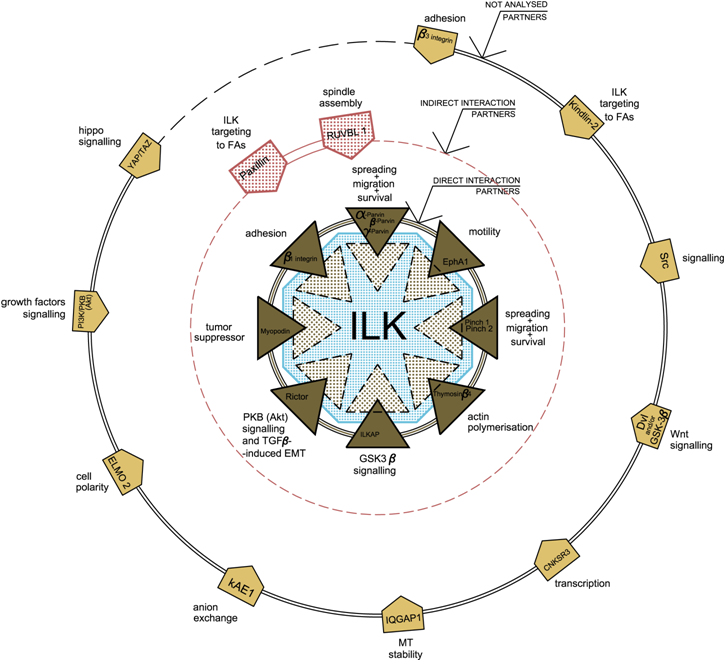
ILK interaction partners. Schematic representation of the signal transduction pathways where ILK is implicated. Dark green represents direct interaction, red represents indirect interaction and light brown represents not analysed. Adapted from Widmaier et al., 2012 by Elena Serrano.
Homology
The ILK gene is highly conserved in a total of 24 species. The most representatives are human, mouse, chicken, lizard, African clawed frog, zebrafish, fruit fly, worm.
Mutations
Note
1. ILK mutation causes human cardiomyopathy via simultaneous defects in cardiomyocytes and endothelial cells (Knoll et al., 2007).
2. Embryonic lethality was observed in Xenopus laevis (Yasunaga et al., 2005) and mouse (Sakai et al., 2003) models of ILK ablation, and this was attributed to defects in adhesive and migratory mechanics.
2. Embryonic lethality was observed in Xenopus laevis (Yasunaga et al., 2005) and mouse (Sakai et al., 2003) models of ILK ablation, and this was attributed to defects in adhesive and migratory mechanics.
Implicated in
Entity name
Melanoma
Note
Increased expression of integrin-linked kinase is correlated with melanoma progression and poor patient survival (Dai et al., 2003; Wong et al., 2007). ILK regulates melanoma angiogenesis by activating NF-kB/interleukin-6 signaling pathway (Wani et al., 2011).
Entity name
Colon cancer
Note
ILK is hyperexpressed in malignant crypts from both the primary and metastatic lesions. Changes in ILK activity coincide with changes on downstream targets, primarily GSK3β. Dysregulation of the ILK-signaling nexus is an important early event in the genesis of human colon cancer (Marotta et al., 2003). ILK expression levels correlated with tumor invasion, grade and stage; higher levels in metastatic tumors (Bravou et al., 2003). Thymosin beta 4 induces colon cancer cell migration and clinical metastasis via enhancing ILK/IQGAP1/Rac1 signal transduction pathway (Tang et al., 2011).
Entity name
Gastric cancer
Note
ILK might be a novel molecular marker for aggressive gastric cancer. Strong expression of ILK is observed in the majority of primary tumors that were associated with tumor cell invasion and nodal metastasis; no expression in non-neoplastic gastric epithelia (Ito et al., 2003). ILK might be used as a potential therapeutic strategy to combat multi-drug resistance through blocking PI3K-Akt and MAPK-ERK pathways in human gastric carcinoma (Song et al., 2012).
Entity name
Lung cancer
Note
ILK expression is significantly associated with tumor grade and stage, and lower than 5-year survival. Increased expression of ILK is a poor prognostic factor in patients with non-small cell lung cancer (Takanami 2005; Okamura et al., 2007).
Entity name
Anaplastic thyroid cancer
Note
ILK is a potential therapeutic target for treating anaplastic thyroid cancer. ILK expression and activity are elevated in human anaplastic thyroid cancer and ILK inhibition leads to growth arrest and apoptosis in vitro and in vivo (Younes et al., 2005).
Entity name
Squamous cell carcinoma of head and neck
Note
ILK is overexpressed in SCCHN tumor specimens. Targeting ILK with the small-molecule ILK inhibitor QLT0267 inhibits cell growth and induces apoptosis in SCCHN cell lines by reducing ILK activity and Akt phosphorylation (Younes et al., 2007).
Entity name
Pancreatic cancer
Note
ILK is involved with aggressive capability in pancreatic cancer. Significant association between strong expression of ILK and poor prognosis of pancreatic cancer patients has been observed (Sawai et al., 2006). Silencing ILK could be a potentially useful therapeutic approach for treating pancreatic cancer (Schaeffer et al., 2010; Zhu et al., 2012).
Entity name
Ovarian cancer
Note
ILK expression is increased with tumor progression; normal epithelium was negative for ILK (Ahmed et al., 2003). ILK gene silencing suppresses tumor growth in human ovarian carcinoma HO-8910 xenografts in mice (Li et al., 2013) and induces apoptosis in ovarian carcinoma SKOV3 cell (Liu et al., 2012).
Entity name
Prostate cancer
Note
ILK expression is increased with tumor progression. Increased expression of the protein has been demonstrated to be inversely related to the 5-year survival rate in prostate cancer (Graff et al., 2001). ILK stimulates the expression of VEGF by stimulating HIF-1alpha protein expression in a PKB/Akt- and mTOR/FRAP-dependent manner and knockdown of ILK expression with siRNA, or inhibition of ILK activity, results in significant inhibition of HIF-1alpha and VEGF expression (Tan el al., 2004). Compound 22, a novel ILK inhibitor, exhibited high in vitro potency against a panel of prostate and breast cancer cell lines and its therapeutic potential has been suggested by its in vivo efficacy as a single oral agent in suppressing PC-3 xenograft tumor growth (Lee et al., 2011).
Entity name
Mesothelioma
Note
ILK is expressed in malignant mesothelioma. Normal mesothelial cells and lung parenchyma are negative (Watzka et al., 2008). Evaluating ILKs potential use as a marker of disease progression in malignant pleural mesothelioma has been suggested (Watzka et al., 2013).
Entity name
Ewings sarcoma and primitive neuroectodermal tumor
Note
Expression is observed (Chung et al., 1998).
Entity name
Glioblastoma
Note
The ILK inhibitor, QLT0267, was able to reduce cellular invasion and angiogenesis of glioma cells. Blocking the ILK/Akt pathway is a potential strategy for molecular targeted therapy for gliomas (Kou et al., 2005; Edwards et al., 2008). Expression of insulin-like growth factor-binding protein 2 (IGFBP2), a glioma oncogene emerging as a target for therapeutic intervention, requires ILK to induce cell motility and activate NF-kB (Holmes et al., 2012).
Entity name
Musculoskeletal sarcoma
Note
Prognostic factor in osteosarcoma and a novel potential therapeutic target for the treatment of osteosarcoma (Rhee et al., 2013).
Entity name
Medulloblastoma
Note
Expression is observed (Chung et al., 1998).
Entity name
Breast cancer, cancer cell growth and metastasis
Note
Epithelial to mesenchymal transition (EMT) causes fibrosis, cancer progression and metastasis. Acquisition of invasive and migratory characteristics in cancer cells results primarily from adopting an EMT phenotype. Overexpression of ILK induces EMT in mammary epithelial cells (Somasiri et al., 2001) and targeting this signaling cascade is an effective strategy for the treatment of fibrotic kidney (Li et al., 2009), lung (Kavvadas et al., 2010) or bladder cancer (Matsui et al., 2011). ILK is a key intracellular mediator of TGFβ-1 induced EMT (Li et al., 2009) through a Snail and Slug mechanism (Serrano et al., 2013b). TGFβ-1 mediated EMT induces an interaction between ILK and Rictor and disruption of this interaction by silencing ILK or using ILK inhibitor molecule, QLT0267, blocks TGFβ-1 induced EMT and partially reverses the mesenchymal phenotype in breast cancer cell lines (Serrano et al., 2013b). ILK promotes lung cancer cell migration and invasion through the induction of EMT process (Chen et al., 2013) and is a therapeutically targetable mediator of ERG-induced EMT and transformation in prostate cancer (Becker-Santos et al., 2012) and in high glucose-induced epithelial-mesenchymal transition of renal tubular cell (Peng et al., 2012). A significant acceleration in mammary tumor incidence and growth was observed in the MMTV-Wnt/ILK mice compared to Wnt alone, showing the cooperation between Wnt1 and ILK transgenes during mammary carcinogenesis (Oloumi et al., 2010). Furthermore, mammary epithelial disruption of ILK in mice results in a profound block in mammary tumor induction (Pontier et al., 2010). ILK plays a critical role in the suppression of the Hippo pathway in breast, colon and prostate cancer cells; inactivation of ILK suppresses YAP activation and tumour growth in vivo (Serrano et al., 2013c). Expression of LIMD2 is associated with the metastatic process of papillary thyroid carcinoma (Cerutti et al., 2007) and has been described to bound directly to the kinase domain of ILK in IPP, a signal transduction pathway strongly linked to cell motility and invasion suggesting that LIMD2 potentiates ILK biological effects (Peng et al., 2014).
Entity name
Embryonic development
Note
Embryonic lethality was observed in Xenopus laevis (Yasunaga et al., 2005) and mouse (Sakai et al., 2003) models of ILK ablation, and this was attributed to defects in adhesive and migratory mechanics.
Entity name
Musculoskeletal system and skin
Note
During bone formation, ILK-dependent interactions and downstream signaling effectors are required for proliferation and differentiation of chondrocytes within the growth plate. The kinase activity of ILK is necessary for mechanosensing and signaling in vertebrate skeletal muscle (Postel et al., 2008). ILK is important for proliferation, adhesion, spreading and migration of keratinocytes (Lorenz et al., 2007; Nakrieko et al., 2008). ILK plays an important modulatory role in the normal contribution of hair follicle stem cell progeny to the regenerating epidermis following injury (Nakrieko et al., 2011). ILK and PI3K activation after skin wounding are critical for tissue repair in an HGF-dependent mechanism (Serrano et al., 2012).
Disease
Mice with depletion of ILK in chondrocytes suffer from dwarfism and chondrodysplasia (Grashoff et al., 2003; Terpstra et al., 2003). Lack of ILK in skin causes skin blistering and inhibition of hair follicle development (Lorenz et al., 2007; Nakrieko et al., 2008). ILK deficiency in mice leads to retarded wound closure in skin (Serrano et al., 2012).
Entity name
Central nervous system
Note
The downregulation of ILK expression was found to inhibit axon formation through the elimination or length reduction of the axon. ILK-Akt-GSK3 signaling axis is implicated in the development and function of neurons (Guo et al., 2007).
Disease
ILK deletion in the central nervous system leads to Cobblestone lissencephaly (Niewmierzycka et al., 2005) and to cerebellar development and loss of NGF signaling (Mills et al., 2006).
Entity name
Kidney
Note
ILK function is required for epithelial to mesenchymal transition and adhesion and in the maintenance of glomerular filtration barrier. Human mesangial cells exposed to abnormal collagen I are protected against apoptosis by a complex mechanism involving integrin β1/ILK/AKT-dependent NFkB activation with consequent Bcl-xL overexpression, that opposes a simultaneously activated ILK/GSK-3β-dependent Bim expression and this dual mechanism may play a role in the progression of glomerular dysfunction (del Nogal et al., 2012). ILK plays a key role in the regulation of renal inflammation by modulating the canonical NF-kB pathway, and suggest a potential therapeutic target for inflammatory renal diseases (Alique et al., 2014). ILK regulates expression of tubular water channel aquaporin-2 (AQP2) and its apical membrane presence in the renal tubule, polyuria and decreased urine osmolality were present in ILK conditional-knockdown (cKD-ILK) adult mice compared with nondepleted ILK littermates pointing ILK as a therapeutic target in nephrogenic diabetes insipidus (Cano-Penalver et al., 2014).
Disease
Fibrosis; proteinuria (Dai et al., 2006; El-Aouni et al., 2006).
Entity name
Heart
Note
ILK plays a central role in protecting the mammalian heart against cardiomyopathy and failure. Thymosin beta4 activates ILK and promotes cardiac cell function and regeneration after infarction (Bock-Marquette et al., 2004; Srivastava et al., 2007). The heart uses the Integrin-ILK-beta-parvin network to sense mechanical stretch (Bendig et al., 2006). Deletion of ILK results in disaggregation of cardiomyocytes, associated with disruption of adhesion signaling through the beta1-integrin/FAK (focal adhesion kinase) complex (White et al., 2006). ILK is implicated in cardiac hypertrophy and contractility and is a novel cardiotropic factor that promotes recruitment of human fetal heart cells to a cardiomyogenic fate (Traister et al., 2012). Increased expression of integrin-linked kinase improves cardiac function and decreases mortality in dilated cardiomyopathy model of rats (Gu et al., 2012). In Drosophila, severely compromised integrin/ILK pathway function is detrimental for the heart, but fine-tuned moderate reduction maintains youthful cardiac performance, suggesting a dual role for this complex in regulating cardiac integrity and aging (Nishimura et al., 2014).
Disease
Cardiomyogenesis
Entity name
Blood vessels
Note
ILK closely regulates capillary formation and the survival of progenitor and differentiated endothelial cells. In endothelial cells, VEGF stimulates ILK activity, and inhibition of ILK expression or activity results in the inhibition of VEGF-mediated endothelial cell migration, capillary formation in vitro, and angiogenesis in vivo (Tan et al., 2004). ILK controls postnatal vasculogenesis by recruitment of endothelial progenitor cells to ischemic tissue (Lee et al., 2006). ILK acts as a regulatory partner of eNOS in vivo that prevents eNOS uncoupling, and suggest ILK as a therapeutic target for prevention of endothelial dysfunction related to shear stress-induced vascular diseases (Herranz et al., 2012). ILK regulates retinal vascular endothelial proliferation, migration and tube formation and targeting ILK may be a potentially useful therapeutic approach for treating ocular neovascularization (Xie et al., 2013). Deletion of ILK in mice leads to increased vascular content and increased activity of sGC (soluble Guanylyl Cyclase) and PKG (Protein Kinase G), resulting in a more intense vasodilatory response to nitric oxide donors (Serrano et al., 2013a).
Disease
Tumor angiogenesis (Tan et al., 2004).
Article Bibliography
| Pubmed ID | Last Year | Title | Authors |
|---|---|---|---|
| 14517840 | 2003 | Integrin-linked kinase expression increases with ovarian tumour grade and is sustained by peritoneal tumour fluid. | Ahmed N et al |
| 24383472 | 2014 | Integrin-linked kinase plays a key role in the regulation of angiotensin II-induced renal inflammation. | Alique M et al |
| 23027626 | 2012 | Integrin-linked kinase as a target for ERG-mediated invasive properties in prostate cancer models. | Becker-Santos DD et al |
| 16921028 | 2006 | Integrin-linked kinase, a novel component of the cardiac mechanical stretch sensor, controls contractility in the zebrafish heart. | Bendig G et al |
| 15565145 | 2004 | Thymosin beta4 activates integrin-linked kinase and promotes cardiac cell migration, survival and cardiac repair. | Bock-Marquette I et al |
| 16546570 | 2006 | Integrin-linked kinase and its partners: a modular platform regulating cell-matrix adhesion dynamics and cytoskeletal organization. | Boulter E et al |
| 14676816 | 2003 | Integrin-linked kinase (ILK) expression in human colon cancer. | Bravou V et al |
| 24784577 | 2014 | Integrin-linked kinase regulates tubular aquaporin-2 content and intracellular location: a link between the extracellular matrix and water reabsorption. | Cano-Peñalver JL et al |
| 17699795 | 2007 | Molecular profiling of matched samples identifies biomarkers of papillary thyroid carcinoma lymph node metastasis. | Cerutti JM et al |
| 22683084 | 2013 | Overexpression of integrin-linked kinase correlates with malignant phenotype in non-small cell lung cancer and promotes lung cancer cell invasion and migration via regulating epithelial-mesenchymal transition (EMT)-related genes. | Chen D et al |
| 9737788 | 1998 | ILK (beta1-integrin-linked protein kinase): a novel immunohistochemical marker for Ewing's sarcoma and primitive neuroectodermal tumour. | Chung DH et al |
| 16837631 | 2006 | Essential role of integrin-linked kinase in podocyte biology: Bridging the integrin and slit diaphragm signaling. | Dai C et al |
| 14555513 | 2003 | Increased expression of integrin-linked kinase is correlated with melanoma progression and poor patient survival. | Dai DL et al |
| 9736715 | 1998 | Phosphoinositide-3-OH kinase-dependent regulation of glycogen synthase kinase 3 and protein kinase B/AKT by the integrin-linked kinase. | Delcommenne M et al |
| 11278951 | 2001 | Ca2+-independent smooth muscle contraction. a novel function for integrin-linked kinase. | Deng JT et al |
| 18202010 | 2008 | Suppression of VEGF secretion and changes in glioblastoma multiforme microenvironment by inhibition of integrin-linked kinase (ILK). | Edwards LA et al |
| 16611717 | 2006 | Podocyte-specific deletion of integrin-linked kinase results in severe glomerular basement membrane alterations and progressive glomerulosclerosis. | El-Aouni C et al |
| 23843624 | 2013 | The role of integrin-linked kinase in the molecular architecture of focal adhesions. | Elad N et al |
| 20838383 | 2011 | A critical role of integrin-linked kinase, ch-TOG and TACC3 in centrosome clustering in cancer cells. | Fielding AB et al |
| 11448915 | 2001 | Integrin-linked kinase expression increases with prostate tumor grade. | Graff JR et al |
| 12671688 | 2003 | Integrin-linked kinase regulates chondrocyte shape and proliferation. | Grashoff C et al |
| 22348065 | 2012 | Increased expression of integrin-linked kinase improves cardiac function and decreases mortality in dilated cardiomyopathy model of rats. | Gu R et al |
| 17490631 | 2007 | Role of the integrin-linked kinase (ILK) in determining neuronal polarity. | Guo W et al |
| 15630415 | 2005 | Integrin-linked kinase: a cancer therapeutic target unique among its ILK. | Hannigan G et al |
| 21602880 | 2011 | Integrin-linked kinase: not so 'pseudo' after all. | Hannigan GE et al |
| 22194624 | 2012 | Integrin-linked kinase regulates vasomotor function by preventing endothelial nitric oxide synthase uncoupling: role in atherosclerosis. | Herranz B et al |
| 22345562 | 2012 | Insulin-like growth factor-binding protein 2-driven glioma progression is prevented by blocking a clinically significant integrin, integrin-linked kinase, and NF-κB network. | Holmes KM et al |
| 12596061 | 2003 | Expression of integrin-linked kinase is closely correlated with invasion and metastasis of gastric carcinoma. | Ito R et al |
| 20857141 | 2010 | Integrin-linked kinase (ILK) in pulmonary fibrosis. | Kavvadas P et al |
| 17646580 | 2007 | Laminin-alpha4 and integrin-linked kinase mutations cause human cardiomyopathy via simultaneous defects in cardiomyocytes and endothelial cells. | Knöll R et al |
| 16275989 | 2005 | Targeting integrin-linked kinase inhibits Akt signaling pathways and decreases tumor progression of human glioblastoma. | Koul D et al |
| 21823616 | 2011 | Identification and characterization of a novel integrin-linked kinase inhibitor. | Lee SL et al |
| 16818815 | 2006 | Integrin-linked kinase, a hypoxia-responsive molecule, controls postnatal vasculogenesis by recruitment of endothelial progenitor cells to ischemic tissue. | Lee SP et al |
| 16493410 | 2006 | ILK, PINCH and parvin: the tIPP of integrin signalling. | Legate KR et al |
| 23340803 | 2013 | Silencing of integrin-linked kinase suppresses in vivo tumorigenesis of human ovarian carcinoma cells. | Li Q et al |
| 19541809 | 2009 | Inhibition of integrin-linked kinase attenuates renal interstitial fibrosis. | Li Y et al |
| 23349730 | 2013 | Integrin-linked kinase regulates interphase and mitotic microtubule dynamics. | Lim S et al |
| 22384810 | 2012 | Silencing of the integrin-linked kinase gene induces the apoptosis in ovarian carcinoma. | Liu Q et al |
| 17485490 | 2007 | Integrin-linked kinase is required for epidermal and hair follicle morphogenesis. | Lorenz K et al |
| 12771992 | 2003 | Characterisation of integrin-linked kinase signalling in sporadic human colon cancer. | Marotta A et al |
| 21351095 | 2012 | The importance of integrin-linked kinase in the regulation of bladder cancer invasion. | Matsui Y et al |
| 18339839 | 2008 | Rictor and integrin-linked kinase interact and regulate Akt phosphorylation and cancer cell survival. | McDonald PC et al |
| 18773488 | 2008 | Integrin-linked kinase regulates E-cadherin expression through PARP-1. | McPhee TR et al |
| 16421303 | 2006 | Critical role of integrin-linked kinase in granule cell precursor proliferation and cerebellar development. | Mills J et al |
| 21593206 | 2011 | Targeted inactivation of integrin-linked kinase in hair follicle stem cells reveals an important modulatory role in skin repair after injury. | Nakrieko KA et al |
| 16049178 | 2005 | Integrin-linked kinase deletion from mouse cortex results in cortical lamination defects resembling cobblestone lissencephaly. | Niewmierzycka A et al |
| 11694518 | 2002 | Molecular dissection of actopaxin-integrin-linked kinase-Paxillin interactions and their role in subcellular localization. | Nikolopoulos SN et al |
| 24400780 | 2014 | A dual role for integrin-linked kinase and β1-integrin in modulating cardiac aging. | Nishimura M et al |
| 17442374 | 2007 | Prognostic value of integrin beta1-ILK-pAkt signaling pathway in non-small cell lung cancer. | Okamura M et al |
| 20565980 | 2010 | Cooperative signaling between Wnt1 and integrin-linked kinase induces accelerated breast tumor development. | Oloumi A et al |
| 15053919 | 2004 | Regulation of E-cadherin expression and beta-catenin/Tcf transcriptional activity by the integrin-linked kinase. | Oloumi A et al |
| 24590809 | 2014 | LIMD2 is a small LIM-only protein overexpressed in metastatic lesions that regulates cell motility and tumor progression by directly binding to and activating the integrin-linked kinase. | Peng H et al |
| 23037158 | 2012 | Rhein inhibits integrin-linked kinase expression and regulates matrix metalloproteinase-9/tissue inhibitor of metalloproteinase-1 ratio in high glucose-induced epithelial-mesenchymal transition of renal tubular cell. | Peng L et al |
| 11313365 | 2001 | Regulation of protein kinase B/Akt-serine 473 phosphorylation by integrin-linked kinase: critical roles for kinase activity and amino acids arginine 211 and serine 343. | Persad S et al |
| 20305688 | 2010 | Integrin-linked kinase has a critical role in ErbB2 mammary tumor progression: implications for human breast cancer. | Pontier SM et al |
| 18436206 | 2008 | Zebrafish integrin-linked kinase is required in skeletal muscles for strengthening the integrin-ECM adhesion complex. | Postel R et al |
| 23784942 | 2013 | Role of integrin-linked kinase in osteosarcoma progression. | Rhee SH et al |
| 12670870 | 2003 | Integrin-linked kinase (ILK) is required for polarizing the epiblast, cell adhesion, and controlling actin accumulation. | Sakai T et al |
| 15718470 | 2005 | Phosphorylation and regulation of Akt/PKB by the rictor-mTOR complex. | Sarbassov DD et al |
| 16407822 | 2006 | Integrin-linked kinase activity is associated with interleukin-1 alpha-induced progressive behavior of pancreatic cancer and poor patient survival. | Sawai H et al |
| 20091050 | 2010 | Tumor expression of integrin-linked kinase (ILK) correlates with the expression of the E-cadherin repressor snail: an immunohistochemical study in ductal pancreatic adenocarcinoma. | Schaeffer DF et al |
| 22971619 | 2012 | Integrin-linked kinase (ILK) modulates wound healing through regulation of hepatocyte growth factor (HGF). | Serrano I et al |
| 11228156 | 2001 | Overexpression of the integrin-linked kinase mesenchymally transforms mammary epithelial cells. | Somasiri A et al |
| 23317227 | 2012 | Role of integrin-linked kinase in multi-drug resistance of human gastric carcinoma SGC7901/DDP cells. | Song W et al |
| 17600280 | 2007 | Thymosin beta4 is cardioprotective after myocardial infarction. | Srivastava D et al |
| 19435803 | 2009 | Molecular dissection of the ILK-PINCH-parvin triad reveals a fundamental role for the ILK kinase domain in the late stages of focal-adhesion maturation. | Stanchi F et al |
| 15631637 | 2005 | Increased expression of integrin-linked kinase is associated with shorter survival in non-small cell lung cancer. | Takanami I et al |
| 14749128 | 2004 | Regulation of tumor angiogenesis by integrin-linked kinase (ILK). | Tan C et al |
| 21621326 | 2011 | Thymosin beta 4 induces colon cancer cell migration and clinical metastasis via enhancing ILK/IQGAP1/Rac1 signal transduction pathway. | Tang MC et al |
| 12835312 | 2003 | Reduced chondrocyte proliferation and chondrodysplasia in mice lacking the integrin-linked kinase in chondrocytes. | Terpstra L et al |
| 22666394 | 2012 | ILK induces cardiomyogenesis in the human heart. | Traister A et al |
| 10523630 | 1999 | Cell-extracellular matrix interactions stimulate the AP-1 transcription factor in an integrin-linked kinase- and glycogen synthase kinase 3-dependent manner. | Troussard AA et al |
| 21278793 | 2011 | Integrin-linked kinase regulates melanoma angiogenesis by activating NF-κB/interleukin-6 signaling pathway. | Wani AA et al |
| 23045294 | 2013 | Serum concentration of integrin-linked kinase in malignant pleural mesothelioma and after asbestos exposure. | Watzka SB et al |
| 18048409 | 2008 | Reactivity of integrin-linked kinase in human mesothelial cell proliferation. | Watzka SB et al |
| 16951252 | 2006 | Targeted ablation of ILK from the murine heart results in dilated cardiomyopathy and spontaneous heart failure. | White DE et al |
| 20951348 | 2010 | Integrin-linked kinase controls microtubule dynamics required for plasma membrane targeting of caveolae. | Wickström SA et al |
| 22637643 | 2012 | Integrin-linked kinase at a glance. | Widmaier M et al |
| 17575101 | 2007 | The role of integrin-linked kinase in melanoma cell migration, invasion, and tumor growth. | Wong RP et al |
| 11683382 | 2001 | ILK interactions. | Wu C et al |
| 23258222 | 2013 | Targeting of integrin-linked kinase with small interfering RNA inhibits VEGF-induced angiogenesis in retinal endothelial cells. | Xie W et al |
| 15773899 | 2005 | Xenopus ILK (integrin-linked kinase) is required for morphogenetic movements during gastrulation. | Yasunaga T et al |
| 16093430 | 2005 | Integrin-linked kinase is a potential therapeutic target for anaplastic thyroid cancer. | Younes MN et al |
| 17224516 | 2007 | Effects of the integrin-linked kinase inhibitor QLT0267 on squamous cell carcinoma of the head and neck. | Younes MN et al |
| 22888305 | 2012 | Silencing of the integrin-linked kinase gene suppresses the proliferation, migration and invasion of pancreatic cancer cells (Panc-1). | Zhu XY et al |
| 23054083 | 2012 | Balance between apoptosis or survival induced by changes in extracellular-matrix composition in human mesangial cells: a key role for ILK-NFκB pathway. | del Nogal M et al |
Other Information
Locus ID:
NCBI: 3611
MIM: 602366
HGNC: 6040
Ensembl: ENSG00000166333
Variants:
dbSNP: 3611
ClinVar: 3611
TCGA: ENSG00000166333
COSMIC: ILK
RNA/Proteins
Expression (GTEx)
Pathways
Protein levels (Protein atlas)
References
| Pubmed ID | Year | Title | Citations |
|---|---|---|---|
| 38734696 | 2024 | Integrin-linked kinase mRNA expression in circulating mononuclear cells as a biomarker of kidney and vascular damage in experimental chronic kidney disease. | 0 |
| 38734696 | 2024 | Integrin-linked kinase mRNA expression in circulating mononuclear cells as a biomarker of kidney and vascular damage in experimental chronic kidney disease. | 0 |
| 36732940 | 2023 | Substrate Stiffness Regulates the Proliferation and Apoptosis of Periodontal Ligament Cells through Integrin-Linked Kinase ILK. | 1 |
| 37357686 | 2023 | Extracellular vesicle-packaged ILK from mesothelial cells promotes fibroblast activation in peritoneal fibrosis. | 6 |
| 38077324 | 2023 | Integrin-linked kinase expression in myeloid cells promotes colon tumorigenesis. | 0 |
| 36732940 | 2023 | Substrate Stiffness Regulates the Proliferation and Apoptosis of Periodontal Ligament Cells through Integrin-Linked Kinase ILK. | 1 |
| 37357686 | 2023 | Extracellular vesicle-packaged ILK from mesothelial cells promotes fibroblast activation in peritoneal fibrosis. | 6 |
| 38077324 | 2023 | Integrin-linked kinase expression in myeloid cells promotes colon tumorigenesis. | 0 |
| 34921014 | 2022 | Loss of Integrin-Linked Kinase Sensitizes Breast Cancer to SRC Inhibitors. | 5 |
| 35089438 | 2022 | Integrin-linked kinase (ILK): the known vs. the unknown and perspectives. | 21 |
| 35246616 | 2022 | Indoxyl sulfate- and P-cresol-induced monocyte adhesion and migration is mediated by integrin-linked kinase-dependent podosome formation. | 9 |
| 35429970 | 2022 | Identification and validation of EMT-immune-related prognostic biomarkers CDKN2A, CMTM8 and ILK in colon cancer. | 15 |
| 36359821 | 2022 | The Role of Hippo Signaling Pathway and ILK in the Pathophysiology of Human Hypertrophic Scars and Keloids: An Immunohistochemical Investigation. | 4 |
| 34921014 | 2022 | Loss of Integrin-Linked Kinase Sensitizes Breast Cancer to SRC Inhibitors. | 5 |
| 35089438 | 2022 | Integrin-linked kinase (ILK): the known vs. the unknown and perspectives. | 21 |
Citation
Isabel Serrano ; Paul McDonald ; Shoukat Dedhar
ILK (integrin-linked kinase)
Atlas Genet Cytogenet Oncol Haematol. 2014-08-01
Online version: http://atlasgeneticsoncology.org/gene/460/ilk-(integrin-linked-kinase)
