PCSK4 (proprotein convertase subtilisin/kexin type 4)
2014-06-01 Majid Khatib , Béatrice Demoures AffiliationUniversity Bordeaux 1, INSERM U1029, Avenue des Facultes, Batiment B2, Talence 33405, France
DNA/RNA

Description
This gene can be found on chromosome 19 at location: at 1432427 and ends at 1441410.
Transcription
The DNA sequence contains 15 exons and the transcript length: 2661 bps translated to a 755 residues protein.
Proteins
Description
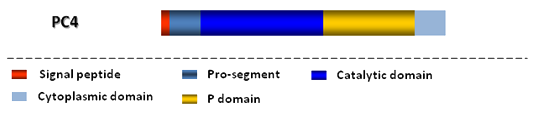
PCSK4 is a member of the family of subtilisin-like proprotein convertase (PCs) that process protein at basic residues. This protein is produced in the inactive zymogen form and is activated by proteolytic removal of its prodomain in the N-terminal site.
Expression
PCSK4 is restricted to the reproductive tract and expressed primarily in testicular germ cells and sperm. Low levels of PCSK4 mRNA have also been detected in ovaries and the placenta.
Localisation
PCSK4 exact intracellular location has not yet been determined.
Function
PCSK4 cleaves synthetic peptide substrates after an Arg in a basic sequence context; most often after paired basic residues (K/R-X-K/R), to release mature proteins from their proproteins. PCSK4 substrates include growth factors (DEAF-1, proIGF2, proenkephalin, proNGF, proPACAP, HGFR), receptors (IGF-1R, HGFR), and members of the ADAM (a-disintegrin-and-metalloproteinase) family (ADAM-1, ADAM-2, ADAM-3, ADAM-5. The activation/inactivation of these substrates implicated directly the latter to the regulation of gonadal functions, sperm motility, and species specific reproduction.
Homology
The PCSK4 catalytic domain has a high percentage of homology with those of the other PCs: 70% between PCSK4 and Furin.
Implicated in
Entity name
Pregnancy difficulties
Note
An aberrant processing of IGF-II by PCSK4 plays a role in inadequate trophoblast migration and, thus, fetal growth restriction.
Entity name
Infertility
Note
The fertilizing ability of PCSK4 null spermatozoa was also found to be significantly reduced. Moreover, PCSK4 cleavages lead to sperm acquisition of fertilization competence.
Article Bibliography
| Pubmed ID | Last Year | Title | Authors |
|---|---|---|---|
| 22204726 | 2011 | Proprotein convertases in health and disease. | Artenstein AW et al |
| 10493908 | 1999 | Enzymic characterization in vitro of recombinant proprotein convertase PC4. | Basak A et al |
| 14972029 | 2004 | In vitro elucidation of substrate specificity and bioassay of proprotein convertase 4 using intramolecularly quenched fluorogenic peptides. | Basak S et al |
| 16167351 | 2005 | Proprotein convertases: "master switches" in the regulation of tumor growth and progression. | Bassi DE et al |
| 21586571 | 2011 | Peptide-protein interactions suggest that acetylation of lysines 381 and 382 of p53 is important for positive coactivator 4-p53 interaction. | Debnath S et al |
| 19109312 | 2009 | Proprotein convertase subtilisin/kexin type 4 in mammalian fertility: a review. | Gyamera-Acheampong C et al |
| 19149690 | 2009 | The potential anti-tumorigenic and anti-metastatic side of the proprotein convertases inhibitors. | Lahlil R et al |
| 16040806 | 2005 | Role of pro-IGF-II processing by proprotein convertase 4 in human placental development. | Qiu Q et al |
| 17012247 | 2006 | Proprotein convertases: lessons from knockouts. | Scamuffa N et al |
| 23775089 | 2013 | The multifaceted proprotein convertases: their unique, redundant, complementary, and opposite functions. | Seidah NG et al |
| 21388412 | 2011 | What lies ahead for the proprotein convertases? | Seidah NG et al |
| 22357636 | 2012 | Alteration in the processing of the ACRBP/sp32 protein and sperm head/acrosome malformations in proprotein convertase 4 (PCSK4) null mice. | Tardif S et al |
| 24396277 | 2013 | Genetics of the first seven proprotein convertase enzymes in health and disease. | Turpeinen H et al |
Other Information
Locus ID:
NCBI: 54760
MIM: 600487
HGNC: 8746
Ensembl: ENSG00000115257
Variants:
dbSNP: 54760
ClinVar: 54760
TCGA: ENSG00000115257
COSMIC: PCSK4
RNA/Proteins
| Gene ID | Transcript ID | Uniprot |
|---|---|---|
| ENSG00000115257 | ENST00000300954 | Q6UW60 |
| ENSG00000115257 | ENST00000300954 | A0A140VJQ9 |
| ENSG00000115257 | ENST00000588671 | K7EN14 |
| ENSG00000115257 | ENST00000591201 | K7EJB6 |
Expression (GTEx)
Protein levels (Protein atlas)
References
| Pubmed ID | Year | Title | Citations |
|---|---|---|---|
| 21080038 | 2011 | The precursor to the germ cell-specific PCSK4 proteinase is inefficiently activated in transfected somatic cells: evidence of interaction with the BiP chaperone. | 2 |
| 21080038 | 2011 | The precursor to the germ cell-specific PCSK4 proteinase is inefficiently activated in transfected somatic cells: evidence of interaction with the BiP chaperone. | 2 |
| 20628086 | 2010 | Variation at the NFATC2 locus increases the risk of thiazolidinedione-induced edema in the Diabetes REduction Assessment with ramipril and rosiglitazone Medication (DREAM) study. | 15 |
| 20628086 | 2010 | Variation at the NFATC2 locus increases the risk of thiazolidinedione-induced edema in the Diabetes REduction Assessment with ramipril and rosiglitazone Medication (DREAM) study. | 15 |
| 19913121 | 2009 | Gene-centric association signals for lipids and apolipoproteins identified via the HumanCVD BeadChip. | 105 |
| 19913121 | 2009 | Gene-centric association signals for lipids and apolipoproteins identified via the HumanCVD BeadChip. | 105 |
| 16040806 | 2005 | Role of pro-IGF-II processing by proprotein convertase 4 in human placental development. | 29 |
| 16040806 | 2005 | Role of pro-IGF-II processing by proprotein convertase 4 in human placental development. | 29 |
Citation
Majid Khatib ; Béatrice Demoures
PCSK4 (proprotein convertase subtilisin/kexin type 4)
Atlas Genet Cytogenet Oncol Haematol. 2014-06-01
Online version: http://atlasgeneticsoncology.org/gene/50716/pcsk4-(proprotein-convertase-subtilisin-kexin-type-4)
