DLX6 (distal-less homeobox 6)
2014-03-01 Yorick Gitton , Giovanni Levi AffiliationEvolution des Regulations Endocriniennes, CNRS, UMR7221, Museum National dHistoire Naturelle, Paris, France
Identity

Abstract
DLX6 belongs to the six-member family of DLX genes characterized by a homeobox related to that found in the insect Distal-less (Dll) gene. The six DLX genes are organized as three bigenic pairs with a tail-to-tail orientation (Zerucha et al., 2000), and located on chromosomes where HOX clusters are also found (DLX5\/DLX6; 7q21.3, syntenic to the HOXA cluster), (DLX1\/DLX2; 2q32 syntenic to the HOXD cluster) and (DLX3\/DLX4; 17q21.33 syntenic to the HOXB cluster). During embryonic development DLX genes are involved in the control of appendage and craniofacial morphogenesis and in the differentiation of reproductive organs; in the adult they play a role in bone homeostasis and in the maintenance of tissue integrity.
DNA/RNA
Description
The status of parental imprinting of the DLX5/DLX6 locus has recently gained strong interest as these genes have been considered to be putative methylation targets of the methyl-CpG binding protein-2 (MECP2), and thus might be indirectly involved in the aetiology of the Rett syndrome, a severe X-linked neurodevelopmental disorder afflicting girls with MECP2 mutation (see further "Rett syndrome").
Transcription
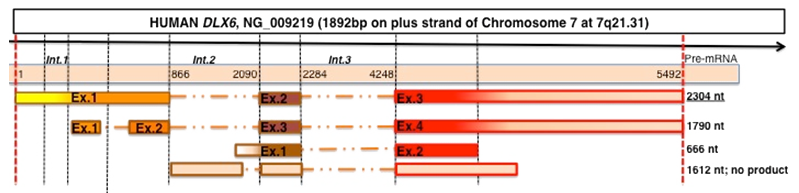
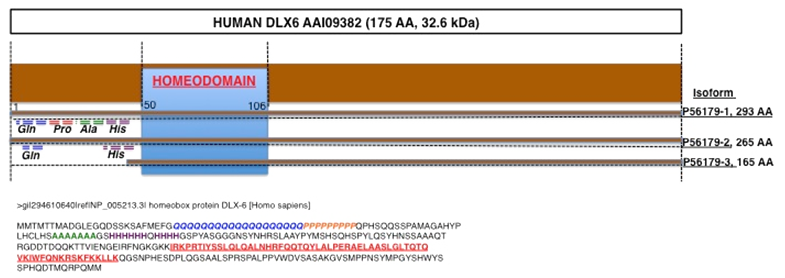
DLX6 sequence analysis of one sporadic SHFM patient (Ferro et al., 2001) has led to the discovery of a longer transcript endowing the N-terminus of DLX6 with an unusual dual poly-glutamine/poly-proline stretch, 11-20 CAG/CCG repeat long, which has been found to be conserved in mouse (Pfeffer et al., 2001; see further "trinucleotide repeats"). The functional consequences of these expansions upon DLX6 activity remain to be determined.
Proteins
Description
Function
Of note, DLX6 encodes for one long isoform endowed with a contiguous series of residue stretches including glutamine, proline, alanine and histidine (see Figure 3).
Homology
Implicated in
DLX6 along with DLX5 is a direct MYC oncogene inducer, responsible for neoplastic initiation in many cancers, including lymphoma and lung cancers (Xu and Testa, 2009).
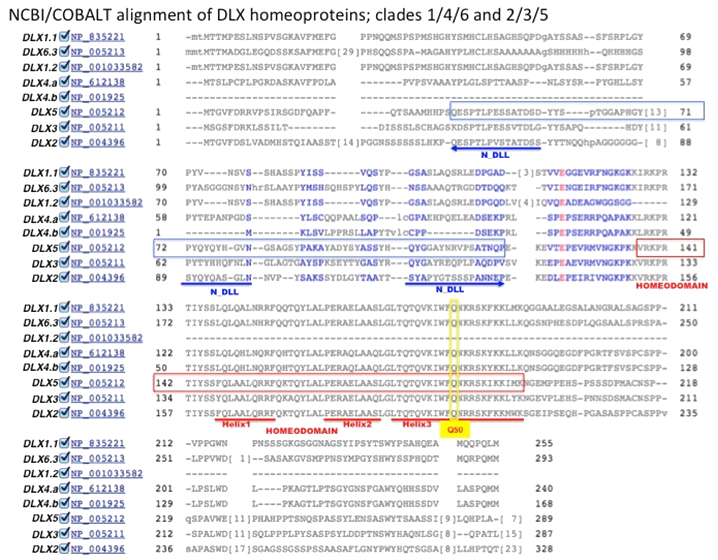
Split hand-foot malformation (SHFM) type 1 with sensory-neural hearing loss (SHFM1D; MIM:220600). This malformative syndrome affects hands and feet alike, resulting in moderate to severe median ray deficiency with syndactily. Among the described six non-syndromic SHFM loci, one spans the DLX5/DLX6 bigenic cluster (Scherer et al., 1994; Crackower et al., 1996). Numerous reported mutations spare DLX5 or DLX6 open reading frames, suggesting it may rather be their common regulatory elements which is impacted (Robledo et al., 2002 ; Lo Iacono et al., 2008). However recently, two rare familial cases of SHFM1 have been demonstrated to result, with highest probability, from intragenic missense mutations of two critical glutamine residues in the third helix of the DLX5 homeodomain (Q178P reported in Shamseldin et al., 2012; and Q186H characterized in Wang et al., 2014). In the first case, a causal link between defective DLX5/DLX6 expression and the pathogenic mechanism impairing limb development remains to be elucidated. In the second case, the mutated DLX5 has been demonstrated to fail at transactivating its bona fide MYC target. Such an observation is not unexpected as the mutation affects Q50, the most conserved residue of all homeoproteins (see diagram), which numerous biochemical studies have demonstrated to be responsible for the specificity of the DNA recognition at the TAATT homeo-element (for review, Galliot et al., 1999).
Other pathogenetic processes: on a further note, SHFM cases have often been reported to include hearing loss, a trait consistent with a developmental role demonstrated for Dlx5/Dlx6 during ear formation in mouse embryogenesis (Acampora et al., 1999; Merlo et al., 2002; Robledo and Lufkin, 2006; Chatterjee et al., 2010; Frenz et al., 2010). Moreover, both genes are major targets of two regulator genes whose deficiencies are responsible for a related pathogenic condition, the auriculo-condylar syndrome (ACS, Rieder et al., 2012).
Anorectal malformation associated with SHFM has been reported in a family with a missense mutation in the P63 gene, a known direct upstream regulator of DLX5/DLX6 during morphogenesis (Su et al., 2013). Whether DLX5/DLX6 expression is dysregulated in this condition, and whether this trait can be functionaly associated with the phenotype, remains to be elucidated.
i) retinoic acid, a vitamin A derivative found in the RoAccutane ® drug, which prevents the induction of Dlx5/Dlx6 in all animal models investigated (Vieux-Rochas et al., 2007; Vieux-Rochas et al., 2010); this discovery has given strong insight into the aetiology of teratologic impact of fetal exposure to RoAccutane medication in man. Analyses of retinoic acid-induced embryopathy in mouse neurulas have demonstrated that retinoic acid exposure prevents proper induction of both Dlx5 and Dlx6 by endothelin-1 signalling. This disruption has been found to be finely tuned during a surprisingly short timeframe spanning a critical period of neurulation. This exposure creates a functional invalidation of Dlx5/Dlx6-controlled cranio-facial morphogenesis (reviewed in Gitton et al., 2010);
ii) the food contaminant ochratoxin A, a fungal toxin demonstrated to prevent Dlx5 activation in exposed mouse embryos, which later develop craniofacial malformations (Wei and Sulik, 1993; Napoletano et al., 2010). Although a causal link between Dlx5, Dlx6 and the toxin remains to be functionally demonstrated, this observation may account for teratogenesis observed in human embryos maternally exposed to the toxin (Hope and Hope, 2012; Thrasher et al., 2012).
Article Bibliography
| Pubmed ID | Last Year | Title | Authors |
|---|---|---|---|
| 12360280 | 2002 | Deregulated homeobox gene expression in cancer: cause or consequence? | Abate-Shen C et al |
| 10433909 | 1999 | Craniofacial, vestibular and bone defects in mice lacking the Distal-less-related gene Dlx5. | Acampora D et al |
| 24089468 | 2013 | Evf2 (Dlx6as) lncRNA regulates ultraconserved enhancer methylation and the differential transcriptional control of adjacent genes. | Berghoff EG et al |
| 21505076 | 2011 | Allelic reduction of Dlx5 and Dlx6 results in early follicular depletion: a new mouse model of primary ovarian insufficiency. | Bouhali K et al |
| 22428046 | 2012 | Genome-wide linkage in a highly consanguineous pedigree reveals two novel loci on chromosome 7 for non-syndromic familial Premature Ovarian Failure. | Caburet S et al |
| 21068835 | 2010 | Dysfunction in GABA signalling mediates autism-like stereotypies and Rett syndrome phenotypes. | Chao HT et al |
| 11711438 | 2001 | Role of Dlx6 in regulation of an endothelin-1-dependent, dHAND branchial arch enhancer. | Charité J et al |
| 20637105 | 2010 | A symphony of inner ear developmental control genes. | Chatterjee S et al |
| 8733122 | 1996 | Characterization of the split hand/split foot malformation locus SHFM1 at 7q21.3-q22.1 and analysis of a candidate gene for its expression during limb development. | Crackower MA et al |
| 16705037 | 2006 | The Evf-2 noncoding RNA is transcribed from the Dlx-5/6 ultraconserved region and functions as a Dlx-2 transcriptional coactivator. | Feng J et al |
| 11719259 | 2001 | Are there CAG repeat expansion-related disorders outside the central nervous system? | Ferro P et al |
| 21108385 | 2010 | Retinoid signaling in inner ear development: A "Goldilocks" phenomenon. | Frenz DA et al |
| 10079362 | 1999 | Evolution of homeobox genes: Q50 Paired-like genes founded the Paired class. | Galliot B et al |
| 20083217 | 2010 | Evolving maps in craniofacial development. | Gitton Y et al |
| 22253638 | 2012 | A review of the diagnosis and treatment of Ochratoxin A inhalational exposure associated with human illness and kidney disease including focal segmental glomerulosclerosis. | Hope JH et al |
| 15608638 | 2005 | Loss of silent-chromatin looping and impaired imprinting of DLX5 in Rett syndrome. | Horike S et al |
| 16688724 | 2006 | Dlx homeobox gene control of mammalian limb and craniofacial development. | Kraus P et al |
| 17965611 | 2007 | The Odyssey of MeCP2 and parental imprinting. | LaSalle JM et al |
| 24459211 | 2014 | Next generation sequencing of chromosomal rearrangements in patients with split-hand/split-foot malformation provides evidence for DYNC1I1 exonic enhancers of DLX5/6 expression in humans. | Lango Allen H et al |
| 23348913 | 2013 | Novel alterations in the epigenetic signature of MeCP2-targeted promoters in lymphocytes of Rett syndrome patients. | Lilja T et al |
| 18326838 | 2008 | Regulation of Dlx5 and Dlx6 gene expression by p63 is involved in EEC and SHFM congenital limb defects. | Lo Iacono N et al |
| 12142028 | 2002 | The Dlx5 homeobox gene is essential for vestibular morphogenesis in the mouse embryo through a BMP4-mediated pathway. | Merlo GR et al |
| 18537997 | 2008 | DLX5 expression is monoallelic and Dlx5 is up-regulated in the Mecp2-null frontal cortex. | Miyano M et al |
| 21108812 | 2010 | Mutually exclusive expression of DLX2 and DLX5/6 is associated with the metastatic potential of the human breast cancer cell line MDA-MB-231. | Morini M et al |
| 20036863 | 2010 | Ochratoxin A induces craniofacial malformation in mice acting on Dlx5 gene expression. | Napoletano M et al |
| 18276760 | 2008 | Positive regulation of steroidogenic acute regulatory protein gene expression through the interaction between Dlx and GATA-4 for testicular steroidogenesis. | Nishida H et al |
| 11351265 | 2001 | The coding region of the human DLX6 gene contains a polymorphic CAG/CCG repeat. | Pfeffer U et al |
| 16530701 | 2006 | Molecular subclasses of high-grade glioma predict prognosis, delineate a pattern of disease progression, and resemble stages in neurogenesis. | Phillips HS et al |
| 24099772 | 2013 | Mesenchymal stem cells from osteoporotic patients feature impaired signal transduction but sustained osteoinduction in response to BMP-2 stimulation. | Prall WC et al |
| 22560091 | 2012 | A human homeotic transformation resulting from mutations in PLCB4 and GNAI3 causes auriculocondylar syndrome. | Rieder MJ et al |
| 16900517 | 2006 | Dlx5 and Dlx6 homeobox genes are required for specification of the mammalian vestibular apparatus. | Robledo RF et al |
| 19415689 | 2009 | Increased bone resorption and osteopenia in Dlx5 heterozygous mice. | Samee N et al |
| 17725487 | 2007 | Role of DLX regulatory proteins in osteogenesis and chondrogenesis. | Samee N et al |
| 7987313 | 1994 | Physical mapping of the split hand/split foot locus on chromosome 7 and implication in syndromic ectrodactyly. | Scherer SW et al |
| 17701895 | 2007 | DLX5 and DLX6 expression is biallelic and not modulated by MeCP2 deficiency. | Schüle B et al |
| 22121204 | 2012 | Identification of a novel DLX5 mutation in a family with autosomal recessive split hand and foot malformation. | Shamseldin HE et al |
| 23736768 | 2013 | Anorectal malformation associated with a mutation in the P63 gene in a family with split hand-foot malformation. | Su P et al |
| 17878916 | 2008 | Abnormal urethra formation in mouse models of split-hand/split-foot malformation type 1 and type 4. | Suzuki K et al |
| 22220187 | 2012 | A water-damaged home and health of occupants: a case study. | Thrasher JD et al |
| 21086490 | 2010 | Irreversible effects of retinoic acid pulse on Xenopus jaw morphogenesis: new insight into cranial neural crest specification. | Vieux-Rochas M et al |
| 24496061 | 2014 | Exome sequencing reveals a heterozygous DLX5 mutation in a Chinese family with autosomal-dominant split-hand/foot malformation. | Wang X et al |
| 8279484 | 1993 | Pathogenesis of craniofacial and body wall malformations induced by ochratoxin A in mice. | Wei X et al |
| 19497851 | 2009 | DLX5 (distal-less homeobox 5) promotes tumor cell proliferation by transcriptionally regulating MYC. | Xu J et al |
| 10632600 | 2000 | A highly conserved enhancer in the Dlx5/Dlx6 intergenic region is the site of cross-regulatory interactions between Dlx genes in the embryonic forebrain. | Zerucha T et al |
Other Information
Locus ID:
NCBI: 1750
MIM: 600030
HGNC: 2919
Ensembl: ENSG00000006377
Variants:
dbSNP: 1750
ClinVar: 1750
TCGA: ENSG00000006377
COSMIC: DLX6
RNA/Proteins
| Gene ID | Transcript ID | Uniprot |
|---|---|---|
| ENSG00000006377 | ENST00000518156 | P56179 |
| ENSG00000006377 | ENST00000555308 | G3V471 |
Expression (GTEx)
Protein levels (Protein atlas)
References
| Pubmed ID | Year | Title | Citations |
|---|---|---|---|
| 33215805 | 2022 | DLX6 promotes cell proliferation and survival in oral squamous cell carcinoma. | 6 |
| 33215805 | 2022 | DLX6 promotes cell proliferation and survival in oral squamous cell carcinoma. | 6 |
| 32239379 | 2021 | DLX6 Antisense RNA 1 Modulates Glucose Metabolism and Cell Growth in Gastric Cancer by Targeting microRNA-4290. | 17 |
| 34508305 | 2021 | Research progress of DLX6-AS1 in human cancers. | 4 |
| 32239379 | 2021 | DLX6 Antisense RNA 1 Modulates Glucose Metabolism and Cell Growth in Gastric Cancer by Targeting microRNA-4290. | 17 |
| 34508305 | 2021 | Research progress of DLX6-AS1 in human cancers. | 4 |
| 32951317 | 2020 | Long non-coding RNA DLX6-AS1 mediates proliferation, invasion and apoptosis of endometrial cancer cells by recruiting p300/E2F1 in DLX6 promoter region. | 13 |
| 32951317 | 2020 | Long non-coding RNA DLX6-AS1 mediates proliferation, invasion and apoptosis of endometrial cancer cells by recruiting p300/E2F1 in DLX6 promoter region. | 13 |
| 30535431 | 2019 | Long non‑coding RNA DLX6‑AS1 promotes proliferation by acting as a ceRNA targeting miR‑199a in cervical cancer. | 11 |
| 30551440 | 2019 | Knockdown of lncRNA DLX6-AS1 inhibits cell proliferation, migration and invasion while promotes apoptosis by downregulating PRR11 expression and upregulating miR-144 in non-small cell lung cancer. | 33 |
| 31646562 | 2019 | The up-regulated lncRNA DLX6-AS1 in colorectal cancer promotes cell proliferation, invasion and migration via modulating PI3K/AKT/mTOR pathway. | 20 |
| 30535431 | 2019 | Long non‑coding RNA DLX6‑AS1 promotes proliferation by acting as a ceRNA targeting miR‑199a in cervical cancer. | 11 |
| 30551440 | 2019 | Knockdown of lncRNA DLX6-AS1 inhibits cell proliferation, migration and invasion while promotes apoptosis by downregulating PRR11 expression and upregulating miR-144 in non-small cell lung cancer. | 33 |
| 31646562 | 2019 | The up-regulated lncRNA DLX6-AS1 in colorectal cancer promotes cell proliferation, invasion and migration via modulating PI3K/AKT/mTOR pathway. | 20 |
| 29145165 | 2017 | Long non-coding RNA DLX6-AS1 aggravates hepatocellular carcinoma carcinogenesis by modulating miR-203a/MMP-2 pathway. | 36 |
Citation
Yorick Gitton ; Giovanni Levi
DLX6 (distal-less homeobox 6)
Atlas Genet Cytogenet Oncol Haematol. 2014-03-01
Online version: http://atlasgeneticsoncology.org/gene/52195/dlx6-(distal-less-homeobox-6)
