ACVRL1 (activin A receptor type II-like 1)
2014-03-01 Federica Ornati , Luca Vecchia , Claudia Scotti , Sara Plumitallo , Carla Olivieri AffiliationDept of Molecular Medicine, Unit of General Biology, Medical Genetics, University of Pavia, Italy (FO, SP, CO); Dept of Molecular Medicine, Unit of Immunology, General Pathology, University of Pavia, Italy (LV, CS)
Identity
Abstract
Activin A receptor, type II-like kinase 1 (ALK1 is a serine-threonine kinase) predominantly expressed on endothelial cells surface. Mutations in its ACVRL1 encoding gene (12q11-14) cause type 2 Hereditary Haemorrhagic Telangiectasia (HHT2), an autosomal dominant multisystem vascular dysplasia. Its involvement in cancer neoangiogenesis has lead to the recent development of novel anti-cancer drugs, which are now in clinical trials.
DNA/RNA
Note
Description
Transcription
The promoter region of ACVRL1 (5 proximal region: -1035/+210) was characterized by Garrido-Martin et al., 2010. This region lacks TATA/CAAT boxes but contains a high number of GC-rich Sp1 consensus sites. It also shares different putative regulatory elements with other endothelial-specific genes. These motifs includes: Ets (E26-Transformation-Specific), KLF (Krüppel-Like Factor), NFkB (Nuclear Factor kappa-light-chain-enhancer of activated B cells), E2F (Elongation Factor 2), one Smad binding element (SBE), RXR (Retinoid X Receptor) and HIF (Hypoxia Inducible Factor). Moreover, the authors demonstrated that methylation status of CpG islands modulates Sp1 transcription of ACVRL1 in endothelial cells.
In 2013, it has been demonstrated that ubiquitin E3 ligase, EDD, can down-regulate ACVRL1 expression in HeLa and HUVEC cells (Chien et al., 2013).
Proteins
Description
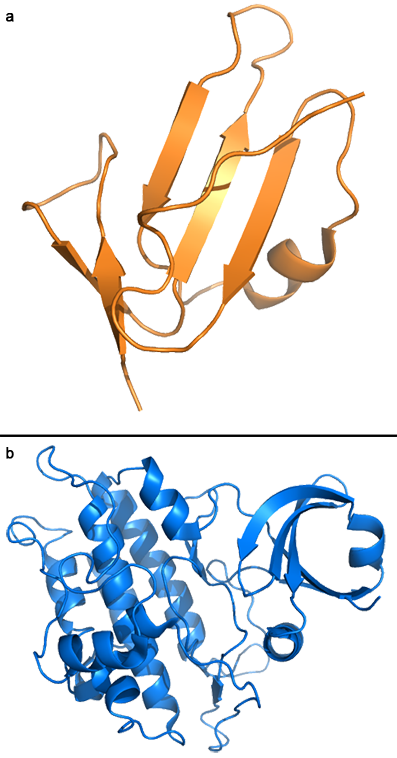
The crystal structure of ALK1 ectodomain (Figure 1a) and of the intracellular kinase domain (Figure 1b) have been recently determined (PDB ID: 4FAO and 3MY0, respectively) (Townson et al., 2012).
Like all type I and type II receptors, ALK1 shows a general fold resembling a class of neurotoxins known as three-finger toxins and hence called "three-finger toxin fold". This fold is comprised from β-strands stabilised by disulphide bonds formed by conserved Cys residues. Three pairs of anti-parallel β-strands are curved to generate a concave surface. Despite the common architecture and the cluster of conserved Cys residues, very little sequence identity and no functional overlap exist between the two types of receptors.
BMPs consist of a Cys knot characterised by three pairs of highly conserved disulphide bonds in which one traverses through a ring formed by the other 2. This fold can be described as a hand with a concave palm side and two parallel β-sheet forming 4 fingers, with each β-strand being likened to a finger. Finger 2 leads to a helix "wrist" region. In the dimeric ligand the 4 fingers extend from the Cys core of the protein like butterfly wings. Binding of type I receptors occurs near the α-helix on the concave side at the junction between the two subunits (Kirsch et al., 2000), whereas binding to type II receptors happens on the convex side of the hand near the "fingertips" (Greenwald et al., 2003; Thompson et al., 2003).
Expression
Function
On the other hand, MESEC (mouse embryonic- stem-cell-derived endothelial cells) and MEEC (mouse embryonic endothelial cells) cells are stimulated to proliferate by ALK1 activation and BMP9 stimulates angiogenesis in a matrigel plug assay and in a tumour model in vivo. Also, cancer cells produced tumours whose size and vascularization were reduced by 50% in ALK1+/- heterozygous mice compared with tumours implanted in wild-type littermates. In addition, a soluble ALK1-Fc fusion protein known as Dalantercept (ACE-041) showed an anti-angiogenic effect by reducing vascular density and perfusion of the tumour burden in model mice of endocrine pancreatic tumorigenesis and mice bearing 786-0 and A498 human renal cell carcinoma (Wang et al., 2012).
This contradictory findings may be explained by the site- and context-dependent balance of the synergic proangiogenic effects of BMP-9 and the lower affinity ALK1 ligand TGF-β, but the assumption has to be confirmed.
Recent studies also report a role for ALK1 in cancer independent from its effects on angiogenesis, enhancing the cell migration and invasion potential in cancers like squamous cell carcinomas of the head and the neck or haepatocarcinomas (Hu-Lowe et al., 2011; Chien et al., 2013; Sun et al., 2013).
ALK1 signalling through SMAD 1/SMAD 5/SMAD 8 seems to induce chondrocytes hypertrophy in cartilages by an effect mediated by the interaction with the canonical Wnt signaling (van den Bosch et al., 2014).
Again, in other kind of cancers ALK1 activation seems to be protective, as assessed for instance in in vitro models of pancreatic cancers (Ungefroren et al., 2007).
Homology
Mutations
Germinal
Somatic
Implicated in
In a study (Hu-Lowe et al., 2011) performed on 3000 human tumour specimens representing more than 100 tumour types, ALK1 resulted particularly expressed in the vasculature of prostate cancers, malignant melanomas of the skin, follicular cancers of the tyroid, renal clear cell cancers and endometrioid ovarian cancers.
A reduced expression of ACVRL1 by qRT-PCR and immunohistochemistry was demonstrated in nasopharingeal carcinomas by Zhang et al., 2012.
An increased ALK1 expression in papillary thyroid carcinomas with bone formation was increased if compared to that in normal thyroid tissue and tumors without bone formation, as assessed using immunohistochemistry and quantitative real-time polymerase chain reaction (Na et al., 2013).
In Head and Neck Squamous Cell Carcinomas (HNSCC), using immunohistochemistry and qRT-PCR, Chien et al. found a correlation between a high ACVRL1 expression and an advanced T classification, a positive N classification, an advanced TNM stage, the presence of lymphovascular invasion, an extracapsular spread of lymph node metastasis and a poorer prognosis (Chien et al., 2013).
As a therapeutic target, anti-ALK1 drugs (both in the form of an Fc-fusion protein acting as a soluble receptor for BMP9 and of an anti-ALK1 monoclonal antibody) are under investigation in phase I and phase II clinical trials in a wide range of solid tumours (Vecchia et al., 2013). Phase II studies clinical trials encompass particularly squamous cell carcinoma of the head and neck, endometrial cancer, epithelial ovarian cancer, fallopian tube cancer and primary peritoneal carcinoma for ACE-041 (also known as Dalantercept, the Fc-receptor fusion protein). Dalantercept displayed promising antitumour activity particularly in patients with advanced refractory cancer (Bendell et al., 2014). PF-03446962 (the anti-ALK1 monoclonal antibody), is up to now studied in phase II clinical trials particularly in malignant mesoteliomas of the pleura and transitional cell carcinomas of the bladder. A recent study showed that PF-03446962 has no activity as a single drug in refractory urothelial cancer as is thus suggested, for this kind of cancer, only as a combination therapy with other agents against the VEGF receptor axis (Necchi et al., 2014). Both Dalantercept and PF-03446962 are currently under investigation in phase II trials particularly in advanced and refractory hepatocarcinomas.
As assessed by Hosman et al., 2013, mutations in ACVRL1 gene, as the ones observed in HHT2 patients, seem to reduce the prevalence of some types of solid tumours and account for the unexpected good life expectancy of HHT patients older than 60 years of age. Although it is important to take with care the results of the study due to the methodology used for the assessment (for the statistical and logistic difficulties to perform a longitudinal study in a rare disease, the authors used a questionnaire, inevitably biased), HHT patients older than 60 presented an apparent reduction in lung, liver and colorectal cancer compared to controls. This could potentially be related to the ALK1 haploinsuffiency present in ALK1 HHT mutations, opposite to the overexpression usually showed in cancers. On the other hand, colorectal cancer was instead more frequent in younger HHT patients, particularly in the subgroup with SMAD4 mutations and juvenile polyposis.
HHT arises from heterozygous mutations in ENG (HHT1, OMIM #187300) coding for ENDOGLIN (ENG) (McAllister et al., 1994) and ACVRL1 (HHT2, OMIM #600376) coding for ALK1 (Johnson et al., 1996), Type III and Type I TGF-β receptors, respectively. Certain HHT2 patients develop a Pulmonary Artery Hypertension (PAH)-like syndrome, suggesting that ACVRL1 mutations are also likely to be involved in PAH (Trembath et al., 2001; Olivieri et al., 2006). A subset of patients with juvenile polyposis, carrying mutations in SMAD4/MADH4 (JPHT, OMIM #175050), can also develop HHT (Gallione et al., 2004). Recently, mutations in BMP9 were reported in three unrelated families affected by a vascular-anomaly syndrome presenting with phenotypic overlap with HHT (Wooderchak-Donahue et al., 2013). Additional as-yet-unknown HHT genes have been suggested by linkage analysis in two affected kindred on chromosome 5 and on chromosome 7 (Cole et al., 2005; Bayrak-Toydemir et al., 2006). Molecular genetic testing of the three known genes detects mutations in approximately 85% of patients. As reported above, the mutated genes encode proteins that mediate signaling by TGF-β family.
More than 375 ACVRL1 variants are present in the international HHT mutation database and more than 185 are demonstrated to be pathogenic for HHT.
TGF-β ligands regulate angiogenesis through their actions either on endothelial cells (EC) and/or mural cell, demonstrating that they play important roles in both activation (via ALK1) and resolution (via ALK5) phases of angiogenesis. It has been reported that BMP9, rather than BMP10, might be the specific ALK1 ligand and activator of the Smad1/5/8 signaling pathway in endothelial cells and that they are potent inhibitors of EC migration and growth (David et al., 2007). Previous studies have suggested the synergy between Notch and TGF-β, and that Notch signaling modulates the balance between TGF-β/ALK1 and TGF-β/ALK5 signaling pathways (Fu et al., 2009).
In the second World Symposium held in Evian, France, in 1998, was proposed a clinical classification for pulmonary hypertension. The first category was defined PAH and includes two subgroups, the first incorporates both the idiopathic form (IPAH) that the inherited (HPAH) of the disease. The second subgroup includes a number of conditions associated with various diseases (APAH), including connective tissue diseases, human immunodeficiency virus infection, congenital heart disease, and portal hypertension (Simonneau et al., 2004; Machado et al., 2009).
Heterozygous mutations in the transforming growth factor-β receptor (TGF-β receptor) super family have been genetically linked to PAH and likely play a causative role in the development of disease. Particularly, mutations in the bone morphogenetic factor receptor type 2 (BMPR2) gene account for approximately 70% of all familial pedigrees of PAH (HPAH) and 10-30% of idiopathic PAH cases (IPAH) (Chan and Loscalzo, 2008; Machado et al., 2009).
Much less commonly (5%) two other members of the TGF-β superfamily are also recognized as uncommon causes of PAH: activine A receptor type II-like kinase 1 (ALK1) and, at significant lower frequency, endoglin (ENG) (Harrison et al., 2003). Heterozygous mutations of these genes cause the autosomal dominant vascular disorder hereditary haemorrhagic teleangiectasia (HHT) (Shovlin, 2010). In fact, in a small proportion of HHT patients, was observed a form of pulmonary arterial hypertension that is associated with a model of precapillary pulmonary hypertension that is histopathologically indistinguishable from idiopathic form of PAH. Since the publication by Trembath et al. in 2001 (Trembath et al., 2001), who first reported patients with a mutation in the gene ACVRL1 with clinical features of both PAH and HHT, subsequently, have been recognized several other mutations in the ALK1 gene that seem to predispose patients with HHT development of PAH. This observation was further confirmed by other studies (Olivieri et al., 2006) and extensively discussed by Machado et al. (Machado et al., 2009). The exact prevalence of PAH in the HHT population has not been systematically evaluated, but most authors agree that it is a rare complication found in less than 1% of HHT patients (Cottin et al., 2007). In rare cases, ACVRL1 mutations have been reported to cause IPAH or HPAH without HHT (Harrison et al., 2003).
Both ALK1 and BMPR2 belong to the family of TGF-β receptors, they have different specific ligands but share a common intracellular pathway based on the activation of the SMAD proteins 1/5/8 (Faughnan et al., 2009). The formation of an heteromeric complex with BMPR2 and ALK1 could at least in part explain why any dysregulation of this pathway may promote pulmonary endothelial and/or smooth muscle cell dysfunction and proliferative characteristic of PAH, in subjects carrying mutation either in BMPR2 or in ACVRL1 gene.
Mutations identified in several studies on ALK1 associated with PAH are all likely to disrupt activation of this intracellular pathway and the majority of these comprise missense mutations. Particularly, mutations in exon 10 of ACVRL1 are relevant because they occur in functional domains of the receptor within a conserved carboxyl-terminal region of ALK1 (the non-activating non-down regulating box) NANDOR BOX (Faughnan et al., 2009; Machado et al., 2009). Of note, the NANDOR BOX, located from codon 479 to 489, is necessary for regulation of TGF-β signaling, accordingly any alteration may have effects on TGF-β-induced receptor signaling (Girerd et al., 2010).
Moreover, recent studies in animal models have shown that Alk1 heterozygous mice spontaneously develop signs of pulmonary hypertension in the early months of life, and with increasing age show more occluded vessels and pulmonary vascular remodeling, indicating a progression of the disease. These mice had also higher ROS levels in adult lungs contributing to PAH development compared to control mice. Whereas Bmpr2 heterozygous mouse model requires additional factors, such as hypoxia and serotonin or inflammation, to elicit a pulmonary hypertensive phenotype (Jerkic et al., 2011).
Finally, Girerd B. et al. hypothesized that mutated ACVRL1 status might be associated with distinct PAH phenotypes, as compared with patients PAH without ALK1 mutations. The authors analyzed clinical, functional characteristic, hemodynamic features and outcomes for patients with PAH carrying ACVRL1 mutation. Of notice, these patients were significantly younger at diagnosis (P
Anyway, ALK1 alterations, opposite to those in ALK5, seemed not to have a significant impact on survival. Furthermore, the prevalence of haematological cancers in HHT patients as assessed by Hosman et al., 2013 showed no difference compared to controls.
Article Bibliography
| Pubmed ID | Last Year | Title | Authors |
|---|---|---|---|
| 16969873 | 2006 | A fourth locus for hereditary hemorrhagic telangiectasia maps to chromosome 7. | Bayrak-Toydemir P et al |
| 24173543 | 2014 | Safety, pharmacokinetics, pharmacodynamics, and antitumor activity of dalantercept, an activin receptor-like kinase-1 ligand trap, in patients with advanced cancer. | Bendell JC et al |
| 17950310 | 2008 | Pathogenic mechanisms of pulmonary arterial hypertension. | Chan SY et al |
| 23447486 | 2013 | The expression of activin receptor-like kinase 1 among patients with head and neck cancer. | Chien CY et al |
| 15994879 | 2005 | A new locus for hereditary haemorrhagic telangiectasia (HHT3) maps to chromosome 5. | Cole SG et al |
| 17641482 | 2007 | Pulmonary vascular manifestations of hereditary hemorrhagic telangiectasia (rendu-osler disease). | Cottin V et al |
| 10323406 | 1999 | Mutational analysis of activin/transforming growth factor-beta type I and type II receptor kinases in human pituitary tumors. | D'Abronzo FH et al |
| 17068149 | 2007 | Identification of BMP9 and BMP10 as functional activators of the orphan activin receptor-like kinase 1 (ALK1) in endothelial cells. | David L et al |
| 21651515 | 2012 | ACVRL1 germinal mosaic with two mutant alleles in hereditary hemorrhagic telangiectasia associated with pulmonary arterial hypertension. | Eyries M et al |
| 19553198 | 2011 | International guidelines for the diagnosis and management of hereditary haemorrhagic telangiectasia. | Faughnan ME et al |
| 19473993 | 2009 | Differential regulation of transforming growth factor beta signaling pathways by Notch in human endothelial cells. | Fu Y et al |
| 15031030 | 2004 | A combined syndrome of juvenile polyposis and hereditary haemorrhagic telangiectasia associated with mutations in MADH4 (SMAD4). | Gallione CJ et al |
| 20587022 | 2010 | Characterization of the human Activin-A receptor type II-like kinase 1 (ACVRL1) promoter and its regulation by Sp1. | Garrido-Martin EM et al |
| 20056902 | 2010 | Clinical outcomes of pulmonary arterial hypertension in patients carrying an ACVRL1 (ALK1) mutation. | Girerd B et al |
| 19337313 | 2009 | Hereditary haemorrhagic telangiectasia: a clinical and scientific review. | Govani FS et al |
| 12667445 | 2003 | The BMP7/ActRII extracellular domain complex provides new insights into the cooperative nature of receptor assembly. | Greenwald J et al |
| 14684682 | 2003 | Molecular and functional analysis identifies ALK-1 as the predominant cause of pulmonary hypertension related to hereditary haemorrhagic telangiectasia. | Harrison RE et al |
| 24354965 | 2013 | Specific cancer rates may differ in patients with hereditary haemorrhagic telangiectasia compared to controls. | Hosman AE et al |
| 21212415 | 2011 | Targeting activin receptor-like kinase 1 inhibits angiogenesis and tumorigenesis through a mechanism of action complementary to anti-VEGF therapies. | Hu-Lowe DD et al |
| 21859819 | 2011 | Pulmonary hypertension in adult Alk1 heterozygous mice due to oxidative stress. | Jerkic M et al |
| 8640225 | 1996 | Mutations in the activin receptor-like kinase 1 gene in hereditary haemorrhagic telangiectasia type 2. | Johnson DW et al |
| 10881198 | 2000 | Crystal structure of the BMP-2-BRIA ectodomain complex. | Kirsch T et al |
| 18285823 | 2008 | Hereditary hemorrhagic telangiectasia: evidence for regional founder effects of ACVRL1 mutations in French and Italian patients. | Lesca G et al |
| 17224686 | 2007 | Genotype-phenotype correlations in hereditary hemorrhagic telangiectasia: data from the French-Italian HHT network. | Lesca G et al |
| 19555857 | 2009 | Genetics and genomics of pulmonary arterial hypertension. | Machado RD et al |
| 7894484 | 1994 | Endoglin, a TGF-beta binding protein of endothelial cells, is the gene for hereditary haemorrhagic telangiectasia type 1. | McAllister KA et al |
| 21546842 | 2011 | Hereditary hemorrhagic telangiectasia: an overview of diagnosis, management, and pathogenesis. | McDonald J et al |
| 23177617 | 2013 | Papillary thyroid carcinoma with bone formation. | Na KY et al |
| 24566706 | 2014 | PF-03446962, a fully-human monoclonal antibody against transforming growth-factor β (TGFβ) receptor ALK1, in pre-treated patients with urothelial cancer: an open label, single-group, phase 2 trial. | Necchi A et al |
| 16540754 | 2006 | Echocardiographic screening discloses increased values of pulmonary artery systolic pressure in 9 of 68 unselected patients affected with hereditary hemorrhagic telangiectasia. | Olivieri C et al |
| 21304536 | 2011 | Expression of TGF-β receptor ALK-5 has a negative impact on outcome of patients with acute myeloid leukemia. | Otten J et al |
| 1518020 | 1992 | Hereditary haemorrhagic telangiectasia: a clinical analysis. | Porteous ME et al |
| 23202738 | 2012 | Molecular pathogenesis of pulmonary arterial hypertension. | Rabinovitch M et al |
| 10751092 | 2000 | Diagnostic criteria for hereditary hemorrhagic telangiectasia (Rendu-Osler-Weber syndrome). | Shovlin CL et al |
| 20870325 | 2010 | Hereditary haemorrhagic telangiectasia: pathophysiology, diagnosis and treatment. | Shovlin CL et al |
| 15194173 | 2004 | Clinical classification of pulmonary hypertension. | Simonneau G et al |
| 23474366 | 2013 | NANOG promotes liver cancer cell invasion by inducing epithelial-mesenchymal transition through NODAL/SMAD3 signaling pathway. | Sun C et al |
| 12660162 | 2003 | Structures of an ActRIIB:activin A complex reveal a novel binding mode for TGF-beta ligand:receptor interactions. | Thompson TB et al |
| 22718755 | 2012 | Specificity and structure of a high affinity activin receptor-like kinase 1 (ALK1) signaling complex. | Townson SA et al |
| 11484689 | 2001 | Clinical and molecular genetic features of pulmonary hypertension in patients with hereditary hemorrhagic telangiectasia. | Trembath RC et al |
| 17230504 | 2007 | Antitumor activity of ALK1 in pancreatic carcinoma cells. | Ungefroren H et al |
| 23815578 | 2013 | Activin Receptor-like kinase 1: a novel anti-angiogenesis target from TGF-β family. | Vecchia L et al |
| 12522784 | 2003 | The prevalence and manifestations of hereditary hemorrhagic telangiectasia in the Afro-Caribbean population of the Netherlands Antilles: a family screening. | Westermann CJ et al |
| 23972370 | 2013 | BMP9 mutations cause a vascular-anomaly syndrome with phenotypic overlap with hereditary hemorrhagic telangiectasia. | Wooderchak-Donahue WL et al |
| 22391627 | 2012 | Evaluation of the prognostic value of TGF-β superfamily type I receptor and TGF-β type II receptor expression in nasopharyngeal carcinoma using high-throughput tissue microarrays. | Zhang W et al |
| 8006002 | 1994 | Identification of type I receptors for osteogenic protein-1 and bone morphogenetic protein-4. | ten Dijke P et al |
| 24463008 | 2014 | Canonical Wnt signaling skews TGF-β signaling in chondrocytes towards signaling via ALK1 and Smad 1/5/8. | van den Bosch MH et al |
Other Information
Locus ID:
NCBI: 94
MIM: 601284
HGNC: 175
Ensembl: ENSG00000139567
Variants:
dbSNP: 94
ClinVar: 94
TCGA: ENSG00000139567
COSMIC: ACVRL1
RNA/Proteins
Expression (GTEx)
Protein levels (Protein atlas)
References
| Pubmed ID | Year | Title | Citations |
|---|---|---|---|
| 38294582 | 2024 | Impact of heterozygous ALK1 mutations on the transcriptomic response to BMP9 and BMP10 in endothelial cells from hereditary hemorrhagic telangiectasia and pulmonary arterial hypertension donors. | 0 |
| 38294582 | 2024 | Impact of heterozygous ALK1 mutations on the transcriptomic response to BMP9 and BMP10 in endothelial cells from hereditary hemorrhagic telangiectasia and pulmonary arterial hypertension donors. | 0 |
| 37743483 | 2023 | ACVRL1 drives resistance to multitarget tyrosine kinase inhibitors in colorectal cancer by promoting USP15-mediated GPX2 stabilization. | 0 |
| 37787089 | 2023 | Endothelial cell SMAD6 balances Alk1 function to regulate adherens junctions and hepatic vascular development. | 2 |
| 37743483 | 2023 | ACVRL1 drives resistance to multitarget tyrosine kinase inhibitors in colorectal cancer by promoting USP15-mediated GPX2 stabilization. | 0 |
| 37787089 | 2023 | Endothelial cell SMAD6 balances Alk1 function to regulate adherens junctions and hepatic vascular development. | 2 |
| 35620871 | 2022 | Hereditary hemorrhagic telangiectasia: First demonstration of a founder effect in Italy; the ACVRL1 c.289_294del variant originated in the country of Bergamo 200 years ago. | 2 |
| 35620871 | 2022 | Hereditary hemorrhagic telangiectasia: First demonstration of a founder effect in Italy; the ACVRL1 c.289_294del variant originated in the country of Bergamo 200 years ago. | 2 |
| 33157202 | 2021 | ALK-1 to ALK-5 ratio dictated by the Akt1-β-catenin pathway regulates TGFβ-induced endothelial-to-mesenchymal transition. | 3 |
| 33566682 | 2021 | ALK1 regulates the internalization of endoglin and the type III TGF-β receptor. | 6 |
| 33768677 | 2021 | Clinical and molecular characterization of patients with hereditary hemorrhagic telangiectasia: Experience from an HHT Center of Excellence. | 1 |
| 34157307 | 2021 | OTULIN allies with LUBAC to govern angiogenesis by editing ALK1 linear polyubiquitin. | 11 |
| 34702814 | 2021 | Clonal hematopoiesis with JAK2V617F promotes pulmonary hypertension with ALK1 upregulation in lung neutrophils. | 21 |
| 33157202 | 2021 | ALK-1 to ALK-5 ratio dictated by the Akt1-β-catenin pathway regulates TGFβ-induced endothelial-to-mesenchymal transition. | 3 |
| 33566682 | 2021 | ALK1 regulates the internalization of endoglin and the type III TGF-β receptor. | 6 |
Citation
Federica Ornati ; Luca Vecchia ; Claudia Scotti ; Sara Plumitallo ; Carla Olivieri
ACVRL1 (activin A receptor type II-like 1)
Atlas Genet Cytogenet Oncol Haematol. 2014-03-01
Online version: http://atlasgeneticsoncology.org/gene/569/acvrl1-(activin-a-receptor-type-ii-like-1)
