Identity
HGNC
LOCATION
10q22.1; on reverse strand
LOCUSID
ALIAS
TTC18
FUSION GENES
Abstract
Review on CFAP70, a poorly known gene and protein, with data on DNA, on the protein encoded, and where the gene is implicated.
DNA/RNA
Transcription
Various transcripts (see below).
Proteins
Description
Various isoforms have been described:
According to Vega: 3 protein coding transcripts: CFAP70-001: 3691 base pairs (bp), coding for a protein of 590 amino acids (aa); CFAP70-006: 1710bp, 498 aa; CFAP70-002: 1403bp, 361 aa
According to Uniprot: Isoform 1 (Q5T0N1-1), canonical sequence: 1,121 aa, 125,721 Da; Isoform 2 (Q5T0N1-2): 1,091 aa, 122,269 Da; Isoform 3 (Q5T0N1-3): 119 aa, 12,999 Da; Isoform 4 (Q5T0N1-6): 195 aa, 22,338 Da; Isoform 5 (Q5T0N1-7): 225 aa, 25,790 Da.
According to Ensembl: Protein ENSP00000310829: the transcript has 28 exons, 3703bp, 1121 aa, 33 domains; Protein ENSP00000347781: the transcript has 28 exons, 3691bp, 590 aa, 32 domains; Protein ENSP00000409527; the transcript has 12 exons, 1710bp, 498 aa, 23 domains; Protein ENSP00000343650: the transcript has 12 exons, 1403bp, 361 aa, 13 domains; Protein ENSP00000378334; the transcript has 9 exons, 1222bp, 179 aa, 13 domains.
Domains in the canonical sequence (Q5T0N1-1 in UniProt): 1121 aa.
there are 8 tetratricopeptide repeats (TRP): TPR 1, aa 635-668, TPR 2: aa 669-702, TPR 3 : aa 704-736, TPR 4: aa 929-962, TPR 5: aa 963-996, TPR 6: aa 1000-1033, TPR 7: aa 1035-1066 and TPR 8: aa 1068-1100. The TPR sequence contains about 34 amino acids, with a consensus sequence of small and large hydrophobic amino acids; small hydrophobic amino acids are often found at positions 8, 20, and 27, and large ones at positions 4, 7, and 24. Three-dimensional structure shows that the TPR motif contains two antiparallel α-helical subdomains (termed helix A and helix B), equivalent in length. TPR adopts a helix-turn-helix arrangement. They self-associate via a "knobs and holes" mechanism (Das et al., 1998; DAndrea and Regan 2003; Cerveny et al., 2013; SMART).
According to Vega: 3 protein coding transcripts: CFAP70-001: 3691 base pairs (bp), coding for a protein of 590 amino acids (aa); CFAP70-006: 1710bp, 498 aa; CFAP70-002: 1403bp, 361 aa
According to Uniprot: Isoform 1 (Q5T0N1-1), canonical sequence: 1,121 aa, 125,721 Da; Isoform 2 (Q5T0N1-2): 1,091 aa, 122,269 Da; Isoform 3 (Q5T0N1-3): 119 aa, 12,999 Da; Isoform 4 (Q5T0N1-6): 195 aa, 22,338 Da; Isoform 5 (Q5T0N1-7): 225 aa, 25,790 Da.
According to Ensembl: Protein ENSP00000310829: the transcript has 28 exons, 3703bp, 1121 aa, 33 domains; Protein ENSP00000347781: the transcript has 28 exons, 3691bp, 590 aa, 32 domains; Protein ENSP00000409527; the transcript has 12 exons, 1710bp, 498 aa, 23 domains; Protein ENSP00000343650: the transcript has 12 exons, 1403bp, 361 aa, 13 domains; Protein ENSP00000378334; the transcript has 9 exons, 1222bp, 179 aa, 13 domains.
Domains in the canonical sequence (Q5T0N1-1 in UniProt): 1121 aa.
there are 8 tetratricopeptide repeats (TRP): TPR 1, aa 635-668, TPR 2: aa 669-702, TPR 3 : aa 704-736, TPR 4: aa 929-962, TPR 5: aa 963-996, TPR 6: aa 1000-1033, TPR 7: aa 1035-1066 and TPR 8: aa 1068-1100. The TPR sequence contains about 34 amino acids, with a consensus sequence of small and large hydrophobic amino acids; small hydrophobic amino acids are often found at positions 8, 20, and 27, and large ones at positions 4, 7, and 24. Three-dimensional structure shows that the TPR motif contains two antiparallel α-helical subdomains (termed helix A and helix B), equivalent in length. TPR adopts a helix-turn-helix arrangement. They self-associate via a "knobs and holes" mechanism (Das et al., 1998; DAndrea and Regan 2003; Cerveny et al., 2013; SMART).
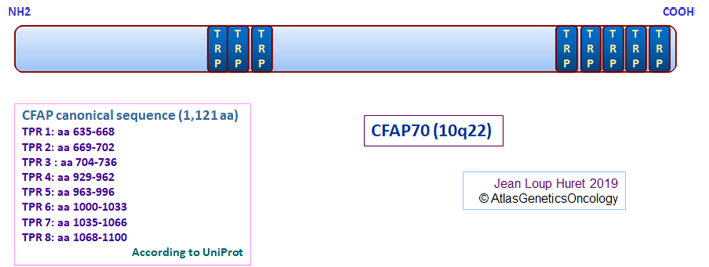
Figure 1 CFAP70 protein and domains.
Expression
CFAP70 is expressed in adrenal gland, bronchus, testis, sperm flagella and in cilia of glandular cells in fallopian tube, and endometrium, according to The Human Protein Atlas.
Localisation
CFAP70 localizes on the epithelial cilia and sperm flagella. It associates tightly to the ciliary axoneme (Shamoto et al., 2018).
Function
Tetratricopeptide repeats are found in at least 149 proteins (PFAM). Tetratricopeptide repeat containing proteins are involved in protein-protein interactions and the assembly of multiprotein complexes, cell cycle, transcription, mitochondrial protein transport, and neurogenesis.
CFAP70 binds to the axoneme of motile cilia and flagella in close proximity to the outer dynein arms and regulates outer dynein arms activity. It is the N-terminus of CFAP70 which localizes at the base of the outer dynein arms and not the tetratricopeptide repeats. Knockdown of CFAP70 causes a reduction in ciliary motility (Shamoto et al., 2018).
CFAP70 binds to the axoneme of motile cilia and flagella in close proximity to the outer dynein arms and regulates outer dynein arms activity. It is the N-terminus of CFAP70 which localizes at the base of the outer dynein arms and not the tetratricopeptide repeats. Knockdown of CFAP70 causes a reduction in ciliary motility (Shamoto et al., 2018).
Implicated in
Top note
Low or high expression of CFAP70 is not a prognostic indicator in any cancer tested (The Human Protein Atlas).
Entity name
Breast adenocarcinoma
Note
Entity name
Uterus corpus adenocarcinoma
Note
The fusion gene P4HA1/CFAP70 (10q22-10q22) has been found in uterus corpus adenocarcinoma (Hu et al. 2018).
Entity name
Lung squamous cell carcinoma
Note
The fusion gene ECD/CFAP70 (10q22-10q22) has been found in lung squamous cell carcinoma (Yoshihara et al. 2015).
Entity name
Thyroid adenocarcinoma
Note
The fusion gene MRPS16/CFAP70 (10q22-10q22) has been found in thyroid adenocarcinoma (Yoshihara et al. 2015).
Article Bibliography
| Pubmed ID | Last Year | Title | Authors |
|---|---|---|---|
| 23264049 | 2013 | Tetratricopeptide repeat motifs in the world of bacterial pathogens: role in virulence mechanisms. | Cerveny L et al |
| 14659697 | 2003 | TPR proteins: the versatile helix. | D'Andrea LD et al |
| 9482716 | 1998 | The structure of the tetratricopeptide repeats of protein phosphatase 5: implications for TPR-mediated protein-protein interactions. | Das AK et al |
| 29617662 | 2018 | Driver Fusions and Their Implications in the Development and Treatment of Human Cancers. | Gao Q et al |
| 29099951 | 2018 | TumorFusions: an integrative resource for cancer-associated transcript fusions. | Hu X et al |
| 25485619 | 2015 | A comprehensive transcriptional portrait of human cancer cell lines. | Klijn C et al |
| 30158508 | 2018 | CFAP70 Is a Novel Axoneme-Binding Protein That Localizes at the Base of the Outer Dynein Arm and Regulates Ciliary Motility. | Shamoto N et al |
| 25500544 | 2015 | The landscape and therapeutic relevance of cancer-associated transcript fusions. | Yoshihara K et al |
Other Information
Locus ID:
NCBI: 118491
MIM: 618661
HGNC: 30726
Ensembl: ENSG00000156042
Variants:
dbSNP: 118491
ClinVar: 118491
TCGA: ENSG00000156042
COSMIC: CFAP70
RNA/Proteins
Expression (GTEx)
Protein levels (Protein atlas)
References
| Pubmed ID | Year | Title | Citations |
|---|---|---|---|
| 31621862 | 2019 | CFAP70 mutations lead to male infertility due to severe astheno-teratozoospermia. A case report. | 25 |
| 31621862 | 2019 | CFAP70 mutations lead to male infertility due to severe astheno-teratozoospermia. A case report. | 25 |
| 16385451 | 2006 | A scan of chromosome 10 identifies a novel locus showing strong association with late-onset Alzheimer disease. | 83 |
| 16385451 | 2006 | A scan of chromosome 10 identifies a novel locus showing strong association with late-onset Alzheimer disease. | 83 |
Citation
Jean Loup Huret
CFAP70 (cilia and flagella associated protein 70)
Atlas Genet Cytogenet Oncol Haematol. 2019-01-01
Online version: http://atlasgeneticsoncology.org/gene/61764/cfap70-(cilia-and-flagella-associated-protein-70)
