t(7;11)(q34;p15) TRB/LMO1
t(11;14)(p15;q11) TRD/LMO1
2002-08-01 Jacques Boyer
Affiliation
1.Laboratoire d hématologie, CH du MANS, France
Clinics and Pathology
Disease
T-cell Acute lymphoblastic leukemia T-ALL
Phenotype stem cell origin
Apparently, this translocation is not restricted to a single maturational stage. Among five cases reported in the litterature: 2 of 4 cases tested coexpressed CD4 and CD8 antigens and 2 cases showed a more immature phenotype like Pro T-ALL: cytCD3+ CD3- CD4- CD8- CD34+
Epidemiology
The t(11 ;14)(p15 ;q11) occurs in less than 1% of patients with T-cell ALL
Cytology
There is limited knowledge about the clinical and biologic characteristics of patients in whom this translocation is present, all of them have childhood T-cell ALL In contrast to cases with the t(11 ;14)(p13 ;q11) only one patient had a markedly elevated leucocyte count at diagnosis.
Prognosis
Remarkably, no patient with this translocation has sustained durable remission.
Cytogenetics
Cytogenetics morphological
This translocation is not to be confused with the t(11 ;14)(p13 ;q11).
Additional anomalies
del(6q), i(17)(q10)
Genes Involved and Proteins
Gene name
LMO1 (LIM domain only 1 (rhombotin 1))
Location
11p15.4
Dna rna description
1214 bp.This gene belongs to the Rhombotin family: RBTN1, RBTN2, RBTN3. Complete characterisation of these genes in man and mouse shows that all three encode cysteine-rich proteins with typical LIM domains. The exon organisation of RBTN1 and RBTN3 are similar, both having an intron, absent from the RBTN2 gene, in the LIM2 encoding region.
Protein description
RBTN1 and RBTN3 derivated proteins have 98% identity in the LIM domain; LMO1derivated protein is a 46kd nuclear protein. Comparison of the sequence of the human and mouse protein LMO1 shows that the main conserved sequence is a tandemly duplicated cystein-rich-region called LIM domain. LIM domain might facilitate protein-protein interaction which modulate transcription via intermolecular competitive binding between LIM domain and certain DNA-binding-transcription factors. The LDB1/NLI is a phosphoprotein and binds to LMO1 in its phophorylated state and essentially all the LMO1 and LDB1 protein in the T cell is part of the complexe. The stem cell leukemia ( SCL) transcription factor is also a partner for LMO1 and LMO2 proteins. RBTN1 and RBTN3 proteins have the same expression pattern in mouse development, since both genes show high expression in the brain, but little lymphoid expression. RBTN2 expression is more ubiquitous.
Gene name
TRA (T cell Receptor Alpha)
Location
14q11.2
Dna rna description
The size of TCR alpha/delta locus is about 1 Mb. The TCR delta variable (V) diversity (D) joining (J) and constant region genes are situated within the TCR alpha locus between the TCR alpha V and the TCR alpha J segments. The TCR delta locus contains three D segments and four J segments, whereas the TCR alpha J regions spans approximately 80 Kb and contains at least 61 segments. The TCR alpha/delta locus is transcribed in a centromer to telomer direction.
Protein description
T-cell receptor
Gene name
TRD (T cell Receptor Delta)
Location
14q11.2
Dna rna description
The size of TCR alpha/delta locus is about 1 Mb. The TCR delta variable (V) diversity (D) joining (J) and constant region genes are situated within the TCR alpha locus between the TCR alpha V and the TCR alpha J segments. The TCR delta locus contains three D segments and four J segments, whereas the TCR alpha J regions spans approximately 80 Kb and contains at least 61 segments. The TCR alpha/delta locus is transcribed in a centromer to telomer direction.
Protein description
T-cell receptor
Result of the Chromosomal Anomaly
Description
The translocation t(11 ;14)(p15 ;q11) occurs at a T-cell receptor joining J delta segment, 12 kb upstream of the constant C delta gene and 98 kb upstream of the C alpha gene at chromosome band 11q11. Rhombotin gene contains oligomers that span the breakpoint region. This breakpoint region possesses a consensus heptamer : it appers to function as a 23-signal and to synapse with a 12-signal on chromosome 14 in the translocation t(11 ;14)(p15 ;q11) but the recombinaison frequency is 20-fold lower than LMO2 and about 530-fold lower than for a normal 23-signal. The 23-signal is a part, as well as the 12-signal, of the RAG complex whose normal function is to initiate the breaks of V(D)J recombinaison.No fusion protein.
Oncogenesis
Erroneous V(D)J joining process and alteration of the transcription networks.
Article Bibliography
| Pubmed ID | Last Year | Title | Authors |
|---|---|---|---|
| 8605327 | 1996 | Cytogenetic abnormalities in adult acute lymphoblastic leukemia: correlations with hematologic findings outcome. A Collaborative Study of the Group Français de Cytogénétique Hématologique. | |
| 3259177 | 1988 | The mechanism of chromosomal translocation t(11;14) involving the T-cell receptor C delta locus on human chromosome 14q11 and a transcribed region of chromosome 11p15. | Boehm T et al |
| 2115645 | 1990 | The rhombotin gene belongs to a class of transcriptional regulators with a potential novel protein dimerisation motif. | Boehm T et al |
| 11522630 | 2001 | scid Thymocytes with TCRbeta gene rearrangements are targets for the oncogenic effect of SCL and LMO1 transgenes. | Chervinsky DS et al |
| 1385638 | 1992 | Pediatric leukemia/lymphoma with t(8;14)(q24;q11). | Lange BJ et al |
| 3540949 | 1986 | T-cell receptor alpha-chain gene is split in a human T-cell leukemia cell line with a t(11;14)(p15;q11). | Le Beau MM et al |
| 3912169 | 1985 | Molecular cloning of a DNA fragment from human chromosome 14(14q11) involved in T-cell malignancies. | Mathieu-Mahul D et al |
| 2501659 | 1989 | The t(11;14)(p15;q11) in a T-cell acute lymphoblastic leukemia cell line activates multiple transcripts, including Ttg-1, a gene encoding a potential zinc finger protein. | McGuire EA et al |
| 1493436 | 1992 | T-cell acute lymphoblastic leukemia with t(11;14) in children. | Ribeiro RC et al |
| 8142620 | 1993 | LIM domain proteins in leukaemia and development. | Sánchez-García I et al |
| 1377008 | 1992 | Karyotype and T-cell receptor expression in T-lineage acute lymphoblastic leukemia. | Secker-Walker LM et al |
| 1721862 | 1991 | CD7+, CD4-/CD8- acute leukemia with t(11;14)(p15;q11) in a child. | Silva ML et al |
| 9872335 | 1998 | The LMO1 and LDB1 proteins interact in human T cell acute leukaemia with the chromosomal translocation t(11;14)(p15;q11). | Valge-Archer V et al |
| 7497440 | 1995 | Translocation 11;14 in three children with acute lymphoblastic leukemia of T-cell origin. | Zalcberg IQ et al |
Summary
Fusion gene
TRD/LMO1 TRD (-) LMO1 (11p15.4) M t(11;14)(p15;q11)
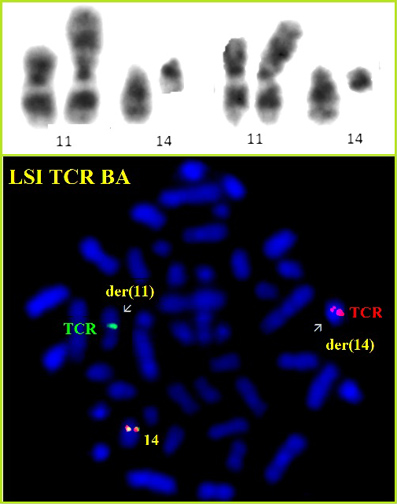
t(11;14)(p15;q11) TRD/LMO1 Hybridization with Vysis TRA/D Break Apart probe (Abbott Molecular, US) showing rearrangement of the gene (green signal on der(11) chromosome) - Courtesy Adriana Zamecnikova.
Citation
Jacques Boyer
t(7;11)(q34;p15) TRB/LMO1
t(11;14)(p15;q11) TRD/LMO1
Atlas Genet Cytogenet Oncol Haematol. 2002-08-01
Online version: http://atlasgeneticsoncology.org/haematological/1069/t(11
