+X solely in myeloid malignancies
2017-07-01 Adriana Zamecnikova Affiliation1.Kuwait Cancer Control Center, Department of Hematology, Laboratory of Cancer Genetics, Kuwait; [email protected]
Abstract
Review on +X solely in myeloid malignancies, with data on clinics.
Clinics and Pathology
Disease
Chronic myeloproliferative disorders and acute myeloid leukemia
Epidemiology
9 patients diagnosed with myeloid malignancies (6 males and 3 females) aged 27 to 73 years (median 50 years); among them there 5 acute myeloid leukemia (AML) cases, not associated with a particular leukemia subtype: 1 acute monoblastic leukemia (AML-M5) (Akiyoshi et al., 1991), 1 acute myeloblastic leukemia with maturation (AML-M2) (Wan et al., 2002), 1 acute myeloblastic leukemia with minimal differentiation (AML-M0) (Dicker et al., 2007) and 2 cases of childhood AML (Raimondi et al 1999). 4 patients had various disorders: 1 secondary myelodysplastic syndrome (MDS) developed after chemotherapy for Hodgkins disease (Pedersen-Bjergaard et al 1997), 1 chronic neutrophilic leukemia (Yamamoto et al., 2002), 1 bilineage or biphenotypic leukemia (Tsutsumi et al., 2005) and 1 chronic myeloid leukemia patient who developed trisomy 8 /trisomy X abnormalities in Philadelphia-negative cells during imatinib mesylate treatment (Kim et al., 2008) (Table 1). Extra chromosome X was also reported in 2 patients receiving high dose chemotherapy who developed blood cytopenias as well as subtle to mild dysplastic features after autologous stem cell transplantation, which were not classifiable as MDS (Martinez-Climent et al., 2000)
Table 1. Clinical and karyotypic data of patients with myeloid malignancies and +X solely.
Abbreviations: M, male; F, female.
1. Akiyoshi et al, 1991; 2. Pedersen-Bjergaard et al., 1997; 3. Raimondi et al., 1999; 4. Raimondi et al., 1999; 5. Martinez-Climent et al., 2000; 6. Martinez-Climent et al., 2000; 7. Yamamoto et al., 2002; 8. Wan et al., 2002; 9. Tsutsumi et al., 2005; 10. Dicker et al., 2007; 11. Kim et al., 2008.
Table 1. Clinical and karyotypic data of patients with myeloid malignancies and +X solely.
| Sex/Age | Diagnosis | Karyotype | |
| 1 | F | Acute monoblastic leukemia | 47,XX,+X |
| 2 | M/27 | Refractory anemia previous chemotherapy for Hodgkins disease | 47,XX,+X |
| 3 | M | Acute myeloid leukemia | 47,XY,+X |
| 4 | M | Acute myeloid leukemia | 47,XY,+X |
| 5 | F/58 | Nonneoplastic hematologic disorder/lesion chemotherapy for adenocarcinoma | 47,XX,+X transient |
| 6 | F/43 | Nonneoplastic hematologic disorder/lesion chemotherapy for adenocarcinoma | 47,XX,+X transient |
| 7 | M/73 | Chronic neutrophilic leukemia | 47,XY,+X at progression |
| 8 | F/44 | Acute myeloblastic leukemia with maturation | 47,XX,+X |
| 9 | M/67 | Bilineage or biphenotypic leukemia | 47,XY,+X |
| 10 | M | Acute myeloblastic leukemia with minimal differentiation | 55,XY,+X,+4,+5,+8,+10,+13,+14,+17,+18/47,XY,+X |
| 11 | F/50 | Chronic myeloid leukemia | 47,XX,+8 47,XX,+X transient |
Abbreviations: M, male; F, female.
1. Akiyoshi et al, 1991; 2. Pedersen-Bjergaard et al., 1997; 3. Raimondi et al., 1999; 4. Raimondi et al., 1999; 5. Martinez-Climent et al., 2000; 6. Martinez-Climent et al., 2000; 7. Yamamoto et al., 2002; 8. Wan et al., 2002; 9. Tsutsumi et al., 2005; 10. Dicker et al., 2007; 11. Kim et al., 2008.
Prognosis
Unknown, due to few number of patients and limited clinical data; the case with a secondary MDS, which developed 4 months after autologous stem cell transplantation for Hodgkins lymphoma died 2 months after the onset of MDS (Pedersen-Bjergaard et al.,1997). The 44-year-old woman with acute myeloblastic leukemia with maturation and abnormal eosinophils in the bone marrow developed diffuse alveolar damage and pulmonary hemorrhage while on induction chemotherapy and died 9 days after institution of chemetherapy (Wan et al., 2002). The 73-year-old man with chronic neutrophilic leukemia had normal karyotype at diagnosis, but after therapy with hydroxyurea for 7 months, the disease progressed to a blast crisis accompanied by appearance of an extra X chromosome, suggesting its role in the progression from chronic phase to the blast crisis of CNL (Yamamoto et al 2002). The 50-years old female with chronic myeloid leukemia developed only transient trisomy X in Philadelphia-negative cells during imatinib mesylate treatment (Kim et al., 2008).
Note
The observation of an extra chromosome X may indicate constitutional or acquired anomaly, therefore it should be carefully interpreted when an extra X chromosome is the only abnormality or present in a form of chromosomal mosaicism in patients with hematologic malignancy.
Genes Involved and Proteins
Result of the Chromosomal Anomaly
Oncogenesis
An extra X chromosome as a sole acquired abnormality has been reported in patients with several hematologic malignancies especially in childhood acute lymphoblastic leukemia and lymphomas. While whole chromosome gains are frequent cytogenetic aberrations in myeloid malignancies, gain of X chromosome as the sole anomaly has been only occasionally observed. Its occurrence in both chronic and acute myeloid malignancies suggest involvement of multiple hematopoietic lineages. The presence of an additional copy of chromosome X might result in increased gene dosage and altered expression of many genes simultaneously, some of which could promote oncogenesis while others could perform inhibitory roles. The oncogenic mechanisms underlying remain largely elusive and it is unclear if gain of X chromosome directly contributes to malignant transformation or aneuploidy-induced transcriptional changes might only allow direct acquisition of cancer-driving mutations.
Article Bibliography
| Pubmed ID | Last Year | Title | Authors |
|---|---|---|---|
| 1654480 | 1991 | Genotypic and cytogenetic study of acute myelocytic leukemia and chronic myelocytic leukemia in blast crisis: specific delta rearrangement pattern does not involve J delta gene locus. | Akiyoshi TT et al |
| 17485549 | 2007 | Trisomy 13 is strongly associated with AML1/RUNX1 mutations and increased FLT3 expression in acute myeloid leukemia. | Dicker F et al |
| 18983302 | 2008 | Transient trisomy 8 abnormality in Philadelphia-negative cells during imatinib mesylate treatment of chronic myelogenous leukemia. | Kim M et al |
| 10849534 | 2000 | Chromosomal abnormalities in women with breast cancer after autologous stem cell transplantation are infrequent and may not predict development of therapy-related leukemia or myelodysplastic syndrome. | Martínez-Climent JA et al |
| 9324285 | 1997 | High risk of therapy-related leukemia after BEAM chemotherapy and autologous stem cell transplantation for previously treated lymphomas is mainly related to primary chemotherapy and not to the BEAM-transplantation procedure. | Pedersen-Bjergaard J et al |
| 10572083 | 1999 | Chromosomal abnormalities in 478 children with acute myeloid leukemia: clinical characteristics and treatment outcome in a cooperative pediatric oncology group study-POG 8821. | Raimondi SC et al |
| 15676158 | 2005 | Acute biphenotypic leukemia and an acquired X chromosome. | Tsutsumi Y et al |
| 11904745 | 2002 | Fatal diffuse alveolar damage complicating acute myeloid leukemia with abnormal eosinophils and trisomy X. | Wan TS et al |
| 11996803 | 2002 | Acquired gain of an X chromosome as the sole abnormality in the blast crisis of chronic neutrophilic leukemia. | Yamamoto K et al |
Summary
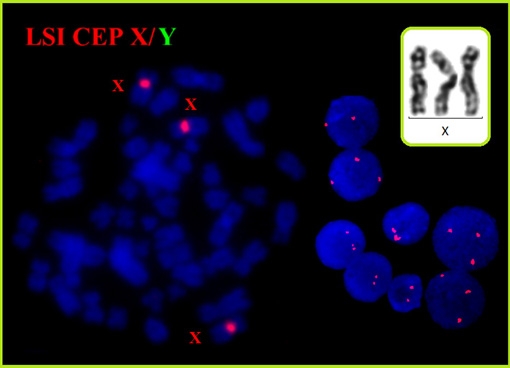
Figure 1. Fluorescence in situ hybridization with centromeric CEP X/Y probe (Abbott Molecular, Vysis, US) showing 3 copies of chromosome X (red signal) in metaphase and interphase cells. Partial karyotype showing an extra copy of chromosome X (inset).
Citation
Adriana Zamecnikova
+X solely in myeloid malignancies
Atlas Genet Cytogenet Oncol Haematol. 2017-07-01
Online version: http://atlasgeneticsoncology.org/haematological/1221/submit-meetings/welcome
