Clinics and Pathology
Disease
Acute myeloid leukaemia (AML) M4/M5a and therapy-related myelodysplastic syndromes (MDS).
Epidemiology
Very rare, only four cases described.
Clinics
There is no erythrophagocytosis associated.
Treatment
Bad response to chemotherapy.
Prognosis
Poor.
Cytogenetics
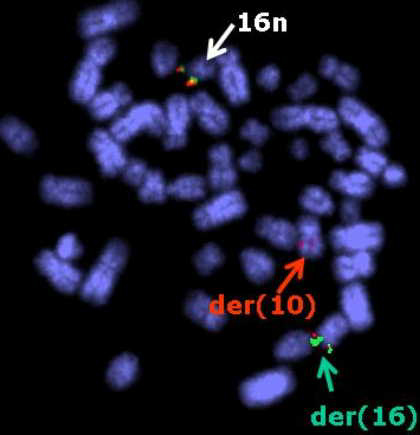
Fig2. FISH analysis. FISH using BACs RPCI-11 461A8 (green) and RPCI-11 95J11 (red) showing that the signal of 95J11, which covers the initial part of the CREBBP gene, is split between der(10) and der(16).
Additional anomalies
First described in a 4-year-old girl with AML M5a with 47,XX,der(7)t(7;10)(p13;p11),+8,der(10)t(7;10)(p13;p11)t(10;16)(q22;p13),der(16)t(10;16)(q22;p13)/46,XX. Later it was also described in an 84-year-old male without erythrophagocytosis and with this sole cytogenetic aberration. In addition, a variant breakpoint was described in a 52-year-old japanese woman with a therapy-related myelodysplastic syndrome (t-MDS) and also this sole translocation. Finally, another fusion variant was described in an AML-M4 female patient with the t(10;16)(q22;p13) and a t(11;17)(q23;q21).
Variants
There are no cytogenetic variants described, but there are molecular variants due to different breakpoints in the genes fused (see below).
Genes Involved and Proteins
Gene name
KAT6B (MYST histone acetyltransferase (monocytic leukemia) 4)
Location
10q22.2
Note
This gene is also involved in rearrangements observed in uterine leiomyomata.
Dna rna description
18 exons spanning 206.0 Kb. Transcription is from centromere to telomere. Up to 7 alternative transcripts.
Protein description
Histone acetyltransferase MYST4 is located probably in the nucleous. And it is probably involved in both positive (N-terminus) and negative (C-terminus) regulation of transcription, maybe involved in cerebral cortex development, required for RUNX2-dependent transcriptional activation and ubiquitously expressed in adult human tissues.
Gene name
CREBBP (CREB binding protein)
Location
16p13.3
Note
This gene is also involved in t(8;16)(p11;p13) with MYST3. CREBBP fusion observed in M4 AML and therapy related AML; t(11;16)(q23;p13) with MLL CREBBP fusion observed also in therapy related. Mutations of CREBBP are associated with Rubinstein-Taybi syndrome.
Dna rna description
Up to 32 exons spanning 154,14 Kb. Transcription is from centromere to telomere and up to 3 alternative transcripts between 8,0 and 8,7 Kb.
Protein description
CREBBP is a wide expression histone acetyltransferase enzyme which locates in the nucleous. Function binds specifically to the DNA-binding protein CREB connecting it to the basal transcriptional machinery. Also acetylates non-histone proteins, like NCOA3 coactivator. It has an essential role in embryogenesis, cell differentiation, apoptosis, and proliferation and it is involved in the regulation of cell cycle during G1/S transition.
Result of the Chromosomal Anomaly
Description
Fusion in-frame between MYST4 exon 17 and CREBBP exon 3. Variants fusing MYST4 exon 16 and CREBBP exon 5; MYST4 exon 17 and CREBBP exon 7 have also been described.
Transcript
5 MYST4-CREBBP 3
Detection protocole
CREBBP-MYST4 has been also detected.
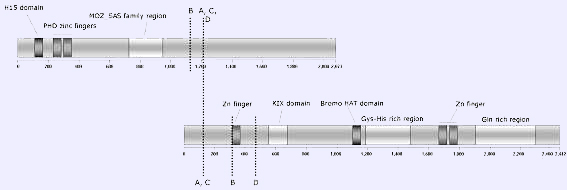
Schematic representation of the fusion MYST4-CREBBP consequence of the t(10;16)(q22;p13). From up to down: MYST4 and CREBBP structures. H15 domain: domain in histone families 1 and 5; PHD zinc fingers: plant homeodomain (PHD) with a C4HC3-type motif, this domain is widely distributed in eukaryotes and it has been found in many chromatin regulatory factors; MOZ_SAS family region: this region has been suggested to be homologous to acetyltransferases but this similarity is not supported by sequence analysis; KIX domain: bind domain for CBP and P300, this domain also binds to transactivation domains of other nuclear factors including Myb and Jun.
Description
In all cases published to date the breakpoints occur in the acidic domain of MYST4 but at different locations of the CREBBP protein: in the nuclear receptor-binding domain, in a C/H rich domain or between this domain and the KIX domain. The putative MYST4-CBP chimaeric protein retains the part of MYST4 that encodes the zinc fingers, two nuclear localization signals (NLS1 and NLS2), the HAT domain, and a portion of the acidic domain, and most of the CBP protein, including its HAT domain.
Oncogenesis
MYST4 has a 60% identity and 66% similarity to MYST3. All the fusions involving this genes result in several fusion proteins that target the acidic domain of MYST3 and MYST4. The partner fusion partners share also functional regions. All the fusion proteins are suspected to be leukaemogenic as a consequence of aberrant histone acetylation and transcription regulation, due probably but not exclusively, to the concomitant presence of two HAT domains coming from the different partners.
Article Bibliography
| Pubmed ID | Last Year | Title | Authors |
|---|---|---|---|
| 12542485 | 2003 | A novel fusion variant of the MORF and CBP genes detected in therapy-related myelodysplastic syndrome with t(10;16)(q22;p13). | Kojima K et al |
| 15147375 | 2004 | Variant MYST4-CBP gene fusion in a t(10;16) acute myeloid leukaemia. | Murati A et al |
| 11157802 | 2001 | Fusion of the MORF and CBP genes in acute myeloid leukemia with the t(10;16)(q22;p13). | Panagopoulos I et al |
| 12619164 | 2003 | t(10;16)(q22;p13) and MORF-CREBBP fusion is a recurrent event in acute myeloid leukemia. | Vizmanos JL et al |
Summary
Fusion gene
KAT6B/CREBBP KAT6B (10q22.2) CREBBP (16p13.3) M t(10;16)(q22;p13)|KAT6B/CREBBP KAT6B (10q22.2) CREBBP (16p13.3) TIC
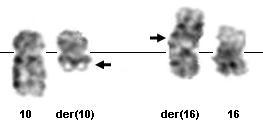
G-band analysis. Partial karyotype showing the t(10;16)(q22;p13). Arrows indicate breakpoints in both chromosomes.
Citation
José Luis Vizmanos
t(10;16)(q22;p13) KAT6B/CREBBP
Atlas Genet Cytogenet Oncol Haematol. 2006-05-01
Online version: http://atlasgeneticsoncology.org/haematological/1332/t(10
