t(11;21)(q21;q22) RUNX1/LPXN
2011-10-01 Jean-Loup Huret Affiliation1.Genetics, Dept Medical Information, University of Poitiers, CHU Poitiers Hospital, F-86021 Poitiers, France
Clinics and Pathology
Disease
Acute myeloid leukemia (AML)
Epidemiology
One case to date, a 65-year-old male patient with M2-AML (Dai et al., 2007).
Evolution
The patient died 10 months after diagnosis.
Genes Involved and Proteins
Gene name
LPXN (leupaxin)
Location
11q12.1
Protein description
LPXN contains two types of protein-protein interaction domains: leucine-aspartate (LD) repeats in N-term, and LIM (Lin-11 Isl-1 Mec-3) domains at the C-term. Belongs to the paxillin family (PXN, LPXN, TGFB1I1). Protein involved in focal adhesion. LPXN and paxillin had opposite roles in adhesion to collagen LPXN siRNA stimulated whereas paxillin siRNA inhibited cell adhesion. Strongly expressed in hematopoietic cells. LPXN is involved in bone resorption and stimulates prostate cancer cell migration (Chen and Kroog, 2010).
Gene name
RUNX1 (runt-related transcription factor 1 (acute myeloid leukemia 1; aml1 oncogene))
Location
21q22.12
Protein description
Transcription factor (activator) for various hematopoietic-specific genes.
Result of the Chromosomal Anomaly
Description
5 RUNX1 - 3 LPXN
Transcript
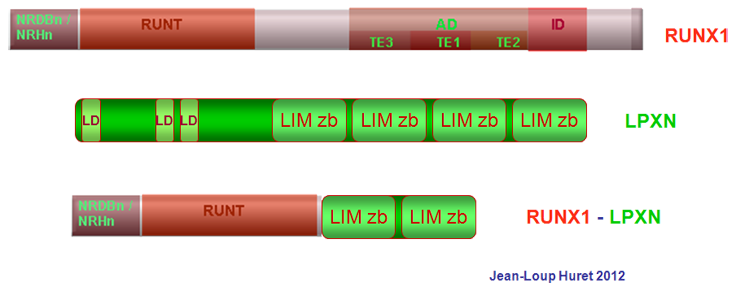
Two in frame fusion transcripts -fusion of exon 5 or 6 of RUNX1 to LPXN exon 8.
Description
The two variant fusion proteins RUNX1-LPXN localized in the nucleus and inhibited RUNX1 transactivation (Dai et al., 2009). It is hypothesized that the reciprocal LPXN-RUNX1 may also play a role in leukemogenesis.
Highly cited references
| Pubmed ID | Year | Title | Citations |
|---|---|---|---|
| 19760607 | 2009 | LPXN, a member of the paxillin superfamily, is fused to RUNX1 in an acute myeloid leukemia patient with a t(11;21)(q12;q22) translocation. | 0 |
Article Bibliography
| Pubmed ID | Last Year | Title | Authors |
|---|---|---|---|
| 20543562 | 2010 | Leupaxin is similar to paxillin in focal adhesion targeting and tyrosine phosphorylation but has distinct roles in cell adhesion and spreading. | Chen PW et al |
| 17854666 | 2007 | Two novel translocations disrupt the RUNX1 gene in acute myeloid leukemia. | Dai H et al |
| 19760607 | 2009 | LPXN, a member of the paxillin superfamily, is fused to RUNX1 in an acute myeloid leukemia patient with a t(11;21)(q12;q22) translocation. | Dai HP et al |
Summary
Fusion gene
RUNX1/LPXN RUNX1 (21q22.12) LPXN (11q12.1) M t(11;21)(q12;q22)|RUNX1/LPXN RUNX1 (21q22.12) LPXN (11q12.1) TIC
Note
This translocation is different from the t(11;21)(q12;q22) with MACROD1/RUNX1 involvement.
Citation
Jean-Loup Huret
t(11;21)(q21;q22) RUNX1/LPXN
Atlas Genet Cytogenet Oncol Haematol. 2011-10-01
Online version: http://atlasgeneticsoncology.org/haematological/1592/t(11
