1.Kuwait Cancer control Center, Department of Hematology, Kuwait; [email protected]
Abstract
In classic APL (acute promyelocytic leukemia), the central leukemia-initiating event is the fusion between the promyelocytic leukemia (PML) and the retinoic acid receptor alpha (RARA) gene, that arise as a result of t(15;17)(q22;q21) chromosomal translocation. In variant forms of APL, RARA gene have other translocation partners than PML resulting in various molecular characteristics and sensitivities to all-trans-retinoic acid (ATRA) therapy. The variant t(3;17)(q26;q21) translocation, in which RARA is fused to TBL1XR1 (transducin beta like 1 X-linked receptor 1, TBLR1) is a rare anomaly, observed only in sporadic cases.
4 cases to date, 3 male and 1 female patients; ages at diagnosis was documented in 2 cases: 27 and 63 years (Macedo et al., 2005; Chen et al., 2014).
Clinics
In one patient, data were available: bone marrow cells revealed hypercellularity with 83% hypergranular promyelocytes lacking Auer rods. Immunophenotyping analysis by flow cytometry was positive for myeloperoxidase, CD13, CD9 with partially expressed CD117, CD15, CD33, and CD64; CD34 and HLA-DR were negative (Chen et al., 2014).
Prognosis
The one patient well described in Chenn et al., 2014 (63-year-old male patient) received induction therapy with ATRA, cytarabine, and mitoxantrone but failed to achieve complete remission (58% promyelocytes on day 32). Therapy with ATRA should be suspended on day 24 because of severe pulmonary infection. He was subsequently treated with arsenic trioxide and chemotherapy resulting in complete remission, but 10 months after diagnosis he relapsed with 81% of promyelocytes in bone marrow and died 1 month later (Chen et al., 2014). The female patient reported by Chen et al., 2014 was initially treated with ATRA and daunorubicin and achieved CR on day 36. However, in addition to the t(3;17)(q21;q25) TBL1XR1/RARA, a t(15;17)(q22;q12) PML/RARA transcript was also detected in this patient. In Machedo et al., 2005, the rearrangement t(3;17)(q26.3;q12) was accompanied with a poor outcome. Due to the limited data available regarding patient outcomes, the efficiency of ATRA on APL patients with TBLR1/RARA is unclear.
Cytogenetics
Cytogenetics morphological
Variable breakpoints on 3q and 17q, described as: t(3;17)(q26;q21), t(3;17)(q27;q22), t(3;17)(q21;q25) (Chen et al., 2014) (Authors note: the latter may be t(3;17)(q25;q21) ?) and as a t(3;17)(q26;q12) in a patient with unknown gene involved at 3q26 (Macedo et al., 2005).
Additional anomalies
Part of complex karyotypes in all the 4 patients; recurrent abnormalities were: del(6)q), -7, del(7q) and in 1 patient t(15;17)(q22;q12) with PML/RARA fusion as above mentioned (Chen et al., 2014).
Genes Involved and Proteins
Gene name
TBL1XR1 (transducin beta like 1 X-linked receptor 1)
Location
3q26.32
Dna rna description
Approximately 200 kb of genomic DNA, containing 18 exons; member of the WD40 repeat-containing gene family and shares sequence similarity with transducin (beta)-like 1X-linked (TBL1X).
Protein description
514 amino acids; contains lissencephaly type-1-like homology motif (LisH domain) in its N-terminal region, F-box-like domain, and 8 WD-40 repeats in its C-terminal region; an integral subunit of the NCOR1 (NCoR, nuclear receptor corepressor) and NCOR2 (SMRT, silencing mediator of retinoic acid and thyroid hormone receptors) repressor complexes that interact with nuclear receptors and repress transcription; required for transcriptional activation by a variety of transcription factors (Li et al., 2014).
Germinal mutations
Heterozygous missense mutation of TBL1XR1 is associated with autosomal dominant Pierpont syndrome; deletions and mutations in this gene have been implicated in autism spectrum disorders and it is suggested that TBL1XR1 haploinsufficiency may be a cause of intellectual disability with dysmorphism (Heinen et al., 2016).
Nuclear retinoic acid receptor, implicated in regulation of development, differentiation, apoptosis, granulopoeisis, and transcription.
Protein description
Retinoic acid receptor alpha belongs to the nuclear hormone receptor family composed of a modulating N-terminal domain, a nuclear receptor DNA-binding domain and a C-terminal ligand-binding domain. RARA can be combined with retinoid X receptor alpha to bind the retinoic acid responsive element composed of tandem 5-AGGTCA-3 sites; mediates retinoic acid-induced granulopoiesis and regulates transcription in a ligand-dependent manner in various biological processes.
Result of the Chromosomal Anomaly
Description
5-TBLR1-3 RARA
Transcript
In-frame fusion transcript; TBLR1 exon 5 is fused to exon 3 of RARA
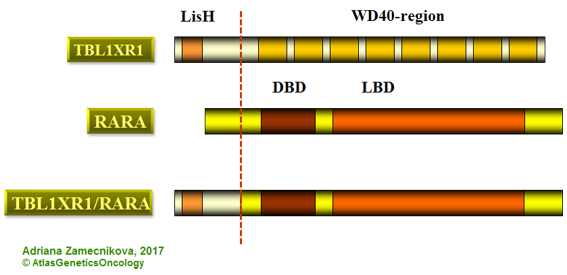
Schematic representation of TBLR1, RARA and TBLR1/RARA proteins. Abbreviations: LisH (lissencephaly type-1-like homology motif); DBD; DNA-binding domain; (LBD), ligand-binding domain (Adopted from Chen et al., 2014).
Description
Predicted to encode a 545 amino acids (aa) fusion protein, containing a LisH domain (6-32 aa) in the TBLR1 portion and a DNA-binding domain (DBD; 166-250 aa) and a ligand-binding domain (LBD; 270-500 aa) in the RARA portion (B through F domains of RARA) (Chen et al., 2014; Heinen et al., 2016).
Oncogenesis
The common feature of RARA fusion proteins is the ability to self-associate, forming homodimers. The TBL1XR1/RARA fusion protein is predominantly localized in the nucleus and self-associate into homodimers through its LisH domain and associate with retinoid X receptor alpha into heterodimers. The multimerization of the chimeric protein may be a key factor in interfering with normal signaling leading to diminished transcriptional activity.
Please, confirm that you want to generate a PDF file of this page. This
may take some seconds once process has started. Then it will be opened automatically.