Pediatric-type Follicular Lymphoma
2016-05-01 Robert S. Ohgami , Michael G. Ozawa Affiliation1.Department of Pathology, Stanford University, Stanford, CA, USA. [email protected]
Clinics and Pathology
Disease
Pediatric-type follicular lymphoma (pFL), which was formerly a provisional diagnosis under follicular lymphoma, is a newly recognized entity in the 2016 WHO classification (Swerdlow et al., 2016). It is an extremely rare nodal B-cell lymphoma occurring predominantly in the pediatric and young-adult population, which shows unique characteristics distinct from the more common follicular lymphoma seen in adults (Louissaint et al., 2012).
Phenotype stem cell origin
pFL is a proliferation of follicle center B-cells with often blastoid morphologic features. The B-cells typically express markers of germinal center B-cells, including CD10, BCL6, human germinal center-associated lymphoma (HGAL) and Lim domain only 2 (LMO2) (Liu et al., 2013; Karnik et al., 2015). The neoplastic cells largely lack BCL2 protein expression, or if it is expressed show only dim or partial expression. Importantly, the characteristic IGH - BCL2 t(14;18)(q32;q21) translocation, seen in follicular lymphomas of adults, is absent. The proliferation index is elevated (>30%) as assessed by Ki67.
Epidemiology
Pediatric-type follicular lymphoma is a rare disease with incidence estimates of approximately 5% of all childhood lymphomas (OSuoji et al., 2016). The age of presentation is between the ages of 3 and 18 years of age, though cases observed in early adulthood have also been described. A male predominance is commonly seen.
Clinics
pFL typically is localized to lymph nodes within the cervical region although extranodal sites including the testis, epididymis and gastrointestinal tract do occur. The vast majority of patients present with localized involvement without systemic disease and follow an indolent clinical course.
Pathology
Histologically, lymph nodes show effacement of normal architecture by a proliferation of expansile, ill-defined follicles with attenuated mantle zones (figure 1). The atypical follicles are comprised of a mixture of intermediate and larger-sized centroblastic lymphocytes with more immature chromatin often lending to an interpretation of higher-grade cytology and aggressive disease. Notably, these morphologic features are often not entirely specific and can show overlap with other lymphomas including pediatric marginal zone lymphoma (Quintanilla-Martinez et al., 2016). By the 2016 WHO classification, diffuse areas suggesting progression or transformation, exclude a diagnosis of pFL.
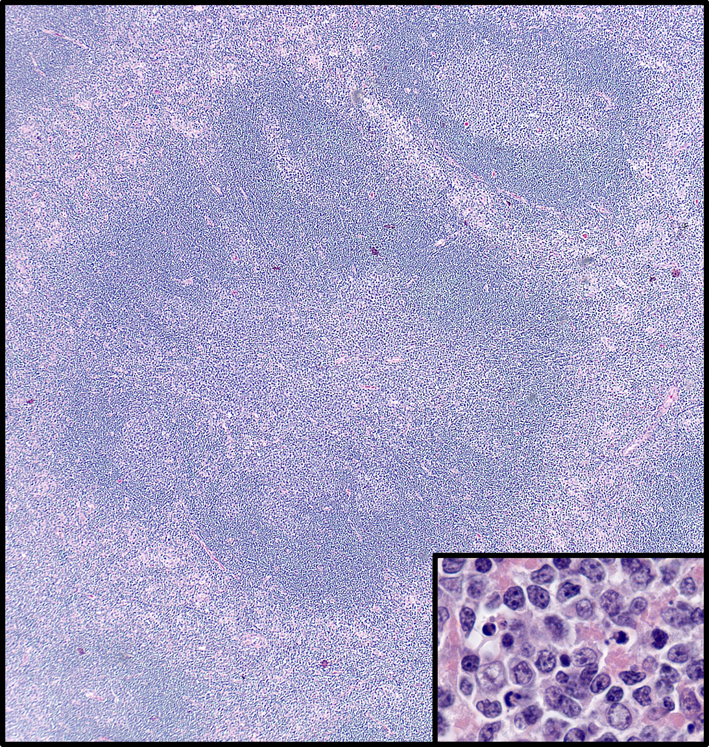
Figure 1: Morphologic features of pediatric-type follicular lymphoma. Irregularly shaped enlarged follicles with abnormal mantle zones are seen at low power (40X). High power magnification illustrates the cytomorphology of neoplastic cells which have more blastoid chromatin and irregular nuclear contours, inset (1000X).
Treatment
Patients presenting with localized disease respond to surgical resection without further intervention. Historically, additional management strategies have included surgical excision with chemotherapy with or without local radiation (Attarbaschi et al., 2013).
Prognosis
Prognosis is similar to other indolent lymphomas, with excellent progression free and overall survival. The vast majority of patients achieve complete remission and show no evidence of disease following local surgical treatment or radiation therapy.
Cytogenetics
Cytogenetics morphological
Cytogenetics molecular
The mutational landscape of pFL is not well understood. TNFRSF14 mutations have been reported in association with, as well as distinct from 1p36 deletion or copy number neutral LOH. Recently, a recurrent somatic variant encoding p.Lys66Arg in the transcription factor interferon regulatory factor 8 (IRF8) was described in 3 of 6 cases of pFL (50%) by whole exome deep sequencing (Ozawa et al., 2016). This point mutation was not observed in adult follicular lymphoma or cases of pediatric marginal zone lymphoma.
Genes Involved and Proteins
Note
While the underlying genetics driving pFL are under investigation, recent studies have suggested at least two potential pathogenic pathways.
Gene name
TNFRSF14 (TNF receptor superfamily member 14)
Location
1p36.32
Note
TNFRSF14 is a member of the TNF (tumor necrosis factor) receptor superfamily. In T-cells it is involved in signal transduction pathways that activate inflammatory and inhibitory immune responses. The role of TNFRSF14 in normal B-cell physiology is unclear, but it is known to be recurrently deleted or show copy number-neutral loss of heterozygosity (LOH) along with somatic point mutations in cases of pFL.
Gene name
IRF8 (interferon regulatory factor 8)
Location
16q24.1
Note
IRF8 is a member of the IRF family of transcription factors contributing to hematopoietic cellular differentiation and development, cell cycle regulation and apoptosis. Variants in this gene have been recently reported in a small percentage of adult follicular lymphomas and pediatric-type follicular lymphomas. In pediatric-type follicular lymphoma the mutations are a specific recurrent mutation, p.Lys66Arg, different from mutations in IRF8 which are seen in adult follicular lymphomas (Ozawa et al., 2016). While currently little is known about the pathogenic role of IRF8 in this setting, the significant portion of pediatric-type follicular lymphomas with the same recurrent nucleotide change is highly suggestive of a critical alteration and potential unique disease origin.
Article Bibliography
| Pubmed ID | Last Year | Title | Authors |
|---|---|---|---|
| 23665980 | 2013 | Children and adolescents with follicular lymphoma have an excellent prognosis with either limited chemotherapy or with a "Watch and wait" strategy after complete resection. | Attarbaschi A et al |
| 25701230 | 2015 | The utility of IgM, CD21, HGAL and LMO2 in the diagnosis of pediatric follicular lymphoma. | Karnik T et al |
| 23108024 | 2013 | Follicular lymphomas in children and young adults: a comparison of the pediatric variant with usual follicular lymphoma. | Liu Q et al |
| 22855608 | 2012 | Pediatric-type nodal follicular lymphoma: an indolent clonal proliferation in children and adults with high proliferation index and no BCL2 rearrangement. | Louissaint A Jr et al |
| 23445872 | 2013 | Recurrent loss of heterozygosity in 1p36 associated with TNFRSF14 mutations in IRF4 translocation negative pediatric follicular lymphomas. | Martin-Guerrero I et al |
| 26728447 | 2016 | Rare Pediatric Non-Hodgkin Lymphomas: A Report From Children's Oncology Group Study ANHL 04B1. | O'Suoji C et al |
| 27338637 | 2016 | A study of the mutational landscape of pediatric-type follicular lymphoma and pediatric nodal marginal zone lymphoma. | Ozawa MG et al |
| 26416032 | 2016 | Indolent lymphomas in the pediatric population: follicular lymphoma, IRF4/MUM1+ lymphoma, nodal marginal zone lymphoma and chronic lymphocytic leukemia. | Quintanilla-Martinez L et al |
| 26980727 | 2016 | The 2016 revision of the World Health Organization classification of lymphoid neoplasms. | Swerdlow SH et al |
Citation
Robert S. Ohgami ; Michael G. Ozawa
Pediatric-type Follicular Lymphoma
Atlas Genet Cytogenet Oncol Haematol. 2016-05-01
Online version: http://atlasgeneticsoncology.org/haematological/1749/gene-explorer/tumors-explorer/teaching-explorer/cancer-prone-explorer/
