t(1;5)(p32;q31) without TAL1 rearrangement
2017-04-01 Adriana Zamecnikova Affiliation1.Kuwait Cancer Control Center, Department of Hematology, Laboratory of Cancer Genetics, Kuwait; [email protected]
Abstract
1p32 translocations and submicroscopic interstitial deletions resulting in TAL1 deregulation are known aberrations in T lymphoblastic leukemia/lymphoma. The t(1;5)(p32;q31) is a rare translocation of 1p32 described only in 1 patient with aberrantly expressed TAL1 mRNA and protein (François et al., 1998) and in 2 other patients without involvement of the TAL1 gene.
Clinics and Pathology
Disease
Acute lymphocytic leukaemia (ALL) and acute promyelocytic leukemia (APL)
Epidemiology
Only 2 ALL cases reported: a 49-years old male with T-cell ALL (Cho et al., 2009) and a 10-years old male diagnosed with B-ALL (Kaleem et al., 2000). In addition, a t(1;5)(p32;q31) was detected as an additional anomaly in a 29-years old female patient diagnosed with acute promyelocyte leukemia (Zamecnikova, unpublished case).
Prognosis
Yet poorly known; the pediatric case with B-precursor phenotype achieved complete remission after induction chemotherapy and remains in complete continuous remission for 24 months (Kaleem et al., 2000). Induction chemotherapy failed to induce remission in the adult patient with T-ALL and 5 months later the patient died due to renal failure and metabolic acidosis (Cho et al., 2009). In the APL case, induction was started with ATRA based therapy resulting in complete remission and she remains in complete remission for 14+ months.
Cytogenetics
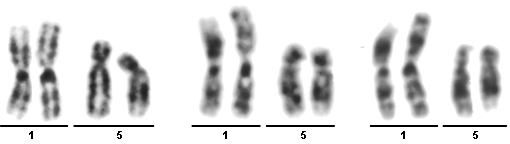
Figure 1. Partial karyotypes with t(1;5)(p32;q31).
Cytogenetics morphological
May be overlooked in suboptimal preparations.
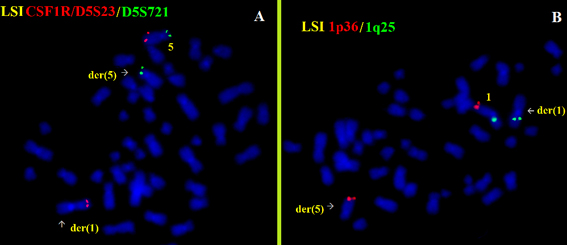
Figure 2. (A) Fluorescence in situ hybridization with LSI CSF1R (SpectrumOrange)/D5S23, D5S721 (SpectrumGreen) showing the presence of 5q sequences on der(1) chromosome. (B) Hybridization with Vysis LSI 1p36 (SpectrumOrange) / LSI 1q25 (SpectrumGreen) probes showing translocation of 1p sequences to der(5) chromosome.
Probes
LSI CSF1R (SpectrumOrange/D5S23, D5S721 SpectrumGreen, and Vysis LSI 1p36 (SpectrumOrange) / LSI 1q25 (SpectrumGreen) probes.
Additional anomalies
Secondary anomaly in addition to t(8;14)(q11.2;q32) in a pediatic B-ALL patient (Kaleem et al., 2000), associated with del(6q) in a sideline in the T-ALL case (Cho et al., 2009) and found in association witht(15;17)(q24;q21) in the APL case.
Genes Involved and Proteins
Result of the Chromosomal Anomaly
Oncogenesis
Because of its rarity, the role of t(1;5)(p32;q31) in disease pathogenesis as well as its clinical significance is unclear. Unlike in the T-ALL case described by François et al., 1998, neither TAL1 translocation nor its aberrant expression was detected FISH and by immunohistochemical staining in the other T-ALL patient (Cho et al., 2009). Therefore it is likely that some other genes located at 1p32 such as BLYM, EPS15, CDKN2C, and JUN may be involved in leukemogenesis (Cho et al., 2009). In the remaining 2 cases, t(1;5)(p32;q31) was found in addition to t(8;14)(q11.2;q32) and to t(15;17)(q24;q21) likely representing a secondary event in these cases.
Article Bibliography
| Pubmed ID | Last Year | Title | Authors |
|---|---|---|---|
| 19571616 | 2009 | A novel translocation t(1;5)(p32;q31) that was not associated with the TAL1 rearrangement in a case of T lymphoblastic leukemia/lymphoma. | Cho HS et al |
| 9713995 | 1998 | Deregulated expression of the TAL1 gene by t(1;5)(p32;31) in patient with T-cell acute lymphoblastic leukemia. | François S et al |
| 10673739 | 2000 | Acute lymphoblastic leukemia with an unusual t(8;14)(q11.2;q32): a Pediatric Oncology Group Study. | Kaleem Z et al |
Citation
Adriana Zamecnikova
t(1;5)(p32;q31) without TAL1 rearrangement
Atlas Genet Cytogenet Oncol Haematol. 2017-04-01
Online version: http://atlasgeneticsoncology.org/haematological/1787/t(1
