t(10;14)(q24;q32) NFKB2/IGH
2017-09-01 Nathalie Nadal Affiliation1.Service de génétique chromosomique et moléculaire, CHU de Dijon, France; [email protected]
Abstract
Review on t(10;14)(q24;q32) NFKB2/IGH, with data on clinics, and the genes involved.
Clinics and Pathology
Disease
B-cell lymphomas: The band 10q24 is involved in 7% of low-grade B-cell lymphomas, splenic marginal zone B-cell lymphomas in particular (Solé et al., 2001; Lefebvre et al., 2007, Nadal, unpublished observation) and also, but less frequently, in intermediate and high risk lymphomas (Neri et al., 1991).
Other chronic lympho proliferative diseases: Multiple myeloma (Migliazza et al., 1994; Mohamed et al.), chronic lymphocytic leukemia (CLL) (Migliazza, 1994)
Other chronic lympho proliferative diseases: Multiple myeloma (Migliazza et al., 1994; Mohamed et al.), chronic lymphocytic leukemia (CLL) (Migliazza, 1994)
Prognosis
Unknown.
Cytogenetics
Cytogenetics morphological
The t(10;14)(q24;q32) is a rare but recurrent abnormality in lymphoid malignancies.
Genes Involved and Proteins
Gene name
Location
10q24.32
Note
Alias: LYT-10, NF-kB2, p105, p49/p100, p52
Dna rna description
NFKB2 gene is a member of NFKB gene family. NFKB2 gene encodes for the precursor p100/p52 from which the active p52 subunit is formed.
Protein description
P52 is a member of the NFKB family transcription factors that are formed by the homo/dimerization of the subunits of the NFKB family. After dimerization with the subunit RELB, P52 migrates to the nucleus where they activate the transcription of target genes.
Localization: cytosol for p100 product and nucleus for the final product p52 after activation
P52 is a component of the non-canonical NF-KB pathway which plays a role in the control of the last stages of B-Cells development (maintenance of the Germinal Center (GC) reaction and Plasma cell development) (Shaffer et al., 2012; De Silva et al., 2017).
Localization: cytosol for p100 product and nucleus for the final product p52 after activation
P52 is a component of the non-canonical NF-KB pathway which plays a role in the control of the last stages of B-Cells development (maintenance of the Germinal Center (GC) reaction and Plasma cell development) (Shaffer et al., 2012; De Silva et al., 2017).
Gene name
IGH (Immunoglobulin Heavy chain)
Location
14q32
Result of the Chromosomal Anomaly
Description
t(10;14)(q24;q32) translocation juxtaposes IGH constant region gene with NFKB2 gene (Neri et al., 1991). The fusion gene NFKB2/IGH results in the constitutional activation of the non-canonical NFKB pathway. The reciprocal fusion gene IGH/NFKB2 is not transcribed.
Note
NFKB2 gene encodes for the protein P52 which contains a DNA binding domain and an Ankyrin domain. The Ankyrin domain is thought to retain p100/P52 in the cytoplasm and thus prevent the DNA binding.
The band in 10q24 can be involved in different types of rearrangement such as cryptic deletion or translocation t(10;14). The common consequence is a truncated protein which retains the DNA binding domain but lack the Ankyrin domain (Migliazza et al., 1994). These rearrangements result in a constitutive activation of P52 which lead to the activation of the non-canonical NFKB pathway and thus promote B-cell malignancies (de silva, 2017; Guo, 2017).
The band in 10q24 can be involved in different types of rearrangement such as cryptic deletion or translocation t(10;14). The common consequence is a truncated protein which retains the DNA binding domain but lack the Ankyrin domain (Migliazza et al., 1994). These rearrangements result in a constitutive activation of P52 which lead to the activation of the non-canonical NFKB pathway and thus promote B-cell malignancies (de silva, 2017; Guo, 2017).
Expression localisation
Nucleus.
Article Bibliography
| Pubmed ID | Last Year | Title | Authors |
|---|---|---|---|
| 7949142 | 1994 | Heterogeneous chromosomal aberrations generate 3' truncations of the NFKB2/lyt-10 gene in lymphoid malignancies. | Migliazza A et al |
| 1760839 | 1991 | B cell lymphoma-associated chromosomal translocation involves candidate oncogene lyt-10, homologous to NF-kappa B p50. | Neri A et al |
| 27457956 | 2016 | Transcription factors of the alternative NF-κB pathway are required for germinal center B-cell development. | De Silva NS et al |
| 28368397 | 2017 | Molecular impact of selective NFKB1 and NFKB2 signaling on DLBCL phenotype. | Guo X et al |
| 17134739 | 2007 | Composite splenic marginal zone lymphoma and mantle cell lymphoma arising from 2 independent B-cell clones. | Lefebvre C et al |
| 17654686 | 2007 | Chromosome aberrations in a series of 120 multiple myeloma cases with abnormal karyotypes. | Mohamed AN et al |
| 22224767 | 2012 | Pathogenesis of human B cell lymphomas. | Shaffer AL 3rd et al |
| 11146574 | 2001 | Splenic marginal zone B-cell lymphomas: two cytogenetic subtypes, one with gain of 3q and the other with loss of 7q. | Solé F et al |
Summary
Fusion gene
NFKB2/IGH
Note
The t(10;14)(q24.31;q11) in T-ALL involves the gene TLX1 at the band 10q24.31 and not NFKB2 at band 10q24.32 (Neri et al., 1991).
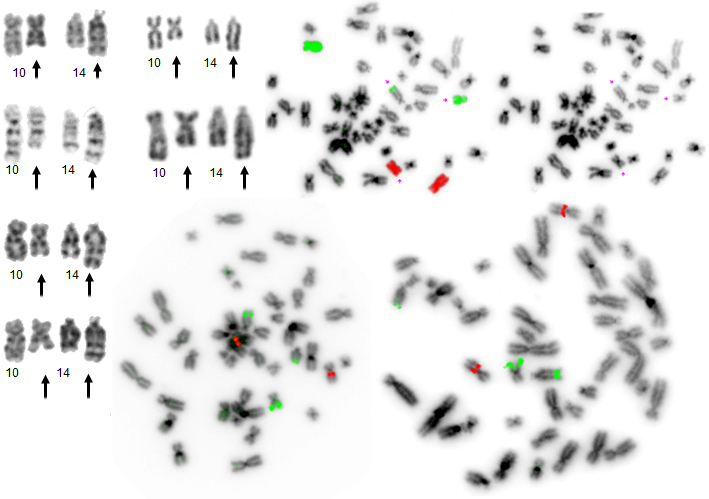
Conventional karyotype: Partial G and R banded karyotype. The derivative chromosomes are denoted with arrows. G-Banding, Courtesy Nathalie Nadal. R-banding, Courtesy Christine Lefebvre (upper row), N Nadal (lower row); FISH: top: WCP7R/WCP10G (aquarius); XL t(11;14)(IGH/CCND1) (metasystems) 11q13R/14q32G - Courtesy Christine Lefebvre
Citation
Nathalie Nadal
t(10;14)(q24;q32) NFKB2/IGH
Atlas Genet Cytogenet Oncol Haematol. 2017-09-01
Online version: http://atlasgeneticsoncology.org/haematological/2019/t(10
