Kidney: Renal cell carcinoma with t(6;11)(p21;q12) MALAT1/TFEB
2016-08-01 Pedram Argani , Marc Ladanyi Affiliation1.Department of Pathology, The Johns Hopkins Hospital, Baltimore MD (PA) [email protected]; Dept. of Pathology, , MSKCC, 1275 York Avenue, New York, NY 10021 (ML) USA.
Summary
Note
A distinctive renal neoplasm with epithelioid morphology, basement membrane production focal HMB45 immunoreactivity.
Abstract
Review on Renal cell carcinoma with t(6;11)(p21;q12) MALAT1/TFEB, with data on clinics, and the genes involved.
Classification
Classification
The t(6;11) renal cell carcinomas (RCCs) harbor a specific Alpha (MALAT1)-TFEB gene fusion. Xp11 translocation RCCs harbor gene fusions involving TFE3 transcription factor. TFEB and TFE3 belong to the same MiT subfamily of transcription factors. Because of similarities at the clinical, morphologic, immunohistochemical, and genetic levels, the Xp11 translocation RCCs and t(6;11) RCCs are currently grouped together under the category of MiT family translocation renal cell carcinoma.
Clinics and Pathology
Etiology
Not clear, but a subset of confirmed cases have occurred in children who were exposed to prior cytotoxic chemotherapy, raising the possibility that this tumor may be induced by chemotherapy.
Epidemiology
There are approximately 50 reported cases, the Male: Female ratio is 1.4:1. The median age is 31 years (range: 3-68 years).
Pathology
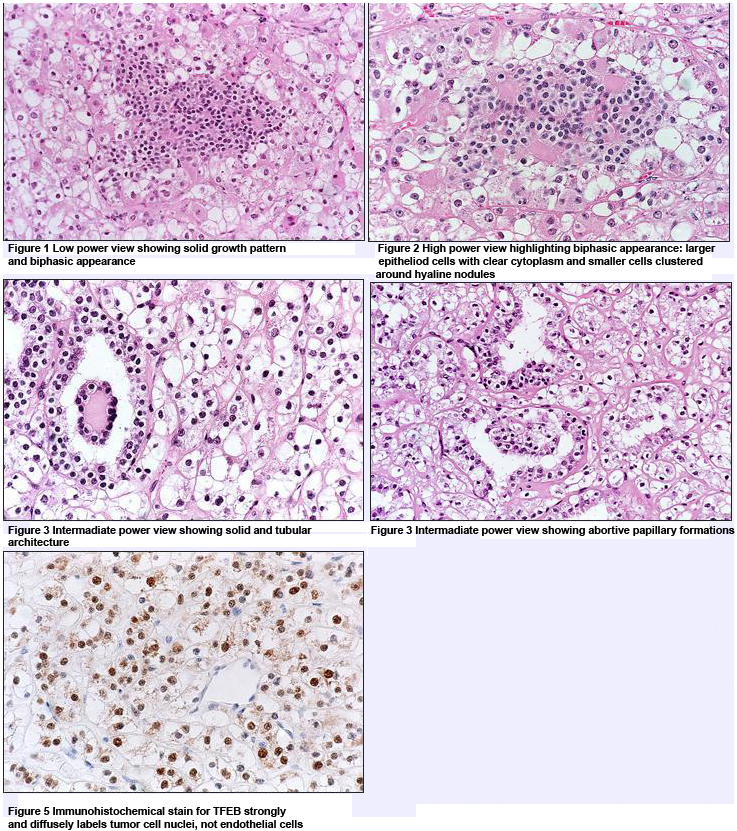
On microscopic examination, these neoplasms feature nests and tubules of polygonal epithelioid cells, separated by thin capillaries. Papillary architecture may be seen. The majority of the tumor cells have abundant clear to granular eosinophilic cytoplasm, well-defined cell borders and round nuclei with small nucleoli. However, a second population of smaller epithelioid cells is also characteristic, typically (but not always) clustered around nodules of hyaline basement membrane material within larger acini. Mitoses are rare and necrosis is usually absent. The cases examined have generally been negative for cytokeratins by immunohistochemistry, but all have labeled at least focally for HMB45 and Melan A. The t(6;11) renal carcinomas demonstrate specific nuclear labeling for TFEB protein by IHC while other neoplasms and normal tissues do not. Hence, nuclear labeling for TFEB is a sensitive and specific diagnostic marker for this renal neoplasm with a TFEB gene fusion. TFEB break-apart FISH is generally more reliable in variably-fixed archival material.
Treatment
Nephrectomy
Prognosis
Unclear at the current time. One case has metastasized and killed the patient, proving that these are malignant neoplasms.
Genes Involved and Proteins
Gene name
TFEB (transcription factor EB)
Location
6p21.1
Dna rna description
TFEB has 10 exons, with the ATG protein initiation codon located within exon 3.
Protein description
TFEB is a transcription factor with a basic helix-loop-helix DNA binding domain, a leucine zipper dimerization domain18, and a nuclear localization signal, thought to be located C-terminal to the helix-loop-helix domain. TFEB is ubiquitously expressed.
TFEB, TFE3, TFEC and Mitf comprise the members of the microphthalmia transcription factor subfamily, which have homologous DNA binding domains and can bind to a common DNA sequence. These four transcription factors may homo- or heterodimerize to bind DNA, and they may have functional overlap.
TFEB, TFE3, TFEC and Mitf comprise the members of the microphthalmia transcription factor subfamily, which have homologous DNA binding domains and can bind to a common DNA sequence. These four transcription factors may homo- or heterodimerize to bind DNA, and they may have functional overlap.
Gene name
MALAT1 (metastasis associated lung adenocarcinoma transcript 1 (non-protein coding))
Location
11q13.1
Protein description
MALAT1 (Alpha) is an intronless, untranslated gene of unknown function.
Result of the chromosomal anomaly
Description
The breakpoint on TFEB is within its second intron, just upstream of the TFEB initiation ATG codon, which results in retention of the entire TFEB coding region in the fusion gene. Although the MALAT1 promoter drives expression of the fusion gene, the MALAT1 gene does not contribute to the open reading frame. Therefore, the consequence of the MALAT1-TFEB fusion is dysregulated expression of the normal full-length TFEB protein. The TFEB-MALAT1 fusion gene is also expressed.
Detection protocole
In the t(6;11)(p21;q12), the lack of splicing between MALAT1 and TFEB results in a different and unique fusion transcript in each case that can vary considerably in size (over 1 kb) from case to case. Based on the sizes of these two breakpoint cluster regions, RT-PCR product sizes using a primer at the 5 end of MALAT1 in combination with a reverse primer in exon 3 of TFEB could range in size to over 1.5 kb. This is a technical drawback for molecular diagnosis that could be addressed by using several assays with different MALAT1 primers scattered from the 5 to the 3 end of the gene. However the unique features of the MALAT1 gene as a translocation partner should result in a lack of splicing across the intron rearranged by the translocation. Indeed, this seems to be the case, since in all three cases with data on both the genomic junction sequence and the fusion transcript, the sequences have been identical. This indicates that the DNA PCR and RT-PCR products will be identical if a reverse primer that binds to TFE3 exon 3 is used. Because it is easier to isolate and amplify 1 to 1.5 kb target DNAs from clinical tumor samples than target RNAs of the same size (given the greater lability of RNA), detecting this fusion by long range DNA PCR may be a useful alternative for molecular diagnosis.
Note
The MALAT1-TFEB gene fusion results in dysregulated expression of native TFEB protein.
Description
TFEB protein that is overexpressed as a result of the MALAT1-TFEB gene fusion localizes to the nucleus as determined by immunohistochemistry. While it is ubiquitously expressed, native TFEB in cells without this translocation is not detectable by this assay.
Highly cited references
| Pubmed ID | Year | Title | Citations |
|---|---|---|---|
| 25048860 | 2014 | Molecular genetics and cellular features of TFE3 and TFEB fusion kidney cancers. | 107 |
| 38386415 | 2024 | Comparative genomics incorporating translocation renal cell carcinoma mouse model reveals molecular mechanisms of tumorigenesis. | 77 |
| 30622287 | 2019 | NEAT1-TFE3 and KAT6A-TFE3 renal cell carcinomas, new members of MiT family translocation renal cell carcinoma. | 37 |
| 31413743 | 2019 | Dihydromyricetin induced lncRNA MALAT1-TFEB-dependent autophagic cell death in cutaneous squamous cell carcinoma. | 29 |
| 34704642 | 2022 | Translocation carcinomas of the kidney. | 0 |
| 35107169 | 2022 | A review of neoplasms with MITF/MiT family translocations. | 0 |
| 33208882 | 2021 | TFEB rearranged renal cell carcinoma. A clinicopathologic and molecular study of 13 cases. Tumors harboring MALAT1-TFEB, ACTB-TFEB, and the novel NEAT1-TFEB translocations constantly express PDL1. | 0 |
| 26888508 | 2015 | [Renal cell carcinoma with t(6;11)(p21.2;q13)/MALAT1-TFEB fusion: a clinical and pathological analysis]. | 0 |
| 31764220 | 2020 | Clinicopathologic and Molecular Analysis of the TFEB Fusion Variant Reveals New Members of TFEB Translocation Renal Cell Carcinomas (RCCs): Expanding the Genomic Spectrum. | 0 |
| 34341271 | 2021 | MiT family translocation renal cell carcinoma in an elderly male. | 0 |
| 28338654 | 2017 | TFEB-VEGFA (6p21.1) co-amplified renal cell carcinoma: a distinct entity with potential implications for clinical management. | 0 |
| 29148086 | 2018 | Novel gene fusion of PRCC-MITF defines a new member of MiT family translocation renal cell carcinoma: clinicopathological analysis and detection of the gene fusion by RNA sequencing and FISH. | 0 |
Article Bibliography
| Pubmed ID | Last Year | Title | Authors |
|---|---|---|---|
| 11395386 | 2001 | A distinctive pediatric renal neoplasm characterized by epithelioid morphology, basement membrane production, focal HMB45 immunoreactivity, and t(6;11)(p21.1;q12) chromosome translocation. | Argani P et al |
| 15644781 | 2005 | Renal carcinomas with the t(6;11)(p21;q12): clinicopathologic features and demonstration of the specific alpha-TFEB gene fusion by immunohistochemistry, RT-PCR, and DNA PCR. | Argani P et al |
| 22892601 | 2012 | Molecular confirmation of t(6;11)(p21;q12) renal cell carcinoma in archival paraffin-embedded material using a break-apart TFEB FISH assay expands its clinicopathologic spectrum. | Argani P et al |
| 12719541 | 2003 | Cloning of an Alpha-TFEB fusion in renal tumors harboring the t(6;11)(p21;q13) chromosome translocation. | Davis IJ et al |
| 12837690 | 2003 | Upregulation of the transcription factor TFEB in t(6;11)(p21;q13)-positive renal cell carcinomas due to promoter substitution. | Kuiper RP et al |
| 24618616 | 2014 | t(6;11) renal cell carcinoma (RCC): expanded immunohistochemical profile emphasizing novel RCC markers and report of 10 new genetically confirmed cases. | Smith NE et al |
Citation
Pedram Argani ; Marc Ladanyi
Kidney: Renal cell carcinoma with t(6;11)(p21;q12) MALAT1/TFEB
Atlas Genet Cytogenet Oncol Haematol. 2016-08-01
Online version: http://atlasgeneticsoncology.org/solid-tumor/5011
Historical Card
2005-04-01 Kidney: Renal cell carcinoma with t(6;11)(p21;q12) MALAT1/TFEB by Pedram Argani,Marc Ladanyi Affiliation
Department of Pathology, The Johns Hopkins Hospital, Baltimore MD (PA) [email protected]; Dept. of Pathology, , MSKCC, 1275 York Avenue, New York, NY 10021 (ML) USA.
