MTUS1 (mitochondrial tumor suppressor 1)
2008-12-01 Xiaofeng Zhou , Jinsheng Yu , Xiqiang Liu AffiliationCenter for Molecular Biology of Oral Diseases, University of Illinois at Chicago, Chicago, IL USA
Identity
HGNC
LOCATION
8p22
IMAGE

LEGEND
Genes located in the frequent LOH region at 8p21.3-p22. The frequent LOH region at 8p21.3-p22 was displayed using UCSC Genome Browser. Genes located in this genomic region and their corresponding mRNAs were plotted.
LOCUSID
ALIAS
ATBP,ATIP,ATIP3,ICIS,MP44,MTSG1
FUSION GENES
DNA/RNA
Note
The MTUS1 gene consists of 17 known exons. Alternative exon utilization leads to the generation of 5 known transcript variants (designated as variant 1 to 5), and consequentially 5 different protein isoforms (designated as isoform 1 to 5). It has been suggested that the transcription of variant 1, 2, and 3 are driven by a common gene promoter, while variant 4 and 5 are driven by 2 additional promoters. This hypothesis is supported by the observation of differential tissue distribution of different MTUS1 variants, which further suggests the differential regulation of MTUS1 gene transcription through these different promoters.
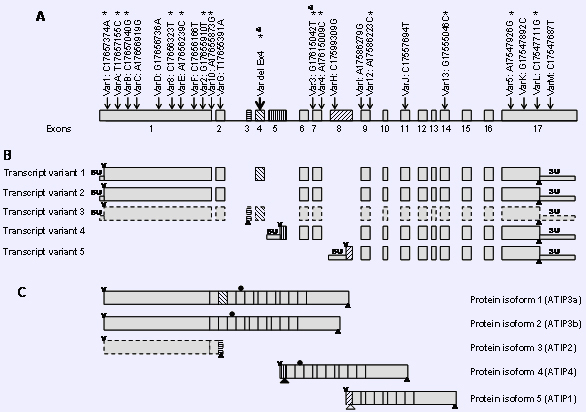
Organization of the MTUS1 gene. A) The schematic representation of genomic organization of MTUS1 gene located on the minus strand of chromosome 8p21.3-p22. The genomic locations of the detected nucleotide sequence variants (both polymorphisms and somatic mutations) for MTUS1 gene were indicated. The nucleotide sequence variants that lead to amino acid changes were identified with *. The & indicates exon deletion. B) The alternative exon utilization by MTUS1 transcript variants. The v indicates translational initiating ATG codon. The ^ indicates stop codon. The 5U indicates 5 untranslated region, and the 3U indicates 3 untranslated region. An in-frame stop codon is located in exon 3. This in-frame stop codon makes the transcript variant 3 (dash-lined) a candidate for nonsense-mediated mRNA decay (NMD). C) The protein isoforms resulted from the MTUS1 transcript variants and cellular localization signals. The alternative names for the isoforms were given in parenthesis. Black circles indicate nuclear localization signals. Black triangle indicates a putative transmembrane region. White triangle indicates a mitochondrial targeting signal. The existence of the in-frame stop codon suggests that isoform 3 (dash-lined) is interrupted at exon 3.
Transcription
The production of transcript variant 1, 2 and 3, which are driven by a common promoter, are produced by alternative splicing of exon 3 and exon 4. The splice junctions contain the conserved nucleotides (GT-AG) for the donor and acceptor splice sites. An in-frame stop codon in exon 3 indicates that the MTUS1 protein isoform 3 (the only isoform to utilize exon 3) may be interrupted at this position. This sequence feature also makes the transcript variant 3 a candidate for nonsense-mediated mRNA decay (NMD). Indeed, it is absent (or weakly expressed) in all normal tissues examined. While both transcript variant 1 and 2 show similar tissue distribution patterns, variant 1 is more expressed than variant 2 in most tissues. However, in the salivar gland, variant 2 accounts for more than 90% of all the MTUS1 transcript members. Apparently, the exon 4 is the only alternatively spliced exon out of 17 exons of the MTUS1 gene, which leads to the production of MTUS1 transcript variant 1 and 2. Alternatively, variant 2 may be a transcript from the MTUS1 gene with a recently identified polymorphic copy number variant at DNA level (Var del Ex4 that lacking the coding exon 4). Interestingly, an association of this MTUS1 gene Var del Ex4 polymorphism and familial breast cancer has been observed in a Germany patient cohort.
Proteins
Expression
- MTUS1 isoform 1 and 2 are the major MTUS1 transcripts in all tissues except brain
- MTUS1 isoform 3 is absent (or weakly expressed) in all normal tissues examined
- MTUS1 isoform 4 is exclusively expressed in the brain, and is particularly abundant in the cerebellum and in the fetal brain.
- MTUS1 isoform 3 is absent (or weakly expressed) in all normal tissues examined
- MTUS1 isoform 4 is exclusively expressed in the brain, and is particularly abundant in the cerebellum and in the fetal brain.
Localisation
MTUS1 isoform 5 is the only isoform localized in mitochondria.
Function
The MTUS1 isoform 5 was the first one among the 5 different isoforms to be characterized independently in 2 laboratories, as a gene that is transiently upregulated during initiation of differentiation and quiescence in a 3-dimensional human umbilical vein endothelial cell culture, and as a early component of growth inhibitory signaling cascade that interacts with angiotensin II AT2 receptor. The exon 8, which is exclusively utilized by MTUS1 isoform 5, contains a mitochondrial targeting signal. This protein isoform has indeed been shown to co-localize with mitochondria, which eventually lead to its current name mitochondrial tumor suppressor 1. These early evidences on MTUS1 isoform 5 suggest the tumor suppressor function of this gene. As a consequence, the majority of the functional analyses have been focused on this specific isoform. As demonstrated in a pancreatic tumor cell line (MIA PaCa-2), recombinant expression of MTUS1 isoform 5 led to a 30% reduction in cell growth as measured by BrdU uptake. Using a CHO cell line stably transfected with both angiotensin II AT2 receptor and MTUS1 isoform 5, Nouet et al. demonstrated that the growth factors (insulin, bFGF, EGF) induced extracellular regulated kinase ( ERK2 ) activation was inhibited. This MTUS1 isoform 5 mediated inhibitory effect was also observed at cell proliferation level as measured by DNA synthesis. The results from Nouet et al., 2006 study also suggested that MTUS1 isoform 5 functions through cooperating with the angiotensin II AT2 receptor to trans-inactivate growth factor receptor tyrosine kinases. The localization of the MTUS1 isoform 5 to mitochondria also lead to speculation that this protein achieves its tumor suppressor function by regulating different mitochondrial functions, such as the maintenance of energy supply, the production of reactive oxygen intermediates and their interactions with other cell cycle regulators.
While ample evidence suggested the tumor suppressor function of isoform 5, it is important to notice that isoform 1 and 2 are the major MTUS1 transcripts in all tissues except brain, and account for an average of 72% of total MTUS1 mRNA. Evidence supporting the tumor suppressor function of MTUS1 isoform 1 and 2 come from the study on Xenopus Icis gene, a homolog of MTUS1 isoform 1/2. Using inactivating antibodies, Ohi et al. found that absence of Icis caused excessive microtubule growth and inhibited spindle formation, a function consistent with tumor suppressor activity. Prior to anaphase, Icis localized to inner centromeres in a Mitotic Centromere Associated Kinesin ( Mcak )-dependent manner. From Xenopus extracts, Icis coimmunoprecipitated Mcak and the inner centromere proteins Incenp and AuroraB, which are thought to promote chromosome biorientation. Immunoelectron microscopy detected Icis on the surface of inner centromeres, in an ideal location to depolymerize microtubules associated laterally with inner centromeres. Ohi et al. hypothesized that Mcak-Icis may destabilize these microtubules and provide a mechanism that prevents kinetochore-microtubule attachment errors.
The MTUS1 isoform 1 and isoform 2 differ in their use of exon 4; exon 4 is contained in isoform 1 but not in isoform 2 (Figure 2). This difference may be a result of alternative splicing. Alternatively, this isoform 2 may be a protein product from the MTUS1 gene with a recently identified polymorphic copy number variant at DNA level (Var del Ex4 that lacking the exon 4).
The existence of MTUS1 isoform 3 is not entirely certain. The expression of MTUS1 isoform 3 appears to be under the control of the same gene promoter that drives the expression of the isoform 1 and 2. However, as a result of alternative splicing, exon 3, which contains an in-frame stop codon, is incorporated into the transcript. This sequence feature makes the transcript variant 3 a candidate for nonsense-mediated mRNA decay (NMD). Indeed, it is absent (or weakly expressed) in all normal tissues examined. Hence, the sequence for this variant in the GenBank (NM_001001927) was permanently suppressed. Nevertheless, it is possible that this alternative splice to include exon 3 in the transcript may provide a mechanism to switch-off the expression of isoform 1 and 2 at posttranscriptional level.
The MTUS1 isoform 4 is exclusively expressed in the brain, and is particularly abundant in the cerebellum and in the fetal brain. It appears that the expression of isoform 4 is driven by a gene promoter specific to central nervous system. These findings suggest multiple cellular/physiological functions of MTUS1 gene, including tumor suppression as well as brain function and/or development.
While ample evidence suggested the tumor suppressor function of isoform 5, it is important to notice that isoform 1 and 2 are the major MTUS1 transcripts in all tissues except brain, and account for an average of 72% of total MTUS1 mRNA. Evidence supporting the tumor suppressor function of MTUS1 isoform 1 and 2 come from the study on Xenopus Icis gene, a homolog of MTUS1 isoform 1/2. Using inactivating antibodies, Ohi et al. found that absence of Icis caused excessive microtubule growth and inhibited spindle formation, a function consistent with tumor suppressor activity. Prior to anaphase, Icis localized to inner centromeres in a Mitotic Centromere Associated Kinesin ( Mcak )-dependent manner. From Xenopus extracts, Icis coimmunoprecipitated Mcak and the inner centromere proteins Incenp and AuroraB, which are thought to promote chromosome biorientation. Immunoelectron microscopy detected Icis on the surface of inner centromeres, in an ideal location to depolymerize microtubules associated laterally with inner centromeres. Ohi et al. hypothesized that Mcak-Icis may destabilize these microtubules and provide a mechanism that prevents kinetochore-microtubule attachment errors.
The MTUS1 isoform 1 and isoform 2 differ in their use of exon 4; exon 4 is contained in isoform 1 but not in isoform 2 (Figure 2). This difference may be a result of alternative splicing. Alternatively, this isoform 2 may be a protein product from the MTUS1 gene with a recently identified polymorphic copy number variant at DNA level (Var del Ex4 that lacking the exon 4).
The existence of MTUS1 isoform 3 is not entirely certain. The expression of MTUS1 isoform 3 appears to be under the control of the same gene promoter that drives the expression of the isoform 1 and 2. However, as a result of alternative splicing, exon 3, which contains an in-frame stop codon, is incorporated into the transcript. This sequence feature makes the transcript variant 3 a candidate for nonsense-mediated mRNA decay (NMD). Indeed, it is absent (or weakly expressed) in all normal tissues examined. Hence, the sequence for this variant in the GenBank (NM_001001927) was permanently suppressed. Nevertheless, it is possible that this alternative splice to include exon 3 in the transcript may provide a mechanism to switch-off the expression of isoform 1 and 2 at posttranscriptional level.
The MTUS1 isoform 4 is exclusively expressed in the brain, and is particularly abundant in the cerebellum and in the fetal brain. It appears that the expression of isoform 4 is driven by a gene promoter specific to central nervous system. These findings suggest multiple cellular/physiological functions of MTUS1 gene, including tumor suppression as well as brain function and/or development.
Homology
Xenopus Icis gene is a homolog of MTUS1 isoform 1 and 2.
Mutations
Somatic
Sequence analyses of this gene in liver cancer and head and neck cancer revealed that MTUS1 gene is prone to various point mutations and small deletions. Many of these mutations lead to substitutions of conserved amino acid residues or interfere with the physiological splice sites that may functionally silence the MTUS1 gene. In particular, a point mutation in exon 7 (Var3 G17615042T), identified in an 8p21.3-p22 LOH-positive liver cancer cell line, abolished a physiological splicing acceptor site of exon 7. Additional experiment confirmed that this point mutation indeed leads to a transcript that lacking exon 7. Thus, this point mutation results in the deletion of the entire exon 7, which codes for several important motifs, including a nuclear localization signal.
Implicated in
Entity name
Various Cancers
Note
Mitochondrial tumor suppressor gene 1 (MTUS1) is a recently identified tumor suppressor gene that resides in a frequent LOH region (8p21.3-p22) in many tumor types. Sequence analyses of MTUS1 gene suggest that this gene is rich in genetic polymorphisms, including single nucleotide polymorphism (SNP) and copy number variation (CNV), and it is susceptible to various point mutations during tumorigenesis. Consistent down-regulation of MTUS1 gene expression was observed in various cancer cell lines and tissue samples.
Entity name
Breast cancer
Note
A copy number variant in MTUS1 gene is significantly associated with a decreased risk for both familial and high-risk familial breast cancer in a Germany patient cohort. This finding was made based on a case-control study on a large homogeneous study cohort (case n = 593, control n = 732) of a single ethnic group. These authors hypothesized that the lack of this exon 4 may lead to increased tumor suppressor activity. Further molecular analyses will be needed to functionally characterize this apparent phenotypic difference. While the true biological consequence(s) of this MTUS1 exon 4 deletion is still unknown, this study clearly suggested a functional difference between MTUS1 isoform 1 and isoform 2.
Entity name
Pancreatic cancer
Note
In a pancreatic tumor cell line (MIA PaCa-2), recombinant expression of MTUS1 isoform 5 led to a 30% reduction in cell growth as measured by BrdU uptake.
Entity name
Head and neck squamous cell carcinoma
Note
Consistent down-regulation in expression was observed in HNSCC for MTUS1 as measured by real-time quantitative RT-PCR. Sequence analysis of MTUS1 gene in HNSCC revealed several important sequence variants in the exon regions of this gene.
Entity name
Hepatocellular carcinoma
Note
Sequence analysis of MTUS1 gene in hepatocellular carcinoma revealed several important sequence variants in the exon regions of this gene.
Article Bibliography
| Pubmed ID | Last Year | Title | Authors |
|---|---|---|---|
| 12759929 | 2003 | Haploinsufficiency and reduced expression of genes localized to the 8p chromosomal region in human prostate tumors. | Chaib H et al |
| 16650523 | 2006 | Mutation analysis of the 8p22 candidate tumor suppressor gene ATIP/MTUS1 in hepatocellular carcinoma. | Di Benedetto M et al |
| 17301065 | 2007 | Copy number variant in the candidate tumor suppressor gene MTUS1 and familial breast cancer risk. | Frank B et al |
| 15123706 | 2004 | Trans-inactivation of receptor tyrosine kinases by novel angiotensin II AT2 receptor-interacting protein, ATIP. | Nouet S et al |
| 12919681 | 2003 | An inner centromere protein that stimulates the microtubule depolymerizing activity of a KinI kinesin. | Ohi R et al |
| 16270321 | 2005 | Five genes from chromosomal band 8p22 are significantly down-regulated in ovarian carcinoma: N33 and EFA6R have a potential impact on overall survival. | Pils D et al |
| 10340384 | 1999 | Identification of three distinct regions of allelic deletions on the short arm of chromosome 8 in hepatocellular carcinoma. | Pineau P et al |
| 12692079 | 2003 | Identification of a new tumor suppressor gene located at chromosome 8p21.3-22. | Seibold S et al |
| 12781443 | 2003 | Transfer of chromosome 8 into two breast cancer cell lines: total exclusion of three regions indicates location of putative in vitro growth suppressor genes. | Wilson P et al |
| 17656251 | 2007 | Genomic assessments of the frequent loss of heterozygosity region on 8p21.3-p22 in head and neck squamous cell carcinoma. | Ye H et al |
| 10023714 | 1999 | Localization of a tumor suppressor gene associated with the progression of human breast carcinoma within a 1-cM interval of 8p22-p23.1. | Yokota T et al |
| 16080964 | 2005 | Frequent allelic imbalances at 8p and 11q22 in oral and oropharyngeal epithelial dysplastic lesions. | Zhou X et al |
Other Information
Locus ID:
NCBI: 57509
MIM: 609589
HGNC: 29789
Ensembl: ENSG00000129422
Variants:
dbSNP: 57509
ClinVar: 57509
TCGA: ENSG00000129422
COSMIC: MTUS1
RNA/Proteins
Expression (GTEx)
References
| Pubmed ID | Year | Title | Citations |
|---|---|---|---|
| 38282475 | 2024 | ATIP/ATIP1 regulates prostate cancer metastasis through mitochondrial dynamic-dependent signaling. | 0 |
| 38658371 | 2024 | [Microtubule-associated tumor suppressor 1 inhibits hemin-induced apoptosis of vascular endothelial cells via hemeoxygenase 1]. | 0 |
| 38282475 | 2024 | ATIP/ATIP1 regulates prostate cancer metastasis through mitochondrial dynamic-dependent signaling. | 0 |
| 38658371 | 2024 | [Microtubule-associated tumor suppressor 1 inhibits hemin-induced apoptosis of vascular endothelial cells via hemeoxygenase 1]. | 0 |
| 35962436 | 2022 | MTUS1 is a promising diagnostic and prognostic biomarker for colorectal cancer. | 4 |
| 37099789 | 2022 | Long Noncoding RNA MIR600HG Binds to MicroRNA-125a-5p to Prevent Pancreatic Cancer Progression Via Mitochondrial Tumor Suppressor 1-Dependent Suppression of Extracellular Regulated Protein Kinases Signaling Pathway. | 1 |
| 35962436 | 2022 | MTUS1 is a promising diagnostic and prognostic biomarker for colorectal cancer. | 4 |
| 37099789 | 2022 | Long Noncoding RNA MIR600HG Binds to MicroRNA-125a-5p to Prevent Pancreatic Cancer Progression Via Mitochondrial Tumor Suppressor 1-Dependent Suppression of Extracellular Regulated Protein Kinases Signaling Pathway. | 1 |
| 32789689 | 2021 | Reciprocal regulation of Aurora kinase A and ATIP3 in the control of metaphase spindle length. | 6 |
| 34062782 | 2021 | Microtubule-Associated Protein ATIP3, an Emerging Target for Personalized Medicine in Breast Cancer. | 4 |
| 34125870 | 2021 | In silico analysis of deleterious SNPs of human MTUS1 gene and their impacts on subsequent protein structure and function. | 12 |
| 32789689 | 2021 | Reciprocal regulation of Aurora kinase A and ATIP3 in the control of metaphase spindle length. | 6 |
| 34062782 | 2021 | Microtubule-Associated Protein ATIP3, an Emerging Target for Personalized Medicine in Breast Cancer. | 4 |
| 34125870 | 2021 | In silico analysis of deleterious SNPs of human MTUS1 gene and their impacts on subsequent protein structure and function. | 12 |
| 31882471 | 2020 | Loss of MTUS1 Expression Is Associated With Poor Prognosis in Patients With Gallbladder Carcinoma. | 6 |
Citation
Xiaofeng Zhou ; Jinsheng Yu ; Xiqiang Liu
MTUS1 (mitochondrial tumor suppressor 1)
Atlas Genet Cytogenet Oncol Haematol. 2008-12-01
Online version: http://atlasgeneticsoncology.org/gene/41451/mtus1
