PPARG (peroxisome proliferator-activated receptor gamma)
2008-07-01 Erhan Astarci , Sreeparna Banerjee AffiliationDepartment of Biological Sciences, Middle East Technical University, Ankara 06531 Turkey
Identity
HGNC
LOCATION
3p25.2
LOCUSID
ALIAS
CIMT1,GLM1,NR1C3,PPARG1,PPARG2,PPARG5,PPARgamma
FUSION GENES
DNA/RNA
Note
The PPAR gamma gene extends over 100kb with 9 exons which gives rise to 3 different PPAR gamma transcripts with differential promoter usage and differential splicing: PPAR gamma 1, 2 and 3. PPAR gamma 1 transcript contains 8 exons which is 97% identical to PPAR gamma 2.
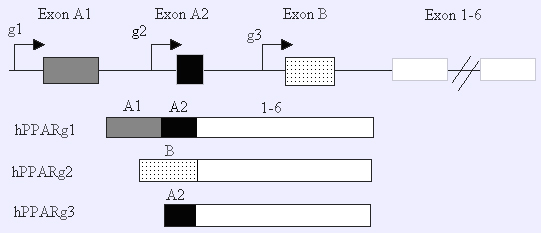
Genomic structure of the 5 primed end of the human PPAR gamma gene. All three subtypes have the exons 1-6. PPAR gamma1 contains in addition the exons A1 and A2 both of which are untranslated, PPAR gamma2 contains exon B, which is translated, and PPAR gamma3 contains only the untranslated exon A2.
Description
According to Entrez-Gene, PPAR gamma gene maps to NC_000003 and spans a region of 100 kilo bases. According to Spidey, PPAR gamma 1 has 8 exons, the sizes being 171, 74, 228, 170, 139, 200, 451 and 459 bps. PPAR gamma 2 has 7 exons, the sizes being 173, 228, 170, 139, 200, 451 and 459. PPAR Gamma 3 has 8 exons, the sizes being 198, 74, 228, 170, 139, 200, 451, and 459.
Transcription
PPAR gamma 1 mRNA (NM_138712) has a size of 1892 bp, PPAR gamma 2 mRNA (NM_015869) has a size of 1820 bp while PPAR gamma 3 mRNA (NM_138711) has a size of 1919 bp.
The ratio of PPAR gamma2 to PPAR gamma1 transcript has been shown to increase in obese patients in correlation with their body mass indices. A low calorie diet was specifically shown to down-regulate the expression of PPAR gamma2 mRNA in adipose tissue of obese humans. However, this effect was lost subsequently during weight maintenance.
The PPAR gamma3 mRNA is transcribed from a novel promoter localized 5 of exon A2 (see diagram above). PPARgamma3 mRNA expression is said to be restricted to human white adipocytes, as well as in HepG2, Caco-2 and HeLa cell lines.
The ratio of PPAR gamma2 to PPAR gamma1 transcript has been shown to increase in obese patients in correlation with their body mass indices. A low calorie diet was specifically shown to down-regulate the expression of PPAR gamma2 mRNA in adipose tissue of obese humans. However, this effect was lost subsequently during weight maintenance.
The PPAR gamma3 mRNA is transcribed from a novel promoter localized 5 of exon A2 (see diagram above). PPARgamma3 mRNA expression is said to be restricted to human white adipocytes, as well as in HepG2, Caco-2 and HeLa cell lines.
Pseudogene
No pseudogene has been reported for PPAR gamma.
Proteins
Note
There are 3 different PPAR gamma proteins PPAR gamma 1, 2 and 3 which differ at their 5-prime ends, each under the control of its own promoter. PPAR gamma1 and PPAR gamma3, however, give rise to the same protein, encoded by exons 1 through 6, because neither the A1 nor the A2 exons are translated.
Description
The PPAR gamma protein consists of 505 amino acids and has a molecular weight of 57.6 kDa. According to the NCBI conserved domain search, it contains two C4 type zinc finger domains. In nearly all cases, this is the DNA binding domain of a nuclear hormone receptor. In addition it contains a ligand binding domain. This all-helical domain is involved in binding the hormone to these receptors.
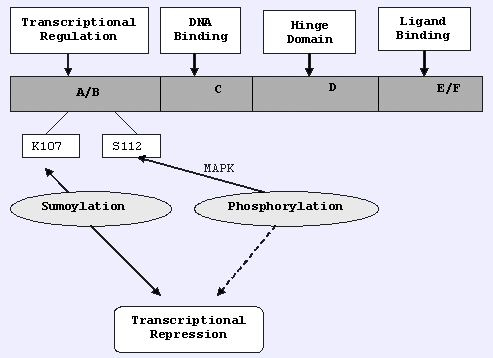
The various domains of PPAR gamma protein with their specific functions. Post transcriptional modifications indicating functional changes have been depicted.
Expression
In general, the highest expression of PPAR gamma can be found in the adipose tissue, colonic epithelia, macrophages, and endothelium, followed by the kidney, liver, and small intestine; whereas PPAR gamma can barely be detected in the muscle.
Of the splice variants, PPAR gamma1 and gamma2 are expressed in adipose tissue. PPAR gamma1 expression levels were lower than gamma2 in the liver and heart, whereas both gamma1 and gamma2 were expressed in skeletal muscle at low levels.
The expression of PPAR gamma3 mRNA is restricted to adipose tissue and differentiated CaCo2 cells.
Of the splice variants, PPAR gamma1 and gamma2 are expressed in adipose tissue. PPAR gamma1 expression levels were lower than gamma2 in the liver and heart, whereas both gamma1 and gamma2 were expressed in skeletal muscle at low levels.
The expression of PPAR gamma3 mRNA is restricted to adipose tissue and differentiated CaCo2 cells.
Localisation
Localized in the nucleus.
Function
Protein-protein interactions PPARs function as heterodimers with retinoid receptor (RXR). The PPAR RXR heterodimer function along with co-activators such as NCOA6, NCOA7 or PPARBP, leading to increases in transcription of target genes.
PPAR gamma1 or PPAR gamma 2 in a heterodimer with RXR is capable of forming complexes with oligonucleotides containing peroxisome proliferator response elements (PPREs) usually 5-AACT AGGNCA A AGGTCA-3 in the promoter regions of the target genes. PPAR gamma1 and PPAR gamma2 can also form complexes with RXRB and RXRG.
Ligands of PPAR gamma PPAR gamma1 and PPAR gamma2 have ligand-dependent and -independent activation domains. Due to the presence of an additional 28 amino acids at the amino terminus, PPAR gamma2 has a ligand-independent activation domain that is several folds more effective than that of PPAR gamma1. However, in the presence of ligands that can be lipid derivatives, eicosanoids, xenobiotics etc, triggers a conformational change in the protein that results in the recruitment of transcriptional co-activators. In the absence of a ligand, PPAR gamma is bound to transcriptional co-repressors containing nuclear receptor corepressor ( N-CoR ) and can actively silence the transcription of target genes.
Phosphorylation of serine 112 at the N terminus of PPAR gamma2 results in a reduction of its transcriptional activity. This phosphorylation further promotes the sumoylation of lysine 107 which then further reduces its transcriptional activity.
The prostaglandin J2 (PGJ2) metabolite l5-deoxy-Delta12,14-PGJ2 binds directly to PPAR gamma and can promotes the differentiation of C3HlOT1/2 fibroblasts to adipocytes. Its principal function came to light when it was found that the anti-diabetic drug thiazolidinediones (TZD) was a PPAR gamma ligand. The TZD series of drugs via their agonist activity on PPAR gamma promotes the uptake of circulating fatty acids into adipocytes. The glucose lowering effects of TZDs are due to increased disposal of glucose into adipose tissues along with increased expression of insulin sensitizing factors (such as adiponectin) and decreased expression of proteins that promote insulin resistance.
PPAR gamma also has an anti-inflammatory role by inhibiting the production of inflammatory cytokines, and other proteins such as TNF-alpha, MMP9 and iNOS from macrophages in the presence of ligands such as TZD. Inhibition of pro-inflammatory transcription factors such as NF-kB, AP-1 and STAT by PPAR gamma is said to be through limited availability of shared co-factors as well as direct protein-protein interactions.
The prostaglandin J2 (PGJ2) metabolite l5-deoxy-Delta12,14-PGJ2 binds directly to PPAR gamma and can promotes the differentiation of C3HlOT1/2 fibroblasts to adipocytes. Its principal function came to light when it was found that the anti-diabetic drug thiazolidinediones (TZD) was a PPAR gamma ligand. The TZD series of drugs via their agonist activity on PPAR gamma promotes the uptake of circulating fatty acids into adipocytes. The glucose lowering effects of TZDs are due to increased disposal of glucose into adipose tissues along with increased expression of insulin sensitizing factors (such as adiponectin) and decreased expression of proteins that promote insulin resistance.
PPAR gamma also has an anti-inflammatory role by inhibiting the production of inflammatory cytokines, and other proteins such as TNF-alpha, MMP9 and iNOS from macrophages in the presence of ligands such as TZD. Inhibition of pro-inflammatory transcription factors such as NF-kB, AP-1 and STAT by PPAR gamma is said to be through limited availability of shared co-factors as well as direct protein-protein interactions.
Homology
Canis familiaris PPARG peroxisome proliferator-activated receptor gamma
Pan troglodytes PPARG peroxisome proliferator-activated receptor gamma
Rattus norvegicus Pparg peroxisome proliferator-activated receptor gamma
Mus musculus Pparg peroxisome proliferator-activated receptor gamma
Pan troglodytes PPARG peroxisome proliferator-activated receptor gamma
Rattus norvegicus Pparg peroxisome proliferator-activated receptor gamma
Mus musculus Pparg peroxisome proliferator-activated receptor gamma
Mutations
Note
Several mutations in the PPAR gamma protein have been reported along with their association with diseased states.
1. P115Q results in severe obesity
2. 1-BP DEL, 472A, Q286P, K319TER and R288H mutations have been reported in somatic colon cancer
3. P467L, V290M mutations have been reported in partial familial lipodystrophy type 3
4. 3-BP DEL/1-BP INS, NT553, shown in digenic insulin resistance.
1. P115Q results in severe obesity
2. 1-BP DEL, 472A, Q286P, K319TER and R288H mutations have been reported in somatic colon cancer
3. P467L, V290M mutations have been reported in partial familial lipodystrophy type 3
4. 3-BP DEL/1-BP INS, NT553, shown in digenic insulin resistance.
Implicated in
Entity name
Metabolic syndrome
Note
Metabolic syndrome is a very common condition that is associated with an increased risk of cardiovascular disease and type 2 diabetes mellitus. In obese and diabetic rodents thiazolidinediones (TZDs), known to be a potent PPAR gamma ligand, are mostly used to alleviate elevated plasma glucose levels and they are known to be efficacious therapeutic agents for the treatment of noninsulin-dependent diabetes mellitus (NIDDM). TZD derivatives can also increase the insulin sensitivity of target tissues in animal models of NIDDM. The antidiabetic effects of TZDs are thought to be mediated by means of transactivation of PPAR gamma 1 and 2.
A commonly found polymorphism of PPAR gamma, P12A, is associated with decreased risk of type 2 diabetes.
An alternative activation of macrophages has been implicated in the atheroprotective effects of PPAR gamma. PPAR gamma is critical for the formation of a subpopulation of "alternatively activated" macrophages which exert their anti-inflammatory properties via paracrine effects on "classically activated" (M1) macrophages within the atherosclerotic lesion. In addition, oxidized low density lipoproteins (LDL), but not normal LDL, reduce the expression of proinflammatory cytokines in LPS stimulated macrophages presumably through their effect on PPAR gamma.
A commonly found polymorphism of PPAR gamma, P12A, is associated with decreased risk of type 2 diabetes.
An alternative activation of macrophages has been implicated in the atheroprotective effects of PPAR gamma. PPAR gamma is critical for the formation of a subpopulation of "alternatively activated" macrophages which exert their anti-inflammatory properties via paracrine effects on "classically activated" (M1) macrophages within the atherosclerotic lesion. In addition, oxidized low density lipoproteins (LDL), but not normal LDL, reduce the expression of proinflammatory cytokines in LPS stimulated macrophages presumably through their effect on PPAR gamma.
Entity name
Familial Partial Lipodystrophy Type 3
Note
In a study including patients with hyperinsulinemia and early-onset hypertension, patients have been shown to have dominant-negative mutations in PPAR gamma proteins. The dominant negative effect is characterized with a proline to leucine (P467L) mutation in the PPAR gamma protein. Patients with these mutations showed symptoms of severe peripheral and hepatic insulin resistance, partial lipodystrophy and abnormal functioning of adipose tissue.
Entity name
Breast Cancer
Note
In human primary and metastatic breast cancers it has been shown that there are significant levels of PPAR gamma expression. Cell culture studies have indicated that in the presence of the PPAR gamma ligand TZD, cells have undergone differentiation, lost the malignant phenotype and showed a decrease in the proliferation rate. This was associated with the accumulation of lipids and subsequent change in the expression profile.
Entity name
Prostate Cancer
Note
PPAR gamma expression has been shown in human prostate adenocarcinomas and corresponding cell lines and specific ligands have been found to decrease the proliferation in these cancer cells by indusing PPAR gamma activation. From these data, it has been concluded that PPAR gamma might have a therapeutic potential in prostate cancer by acting as a biological modifier.
Entity name
Colorectal Cancer
Note
Mouse colon treated with PPAR gamma ligands was shown to increase the expression level of beta-catenin protein, In addition, protein-protein interaction was observed between beta-catenin and PPARgamma in cultured cell lines and colonic epithelium in mice. Thus, ligand-activated PPARgamma interacts with beta-catenin, thereby retaining it in the cytosol and reducing beta-catenin/T cell factor transcriptional activity that is required for aberrant crypt foci (ACF) formation. Short-term exposure to dietary PPAR gamma ligands such as linoleic acid and conjugated linoleic acid has been shown to inhibit colon cancer metastasis.
Entity name
Lung cancer
Note
PPAR gamma ligands have been shown to decrease the proliferation of non small cell lung cancer (NSCLC) cell lines and xenograft models. Forced overexpression of PPAR gamma in a NSCLC cell line model inhibited the expression of COX-2 protein and promoter activity, resulting in decreased prostaglandin E2 production. The increased activity of the PTEN homologue caused a decrease in the level of phosphor-AKT and the resulting inhibition of NF-kB was implicated in the inhibition of COX-2 expression.
Entity name
T-Cell Leukaemia
Note
In T-cell leukaemia, the PPAR gamma ligand Prostaglandin D(2) (PGD(2)) which is highly produced in mast cells, platelets, and alveolar macrophages, has antiproliferative effects. On the other hand these prostaglandins have no effect in normal human T cells. Similar actions were observed in the presence of ciglitazone and troglitazone. All of these ligands are thought to be antiapoptotic and exerting their function in a PPAR gamma dependent manner.
Entity name
Pituitary Tumours
Note
PPAR gamma ligands have been shown to induce G0/G1 cell-cycle arrest and apoptosis and suppressed ACTH secretion in human and murine corticotroph tumour cells . In adrenocorticotrophic hormone (ACTH)-secreting pituitary tumours, there is high morbidity associated with excessive glucocorticoid production. The PPAR gamma ligand, rosiglitazone, prevented tumour formation of subcutaneously injected At20 cells secreting ACTH murine corticotroph cells.
Article Bibliography
| Pubmed ID | Last Year | Title | Authors |
|---|---|---|---|
| 17681149 | 2007 | PPARgamma activation primes human monocytes into alternative M2 macrophages with anti-inflammatory properties. | Bouhlel MA et al |
| 18055759 | 2008 | Antitumorigenic effects of peroxisome proliferator-activated receptor-gamma in non-small-cell lung cancer cells are mediated by suppression of cyclooxygenase-2 via inhibition of nuclear factor-kappaB. | Bren-Mattison Y et al |
| 17560826 | 2007 | Modulation of PPAR activity via phosphorylation. | Burns KA et al |
| 8702406 | 1996 | Molecular cloning, expression and characterization of human peroxisome proliferator activated receptors gamma 1 and gamma 2. | Elbrecht A et al |
| 9228052 | 1997 | The organization, promoter analysis, and expression of the human PPARgamma gene. | Fajas L et al |
| 9821958 | 1998 | PPARgamma3 mRNA: a distinct PPARgamma mRNA subtype transcribed from an independent promoter. | Fajas L et al |
| 1816321 | 1991 | Inhibition of lipopolysaccharide-induced interleukin-1 beta mRNA expression in mouse macrophages by oxidized low density lipoprotein. | Fong LG et al |
| 18391483 | 2008 | Peroxisome proliferator-activated receptor gamma (PPARgamma) suppresses colonic epithelial cell turnover and colon carcinogenesis through inhibition of the beta-catenin/T cell factor (TCF) pathway. | Fujisawa T et al |
| 18308193 | 2008 | Narrowing in on cardiovascular disease: the atheroprotective role of peroxisome proliferator-activated receptor gamma. | Gerry JM et al |
| 11849312 | 2002 | Prostaglandin D(2), its metabolite 15-d-PGJ(2), and peroxisome proliferator activated receptor-gamma agonists induce apoptosis in transformed, but not normal, human T lineage cells. | Harris SG et al |
| 12379847 | 2002 | Functional PPAR-gamma receptor is a novel therapeutic target for ACTH-secreting pituitary adenomas. | Heaney AP et al |
| 12088279 | 2002 | PPARs: transcriptional effectors of fatty acids and their derivatives. | Hihi AK et al |
| 8953045 | 1996 | Inhibition of adipogenesis through MAP kinase-mediated phosphorylation of PPARgamma. | Hu E et al |
| 18220654 | 2007 | Peroxisome proliferator-activated receptor (PPAR) in metabolic syndrome and type 2 diabetes mellitus. | Jay MA et al |
| 8521498 | 1995 | A prostaglandin J2 metabolite binds peroxisome proliferator-activated receptor gamma and promotes adipocyte differentiation. | Kliewer SA et al |
| 18551182 | 2008 | The Roles of Dietary PPARgamma Ligands for Metastasis in Colorectal Cancer. | Kuniyasu H et al |
| 7768881 | 1995 | An antidiabetic thiazolidinedione is a high affinity ligand for peroxisome proliferator-activated receptor gamma (PPAR gamma). | Lehmann JM et al |
| 16360030 | 2005 | The many faces of PPARgamma. | Lehrke M et al |
| 14708026 | 2004 | Peroxisome-proliferator-activated receptors and cancers: complex stories. | Michalik L et al |
| 10984506 | 2000 | Effects of ligand activation of peroxisome proliferator-activated receptor gamma in human prostate cancer. | Mueller E et al |
| 11684010 | 2001 | A unique PPARgamma ligand with potent insulin-sensitizing yet weak adipogenic activity. | Rocchi S et al |
| 12663460 | 2003 | Human metabolic syndrome resulting from dominant-negative mutations in the nuclear receptor peroxisome proliferator-activated receptor-gamma. | Savage DB et al |
| 17563457 | 2007 | The role of the Pro12Ala polymorphism in peroxisome proliferator-activated receptor gamma in diabetes risk. | Tönjes A et al |
| 9153284 | 1997 | Peroxisome proliferator-activated receptor gene expression in human tissues. Effects of obesity, weight loss, and regulation by insulin and glucocorticoids. | Vidal-Puig AJ et al |
| 9425261 | 1997 | Molecular scanning of the human peroxisome proliferator activated receptor gamma (hPPAR gamma) gene in diabetic Caucasians: identification of a Pro12Ala PPAR gamma 2 missense mutation. | Yen CJ et al |
| 17306620 | 2007 | Transcription coactivators for peroxisome proliferator-activated receptors. | Yu S et al |
Other Information
Locus ID:
NCBI: 5468
MIM: 601487
HGNC: 9236
Ensembl: ENSG00000132170
Variants:
dbSNP: 5468
ClinVar: 5468
TCGA: ENSG00000132170
COSMIC: PPARG
RNA/Proteins
Expression (GTEx)
Pathways
Protein levels (Protein atlas)
PharmGKB
| Entity ID | Name | Type | Evidence | Association | PK | PD | PMIDs |
|---|---|---|---|---|---|---|---|
| PA10235 | zoledronate | Chemical | VariantAnnotation | associated | PD | ||
| PA443450 | Asthma | Disease | ClinicalAnnotation | associated | PD | ||
| PA443890 | Diabetes Mellitus, Type 2 | Disease | ClinicalAnnotation | associated | PD | 12610044 | |
| PA444985 | Multiple Myeloma | Disease | VariantAnnotation | associated | PD | ||
| PA447216 | Schizophrenia | Disease | ClinicalAnnotation | associated | PD | 19622037 | |
| PA448497 | aspirin | Chemical | ClinicalAnnotation | associated | PD | ||
| PA448871 | celecoxib | Chemical | Pathway | associated | 22336956 | ||
| PA450688 | olanzapine | Chemical | ClinicalAnnotation | associated | PD | 19622037 | |
| PA450970 | pioglitazone | Chemical | ClinicalAnnotation | associated | PD | 12610044 |
References
| Pubmed ID | Year | Title | Citations |
|---|---|---|---|
| 37992807 | 2024 | Testicular ACE regulates sperm metabolism and fertilization through the transcription factor PPARγ. | 2 |
| 38251918 | 2024 | Cutting Edge: Cytosolic Receptor AIM2 Is Induced by Peroxisome Proliferator-activated Receptor γ following Mycobacterium tuberculosis Infection of Human Macrophages but Does Not Contribute to IL-1β Release. | 1 |
| 38426604 | 2024 | Adipocyte‑rich microenvironment promotes chemoresistance via upregulation of peroxisome proliferator‑activated receptor gamma/ABCG2 in epithelial ovarian cancer. | 1 |
| 38492104 | 2024 | Association of Polymorphic Variants of TCF7L2 and PPARG Genes with Metabolic Markers in Patients with Early Disorders of Carbohydrate Metabolism. | 0 |
| 38573982 | 2024 | Identification of PPARG as key gene to link coronary atherosclerosis disease and rheumatoid arthritis via microarray data analysis. | 0 |
| 38619661 | 2024 | Dual function of activated PPARγ by ligands on tumor growth and immunotherapy. | 1 |
| 38624012 | 2024 | Abscisic acid signaling through LANCL2 and PPARγ induces activation of p38MAPK resulting in dormancy of prostate cancer metastatic cells. | 0 |
| 38642079 | 2024 | Tumor necrosis factor receptor-associated factor 5 protects against intimal hyperplasia by regulation of macrophage polarization via directly targeting PPARγ. | 0 |
| 38648706 | 2024 | PPARG-mediated autophagy activation alleviates inflammation in rheumatoid arthritis. | 0 |
| 38753762 | 2024 | PPARgamma dependent PEX11beta counteracts the suppressive role of SIRT1 on neural differentiation of HESCs. | 0 |
| 37992807 | 2024 | Testicular ACE regulates sperm metabolism and fertilization through the transcription factor PPARγ. | 2 |
| 38251918 | 2024 | Cutting Edge: Cytosolic Receptor AIM2 Is Induced by Peroxisome Proliferator-activated Receptor γ following Mycobacterium tuberculosis Infection of Human Macrophages but Does Not Contribute to IL-1β Release. | 1 |
| 38426604 | 2024 | Adipocyte‑rich microenvironment promotes chemoresistance via upregulation of peroxisome proliferator‑activated receptor gamma/ABCG2 in epithelial ovarian cancer. | 1 |
| 38492104 | 2024 | Association of Polymorphic Variants of TCF7L2 and PPARG Genes with Metabolic Markers in Patients with Early Disorders of Carbohydrate Metabolism. | 0 |
| 38573982 | 2024 | Identification of PPARG as key gene to link coronary atherosclerosis disease and rheumatoid arthritis via microarray data analysis. | 0 |
Citation
Erhan Astarci ; Sreeparna Banerjee
PPARG (peroxisome proliferator-activated receptor gamma)
Atlas Genet Cytogenet Oncol Haematol. 2008-07-01
Online version: http://atlasgeneticsoncology.org/gene/383/pparg
