t(14;20)(q32;q12) IGH/MAFB in Plasma Cell Myeloma
2018-09-01 Mark A Micale Affiliation1.Department of Pathology and Laboratory Medicine and Department of Obstetrics & Gynecology Beaumont Health and Oakland University William Beaumont School of Medicine, Royal Oak, MI 48073 [email protected]
Abstract
Plasma cell myeloma (PCM) is a complex and genetically heterogenous hematological malignancy involving clonal proliferation of plasma cells in bone marrow. It is the third most common hematolymphoid malignancy in the United States and primarily affects elderly people with a median onset age of 69 years and a survival duration ranging from a few months to more than 10 years. Standard karyotype and fluorescence in situ hybridization (FISH) evaluation of bone marrow is required in the initial diagnostic workup to risk stratify patients based on their cytogenetic status. Primary cytogenetic events are classified as either hyperdiploid or non-hyperdiploid. Common in non-hyperdiploid cases is rearrangement of the IGH gene on chromosome 14q32.33, most commonly with the CCND1 gene at 11q13.3, and to a lesser extent FGFR3/MMSET genes at 4p16.3 or the MAF gene at 16q23.2. The rarest of these IGH translocations involves the MAFB gene at 20q12, which is the subject of this review.
Clinics and Pathology
Disease
Collectively, the term plasma cell neoplasms include a number of disorders characterized by monoclonal gammopathy. The most common of these disorders, monoclonal gammopathy of undetermined significance (MGUS), is characterized by the infiltration of clonal plasma cells into bone marrow (30% plasma cells, a non-systemic solitary plasmacytoma, or plasma cell leukemia with a peripheral blood plasmacytosis >20% [Rollig et al, 2015].
Phenotype stem cell origin
Plasma cells develop from hematopoietic stem cells that differentiate first into B-cells, then eventually after several rounds of differentiation into plasma cells. The final differentiation stage of B-cells occurs in bone marrow and involves rearrangement of the immunoglobulin heavy chain gene (IGH), followed by rearrangement of the light chain genes [IG kappa (IGK) and IG lambda [IGL)]. The mature B cell than exits the bone marrow to populate secondary lymphoid organs where it will continue its maturation. Somatic hypermutation occurs within the germinal centers of these secondary lymphoid organs, involving stochastic mutations within the VDJ segment. The final maturation stage involves class switch recombination, resulting in the mature B-cell expressing IgG, IgA, or IgE. The mature B-cell will now either differentiate into a memory B-cell or return to bone marrow as a long-lived plasma cell [Corre et al, 2015].
Etiology
Epidemiology
Approximately 40-50% of myeloma cases demonstrate an IGH gene rearrangement. The t(14;20)(q32;q12) is the rarest of the five most common IGH-rearrangements, found in approximately 1% of cases [Manier et al, 2016].
Pathology
Malignant plasma cells are positive by flow cytometry for CD138 and CD38, negative for CD19, and either positive or negative for CD45 and CD56. Immunohistochemical detection of CD138 (syndecan-1) helps to quantify plasma cell in tissue. Detection of CD56, cyclin-D1, and CD117 are also helpful.
Prognosis
Cytogenetics
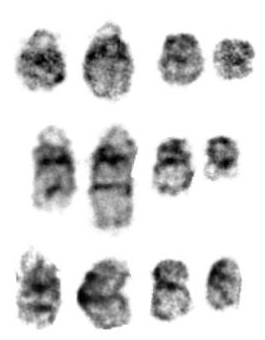
Cytogenetics morphological
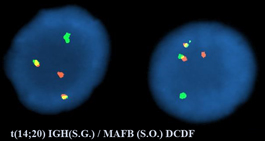
Genes Involved and Proteins
Result of the Chromosomal Anomaly
Oncogenesis
Myeloma cases with either of the two poor prognosis translocations, t(14;16) (q32;q23) and t(14;20)(q32;q12) associated with MAF or MAFB gene dysregulation, respectively, have been shown to have a higher mutational burden than other cytogenetic groups of myeloma and to have an APOBEC gene signature resulting in overexpression of APOBEC3Aand APOBEC3B genes. ENCODE data demonstrates a maf transcription factor binding site in the promoter regions of both genes, providing the link between MAF or MAFB dysregulation and increased tumor load [Walker BA et al, 2015]. The t(14;16) and t(14;20) are known to be associated with long-term stable disease in MGUS and SM despite their poor prognostic indication in plasma cell myeloma. This raised the possibility that the APOBEC signature is acquired at a later stage in the disease, and only at that time does the condition transform to plasma cell myeloma. A very recent study has proven that APOBEC activity does, in fact, increase with disease progression from MGUS or SM to overt PCM [Bolli N et al, 2018].
Finally, genome-scale methylation profiling studies have shown that the MAFB protein establishes an epigenetic program in hematopoietic stem/progenitor cells which can reset the genome of such cells to a terminally differentiated tumor state [Vicente-Dueñas et al, 2012].
Highly cited references
| Pubmed ID | Year | Title | Citations |
|---|---|---|---|
| 37206191 | 2023 | A diagnostic approach to detect cytogenetic heterogeneity and its prognostic significance in multiple myeloma. | 32 |
| 31391406 | 2019 | Plasma cell myeloma positive for t(14;20) with relapse in the central nervous system. | 19 |
| 32447782 | 2020 | High-risk cytogenetics in multiple myeloma: Further scrutiny of deletions within the IGH gene region enhances risk stratification. | 0 |
| 30295256 | 2018 | [Detection of the Cytogenetic Aberrations in Multiple Myeloma by Using Microrray Comparative Genomic Hybridization]. | 0 |
Article Bibliography
| Pubmed ID | Last Year | Title | Authors |
|---|---|---|---|
| 30135448 | 2018 | Genomic patterns of progression in smoldering multiple myeloma. | Bolli N et al |
| 25628468 | 2015 | Genetics of multiple myeloma: another heterogeneity level? | Corre J et al |
| 29506935 | 2018 | Prognostic Biomarkers in the Progression From MGUS to Multiple Myeloma: A Systematic Review. | Cosemans C et al |
| 29295877 | 2018 | NCCN Guidelines Insights: Multiple Myeloma, Version 3.2018. | Kumar SK et al |
| 28726797 | 2017 | Multiple myeloma. | Kumar SK et al |
| 27696256 | 2016 | Genomic Aberrations in Multiple Myeloma. | Manier S et al |
| 2542821 | 1989 | Factors contributing to cerebral hypomyelination in the growth hormone-deficient little mouse. | Morisawa K et al |
| 25540889 | 2015 | Multiple myeloma. | Röllig C et al |
| 20410185 | 2010 | The t(14;20) is a poor prognostic factor in myeloma but is associated with long-term stable disease in monoclonal gammopathies of undetermined significance. | Ross FM et al |
| 22903061 | 2012 | A novel molecular mechanism involved in multiple myeloma development revealed by targeting MafB to haematopoietic progenitors. | Vicente-Dueñas C et al |
| 25904160 | 2015 | APOBEC family mutational signatures are associated with poor prognosis translocations in multiple myeloma. | Walker BA et al |
| 19013005 | 2009 | Identification of primary MAFB target genes in multiple myeloma. | van Stralen E et al |
Summary
Fusion gene
Citation
Mark A Micale
t(14;20)(q32;q12) IGH/MAFB in Plasma Cell Myeloma
Atlas Genet Cytogenet Oncol Haematol. 2018-09-01
Online version: http://atlasgeneticsoncology.org/haematological/1313/t(14;20)(q32;q12)-igh-mafb-in-plasma-cell-myeloma
