CDH3 (Cadherin 3, Type 1, P-Cadherin (Placental))
2014-05-01 André Filipe Vieira , Ana Sofia Ribeiro , Joana Paredes AffiliationInstitute of Pathology, Immunology of the University of Porto, Portugal
Identity
HGNC
LOCATION
16q22.1
IMAGE

LEGEND
Localization of CDH3 gene (P-cadherin). 5 cadherin genes (CDH1; CDH3; CDH5; CDH8; and CDH11) are clustered in the 16q21-q22.1 region. The CDH3 gene is localized in the larger arm of chromosome 16, just 32Kb upstream of the gene encoding CDH1 (E-cadherin) (Bussemakers et al., 1994; Kremmidiotis et al., 1998).
LOCUSID
ALIAS
CDHP,HJMD,PCAD
FUSION GENES
DNA/RNA
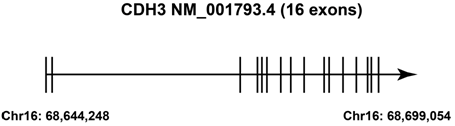
The genomic structure of the CDH3/P-cadherin gene is constituted by 16 coding exons (NCBI Reference Sequence: NM_001793.4): the extracellular part of P-cadherin is encoded by 10 exons (exons 4-13), whereas the transmembrane and the intracellular domains are codified by the last 3 exons (exons 14-16) (Albergaria et al., 2011) (NCBI Reference Sequence: NM_001793.4).
Description
DNA contains 54807 bp containing 16 coding exons.
Transcription
4276 bp mRNA transcribed in centromeric to telomeric orientation; 2490 bp open reading frame (CCDS10868.1). Concerning CDH3/P-cadherin gene regulation, the main transcriptional activators described for the CDH3/P-cadherin gene promoter are β-catenin (Faraldo et al., 2007), p63 (Shimomura et al., 2008) and C/EBPβ (Albergaria et al., 2010; Albergaria et al., 2013). In contrast, BRCA1/c-Myc/Sp1 complex acts as a transcriptional repressor of the CDH3 promoter (Gorski et al., 2009). It was also demonstrated that ER can indirectly repress P-cadherin expression by promoting epigenetic changes in the CDH3 gene promoter (Paredes et al., 2004; Albergaria et al., 2010).
This gene has 12 transcripts (splice variants), of which 5 are protein coding transcripts, 4 are transcripts suffering nonsense mediated decay, and 3 transcripts do not code for any protein product (ensemble ENSG00000062038 and vega genome OTTHUMG00000137560).
This gene has 12 transcripts (splice variants), of which 5 are protein coding transcripts, 4 are transcripts suffering nonsense mediated decay, and 3 transcripts do not code for any protein product (ensemble ENSG00000062038 and vega genome OTTHUMG00000137560).
Proteins
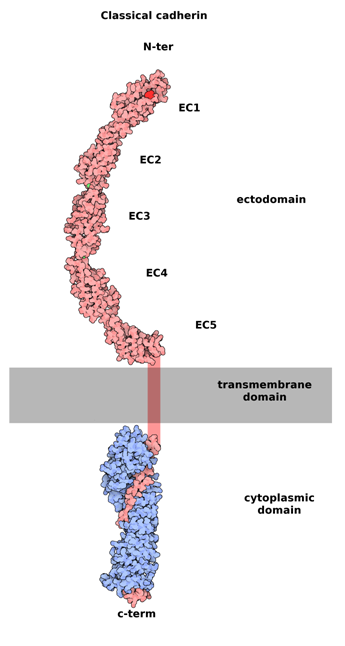
Image of a classical type I cadherin, adapted with permission from the RCSB PDB March 2008 Molecule of the Month feature by David Goodsell (doi: 10.2210/rcsb_pdb/mom_2008_3).
P-cadherin is a transmembrane protein included in the classical cadherin family, with an ectodomain containing 5 cadherin repeats (which interacts with another cadherins ectodomain in a cis or trans manner) and a highly conserved cytoplasmic domain that binds to catenins. Sharing about 67% of homology with the CDH1/E-cadherin gene, P-cadherin differs mainly in the extracellular portion and it is far less characterized.
Description
Described for the first time in 1986, as "a novel class of cadherin that appeared in developing mouse embryos", this adhesion molecule was found in the tissues that gave rise to its name, the placenta (Nose and Takeichi, 1986). P-cadherin is a transmembrane glycoprotein that belongs to a large family of molecules that mediate calcium-dependent homophilic cell-cell adhesion. It plays a role in many cellular processes such as embryonic development, differentiation, cell polarity, growth and migration (Larue et al., 1996).
P-cadherin is composed by three domains: 1) an extracellular portion responsible for calcium-dependent homotypic cadherin-cadherin interaction (which has 5 repeated cadherin domains); 2) a single pass transmembrane domain; and 3) a highly conserved cytoplasmic domain that binds to the intracellular catenins p120-catenin and β-catenin. Catenins have a dual role, acting as signalling mediators or as adaptor molecules that stabilize the cadherin complex at the membrane and link the cadherin molecule to the actin filaments of the cytoskeleton (Wheelock et al., 2001).
P-cadherin is composed by three domains: 1) an extracellular portion responsible for calcium-dependent homotypic cadherin-cadherin interaction (which has 5 repeated cadherin domains); 2) a single pass transmembrane domain; and 3) a highly conserved cytoplasmic domain that binds to the intracellular catenins p120-catenin and β-catenin. Catenins have a dual role, acting as signalling mediators or as adaptor molecules that stabilize the cadherin complex at the membrane and link the cadherin molecule to the actin filaments of the cytoskeleton (Wheelock et al., 2001).
Expression
It is expressed in the placenta of mice (hence, its name). It is also expressed in human placental tissues, albeit at lower levels (Shimoyama et al., 1989; Sahin et al., 2014).
Despite being expressed in several human fetal structures, in the adult it is only expressed in certain tissues, usually co-expressed with E-cadherin, such as the basal layer of the epidermis, the breast and the prostate, as well as the mesothelium, the ovary, the hair follicle, and the corneal endothelium (Nose and Takeichi, 1986; Imai et al., 2008).
According to human protein reference database (HPRD:00227), the major sites of expression include endometrium, the glomerulus, hair follicle, keratinocytes, mammary myoepithelium, melanocytes, oocytes, spermatozoa, placenta, prostate, retina, serum, skin. An 80 KDa fragment of P-cadherin (known as soluble P-cadherin) is also found in human breast milk (Soler et al., 2002), nipple aspirates (Mannello et al., 2008), semen (De Paul et al., 2005) and urine (Adachi et al., 2006).
Despite being expressed in several human fetal structures, in the adult it is only expressed in certain tissues, usually co-expressed with E-cadherin, such as the basal layer of the epidermis, the breast and the prostate, as well as the mesothelium, the ovary, the hair follicle, and the corneal endothelium (Nose and Takeichi, 1986; Imai et al., 2008).
According to human protein reference database (HPRD:00227), the major sites of expression include endometrium, the glomerulus, hair follicle, keratinocytes, mammary myoepithelium, melanocytes, oocytes, spermatozoa, placenta, prostate, retina, serum, skin. An 80 KDa fragment of P-cadherin (known as soluble P-cadherin) is also found in human breast milk (Soler et al., 2002), nipple aspirates (Mannello et al., 2008), semen (De Paul et al., 2005) and urine (Adachi et al., 2006).
Localisation
Cell junctions: a single-pass type I membrane protein anchored to actin microfilaments through association with α-catenin, β-catenin and γ-catenin. Sequential proteolysis induced by apoptosis or calcium influx, results in translocation from sites of cell-cell contact to the cytoplasm.
Function
Cell-cell adhesion: cadherin mediated cell-cell adhesion is accomplished by homophilic interactions between two cadherin molecules at the surface of the respective cells in a cis and/or trans manner (Cavallaro and Dejana, 2011) and the cadherin-catenin complex constitutes the main building block of the adherens-type junctions. These complexes also represent a major regulatory mechanism that guides cell fate decisions, influencing cell growth, differentiation, cell motility and survival (Cavallaro and Dejana, 2011).
Cell signalling: P-cadherin shares common interplayers with the wnt signalling pathway (eg. : β-catenin) (Kamposioras et al., 2013; Samuelov et al., 2013) and Integrin signalling (Vieira et al., 2014).
In cancer, it may have a tumour suppressive or a cancer promoting function, depending on the cellular and tissue context (see below).
Cell signalling: P-cadherin shares common interplayers with the wnt signalling pathway (eg. : β-catenin) (Kamposioras et al., 2013; Samuelov et al., 2013) and Integrin signalling (Vieira et al., 2014).
In cancer, it may have a tumour suppressive or a cancer promoting function, depending on the cellular and tissue context (see below).
Homology
Sharing about 67% of homology with the CDH1/E-cadherin gene, P-cadherin differs mainly in the extracellular portion and it is far less characterized.
64 organisms have orthologs with the human CDH3 gene. For example, the CDH3 gene is conserved in chimpanzee, dog, cow, mouse, rat and chicken (HomoloGene:20425).
64 organisms have orthologs with the human CDH3 gene. For example, the CDH3 gene is conserved in chimpanzee, dog, cow, mouse, rat and chicken (HomoloGene:20425).
Mutations
Note
According to the Human Gene Mutation Database, 21 mutations have been described for the P-cadherin/CDH3 gene, namely 9 missense/nonsense mutations, 4 splicing mutations, 1 regulatory mutation, 1 gross deletion, 5 small deletions and 1 small insertion (The Human Gene Mutation Database).
There are no reported descriptions of small indels, gross insertions/duplications, complex rearrangements or repeat variations.
16 mutations are associated with Hypotricosis with Juvenile Macular Dystrophy (HJMD) and 2 mutations are implicated with Ectodermal dysplasia, Ectrodactyly and Macular dystrophy (EEM) syndrome (The Human Gene Mutation Database).
Regarding polymorphisms, several SNPs have been reported for the CDH3 gene that have no clinical significance because they code for synonymous codons or related residues (ClinVar).
There are no reported descriptions of small indels, gross insertions/duplications, complex rearrangements or repeat variations.
16 mutations are associated with Hypotricosis with Juvenile Macular Dystrophy (HJMD) and 2 mutations are implicated with Ectodermal dysplasia, Ectrodactyly and Macular dystrophy (EEM) syndrome (The Human Gene Mutation Database).
Regarding polymorphisms, several SNPs have been reported for the CDH3 gene that have no clinical significance because they code for synonymous codons or related residues (ClinVar).
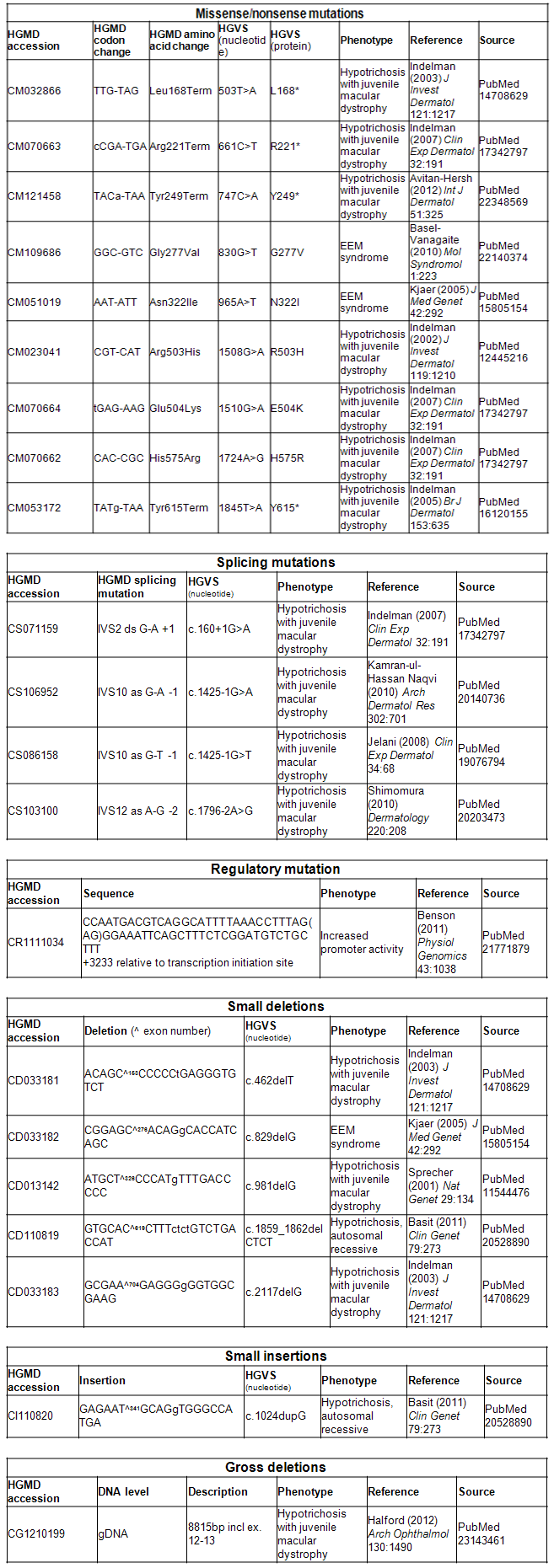
Summary of the human CDH3 gene mutations. 21 mutations have been described for the P-cadherin/CDH3 gene, namely 9 missense/nonsense mutations, 4 splicing mutations, 1 regulatory mutation, 5 small deletions, 1 small insertion and 1 gross deletion (The Human Gene Mutation Database).
Germinal
Human germline mutations for the CDH3 gene have been reported to carry the phenotype of HJMD and EEM syndromes (Sprecher et al., 2001;Kjaer et al., 2005; Avitan-Hersh et al., 2012; Halford et al., 2012). The germline deletion of CDH3 in the mouse causes breast secretory immaturity and premature mammary gland differentiation. The P-cadherin mutant mice develop hyperplasia and dysplasia of the mammary epithelium with age and, in contrast to humans, no reports regarding development defects have been described (Radice et al., 1997).
Implicated in
Entity name
Various cancers
Note
P-cadherin is altered in various human tumours, but its effective role in the carcinogenesis process remains object of debate, since it can behave differently depending on the studied tumour cell model and context. For example, in melanoma, P-cadherin seems to have a tumour suppressive function, exactly as E-cadherin (Van Marck et al., 2005). In breast cancer P-cadherin is often overexpressed and it is reported to exhibit tumour promoting effects (Paredes et al., 2012). Importantly, P-cadherin upregulation is also found in other malignancies such as gastric, endometrial, colorectal and pancreatic carcinomas (Hardy et al., 2002; Stefansson et al., 2004; Taniuchi et al., 2005; Imai et al., 2008).
Entity name
Breast cancer
Note
P-cadherin aberrant expression is found in 20% to 40% of invasive breast carcinomas, as well as in 25% of pre-invasive (in situ) ductal carcinomas. Aberrant P-cadherin expression was shown to be associated with tumours of high histological grade, as well as with well established markers of poor prognosis, like Ki-67, EGFR, CK5, vimentin, p53 and HER-2 expression, and negatively associated with age at prognosis and hormonal receptors (ER and PgR) expression. None of these reports showed a significant association with tumour size and lymph node metastasis (Turashvili et al., 2011; Peralta Soler et al., 1999; Gamallo et al., 2001; Paredes et al., 2002; Paredes et al., 2005). P-cadherin aggressive behaviour in breast cancer is dependent on an E-cadherin positive background (Ribeiro et al., 2013) and it is substantially attributed to an increased migratory and invasive capacity of cancer cells (Ribeiro et al., 2010), increased stem cell activity (Vieira et al., 2012) and cross-talk with integrin oncogenic signalling pathways (Vieira et al., 2014).
P-cadherin up-regulation is predominantly found in the basal-like subgroup of breast cancers (Matos et al., 2005; Paredes et al., 2007a; Paredes et al., 2007b) and it is strongly associated with the presence of BRCA1 mutation (Arnes et al., 2005) and poor clinical outcome (Paredes et al., 2005; Turashvili et al., 2011). It has been proposed that P-cadherin in conjugation with vimentin and CK14 constitutes a better criterion for the identification of basal-like breast carcinomas by immunohistochemistry (Sousa et al., 2010).
P-cadherin up-regulation is predominantly found in the basal-like subgroup of breast cancers (Matos et al., 2005; Paredes et al., 2007a; Paredes et al., 2007b) and it is strongly associated with the presence of BRCA1 mutation (Arnes et al., 2005) and poor clinical outcome (Paredes et al., 2005; Turashvili et al., 2011). It has been proposed that P-cadherin in conjugation with vimentin and CK14 constitutes a better criterion for the identification of basal-like breast carcinomas by immunohistochemistry (Sousa et al., 2010).
Prognosis
P-cadherin overexpression in breast cancer is an independent factor of poor prognosis (poor disease free and overall survival) (Paredes et al., 2005; Turashvili et al., 2011).
Entity name
Hypotrichosis with juvenile macular dystrophy (HJMD)
Note
In humans, the loss of P-cadherin induces characteristic genetic syndromes.
CDH3 gene mutations have been shown to cause P-cadherin functional inactivation, leading to developmental defects associated with hypotrichosis with juvenile macular dystrophy (HJMD) (Sprecher et al., 2001; Avitan-Hersh et al., 2012; Halford et al., 2012).
CDH3 gene mutations have been shown to cause P-cadherin functional inactivation, leading to developmental defects associated with hypotrichosis with juvenile macular dystrophy (HJMD) (Sprecher et al., 2001; Avitan-Hersh et al., 2012; Halford et al., 2012).
Disease
Hypotrichosis with juvenile macular dystrophy (HJMD; OMIM: 601553) is a rare recessive disorder, characterized by hair loss heralding progressive macular degeneration and early blindness. Affected HJMD individuals are born with seemingly normal hair but develop alopecia of the scalp at around 3 months. After the age of 3 years, affected individuals develop progressive macular degeneration with slight peripheral retinal dystrophy. The severe degenerative changes of the retinal macula culminate in blindness during the second to third decade of life. Since Sprech er et al. (2001) first established a link between this disease and a mutation in gene encoding CDH3/P-cadherin (Sprecher et al., 2001), several other mutations were found, which essentially disturb the Ca2+ binding and the cadherin functional domains or result in the synthesis of a truncated form of P-cadherin or in the absence of P-cadherin expression.
Cytogenetics
The following allelic variants are responsible for HJMD:
- CDH3, c.2117delG - (Indelman et al., 2003)
- CDH3, IVS12 as A-G -2 - (Shimomura et al., 2010)
- CDH3, IVS10 as G-A -1 - (Jelani et al., 2009; Kamran-ul-Hassan Naqvi et al., 2010)
- CDH3, gDNA 8815bp deleted incl exons 12-13 - (Halford et al., 2012)
- CDH3, c.2117delG - (Indelman et al., 2003)
- CDH3, IVS12 as A-G -2 - (Shimomura et al., 2010)
- CDH3, IVS10 as G-A -1 - (Jelani et al., 2009; Kamran-ul-Hassan Naqvi et al., 2010)
- CDH3, gDNA 8815bp deleted incl exons 12-13 - (Halford et al., 2012)
Entity name
Ectodermal dysplasia, ectrodactyly and macular dystrophy (EEM)
Note
CDH3 gene mutations have been shown to cause P-cadherin functional inactivation, leading to ectodermal dysplasia, ectrodactyly, and macular dystrophy (EEM syndrome ), a developmental defect associated syndrome. This inherited disease is characterized by sparse hair and macular dystrophy of the retina, and split hand/foot malformation (Kjaer et al., 2005).
Disease
This ectodermal defect is characterised by hypotrichosis with sparse and short hair on the scalp, sparse and short eyebrows and eyelashes, and partial anodontia. Different degrees of absence deformities as well as syndactyly have been described, the hands often being more severely affected than the feet. The retinal lesion appears as a central geographic atrophy of the retinal pigment epithelium and choriocapillary layer of the macular area with coarse hyperpigmentations and sparing of the larger choroidal vessels.
Kjaer et al. (2005) first established a link between families with ectodermal dysplasia, ectrodactyly, and macular dystrophy (EEM; OMIM: 225280) and homozygous mutations in CDH3/P-cadherin in affected individuals: a missense mutation (114021.0003) and a deletion (114021.0004), respectively (Kjaer et al., 2005).
Kjaer et al. (2005) first established a link between families with ectodermal dysplasia, ectrodactyly, and macular dystrophy (EEM; OMIM: 225280) and homozygous mutations in CDH3/P-cadherin in affected individuals: a missense mutation (114021.0003) and a deletion (114021.0004), respectively (Kjaer et al., 2005).
Cytogenetics
The following allelic variants are responsible for EEM:
- CDH3, Gly277Val - (Basel-Vanagaite et al., 2010)
- CDH3, Gly277Val - (Basel-Vanagaite et al., 2010)
Article Bibliography
| Pubmed ID | Last Year | Title | Authors |
|---|---|---|---|
| 16948836 | 2006 | The human urinary proteome contains more than 1500 proteins, including a large proportion of membrane proteins. | Adachi J et al |
| 23405208 | 2013 | CCAAT/enhancer binding protein β (C/EBPβ) isoforms as transcriptional regulators of the pro-invasive CDH3/P-cadherin gene in human breast cancer cells. | Albergaria A et al |
| 15930334 | 2005 | Placental cadherin and the basal epithelial phenotype of BRCA1-related breast cancer. | Arnes JB et al |
| 22348569 | 2012 | A novel nonsense CDH3 mutation in hypotrichosis with juvenile macular dystrophy. | Avitan-Hersh E et al |
| 22140374 | 2010 | CDH3-Related Syndromes: Report on a New Mutation and Overview of the Genotype-Phenotype Correlations. | Basel-Vanagaite L et al |
| 8093046 | 1994 | The genes for the calcium-dependent cell adhesion molecules P- and E-cadherin are tandemly arranged in the human genome. | Bussemakers MJ et al |
| 21346732 | 2011 | Adhesion molecule signalling: not always a sticky business. | Cavallaro U et al |
| 15611565 | 2005 | Soluble p-cadherin found in human semen. | De Paul AL et al |
| 17292359 | 2007 | beta-Catenin regulates P-cadherin expression in mammary basal epithelial cells. | Faraldo MM et al |
| 11454996 | 2001 | The prognostic significance of P-cadherin in infiltrating ductal breast carcinoma. | Gamallo C et al |
| 19882246 | 2010 | BRCA1 transcriptionally regulates genes associated with the basal-like phenotype in breast cancer. | Gorski JJ et al |
| 23143461 | 2012 | Homozygous deletion in CDH3 and hypotrichosis with juvenile macular dystrophy. | Halford S et al |
| 11889072 | 2002 | Aberrant P-cadherin expression is an early event in hyperplastic and dysplastic transformation in the colon. | Hardy RG et al |
| 18927288 | 2008 | Identification of a novel tumor-associated antigen, cadherin 3/P-cadherin, as a possible target for immunotherapy of pancreatic, gastric, and colorectal cancers. | Imai K et al |
| 17342797 | 2007 | Novel CDH3 mutations in hypotrichosis with juvenile macular dystrophy. | Indelman M et al |
| 19076794 | 2009 | A novel splice-site mutation in the CDH3 gene in hypotrichosis with juvenile macular dystrophy. | Jelani M et al |
| 24123033 | 2013 | The prognostic significance of WNT pathway in surgically-treated colorectal cancer: β-catenin expression predicts for disease-free survival. | Kamposioras K et al |
| 20140736 | 2010 | A novel splice-acceptor site mutation in CDH3 gene in a consanguineous family exhibiting hypotrichosis with juvenile macular dystrophy. | Kamran-ul-Hassan Naqvi S et al |
| 15805154 | 2005 | Distinct CDH3 mutations cause ectodermal dysplasia, ectrodactyly, macular dystrophy (EEM syndrome). | Kjaer KW et al |
| 9615235 | 1998 | Localization of human cadherin genes to chromosome regions exhibiting cancer-related loss of heterozygosity. | Kremmidiotis G et al |
| 8898231 | 1996 | A role for cadherins in tissue formation. | Larue L et al |
| 18811693 | 2008 | Increased shedding of soluble fragments of P-cadherin in nipple aspirate fluids from women with breast cancer. | Mannello F et al |
| 16012853 | 2005 | p63, cytokeratin 5, and P-cadherin: three molecular markers to distinguish basal phenotype in breast carcinomas. | Matos I et al |
| 3539943 | 1986 | A novel cadherin cell adhesion molecule: its expression patterns associated with implantation and organogenesis of mouse embryos. | Nose A et al |
| 16115928 | 2005 | P-cadherin overexpression is an indicator of clinical outcome in invasive breast carcinomas and is associated with CDH3 promoter hypomethylation. | Paredes J et al |
| 18001487 | 2007 | P-cadherin expression in breast cancer: a review. | Paredes J et al |
| 22613680 | 2012 | Epithelial E- and P-cadherins: role and clinical significance in cancer. | Paredes J et al |
| 17123107 | 2007 | P-cadherin and cytokeratin 5: useful adjunct markers to distinguish basal-like ductal carcinomas in situ. | Paredes J et al |
| 11942571 | 2002 | P-cadherin expression is associated with high-grade ductal carcinoma in situ of the breast. | Paredes J et al |
| 15548699 | 2004 | P-cadherin is up-regulated by the antiestrogen ICI 182,780 and promotes invasion of human breast cancer cells. | Paredes J et al |
| 10506713 | 1999 | P-cadherin expression in breast carcinoma indicates poor survival. | Peralta Soler A et al |
| 9362520 | 1997 | Precocious mammary gland development in P-cadherin-deficient mice. | Radice GL et al |
| 23180380 | 2013 | P-cadherin functional role is dependent on E-cadherin cellular context: a proof of concept using the breast cancer model. | Ribeiro AS et al |
| 24790510 | 2014 | Expression of P-cadherin (cadherin-3) and E-selectin in the villous trophoblast of first trimester human placenta. | Sahin H et al |
| 23334344 | 2013 | Topobiology of human pigmentation: P-cadherin selectively stimulates hair follicle melanogenesis. | Samuelov L et al |
| 20203473 | 2010 | Splice site mutations in the P-cadherin gene underlie hypotrichosis with juvenile macular dystrophy. | Shimomura Y et al |
| 2793940 | 1989 | Molecular cloning of a human Ca2+-dependent cell-cell adhesion molecule homologous to mouse placental cadherin: its low expression in human placental tissues. | Shimoyama Y et al |
| 11891861 | 2002 | Soluble fragment of P-cadherin adhesion protein found in human milk. | Soler AP et al |
| 20552547 | 2010 | P-cadherin, vimentin and CK14 for identification of basal-like phenotype in breast carcinomas: an immunohistochemical study. | Sousa B et al |
| 11544476 | 2001 | Hypotrichosis with juvenile macular dystrophy is caused by a mutation in CDH3, encoding P-cadherin. | Sprecher E et al |
| 15051772 | 2004 | Prognostic impact of alterations in P-cadherin expression and related cell adhesion markers in endometrial cancer. | Stefansson IM et al |
| 15833838 | 2005 | Overexpressed P-cadherin/CDH3 promotes motility of pancreatic cancer cells by interacting with p120ctn and activating rho-family GTPases. | Taniuchi K et al |
| 20852590 | 2011 | P-cadherin expression as a prognostic biomarker in a 3992 case tissue microarray series of breast cancer. | Turashvili G et al |
| 16204047 | 2005 | P-cadherin promotes cell-cell adhesion and counteracts invasion in human melanoma. | Van Marck V et al |
| 24553076 | 2014 | P-cadherin signals through the laminin receptor α6β4 integrin to induce stem cell and invasive properties in basal-like breast cancer cells. | Vieira AF et al |
| 11547897 | 2001 | Cadherin junctions in mammary tumors. | Wheelock MJ et al |
Other Information
Locus ID:
NCBI: 1001
MIM: 114021
HGNC: 1762
Ensembl: ENSG00000062038
Variants:
dbSNP: 1001
ClinVar: 1001
TCGA: ENSG00000062038
COSMIC: CDH3
RNA/Proteins
Expression (GTEx)
Pathways
Protein levels (Protein atlas)
References
| Pubmed ID | Year | Title | Citations |
|---|---|---|---|
| 38003666 | 2023 | Alteration of Cadherin 3 Expression and DNA Methylation in Association with Aggressive Renal Cell Carcinoma. | 0 |
| 38003666 | 2023 | Alteration of Cadherin 3 Expression and DNA Methylation in Association with Aggressive Renal Cell Carcinoma. | 0 |
| 34216280 | 2022 | P-Cadherin and WNT5A expression in assessment of lymph node metastasis in oral squamous cell carcinoma. | 3 |
| 34825969 | 2022 | Placental-Cadherin, a biomarker for local immune status and poor prognosis among patients with tongue squamous cell carcinoma. | 3 |
| 34919784 | 2022 | Cadherin-3 is a novel oncogenic biomarker with prognostic value in glioblastoma. | 5 |
| 35305877 | 2022 | CDH3 is associated with poor prognosis by promoting the malignancy and chemoresistance in oral squamous cell carcinoma. | 4 |
| 35563773 | 2022 | P-Cadherin Regulates Intestinal Epithelial Cell Migration and Mucosal Repair, but Is Dispensable for Colitis Associated Colon Cancer. | 6 |
| 35853629 | 2022 | Novel compound heterozygous cadherin 3 mutations in hypotrichosis and juvenile macular dystrophy. | 0 |
| 34216280 | 2022 | P-Cadherin and WNT5A expression in assessment of lymph node metastasis in oral squamous cell carcinoma. | 3 |
| 34825969 | 2022 | Placental-Cadherin, a biomarker for local immune status and poor prognosis among patients with tongue squamous cell carcinoma. | 3 |
| 34919784 | 2022 | Cadherin-3 is a novel oncogenic biomarker with prognostic value in glioblastoma. | 5 |
| 35305877 | 2022 | CDH3 is associated with poor prognosis by promoting the malignancy and chemoresistance in oral squamous cell carcinoma. | 4 |
| 35563773 | 2022 | P-Cadherin Regulates Intestinal Epithelial Cell Migration and Mucosal Repair, but Is Dispensable for Colitis Associated Colon Cancer. | 6 |
| 35853629 | 2022 | Novel compound heterozygous cadherin 3 mutations in hypotrichosis and juvenile macular dystrophy. | 0 |
| 32341236 | 2021 | Aberrant Expression of E-cadherin, N-cadherin, and P-cadherin in Clear Cell Renal Cell Carcinoma: Association With Adverse Clinicopathologic Factors and Poor Prognosis. | 1 |
Citation
André Filipe Vieira ; Ana Sofia Ribeiro ; Joana Paredes
CDH3 (Cadherin 3, Type 1, P-Cadherin (Placental))
Atlas Genet Cytogenet Oncol Haematol. 2014-05-01
Online version: http://atlasgeneticsoncology.org/gene/40025/cdh3
