PDGFRA (platelet-derived growth factor receptor, alpha polypeptide)
2014-06-01 Adriana Zamecnikova , Soad Al Bahar AffiliationKuwait Cancer Control Center, Laboratory of Cancer Genetics, Department of Hematology, Shuwaikh, 70653, Kuwait
Identity
HGNC
LOCATION
4q12
IMAGE

LEGEND
PDGFRA (platelet-derived growth factor receptor, alpha polypeptide) Hybridization with Vysis 4q12 Tri-Color break apart rearrangement probe (Abbott Molecular, US) showing PDGFRA on 4q12 (red-green-aqua signal) - Courtesy Adriana Zamecnikova.
LOCUSID
ALIAS
CD140A,PDGFR-2,PDGFR2
FUSION GENES
DNA/RNA
Description
The gene encoding the α-subunit of the PDGFRA maps to band q12 of chromosome 4. The gene contains 23 exons spanning about 65 kb. The first noncoding exon is followed by a large intron of approximately 23 kb (Gronwald et al., 1990; Kawagishi et al., 1995). An important paralog of PDGFRA is FLT4.
Transcription
6.4-kb transcript; coexpressed with the 5.3-kb PDGF receptor mRNA.
Proteins
Description
Expression
PDGFR expression is characteristic of various mesodermal derivatives; specially expressed in the urinary tracts and in male and female genitals.
Localisation
Subcellular location: cell membrane.
Function
Member of the type III class of tyrosine kinase receptors which also includes c-KIT, FLT3 and the macrophage-colony-stimulating factor receptor; characterized by five immunoglobuline-like extracellular domains; a single-spanning transmembrane domain and an intracellular split kinase domain, connected by a flexible polypeptide insert; structurally homologous to c-KIT. PDGFA has transmembrane receptor protein tyrosine kinase activity and acts as a cell-surface receptor for members of the platelet-derived growth factor family: PDGFA, PDGFB and PDGFC, which are mitogens for fibroblasts and cells of mesenchymal origin origin. It plays an essential role in the regulation of many biological processes including cell proliferation, survival, differentiation and cell migration. Plays an important role in embryonic development, in the adult control tissue homeostasis in various organs including kidney, epidydimis, lung and pancreas; required for normal development of intestinal villi in the gastrointestinal tract, plays a role in platelet activation, wound healing and angiogenesis (Demoulin et al., 2012; Heldin et al., 2013).
Regulation: Function as homo- and/or heterodimers depending on the cell type; activated by ligand-induced dimerization and autophosphorylation on specific tyrosine residues upon binding. Activation of the intracellular kinase activity of the receptor leads to creation of docking sites for signal transduction molecules. Subsequent phosphorylation of its substrates initiates a variety of signal transduction cascades that promotes cell proliferation, survival and migration through the PI3K-AKT-mTOR and RAS-MAPK pathways as well as promotes activation of STAT family members (JAK/STAT) (Demoulin et al., 2012).
Regulation: Function as homo- and/or heterodimers depending on the cell type; activated by ligand-induced dimerization and autophosphorylation on specific tyrosine residues upon binding. Activation of the intracellular kinase activity of the receptor leads to creation of docking sites for signal transduction molecules. Subsequent phosphorylation of its substrates initiates a variety of signal transduction cascades that promotes cell proliferation, survival and migration through the PI3K-AKT-mTOR and RAS-MAPK pathways as well as promotes activation of STAT family members (JAK/STAT) (Demoulin et al., 2012).
Mutations
Note
Mutations in the PDGFRA gene contribute to the pathophysiology of various diseases such as atherosclerosis, abnormalities of the tubal neural development and fibrotic diseases. In cancer, activating point mutations, gene amplifications and chromosomal rearrangements including gene fusions and chromosomal deletions have been found in certain malignancies. These include hematological malignancies such as acute myeloid leukemia, atypical chronic myelogenous leukemia, chronic myelomonocytic leukemia, eosinophilic disorders and mastocytosis (Gotlib et al., 2008). PDGFRA mutations also have been described in somatic and familial gastrointestinal stromal tumors, synovial sarcomas, glioblastoma, malignant peripheral nerve sheath tumors, melanoma and a in a variety of other cancers (Chompret et al., 2004; Heinrich et al., 2003).
Implicated in
Entity name
Gastrointestinal stromal tumor (GIST)
Note
Activating mutations of PDGFRA are found in 5-8% of patients with gastrointestinal stromal tumors (GISTs) but their frequency increases to 30% to 40% in gastric GISTs lacking KIT mutations (Corless et al., 2005; Lasota et al., 2008). The majority of these mutations are "substitution missense", that can arise by various mechanisms (Figure 1). These include mutation hot spots in exon 18 of the PDGFRA gene such as the Asp-to-Val substitution at codon 842 (D842V) encoding the activation loop. Other activating mutations are less frequent such as mutations in exons 12 encoding the juxtamembrane domain and in exon 14 encoding the tyrosine kinase 1 domain of PDGFRA (Chompret et al., 2004; Heinrich et al., 2003). PDGFRA mutations except for D842V in exon 18 are sensitive to imatinib inhibition. However, despite initial clinical responses to tyrosine kinase inhibitors (imatinib, nilotinib, sorafenib and sunatinib), the majority of these patient develops resistance to the drug limiting the long-term benefit of tyrosine kinase inhibitors in this group of patients (Gramza et al., 2009; Pierotti et al., 2011).
The D842V mutation results in an amino acid substitution at position 842 in PDGFRA, from an aspartic acid (D) to a valine (V). This mutation occurs within the TK2 domain (Figure 1).
PDGFRA D842V mutation has been found in a distinct subset of GIST, typically from the stomach. The D842V mutation is known to be associated with tyrosine kinase inhibitor resistance.
The D842V mutation results in an amino acid substitution at position 842 in PDGFRA, from an aspartic acid (D) to a valine (V). This mutation occurs within the TK2 domain (Figure 1).
PDGFRA D842V mutation has been found in a distinct subset of GIST, typically from the stomach. The D842V mutation is known to be associated with tyrosine kinase inhibitor resistance.
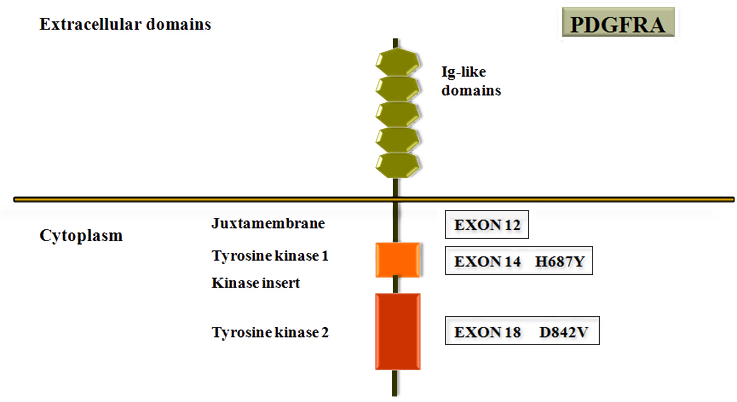
Figure 1. Schematic representation of the most frequent activating mutations of the homologous platelet-derived growth factor receptor alpha (PDGFRA) kinase in patients with gastrointestinal stromal tumors. Most common mutations are in exon 18, such as the D842V substitution that shows resistance to imatinib. Mutations in the juxtamembrane domain (exon 12; V561D most common) and in exon 14 tyrosine kinase 1 (TK1) domain (e.g., N659K) are less common. Abbreviations: JM, juxtamembrane; TK, tyrosine kinase. Adopted and modified from Pierott et al., 2011).
Entity name
Hematologic disorders with primary eosinophilia
Note
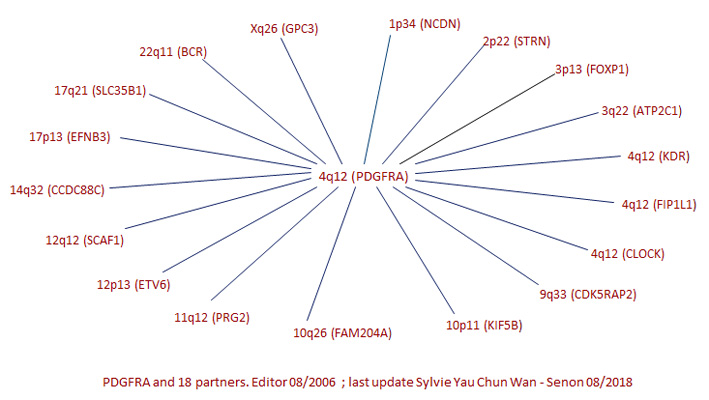
Several chromosomal rearrangements generating fusion genes causing PDGFRA activation have been described in a variety of uncommon hematologic disorders that are often accompanied with a related condition called hypereosinophilic syndrome. These rearrangements activate PDGFRA by fusion to various partner genes: STRN (2p24) in the t(2;4)(p22;q12), FIP1L1 (interstitial 4q12 deletion), CDK5RAP2 (9q33) in the ins(9;4)(q33;q12q25), KIF5B (10p11) in the t(4;10)(q12;p11), ETV6 (12p13) in the t(4;12)(q12;p13), and BCR (22q11) in the t(4;22)(q12;q11). In each of these rearrangements, the breakpoints in PDGFRA partner genes are variable, but the breakpoints in PDGFRA invariably involve exon 12 encoding a portion of the juxtamembrane domain with autoinhibitory function (Baxter et al., 2002; Gotlib et al., 2008); the disruption of which activates the fusion protein (Figure 2).
The most investigated of these fusion genes is FIP1L1-PDGFRA that arise as a result of a cryptic interstitial deletion on chromosome 4q12. FIP1L1-PDGFRA fusion protein is involved in the pathogenesis of uncommon hematologic disorders with primary eosinophilia like chronic eosinophilic leukemia (CEL) hyperseosinophilic syndrome (HES) and systemic mastocytosis (SM). Similar to other fusion tyrosine kinases, FIP1L1-PDGFRA is a constitutively active tyrosine kinase that was shown to be sensitive to kinase inhibitors (Cools et al., 2003; Jain et al., 2013).
The most investigated of these fusion genes is FIP1L1-PDGFRA that arise as a result of a cryptic interstitial deletion on chromosome 4q12. FIP1L1-PDGFRA fusion protein is involved in the pathogenesis of uncommon hematologic disorders with primary eosinophilia like chronic eosinophilic leukemia (CEL) hyperseosinophilic syndrome (HES) and systemic mastocytosis (SM). Similar to other fusion tyrosine kinases, FIP1L1-PDGFRA is a constitutively active tyrosine kinase that was shown to be sensitive to kinase inhibitors (Cools et al., 2003; Jain et al., 2013).
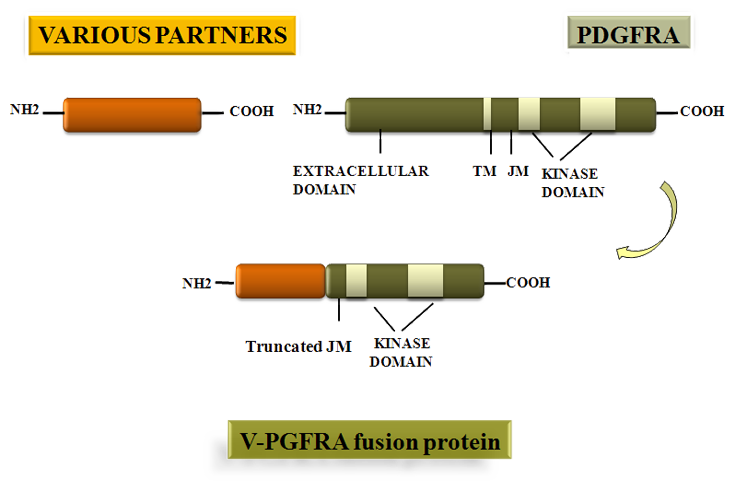
Figure 2. The structure and mechanism of activation of PDGFRA fusions in hematological disorders. In the fusion oncogene, the partner gene always replaces the 5 part of exon 12 of PDGFRA creating an in frame fusion. As the 5 part of exon 12 of PDGFRA containing the inhibitory domain is truncated, its expression is controlled by the partner gene promoter resulting in constitutive activation of the PDGFRA kinase domain. NH2: N-terminal site; COOH: C-terminal site; TM: transmembrane domain; JM: juxtamembrane domain. Adopted and modified from Cools et al., 2003 and Gotlib et al., 2008).
Entity name
Lung adenocarcinoma
Cytogenetics
A t(4;12)(q12;q12) was found in a case of lung adenocarcinoma (Seo et al., 2012).
Hybrid gene
SCAF11/PDGFRA
Breakpoints
Article Bibliography
| Pubmed ID | Last Year | Title | Authors |
|---|---|---|---|
| 12023981 | 2002 | The t(4;22)(q12;q11) in atypical chronic myeloid leukaemia fuses BCR to PDGFRA. | Baxter EJ et al |
| 14699510 | 2004 | PDGFRA germline mutation in a family with multiple cases of gastrointestinal stromal tumor. | Chompret A et al |
| 12660384 | 2003 | A tyrosine kinase created by fusion of the PDGFRA and FIP1L1 genes as a therapeutic target of imatinib in idiopathic hypereosinophilic syndrome. | Cools J et al |
| 15928335 | 2005 | PDGFRA mutations in gastrointestinal stromal tumors: frequency, spectrum and in vitro sensitivity to imatinib. | Corless CL et al |
| 22432087 | 2012 | Platelet-derived growth factors and their receptors in normal and malignant hematopoiesis. | Demoulin JB et al |
| 18843283 | 2008 | Five years since the discovery of FIP1L1-PDGFRA: what we have learned about the fusion and other molecularly defined eosinophilias. | Gotlib J et al |
| 20008851 | 2009 | Resistance to Tyrosine Kinase Inhibitors in Gastrointestinal Stromal Tumors. | Gramza AW et al |
| 1697560 | 1990 | The human PDGF receptor alpha-subunit gene maps to chromosome 4 in close proximity to c-kit. | Gronwald RG et al |
| 12522257 | 2003 | PDGFRA activating mutations in gastrointestinal stromal tumors. | Heinrich MC et al |
| 23906712 | 2013 | Structural and functional properties of platelet-derived growth factor and stem cell factor receptors. | Heldin CH et al |
| 24203930 | 2013 | Imatinib therapy in a patient with suspected chronic neutrophilic leukemia and FIP1L1-PDGFRA rearrangement. | Jain N et al |
| 8586421 | 1995 | Structure, organization, and transcription units of the human alpha-platelet-derived growth factor receptor gene, PDGFRA. | Kawagishi J et al |
| 18312355 | 2008 | Clinical significance of oncogenic KIT and PDGFRA mutations in gastrointestinal stromal tumours. | Lasota J et al |
| 21364689 | 2011 | Targeted therapy in GIST: in silico modeling for prediction of resistance. | Pierotti MA et al |
| 22975805 | 2012 | The transcriptional landscape and mutational profile of lung adenocarcinoma. | Seo JS et al |
Other Information
Locus ID:
NCBI: 5156
MIM: 173490
HGNC: 8803
Ensembl: ENSG00000134853
Variants:
dbSNP: 5156
ClinVar: 5156
TCGA: ENSG00000134853
COSMIC: PDGFRA
RNA/Proteins
Expression (GTEx)
Pathways
Protein levels (Protein atlas)
PharmGKB
| Entity ID | Name | Type | Evidence | Association | PK | PD | PMIDs |
|---|---|---|---|---|---|---|---|
| PA10804 | imatinib | Chemical | LabelAnnotation, VariantAnnotation | ambiguous | PD | 30713339 | |
| PA151958383 | Gastrointestinal Stromal Tumors | Disease | MultilinkAnnotation, VariantAnnotation | ambiguous | PD | 19248971, 30713339 | |
| PA166123046 | cessation | Disease | VariantAnnotation | not associated | PD | 30713339 | |
| PA166163434 | olaratumab | Chemical | LabelAnnotation | associated | |||
| PA30128 | KIT | Gene | MultilinkAnnotation | associated | 24531699 | ||
| PA443937 | Drug Toxicity | Disease | VariantAnnotation | not associated | PD | 30713339 |
References
| Pubmed ID | Year | Title | Citations |
|---|---|---|---|
| 37802365 | 2024 | PDGFRA exhibits potential as an indicator of angiogenesis within the tumor microenvironment and is up-regulated in BLCA. | 0 |
| 38178783 | 2024 | Molecular and clinicopathological features of KIT/PDGFRA wild-type gastrointestinal stromal tumors. | 1 |
| 38428409 | 2024 | PDGFRα(+)ITGA11(+) fibroblasts foster early-stage cancer lymphovascular invasion and lymphatic metastasis via ITGA11-SELE interplay. | 4 |
| 38605367 | 2024 | Pediatric-type high-grade gliomas with PDGFRA amplification in adult patients with Li-Fraumeni syndrome: clinical and molecular characterization of three cases. | 0 |
| 38673853 | 2024 | Association between Platelet-Derived Growth Factor Receptor Alpha Gene Polymorphisms and Platelet-Rich Plasma's Efficiency in Treating Lateral Elbow Tendinopathy-A Prospective Cohort Study. | 0 |
| 37802365 | 2024 | PDGFRA exhibits potential as an indicator of angiogenesis within the tumor microenvironment and is up-regulated in BLCA. | 0 |
| 38178783 | 2024 | Molecular and clinicopathological features of KIT/PDGFRA wild-type gastrointestinal stromal tumors. | 1 |
| 38428409 | 2024 | PDGFRα(+)ITGA11(+) fibroblasts foster early-stage cancer lymphovascular invasion and lymphatic metastasis via ITGA11-SELE interplay. | 4 |
| 38605367 | 2024 | Pediatric-type high-grade gliomas with PDGFRA amplification in adult patients with Li-Fraumeni syndrome: clinical and molecular characterization of three cases. | 0 |
| 38673853 | 2024 | Association between Platelet-Derived Growth Factor Receptor Alpha Gene Polymorphisms and Platelet-Rich Plasma's Efficiency in Treating Lateral Elbow Tendinopathy-A Prospective Cohort Study. | 0 |
| 36411356 | 2023 | Isocitrate dehydrogenase 1 mutation drives leukemogenesis by PDGFRA activation due to insulator disruption in acute myeloid leukemia (AML). | 2 |
| 36723852 | 2023 | Identification of an Activating PDGFRA Deletion in a Novel Sinonasal Soft Tissue Neoplasm. | 0 |
| 37610648 | 2023 | PDGFRA, KIT, and KDR Gene Amplification in Glioblastoma: Heterogeneity and Clinical Significance. | 0 |
| 37752244 | 2023 | Association of PDGFRA polymorphisms with the risk of corneal astigmatism in a Japanese population. | 0 |
| 36411356 | 2023 | Isocitrate dehydrogenase 1 mutation drives leukemogenesis by PDGFRA activation due to insulator disruption in acute myeloid leukemia (AML). | 2 |
Citation
Adriana Zamecnikova ; Soad Al Bahar
PDGFRA (platelet-derived growth factor receptor, alpha polypeptide)
Atlas Genet Cytogenet Oncol Haematol. 2014-06-01
Online version: http://atlasgeneticsoncology.org/gene/143
