Identity

Abstract
CD95 (also known as Fas) is a death receptor that belongs to the TNF-receptor superfamily. Expressed at the cell surface as a homotrimer, this receptor implements both apoptotic and non-apoptotic signalling pathways. While the apoptotic signalling pathway is involved in tumor surveillance, peripheral tolerance and immune homeostasis (Strasser et al., 2009), its non-apoptotic cues seem to promote oncogenesis (Chen et al., 2010; Hoogwater et al., 2010; Kleber et al., 2010; Malleter et al., 2013; Steller et al., 2011).
DNA/RNA
Note
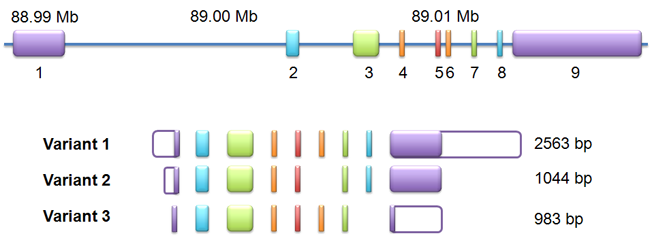
Description
Transcription
Pseudogene
Proteins
Note
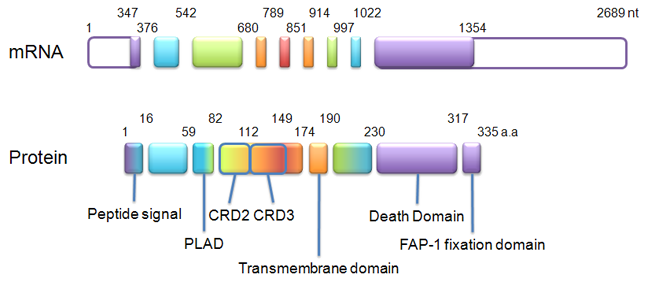
Description
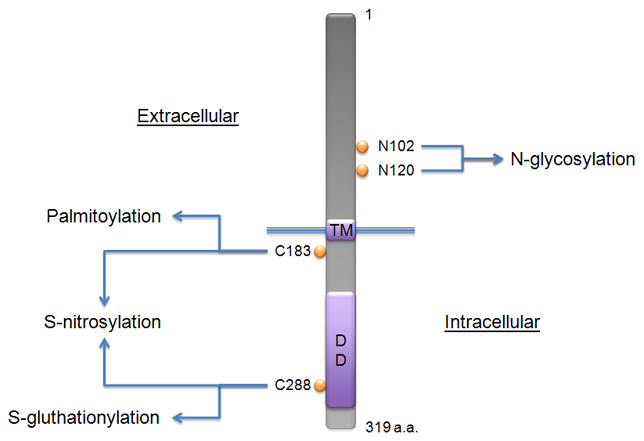
Expression
Localisation
Function
Upon binding of membrane-bound CD95L to CD95, CD95-DD recruits the adaptor molecule Fas-associated death domain protein (FADD) and caspase-8, leading to caspase activation and apoptosis (Kischkel et al., 1995). The complex CD95/FADD/Caspase-8 is called death-inducing signalling complex (DISC) (Kischkel et al., 1995). DISC formation is regulated by several molecular mechanisms including c-FLIP (FLICE-like-inhibitory-protein) (Irmler et al., 1997), FAP-1 (Fas associated phosphatase 1) (Sato et al., 1995) and PED-PEA15 (Condorelli et al., 1999).
Cells can be divided in two groups with regard to the magnitude of DISC formation, and the role played by the mitochondrion in this pathway (Scaffidi et al., 1998). In type I cells, DISC formation occurs rapidly and efficiently, resulting in the release of a large amount of activated caspase-8 in the cytosol. Whereas, type II cells have difficulties forming this complex, and the amount of active caspase-8 is insufficient to directly activate the effector caspase-3 and caspase-7 (Scaffidi et al., 1998). The low level of activated caspase-8 in type II cells is sufficient to cleave BID, a BH3-only protein, which links the death receptor to the apoptotic activity of mitochondria. Indeed, caspase-8-driven BID truncation generates tBID, which translocates to mitochondria, and triggers the release of pro-apoptotic factors (Yin, 2000; Yin et al., 1999). Type II cells are addicted to this latter signal because they contain higher levels of the caspase-3 inhibitor XIAP than type I cells (Jost et al., 2009). To summarize, DISC formation and IAP amount are two cellular markers that allow a clear discrimination between type I and type II cells.
CD95 engagement also induces non-apoptotic signalling pathways promoting cell motility, invasiveness (Hoogwater et al., 2010; Kleber et al., 2010; Malleter et al., 2013; Steller et al., 2011; Barnhart et al., 2004), inflammation (O Reilly et al., 2009; Audo et al., 2014; Letellier et al., 2010; Tauzin et al., 2011) and organ regeneration (Desbarats et al., 2003; Desbarats and Newell, 2000). Indeed, CD95 can implement NFκB (O Reilly et al., 2009; Barnhart et al., 2004; Wajant et al., 1998), phosphatidylinositol 3-kinase (PI3K) (Kleber et al., 2008;Tauzin et al., 2011) or MAPK signaling pathways (Hoogwater et al., 2010; Desbarats et al., 2003). CD95 has also been reported to play a pivotal role in T cell activation (Akimzhanov et al., 2010; Alderson et al., 1993).
Of note, while interaction of transmembrane CD95L with CD95 triggers cell death, its metalloprotease-cleaved counterpart (cl-CD95L) does not form DISC, but induces the formation of an atypical complex designated motility-inducing signalling complex (MISC)5.
Homology
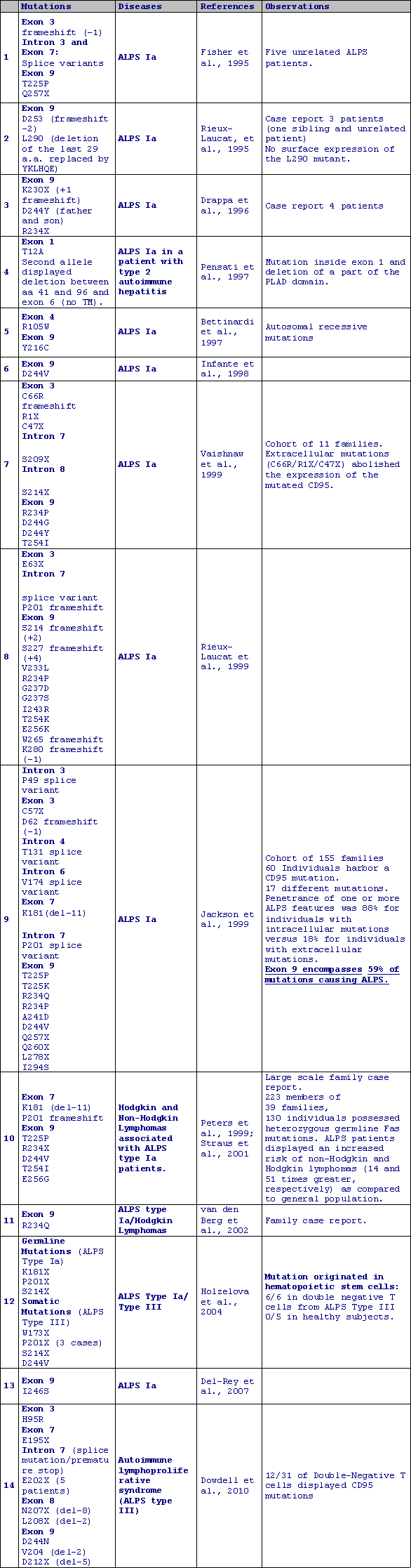
Mutations
Note
Other mutations are reported on different website: COSMIC and LOVD.
Germinal
Somatic
Implicated in

Article Bibliography
| Pubmed ID | Last Year | Title | Authors |
|---|---|---|---|
| 20696918 | 2010 | T-cell receptor complex is essential for Fas signal transduction. | Akimzhanov AM et al |
| 7504062 | 1993 | Fas transduces activation signals in normal human T lymphocytes. | Alderson MR et al |
| 19171757 | 2009 | Redox amplification of apoptosis by caspase-dependent cleavage of glutaredoxin 1 and S-glutathionylation of Fas. | Anathy V et al |
| 25078097 | 2014 | Distinct effects of soluble and membrane-bound fas ligand on fibroblast-like synoviocytes from rheumatoid arthritis patients. | Audo R et al |
| 15272306 | 2004 | CD95 ligand induces motility and invasiveness of apoptosis-resistant tumor cells. | Barnhart BC et al |
| 9028321 | 1997 | Missense mutations in the Fas gene resulting in autoimmune lymphoproliferative syndrome: a molecular and immunological analysis. | Bettinardi A et al |
| 17159908 | 2007 | Palmitoylation is required for efficient Fas cell death signaling. | Chakrabandhu K et al |
| 20505730 | 2010 | CD95 promotes tumour growth. | Chen L et al |
| 12860530 | 2003 | A co-evolution perspective of the TNFSF and TNFRSF families in the immune system. | Collette Y et al |
| 10442631 | 1999 | PED/PEA-15: an anti-apoptotic molecule that regulates FAS/TNFR1-induced apoptosis. | Condorelli G et al |
| 17336828 | 2007 | Autoimmune lymphoproliferative syndrome (ALPS) in a patient with a new germline Fas gene mutation. | Del-Rey MJ et al |
| 12060388 | 2002 | Infrequent Fas mutations but no Bax or p53 mutations in early mycosis fungoides: a possible mechanism for the accumulation of malignant T lymphocytes in the skin. | Dereure O et al |
| 12545171 | 2003 | Fas engagement induces neurite growth through ERK activation and p35 upregulation. | Desbarats J et al |
| 20360470 | 2010 | Somatic FAS mutations are common in patients with genetically undefined autoimmune lymphoproliferative syndrome. | Dowdell KC et al |
| 8929361 | 1996 | Fas gene mutations in the Canale-Smith syndrome, an inherited lymphoproliferative disorder associated with autoimmunity. | Drappa J et al |
| 24632610 | 2015 | Downregulation of ceramide synthase-6 during epithelial-to-mesenchymal transition reduces plasma membrane fluidity and cancer cell motility. | Edmond V et al |
| 17159907 | 2007 | Palmitoylation of CD95 facilitates formation of SDS-stable receptor aggregates that initiate apoptosis signaling. | Feig C et al |
| 7540117 | 1995 | Dominant interfering Fas gene mutations impair apoptosis in a human autoimmune lymphoproliferative syndrome. | Fisher GH et al |
| 9787134 | 1998 | Somatic Fas mutations in non-Hodgkin's lymphoma: association with extranodal disease and autoimmunity. | Grønbaek K et al |
| 15459302 | 2004 | Autoimmune lymphoproliferative syndrome with somatic Fas mutations. | Holzelova E et al |
| 20188103 | 2010 | Oncogenic K-Ras turns death receptors into metastasis-promoting receptors in human and mouse colorectal cancer cells. | Hoogwater FJ et al |
| 8967952 | 1996 | NMR structure and mutagenesis of the Fas (APO-1/CD95) death domain. | Huang B et al |
| 9821419 | 1998 | The clinical spectrum in a large kindred with autoimmune lymphoproliferative syndrome caused by a Fas mutation that impairs lymphocyte apoptosis. | Infante AJ et al |
| 9217161 | 1997 | Inhibition of death receptor signals by cellular FLIP. | Irmler M et al |
| 1713127 | 1991 | The polypeptide encoded by the cDNA for human cell surface antigen Fas can mediate apoptosis. | Itoh N et al |
| 12724420 | 2003 | FAP-1 association with Fas (Apo-1) inhibits Fas expression on the cell surface. | Ivanov VN et al |
| 16306044 | 2006 | Opposite roles of FAP-1 and dynamin in the regulation of Fas (CD95) translocation to the cell surface and susceptibility to Fas ligand-mediated apoptosis. | Ivanov VN et al |
| 10090885 | 1999 | Autoimmune lymphoproliferative syndrome with defective Fas: genotype influences penetrance. | Jackson CE et al |
| 19626005 | 2009 | XIAP discriminates between type I and type II FAS-induced apoptosis. | Jost PJ et al |
| 12894227 | 2003 | Eiger and its receptor, Wengen, comprise a TNF-like system in Drosophila. | Kauppila S et al |
| 10336988 | 1999 | Differential sialylation of cell surface glycoconjugates in a human B lymphoma cell line regulates susceptibility for CD95 (APO-1/Fas)-mediated apoptosis and for infection by a lymphotropic virus. | Keppler OT et al |
| 8521815 | 1995 | Cytotoxicity-dependent APO-1 (Fas/CD95)-associated proteins form a death-inducing signaling complex (DISC) with the receptor. | Kischkel FC et al |
| 18328427 | 2008 | Yes and PI3K bind CD95 to signal invasion of glioblastoma. | Kleber S et al |
| 9373236 | 1997 | Mutations in the Fas antigen in patients with multiple myeloma. | Landowski TH et al |
| 10620127 | 2000 | Somatic mutations of Fas (Apo-1/CD95) gene in cutaneous squamous cell carcinoma arising from a burn scar. | Lee SH et al |
| 15514680 | 2004 | Induction of apoptosis and activation of NF-kappaB by CD95 require different signalling thresholds. | Legembre P et al |
| 21354149 | 2011 | S-nitrosylation of the death receptor fas promotes fas ligand-mediated apoptosis in cancer cells. | Leon-Bollotte L et al |
| 20153221 | 2010 | CD95-ligand on peripheral myeloid cells activates Syk kinase to trigger their recruitment to the inflammatory site. | Letellier E et al |
| 10190897 | 1999 | Fas gene mutation in the progression of adult T cell leukemia. | Maeda T et al |
| 24072745 | 2013 | CD95L cell surface cleavage triggers a prometastatic signaling pathway in triple-negative breast cancer. | Malleter M et al |
| 12176339 | 2002 | Evolution of TNF signaling mechanisms: JNK-dependent apoptosis triggered by Eiger, the Drosophila homolog of the TNF superfamily. | Moreno E et al |
| 11059754 | 2000 | Somatic mutations of the CD95 gene in Hodgkin and Reed-Sternberg cells. | Müschen M et al |
| 19794494 | 2009 | Membrane-bound Fas ligand only is essential for Fas-induced apoptosis. | O' Reilly LA et al |
| 11180161 | 2001 | Somatic mutations in the death domain of the Fas (Apo-1/CD95) gene in gastric cancer. | Park WS et al |
| 9322534 | 1997 | Fas/Apo1 mutations and autoimmune lymphoproliferative syndrome in a patient with type 2 autoimmune hepatitis. | Pensati L et al |
| 10340403 | 1999 | Defective apoptosis due to a point mutation in the death domain of CD95 associated with autoimmune lymphoproliferative syndrome, T-cell lymphoma, and Hodgkin's disease. | Peters AM et al |
| 24927546 | 2014 | Evolution of TNF-induced apoptosis reveals 550 My of functional conservation. | Quistad SD et al |
| 10515860 | 1999 | Lymphoproliferative syndrome with autoimmunity: A possible genetic basis for dominant expression of the clinical manifestations. | Rieux-Laucat F et al |
| 7536343 | 1995 | FAP-1: a protein tyrosine phosphatase that associates with Fas. | Sato T et al |
| 9501089 | 1998 | Two CD95 (APO-1/Fas) signaling pathways. | Scaffidi C et al |
| 9228058 | 1997 | Characterization of Fas (Apo-1, CD95)-Fas ligand interaction. | Schneider P et al |
| 17487740 | 2007 | Mutations within the 5' region of FAS/CD95 gene in nodal diffuse large B-cell lymphoma. | Scholl V et al |
| 11454987 | 2001 | Loss of Fas (CD95/APO-1) regulatory function is an important step in early MALT-type lymphoma development. | Seeberger H et al |
| 21625644 | 2011 | Modulation of the CD95-induced apoptosis: the role of CD95 N-glycosylation. | Shatnyeva OM et al |
| 12037669 | 2002 | Alterations of Fas-pathway genes associated with nodal metastasis in non-small cell lung cancer. | Shin MS et al |
| 10362803 | 1999 | Alterations of Fas (Apo-1/CD95) gene in cutaneous malignant melanoma. | Shin MS et al |
| 10875918 | 2000 | Fas preassociation required for apoptosis signaling and dominant inhibition by pathogenic mutations. | Siegel RM et al |
| 22064519 | 2011 | How CD95 stimulates invasion. | Steller EJ et al |
| 19239902 | 2009 | The many roles of FAS receptor signaling in the immune system. | Strasser A et al |
| 11418480 | 2001 | The development of lymphomas in families with autoimmune lymphoproliferative syndrome with germline Fas mutations and defective lymphocyte apoptosis. | Straus SE et al |
| 12096347 | 2002 | Frequent mutations of Fas gene in nasal NK/T cell lymphoma. | Takakuwa T et al |
| 12163388 | 2002 | Frequent Fas gene mutations in testicular germ cell tumors. | Takayama H et al |
| 21713032 | 2011 | The naturally processed CD95L elicits a c-yes/calcium/PI3K-driven cell migration pathway. | Tauzin S et al |
| 22042271 | 2012 | CD95-mediated cell signaling in cancer: mutations and post-translational modulations. | Tauzin S et al |
| 9927496 | 1999 | The molecular basis for apoptotic defects in patients with CD95 (Fas/Apo-1) mutations. | Vaishnaw AK et al |
| 9427646 | 1998 | Dominant-negative FADD inhibits TNFR60-, Fas/Apo1- and TRAIL-R/Apo2-mediated cell death but not gene induction. | Wajant H et al |
| 14982861 | 2004 | FAS (CD95) mutations are rare in gastric MALT lymphoma but occur more frequently in primary gastric diffuse large B-cell lymphoma. | Wohlfart S et al |
| 21793106 | 2011 | FAS mRNA editing in Human Systemic Lupus Erythematosus. | Wu J et al |
| 9079683 | 1997 | The molecular interaction of Fas and FAP-1. A tripeptide blocker of human Fas interaction with FAP-1 promotes Fas-induced apoptosis. | Yanagisawa J et al |
| 10476969 | 1999 | Bid-deficient mice are resistant to Fas-induced hepatocellular apoptosis. | Yin XM et al |
| 11032168 | 2000 | Signal transduction mediated by Bid, a pro-death Bcl-2 family proteins, connects the death receptor and mitochondria apoptosis pathways. | Yin XM et al |
| 11830507 | 2002 | Germline FAS gene mutation in a case of ALPS and NLP Hodgkin lymphoma. | van den Berg A et al |
Other Information
Locus ID:
NCBI: 355
MIM: 134637
HGNC: 11920
Ensembl: ENSG00000026103
Variants:
dbSNP: 355
ClinVar: 355
TCGA: ENSG00000026103
COSMIC: FAS
RNA/Proteins
Expression (GTEx)
Pathways
Protein levels (Protein atlas)
References
| Pubmed ID | Year | Title | Citations |
|---|---|---|---|
| 37837385 | 2024 | CD95L concatemers highlight different stoichiometries of CD95-mediated apoptotic and nonapoptotic pathways. | 0 |
| 37979702 | 2024 | Abnormal biomarkers predict complex FAS or FADD defects missed by exome sequencing. | 1 |
| 38159593 | 2024 | CD95 promotes stemness of colorectal cancer cells by lncRNA MALAT1. | 0 |
| 38212800 | 2024 | Interactions of genetic variations in FAS, GJB2 and PTPRN2 are associated with noise-induced hearing loss: a case-control study in China. | 0 |
| 38215192 | 2024 | Non-apoptotic FAS signaling controls mTOR activation and extrafollicular maturation in human B cells. | 0 |
| 38593227 | 2024 | Somatic mutations in FAS pathway increase hemophagocytic lymphohistiocytosis risk in patients with T- and/or NK-cell lymphoma. | 0 |
| 37837385 | 2024 | CD95L concatemers highlight different stoichiometries of CD95-mediated apoptotic and nonapoptotic pathways. | 0 |
| 37979702 | 2024 | Abnormal biomarkers predict complex FAS or FADD defects missed by exome sequencing. | 1 |
| 38159593 | 2024 | CD95 promotes stemness of colorectal cancer cells by lncRNA MALAT1. | 0 |
| 38212800 | 2024 | Interactions of genetic variations in FAS, GJB2 and PTPRN2 are associated with noise-induced hearing loss: a case-control study in China. | 0 |
| 38215192 | 2024 | Non-apoptotic FAS signaling controls mTOR activation and extrafollicular maturation in human B cells. | 0 |
| 38593227 | 2024 | Somatic mutations in FAS pathway increase hemophagocytic lymphohistiocytosis risk in patients with T- and/or NK-cell lymphoma. | 0 |
| 37513656 | 2023 | Glycemic Index, Glycemic Load, and FAS rs6586161 Polymorphism in Relation to Gastric Cancer Risk: A Case-Control Study in Korea. | 0 |
| 37513656 | 2023 | Glycemic Index, Glycemic Load, and FAS rs6586161 Polymorphism in Relation to Gastric Cancer Risk: A Case-Control Study in Korea. | 0 |
| 34366198 | 2022 | Fas -670 A/G polymorphism predicts prognosis of hepatocellular carcinoma after curative resection in Chinese Han population. | 0 |
Citation
Doriane Sanséau ; Patrick Legembre
FAS (Fas cell surface death receptor)
Atlas Genet Cytogenet Oncol Haematol. 2014-11-01
Online version: http://atlasgeneticsoncology.org/gene/207
