IRS1 (insulin receptor substrate 1)
2013-03-01 Joao Agostinho Machado-Neto, PhD , Fabiola Traina AffiliationDNA/RNA
Note
Insulin receptor substrate 1 (IRS1) was the first IRS family member to be identified and cloned (Sun et al., 1991). The entire gene is about 68,4 kb and contains 2 exons (start: 227596033 and end: 227664745; orientation: minus strand). The cDNA contains 8743 bp.
Proteins
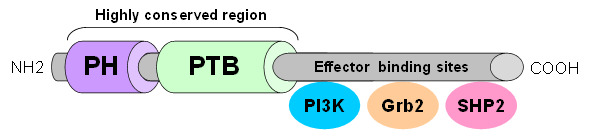
Figure 1. Schematic structure of IRS1. Interaction domains of IRS1: pleckstrin homology (PH) domain (purple), phosphotyrosine binding (PTB) domain (green) and effector binding sites (including PI3K, Grb2 and SHP2) are indicated.
Description
IRS1 belongs to the insulin receptor substrate (IRS) protein family, these proteins are characterized by the presence of a pleckstrin homology (PH) domain and a phosphotyrosine binding (PTB) domain (figure 1). The PH domain contributes to protein-protein binding and facilitates the recruitment of IRS proteins by cell membrane receptors. The PTB domain is actived by receptors (Mardilovich et al., 2009).
Expression
Ubiquitous.
Localisation
IRS1 is predominantly found in the cytoplasm. Nuclear localization may occur in some cell types and under specific stimuli.
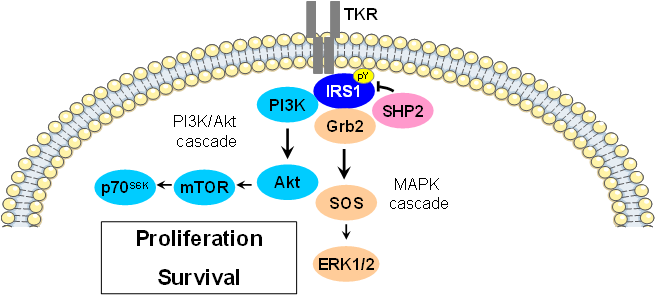
Figure 2. IRS1 signaling pathway. IRS1 is recruited by its PH/PTB domains and phosphorylated in tyrosine residues (pY) by upstream tyrosine kinase receptors. Tyrosine phosphorylated IRS1 binds to signaling effectors and activates signaling cascades, regulating several biological processes, including proliferation and survival.
Function
IRS1 is an intracellular signaling adaptor protein that integrates and coordinates numerous biologically key extracellular signals within the cell. First identified as a signaling intermediate of the insulin receptor (IR), it is now clear that IRS1 is the main substrate of the insulin-like grow factor 1 receptor (IGF1R) (Dearth et al., 2007). IRS1 contains multiple tyrosine phosphorylation sites, which during insulin stimulation are phosphorylated and act as docking sites for multiple SH2-containing proteins including PI3K, Grb2, Nck, Crk, Fyn, Syp and SHP2 (Mardilovich et al., 2009). The two best-studied being the PI3K/Akt/mTOR and the MAPK pathway, which includes the ERK protein (figure 2) (Mardilovich et al., 2009). IRS1 has no intrinsic kinase activity and requires upstream activators, however many studies have shown that this signaling adaptor is in itself oncogenic and can induce malignant transformation (Dearth et al., 2007).
More recently, nuclear localization of IRS1 was observed in cells expressing SV40 T antigen, fibroblasts under IGF1 stimulation, hepatocytes, 32D cells and others. Several nuclear functions have been attributed to IRS1, including DNA repair fidelity, transcriptional activity and cell growth, which contributes to tumor development and progression (Reiss et al., 2011).
More recently, nuclear localization of IRS1 was observed in cells expressing SV40 T antigen, fibroblasts under IGF1 stimulation, hepatocytes, 32D cells and others. Several nuclear functions have been attributed to IRS1, including DNA repair fidelity, transcriptional activity and cell growth, which contributes to tumor development and progression (Reiss et al., 2011).
Homology
IRS1 shares high homology in its N-termini with the other members of the IRS proteins family. IRS1 also shares a high homology among different species (table 1).
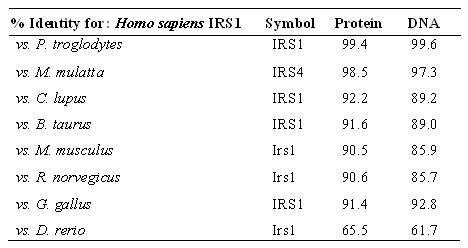
Table 1. Comparative identity of human IRS1 with other species. Source: HomoloGene.
Implicated in
Entity name
Philadelphia chromosome-positive (Ph+) leukemias
Note
IRS1 was identified as a binding partner of BCR-ABL protein and found to be involved in the activation of the PI3K/Akt/mTOR and MAPK signaling pathway in the BCR-ABL network (Traina et al., 2003). In BCR-ABL positive leukemia cells, IRS1 silencing resulted in decreased cell proliferation and clonogenicity (Machado-Neto et al., 2011). In addition, IRS1 expression was found to be negatively correlated with survival in patients with Ph+ acute lymphosblastic leukemia, regardless of age and white blood cell count at diagnosis (Juric et al., 2007).
Entity name
Breast cancer
Note
In breast cancer tumors, IRS1 has been described as constitutively activated and its expression has been correlated with poor differentiation and positive lymph node status (Chang et al., 2002; Lee et al., 1999; Koda et al., 2005). High levels of IRS1 were associated with lower disease-free survival and positively correlated with proliferation in estrogen receptor (ER) positive breast cancer tumors (Rocha et al., 1997). In ER positive breast cancer cells, IRS1 silencing promoted apoptosis and increased the sensibility to chemotherapy (Cesarone et al., 2006).
Entity name
Hepatocellular carcinoma
Note
IRS1 was found overexpressed in 80% of hepatocellular carcinoma (HCC) when compared with adjacent HCC-free tissue (Cantarini et al., 2006). In vitro experiments provided evidence that IRS1 overexpression was able to promote malignant transformation of hepatocytes (Tanaka et al., 1997).
Entity name
Lung cancer
Note
Han et al. reported a downregulation of IRS1 in non-small cell lung cancer (NSCLC) and suggested that loss of IRS1 might be an early event in NSCLC development (Han et al., 2006).
Entity name
Medulloblastoma
Note
Abundant IRS1 expression was found in medulloblastoma cell lines and medulloblastoma biopsies. Nuclear translocation of IRS1 was observed in all cell lines and primary samples in the presence of the JC virus T antigen (Del Valle et al., 2002).
Entity name
Mesothelioma
Note
Up-regulation of IRS1 was found in mesothelioma samples and may contribute to malignant pleural mesothelioma tumorigenesis by IGF1-induced cell proliferation (Hoang et al., 2004).
Entity name
Ovarian cancer
Note
The majority of malignant epithelial ovarian tumors showed IRS1 overexpression when compared with normal ovarian tissue, suggesting a correlation between IRS1 expression and cancer phenotype. The same study suggested that IRS1 is an important growth-regulatory protein and may be a possible target in ovarian cancer (Ravikumar et al., 2007).
Entity name
Pancreatic cancer
Note
IRS1 was highly expressed in 43% of pancreatic cancer samples when compared with normal pancreas samples (Bergmann et al., 1996).
Entity name
Prostate cancer
Note
High expression of IRS1 was correlated with high expression of IGF1R in both benign and malignant prostate samples (Hellawell et al., 2002), but IRS1 expression did not differ among these samples. In prostate cancer cells, IRS1 silencing plus rapamycin treatment synergistically antagonized the activation of mTOR and induced tumor suppression in vivo, through inhibition of proliferation and induction of apoptosis (Oliveira et al., 2008).
Entity name
Endometrial cancer
Note
IRS1 activation was significantly elevated in patients with endometrial cancer (EC) compared to those without EC and was associated with aggressive features. In addition, Wang et al. suggested that the inhibition of the IR/IRS1/PI3K/Akt pathway could be used as preventive and therapeutic strategies for EC (Wang et al., 2012).
Entity name
Colorectal cancer
Note
Esposito et al. reported that IRS1 was found highly expressed in adenomas of familial adenomatous polyposis patients, relative to paired normal mucosa, and in metastasized colorectal tumors compared with primary colorectal cancer (CRC) and colonic epithelium (Esposito et al., 2012). The authors also related that IRS1 staining was associated with high expressions of Ki67, p53, and β-catenin, suggesting that IRS1 is modulated according to CRC differentiation and plays a role in CRC progression and metastasis (Esposito et al., 2012).
Article Bibliography
| Pubmed ID | Last Year | Title | Authors |
|---|---|---|---|
| 8607861 | 1996 | Increased expression of insulin receptor substrate-1 in human pancreatic cancer. | Bergmann U et al |
| 16871543 | 2006 | Aspartyl-asparagyl beta hydroxylase over-expression in human hepatoma is linked to activation of insulin-like growth factor and notch signaling mechanisms. | Cantarini MC et al |
| 16440325 | 2006 | RNAi-mediated silencing of insulin receptor substrate 1 (IRS-1) enhances tamoxifen-induced cell death in MCF-7 breast cancer cells. | Cesarone G et al |
| 12414625 | 2002 | Constitutive activation of insulin receptor substrate 1 is a frequent event in human tumors: therapeutic implications. | Chang Q et al |
| 17374994 | 2007 | Oncogenic transformation by the signaling adaptor proteins insulin receptor substrate (IRS)-1 and IRS-2. | Dearth RK et al |
| 12491166 | 2002 | Insulin-like growth factor I receptor signaling system in JC virus T antigen-induced primitive neuroectodermal tumors--medulloblastomas. | Del Valle L et al |
| 22558377 | 2012 | The insulin receptor substrate 1 (IRS1) in intestinal epithelial differentiation and in colorectal cancer. | Esposito DL et al |
| 17089038 | 2006 | Clinical significance of insulin receptor substrate-I down-regulation in non-small cell lung cancer. | Han CH et al |
| 12019176 | 2002 | Expression of the type 1 insulin-like growth factor receptor is up-regulated in primary prostate cancer and commonly persists in metastatic disease. | Hellawell GO et al |
| 15492273 | 2004 | Selective activation of insulin receptor substrate-1 and -2 in pleural mesothelioma cells: association with distinct malignant phenotypes. | Hoang CD et al |
| 17312329 | 2007 | Differential gene expression patterns and interaction networks in BCR-ABL-positive and -negative adult acute lymphoblastic leukemias. | Juric D et al |
| 15917419 | 2005 | Expression of insulin receptor substrate 1 in primary breast cancer and lymph node metastases. | Koda M et al |
| 14633864 | 2003 | The role of insulin receptor substrate-1 gene (IRS1) in type 2 diabetes in Pima Indians. | Kovacs P et al |
| 10319328 | 1999 | Enhancement of insulin-like growth factor signaling in human breast cancer: estrogen regulation of insulin receptor substrate-1 expression in vitro and in vivo. | Lee AV et al |
| 21569802 | 2011 | Knockdown of insulin receptor substrate 1 reduces proliferation and downregulates Akt/mTOR and MAPK pathways in K562 cells. | Machado-Neto JA et al |
| 19534786 | 2009 | Expression and function of the insulin receptor substrate proteins in cancer. | Mardilovich K et al |
| 18264722 | 2008 | Antineoplastic effect of rapamycin is potentiated by inhibition of IRS-1 signaling in prostate cancer cells xenografts. | Oliveira JC et al |
| 17909034 | 2007 | Insulin receptor substrate-1 is an important mediator of ovarian cancer cell growth suppression by all-trans retinoic acid. | Ravikumar S et al |
| 22454254 | 2012 | Nuclear IRS-1 and cancer. | Reiss K et al |
| 9815544 | 1997 | Insulin-like growth factor binding protein-3 and insulin receptor substrate-1 in breast cancer: correlation with clinical parameters and disease-free survival. | Rocha RL et al |
| 1648180 | 1991 | Structure of the insulin receptor substrate IRS-1 defines a unique signal transduction protein. | Sun XJ et al |
| 7969452 | 1994 | Insulin resistance and growth retardation in mice lacking insulin receptor substrate-1. | Tamemoto H et al |
| 9303488 | 1997 | Biological effects of human insulin receptor substrate-1 overexpression in hepatocytes. | Tanaka S et al |
| 12560071 | 2003 | BCR-ABL binds to IRS-1 and IRS-1 phosphorylation is inhibited by imatinib in K562 cells. | Traina F et al |
| 22426488 | 2012 | Mitogenic and anti-apoptotic effects of insulin in endometrial cancer are phosphatidylinositol 3-kinase/Akt dependent. | Wang Y et al |
Other Information
Locus ID:
NCBI: 3667
MIM: 147545
HGNC: 6125
Ensembl: ENSG00000169047
Variants:
dbSNP: 3667
ClinVar: 3667
TCGA: ENSG00000169047
COSMIC: IRS1
RNA/Proteins
| Gene ID | Transcript ID | Uniprot |
|---|---|---|
| ENSG00000169047 | ENST00000305123 | P35568 |
| ENSG00000169047 | ENST00000305123 | A0A024R499 |
Expression (GTEx)
Pathways
Protein levels (Protein atlas)
PharmGKB
| Entity ID | Name | Type | Evidence | Association | PK | PD | PMIDs |
|---|---|---|---|---|---|---|---|
| PA128406956 | fluorouracil | Chemical | ClinicalAnnotation | associated | PD | ||
| PA164712711 | Drugs Used In Diabetes | Chemical | ClinicalAnnotation, VariantAnnotation | ambiguous | PD | 28696414 | |
| PA166124406 | platelet reactivity | Disease | VariantAnnotation | not associated | PD | ||
| PA443560 | Breast Neoplasms | Disease | ClinicalAnnotation | associated | PD | ||
| PA443796 | Coronary Artery Disease | Disease | ClinicalAnnotation, VariantAnnotation | ambiguous | PD | ||
| PA443890 | Diabetes Mellitus, Type 2 | Disease | ClinicalAnnotation, VariantAnnotation | ambiguous | PD | 28696414 | |
| PA445113 | Neutropenia | Disease | ClinicalAnnotation | associated | PD | ||
| PA448497 | aspirin | Chemical | VariantAnnotation | not associated | PD | ||
| PA449053 | clopidogrel | Chemical | ClinicalAnnotation, VariantAnnotation | ambiguous | PD | ||
| PA449165 | cyclophosphamide | Chemical | ClinicalAnnotation | associated | PD | ||
| PA449476 | epirubicin | Chemical | ClinicalAnnotation | associated | PD |
References
| Pubmed ID | Year | Title | Citations |
|---|---|---|---|
| 38172081 | 2024 | IRS1 promotes thyroid cancer metastasis through EMT and PI3K/AKT pathways. | 0 |
| 38491191 | 2024 | Sex differences in adipose insulin resistance are linked to obesity, lipolysis and insulin receptor substrate 1. | 0 |
| 38497391 | 2024 | sh- Ambra1 inhibits IRS-1/PI3K/Akt signalling pathway to reduce autophagy in gestational diabetes. | 0 |
| 38172081 | 2024 | IRS1 promotes thyroid cancer metastasis through EMT and PI3K/AKT pathways. | 0 |
| 38491191 | 2024 | Sex differences in adipose insulin resistance are linked to obesity, lipolysis and insulin receptor substrate 1. | 0 |
| 38497391 | 2024 | sh- Ambra1 inhibits IRS-1/PI3K/Akt signalling pathway to reduce autophagy in gestational diabetes. | 0 |
| 36346578 | 2023 | Long Non-coding RNA SPAG5-AS1 Attenuates Diabetic Retinal Vascular Dysfunction by Inhibiting Human Retinal Microvascular Endothelial Cell Proliferation, Migration, and Tube Formation by Regulating the MicroRNA-1224-5p/IRS-1 Axis. | 1 |
| 36610717 | 2023 | Suppression of Insulin Receptor Substrate 1 Inhibits Breast Cancer Growth In Vitro and in Female Athymic Mice. | 0 |
| 36768755 | 2023 | Overexpression of Insulin Receptor Substrate 1 (IRS1) Relates to Poor Prognosis and Promotes Proliferation, Stemness, Migration, and Oxidative Stress Resistance in Cholangiocarcinoma. | 1 |
| 36907599 | 2023 | High risk genetic variants of human insulin receptor substrate 1(IRS1) infer structural instability and functional interference. | 0 |
| 37173295 | 2023 | Association of IRS-1 and IRS-2 polymorphisms with predisposition to type-2 diabetes (T2D): a meta-analysis and trial sequential analysis. | 0 |
| 37716291 | 2023 | Influence of polymorphisms in IRS1, IRS2, MC3R, and MC4R on metabolic and inflammatory status and food intake in Brazilian adults: An exploratory pilot study. | 0 |
| 37915155 | 2023 | Gender Differences of Gly972Arg Polymorphism of the IRS-1 Gene Related to Cardiovascular Disease Risk Factors Among Indonesians. | 0 |
| 36346578 | 2023 | Long Non-coding RNA SPAG5-AS1 Attenuates Diabetic Retinal Vascular Dysfunction by Inhibiting Human Retinal Microvascular Endothelial Cell Proliferation, Migration, and Tube Formation by Regulating the MicroRNA-1224-5p/IRS-1 Axis. | 1 |
| 36610717 | 2023 | Suppression of Insulin Receptor Substrate 1 Inhibits Breast Cancer Growth In Vitro and in Female Athymic Mice. | 0 |
Citation
Joao Agostinho Machado-Neto, PhD ; Fabiola Traina
IRS1 (insulin receptor substrate 1)
Atlas Genet Cytogenet Oncol Haematol. 2013-03-01
Online version: http://atlasgeneticsoncology.org/gene/384/irs1-%28insulin-receptor-substrate-1%29
