CDC7 (cell division cycle 7)
2020-02-01 Hugo Passos Vicari , Joao Agostinho Machado-Neto, PhD AffiliationDepartment of Pharmacology, Institute of Biomedical Sciences of the University of São Paulo, São Paulo, Brazil; [email protected]; [email protected]
Abstract
CDC7 is a serine-threonine kinase that participates in multiple cellular processes, including DNA replication, chromosomal segregation, S phase cell cycle progression, and DNA damage checkpoint. CDC7 is frequently highly expressed in several types of neoplasm, and it has been associated with cancer development and poor clinical outcomes. In different cancer models, functional studies indicated that CDC7 may be an attractive target for antineoplastic therapy, and CDC7 inhibitors have been developed. The present review on CDC7 contains data on DNA\/RNA, the protein encoded, and the implication of this gene in cancer cell biology and clinical outcomes.
DNA/RNA
Description
Proteins
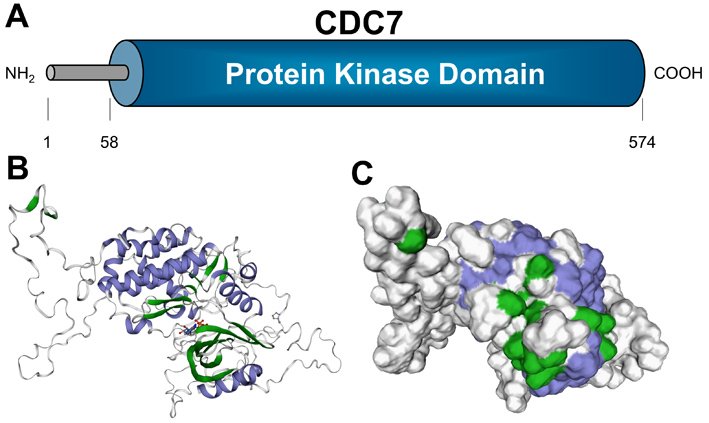
Description
Expression
Localisation
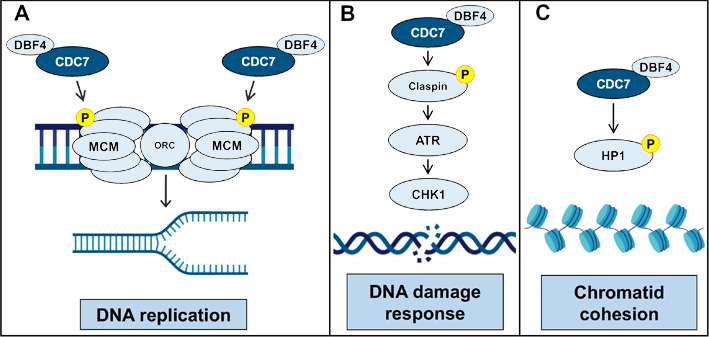
Function
Homology
Table 1. Comparative identity of human CDC7 with other species
| % Identity for: Homo sapiens CDC7 | Symbol | Protein | DNA |
| vs. P.troglodytes | CDC7 | 97.7 | 98.6 |
| vs. M.mulatta | CDC7 | 96.9 | 97.8 |
| vs. C.lupus | CDC7 | 90.6 | 92.9 |
| vs. B.taurus | CDC7 | 89.4 | 90.8 |
| vs. M.musculus | Cdc7 | 81.4 | 83.2 |
| vs. R.norvegicus | Cdc7 | 81.5 | 81.9 |
| vs. G.gallus | CDC7 | 69.8 | 74.1 |
| vs. X.tropicalis | cdc7 | 66.9 | 68.3 |
| vs. D.rerio | cdc7 | 63.7 | 60.6 |
| vs. A.gambiae | AgaP_AGAP002110 | 40.0 | 43.8 |
(Source: http://www.ncbi.nlm.nih.gov/homologene)
Mutations
Somatic
Implicated in
In triple negative breast cancer cellular models, the dual CDC7/CDK9 inhibitor (PHA-767491) synergizes with tyrosine kinase inhibitors to overcome resistance to EGFR -targeted therapy (McLaughlin et al., 2019): combined inhibition of EGFR and CDC7/CDK9 reduced cell proliferation accompanied by apoptosis induction, G2/M cell cycle arrest, and DNA replication inhibition.
Due to the rarity of male breast cancer (MBC), serum protein alterations have not been extensively studied. Using two-dimensional gel electrophoresis (2-DE) and matrix-assisted laser desorption/ionization time mass spectrometry (MALDI-TOF MS), a panel of differentially expressed serum proteins were identified, which included the high CDC7 expression in MBC patients (Zografos et al., 2019).
In chronic lymphocytic leukemia (CLL), CDC7 was expressed and activated in lymph node biopsies. A similar finding was also observed in an in vitro model that partially recapitulates lymph node proliferation centers of CLL. These data suggested a potential role for CDC7 in the aberrant lymph node microenvironment (Natoni et al., 2011). In addition, high CDC7 expression was associated with poor prognosis in patients with diffuse large B-cell lymphoma (DLBCL) (Hou et al., 2012b; Hou et al., 2011; Krawczyk et al., 2009). In DLBCL cell lines, CDC7 silencing combined with rituximab synergistically increased apoptosis (Hou et al., 2012a).
The dual CDC7/ CDK9 inhibitor, PHA-767491, also induced cell death on a panel of multiple myeloma cell lines and primary patient samples alone or in combination with drugs currently used in the clinics, including the TP53 mutant cells that developed resistance to dexamethasone, melphalan, and doxorubicin. PHA-767491 had the same effect on primary myeloma cells from patients who relapsed with progressive refractory disease. These data suggested that the mechanisms leading to chemoresistance in myeloma may not affect the activity of a dual CDC7/CDK9 inhibitor, thus supporting further evaluation of CDC7 and CDK9 targeting in multiple myeloma (Natoni et al., 2013).
In acute myeloid leukemia (AML), the dual CDC7/CDK9 inhibitor, PHA-767491, downregulated MCL1 and sensitized AML cell lines and primary AML blasts to BCL2 inhibitors, ABT-737 and ABT-199 (O Reilly et al., 2018).
In order to better understand the transcriptional regulation cell cycle checkpoints in melanocytes and melanoma cell lines, Kaufmann et al. (Kaufmann et al., 2008) analyzed global gene expression patterns upon DNA damage induced by ionizing radiation, and most melanoma cell lines (11 of out 16) showed significant defects in checkpoints, which included reduced expression of TP53 transcriptional targets, and enhanced expression of proliferation-associated genes. Of note, defective melanomas at checkpoint G1 exhibited higher levels of DNA synthesis-related genes, including CDC7 and CKS1B.
Using a VSV-cDNA library and B16 melanoma tumors, CDC7 was identified (among others) as a potential immunogenic antigen for chemotherapy or immunotherapy (Zaidi et al., 2015).
Article Bibliography
| Pubmed ID | Last Year | Title | Authors |
|---|---|---|---|
| 14625560 | 2003 | Hsk1-Dfp1 is required for heterochromatin-mediated cohesion at centromeres. | Bailis JM et al |
| 25748237 | 2015 | Molecular subtypes of uterine leiomyosarcoma and correlation with clinical outcome. | Barlin JN et al |
| 18714392 | 2008 | Cdc7-Dbf4 kinase overexpression in multiple cancers and tumor cell lines is correlated with p53 inactivation. | Bonte D et al |
| 9472017 | 1998 | The Cdc7 protein kinase is required for origin firing during S phase. | Bousset K et al |
| 31002360 | 2019 | miR‑888 regulates cancer progression by targeting multiple targets in lung adenocarcinoma. | Cao JX et al |
| 30588031 | 2019 | Targeting CDC7 improves sensitivity to chemotherapy of esophageal squamous cell carcinoma. | Cao JX et al |
| 23716994 | 2013 | Expression of huCdc7 in colorectal cancer. | Chen HJ et al |
| 23684929 | 2013 | Increased Cdc7 expression is a marker of oral squamous cell carcinoma and overexpression of Cdc7 contributes to the resistance to DNA-damaging agents. | Cheng AN et al |
| 19896697 | 2010 | Overexpression of cell division cycle 7 homolog is associated with gene amplification frequency in breast cancer. | Choschzick M et al |
| 19278428 | 2009 | Cdc7 expression in melanomas, Spitz tumors and melanocytic nevi. | Clarke LE et al |
| 12535533 | 2003 | An ATR- and Cdc7-dependent DNA damage checkpoint that inhibits initiation of DNA replication. | Costanzo V et al |
| 28887320 | 2017 | p53 gain-of-function mutations increase Cdc7-dependent replication initiation. | Datta A et al |
| 27891063 | 2016 | Cell division cycle 7-kinase inhibitor PHA-767491 hydrochloride suppresses glioblastoma growth and invasiveness. | Erbayraktar Z et al |
| 19555113 | 2009 | Cell division cycle 7 kinase inhibitors: 1H-pyrrolo[2,3-b]pyridines, synthesis and structure-activity relationships. | Ermoli A et al |
| 16676402 | 2006 | Gene expression in poorly differentiated papillary thyroid carcinomas. | Fluge Ø et al |
| 27574806 | 2016 | Kinase Gene Expression Profiling of Metastatic Clear Cell Renal Cell Carcinoma Tissue Identifies Potential New Therapeutic Targets. | Ghatalia P et al |
| 17344846 | 2007 | Patterns of somatic mutation in human cancer genomes. | Greenman C et al |
| 9573348 | 1998 | A human homolog of the yeast CDC7 gene is overexpressed in some tumors and transformed cell lines. | Hess GF et al |
| 22806309 | 2012 | Effects of CDC7 gene silencing and Rituximab on apoptosis in diffuse large B cell lymphoma cells. | Hou Y et al |
| 26921250 | 2016 | Cdc7 is a potent anti-cancer target in pancreatic cancer due to abrogation of the DNA origin activation checkpoint. | Huggett MT et al |
| 31131319 | 2019 | Molecular mechanism and potential target indication of TAK-931, a novel CDC7-selective inhibitor. | Iwai K et al |
| 29339028 | 2019 | Overexpression of CDC7 in malignant salivary gland tumors correlates with tumor differentiation. | Jaafari-Ashkavandi Z et al |
| 29713760 | 2018 | Cell division cycle 7 is a potential therapeutic target in oral squamous cell carcinoma and is regulated by E2F1. | Jin S et al |
| 17597816 | 2008 | Defective cell cycle checkpoint functions in melanoma are associated with altered patterns of gene expression. | Kaufmann WK et al |
| 18084324 | 2008 | Cdc7 kinase mediates Claspin phosphorylation in DNA replication checkpoint. | Kim JM et al |
| 11980714 | 2002 | Inactivation of Cdc7 kinase in mouse ES cells results in S-phase arrest and p53-dependent cell death. | Kim JM et al |
| 14517263 | 2003 | Hypomorphic mutation in an essential cell-cycle kinase causes growth retardation and impaired spermatogenesis. | Kim JM et al |
| 14643427 | 2003 | Functions of mammalian Cdc7 kinase in initiation/monitoring of DNA replication and development. | Kim JM et al |
| 26966728 | 2016 | Upregulated expression of BCL2, MCM7, and CCNE1 indicate cisplatin-resistance in the set of two human bladder cancer cell lines: T24 cisplatin sensitive and T24R2 cisplatin resistant bladder cancer cell lines. | Kim SH et al |
| 22560567 | 2012 | Discovery of XL413, a potent and selective CDC7 inhibitor. | Koltun ES et al |
| 19318489 | 2009 | Cdc7 kinase is a predictor of survival and a novel therapeutic target in epithelial ovarian carcinoma. | Kulkarni AA et al |
| 31895562 | 2020 | Discovery of a Novel, Highly Potent, and Selective Thieno[3,2-d]pyrimidinone-Based Cdc7 Inhibitor with a Quinuclidine Moiety (TAK-931) as an Orally Active Investigational Antitumor Agent. | Kurasawa O et al |
| 20551170 | 2010 | How do Cdc7 and cyclin-dependent kinases trigger the initiation of chromosome replication in eukaryotic cells? | Labib K et al |
| 22123827 | 2012 | Dbf4 is direct downstream target of ataxia telangiectasia mutated (ATM) and ataxia telangiectasia and Rad3-related (ATR) protein to regulate intra-S-phase checkpoint. | Lee AY et al |
| 29413763 | 2018 | CDC7-dependent transcriptional regulation of RAD54L is essential for tumorigenicity and radio-resistance of glioblastoma. | Li Q et al |
| 25643258 | 2015 | Dual Inhibition of Cdc7 and Cdk9 by PHA-767491 Suppresses Hepatocarcinoma Synergistically with 5-Fluorouracil. | Li W et al |
| 27706618 | 2016 | Identification of key biomarkers involved in osteosarcoma using altered modules. | Liu ZZ et al |
| 19013276 | 2008 | Dbf4-dependent CDC7 kinase links DNA replication to the segregation of homologous chromosomes in meiosis I. | Matos J et al |
| 24256280 | 2013 | Regulation of chromosome dynamics by Hsk1/Cdc7 kinase. | Matsumoto S et al |
| 31262335 | 2019 | A kinase inhibitor screen identifies a dual cdc7/CDK9 inhibitor to sensitise triple-negative breast cancer to EGFR-targeted therapy. | McLaughlin RP et al |
| 26208856 | 2015 | Cdc7 overexpression is an independent prognostic marker and a potential therapeutic target in colorectal cancer. | Melling N et al |
| 19115845 | 2009 | First Cdc7 kinase inhibitors: pyrrolopyridinones as potent and orally active antitumor agents. 2. Lead discovery. | Menichincheri M et al |
| 17768177 | 2007 | Identification and functional characterization of ASK/Dbf4, a novel cell survival gene in cutaneous melanoma with prognostic relevance. | Nambiar S et al |
| 24202326 | 2013 | Characterization of a Dual CDC7/CDK9 Inhibitor in Multiple Myeloma Cellular Models. | Natoni A et al |
| 21768328 | 2011 | Mechanisms of action of a dual Cdc7/Cdk9 kinase inhibitor against quiescent and proliferating CLL cells. | Natoni A et al |
| 30361682 | 2018 | Repression of Mcl-1 expression by the CDC7/CDK9 inhibitor PHA-767491 overcomes bone marrow stroma-mediated drug resistance in AML. | O' Reilly E et al |
| 23598722 | 2013 | Cdc7-dependent and -independent phosphorylation of Claspin in the induction of the DNA replication checkpoint. | Rainey MD et al |
| 20724597 | 2010 | Targeting DNA replication before it starts: Cdc7 as a therapeutic target in p53-mutant breast cancers. | Rodriguez-Acebes S et al |
| 19920912 | 2009 | Drug design with Cdc7 kinase: a potential novel cancer therapy target. | Sawa M et al |
| 29134273 | 2018 | O Cdc7 kinase where art thou? | Sclafani RA et al |
| 23846933 | 2013 | Preclinical research in treatment of pancreatic cancer. | Skoura E et al |
| 16467079 | 2006 | Gene expression differences associated with human papillomavirus status in head and neck squamous cell carcinoma. | Slebos RJ et al |
| 30413320 | 2019 | Over expression of DNA damage and cell cycle dependent proteins are associated with poor survival in patients with adrenocortical carcinoma. | Subramanian C et al |
| 30150654 | 2018 | An interaction network driven approach for identifying biomarkers for progressing cervical intraepithelial neoplasia. | Suman S et al |
| 18628396 | 2008 | Cdc7-Drf1 kinase links chromosome cohesion to the initiation of DNA replication in Xenopus egg extracts. | Takahashi TS et al |
| 17062569 | 2007 | Cdc7 is an active kinase in human cancer cells undergoing replication stress. | Tenca P et al |
| 19111665 | 2008 | The role of Dbf4/Drf1-dependent kinase Cdc7 in DNA-damage checkpoint control. | Tsuji T et al |
| 15236317 | 2004 | Deletion mapping suggests that the 1p22 melanoma susceptibility gene is a tumor suppressor localized to a 9-Mb interval. | Walker GJ et al |
| 24240236 | 2013 | ATR-Chk1-APC/CCdh1-dependent stabilization of Cdc7-ASK (Dbf4) kinase is required for DNA lesion bypass under replication stress. | Yamada M et al |
| 25475780 | 2015 | Molecular genetic study of novel biomarkers for early diagnosis of oral squamous cell carcinoma. | Yong-Deok K et al |
| 25544599 | 2015 | Mutated BRAF Emerges as a Major Effector of Recurrence in a Murine Melanoma Model After Treatment With Immunomodulatory Agents. | Zaidi S et al |
| 30363964 | 2018 | Upregulation of BUB1B, CCNB1, CDC7, CDC20, and MCM3 in Tumor Tissues Predicted Worse Overall Survival and Disease-Free Survival in Hepatocellular Carcinoma Patients. | Zhuang L et al |
| 30850364 | 2019 | Serum Proteomic Signatures of Male Breast Cancer. | Zografos E et al |
Other Information
Locus ID:
NCBI: 8317
MIM: 603311
HGNC: 1745
Ensembl: ENSG00000097046
Variants:
dbSNP: 8317
ClinVar: 8317
TCGA: ENSG00000097046
COSMIC: CDC7
RNA/Proteins
Expression (GTEx)
Pathways
Protein levels (Protein atlas)
References
| Pubmed ID | Year | Title | Citations |
|---|---|---|---|
| 38205514 | 2024 | Druggable cavities and allosteric modulators of the cell division cycle 7 (CDC7) kinase. | 0 |
| 38865090 | 2024 | DBF4, not DRF1, is the crucial regulator of CDC7 kinase at replication forks. | 0 |
| 38205514 | 2024 | Druggable cavities and allosteric modulators of the cell division cycle 7 (CDC7) kinase. | 0 |
| 38865090 | 2024 | DBF4, not DRF1, is the crucial regulator of CDC7 kinase at replication forks. | 0 |
| 35398961 | 2023 | Novel insights into the roles of Cdc7 in response to replication stress. | 2 |
| 37497004 | 2023 | DBF4 Dependent Kinase Inhibition Suppresses Hepatocellular Carcinoma Progression and Potentiates Anti-Programmed Cell Death-1 Therapy. | 2 |
| 35398961 | 2023 | Novel insights into the roles of Cdc7 in response to replication stress. | 2 |
| 37497004 | 2023 | DBF4 Dependent Kinase Inhibition Suppresses Hepatocellular Carcinoma Progression and Potentiates Anti-Programmed Cell Death-1 Therapy. | 2 |
| 33599894 | 2021 | MiR-200a with CDC7 as a direct target declines cell viability and promotes cell apoptosis in Wilm's tumor via Wnt/β-catenin signaling pathway. | 5 |
| 33763482 | 2021 | Upregulation of CDC7 Associated with Cervical Cancer Incidence and Development. | 2 |
| 34663432 | 2021 | Targeting CDC7 potentiates ATR-CHK1 signaling inhibition through induction of DNA replication stress in liver cancer. | 0 |
| 33599894 | 2021 | MiR-200a with CDC7 as a direct target declines cell viability and promotes cell apoptosis in Wilm's tumor via Wnt/β-catenin signaling pathway. | 5 |
| 33763482 | 2021 | Upregulation of CDC7 Associated with Cervical Cancer Incidence and Development. | 2 |
| 34663432 | 2021 | Targeting CDC7 potentiates ATR-CHK1 signaling inhibition through induction of DNA replication stress in liver cancer. | 0 |
| 32496651 | 2020 | CDC7 kinase promotes MRE11 fork processing, modulating fork speed and chromosomal breakage. | 16 |
Citation
Hugo Passos Vicari ; Joao Agostinho Machado-Neto, PhD
CDC7 (cell division cycle 7)
Atlas Genet Cytogenet Oncol Haematol. 2020-02-01
Online version: http://atlasgeneticsoncology.org/gene/40015/cdc7-(cell-division-cycle-7)
