VCAN (versican)
2010-10-01 Daniel Hernández , Maria José Docampo , Anna Bassols AffiliationDepartament de Bioquimica i Biologia Molecular, Facultat de Veterinaria, Universitat Autonoma de Barcelona, 08193 Bellaterra, Spain
Identity
DNA/RNA

Description
Transcription
The expression of the versican gene (CSPG2) is regulated by a promoter that harbors a typical TATA box and potential binding sites for several transcription factors, including AP1, AP2, CCAAT enhancer protein, TCF-4 and cAMP-responsive element (Naso et al., 1994; Rahmani et al., 2006; Domenzain-Reyna et al., 2009). Regulation of the versican gene through an androgen response element in the proximal promoter has been reported in prostate (Read et al., 2007).
Proteins
Description
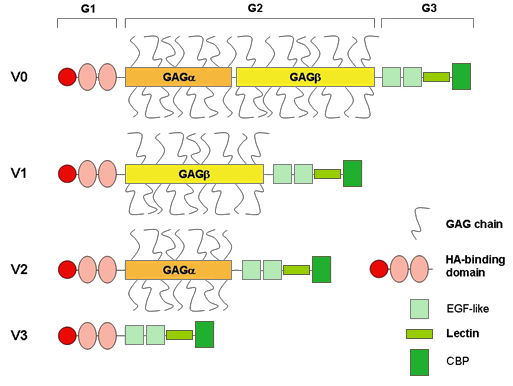
The largest versican isoform (V0) consists of 3396 aa. The core protein can be divided into three domains: the globular N-terminal domain (G1), the central domain (G2) where glycosaminoglycan (GAG) chains attach, and the globular C-terminal domain (G3). The G1 domain is composed of an immunoglobulin-like motif, followed by two tandem repeats which bind hyaluronan (HA). The G3 domain contains two EGF-like repeats, a lectin-like subdomain and a complement binding protein (CBP)-like subdomain. The central domain G2 can be alternatively spliced to give rise to the four versican isoforms: V0 (containing both GAG alpha and GAG beta), V1 (containing GAG beta), V2 (containing GAG alpha) and V3, lacking any GAG subdomain (Wight, 2002).
A new alternatively spliced versican isoform, referred to as V4, has been identified and found to be upregulated in human breast cancer (Kischel et al., 2010).
Posttranslational modifications (PTM): the consensus sequence for chondroitin sulphate attachment sites reveals the number of potential GAG attachment sites: the number of GAG chains attached to the protein core depends on the isoforms since the GAG alpha subdomain bears 12-17 chondroitin sulphate (CS) chains, whereas the GAG beta subdomain bears 5-8 CS chains (Ricciardelli et al., 2009).
Expression
Versican is highly expressed in tissue compartments undergoing active cell proliferation and migration. V0 and V1 isoforms are highly expressed during embryonic development, and their expression decreases after tissue maturation. In adult tissues, versican is present in the loose connective tissues of various organs and often associated with the elastic fibre network. It is localized in most smooth muscle tissues, in cartilage, in the basal layer of the epidermis, and in blood vessels (Bode-Lesniewska et al., 1996). Versican V2 is abundant in the central nervous system (Schmalfeldt et al., 2000). The V3 isoform has been identified at the mRNA levels but very scarcely at the protein level (Cattaruzza et al., 2002).
Localisation
Function
Versican belongs to the hyalectan family, characterized by its ability to bind hyaluronan. The overall consensus is that versican together with hyaluronan forms a pericellular matrix that modulates cell proliferation, adhesion and migration in conditions such as in development and wound healing cell. Some of these actions have been ascribed to specific domains in the molecule. Thus, overexpression of versican G1 domain can enhance cell proliferation and reduce cell adhesion (Ang et al., 1999; Zhang et al., 1999). G3 domain has also been involved in several processes like cell proliferation and invasion (Zhang et al., 1998; Yang et al., 2003; Zheng et al., 2004; Yee et al., 2007), and GAG chains have been considered partially responsible for the antiadhesive properties of versican (Yamagata and Kimata, 1994; Sakko et al., 2003).
Cell proliferation. Versican is associated with a proliferative cell phenotype and it is often found in tissues showing elevated proliferation such as in development and in a variety of tumours (Wight, 2002; Ricciardelli et al., 2009). Purified versican added to the culture media in a melanoma cell line induces proliferation (Touab et al., 2002). Silencing experiments with siRNA have lead to the same conclusion in vascular smooth muscle cells (Huang et al., 2006) and preadipocytes (Zizola et al., 2007).
Cell adhesion. Versican is an anti-adhesive substrate (Yamagata and Kimata, 1994). The anti-adhesive role of versican has been also shown in melanoma cells (Touab et al., 2002), prostate carcinoma cells (Sakko et al., 2003) or neural crest cells (Dutt et al., 2006). This inhibitory effect on cell adhesion may be mainly due to the presence of the GAG chains that might create a more hydrated extracellular matrix less suitable for cell adhesion.
Nevertheless, the G3 domain of versican has pro-adhesive properties raising the possibility that different breakdown products might differentially affect cell adhesion (Wu et al., 2002).
Cell migration and invasion. Versican can increase cell motility in embryonic as well as tumour cells. This activity may be mostly associated with its antiadhesive activities. Silencing of V0/V1 versican expression reduces cell migration in wound healing assays in smooth muscle cells (Huang et al., 2006), or in prostate cancer cells, where addition of purified versican to the cells caused an increase in the invasion ability (Ricciardelli et al., 2007). In glioma, treatment of the cells with TGF-beta2 caused an increase in cell migration associated to an increase in versican production (Arslan et al., 2007). In the nervous system and in axonal growth, the V2 splice variant inhibits axonal growth and migration (Schmalfeldt et al., 2000).
Apoptosis. The effect of versican on apoptosis is complex and anti- as well as pro-apoptotic functions have been reported. Overexpression of the V1 versican isoform in cultured fibroblasts increases apoptotic resistance, but cells were also sensitized to a wide range of cytotoxic agents (LaPierre et al., 2007).
Cell differentiation and epithelial-mesenchymal transition (EMT). Versican modulates cell differentiation and morphogenesis, since it is involved in EMT interactions and in mesenchymal cell condensation required for organogenesis. V1 (but not V2) has been shown to trigger MET in fibroblasts by inducing a switch from N-cadherin to E-cadherin and subsequent acquirement of epithelioid phenotype. Silencing of endogenous versican prevents condensation and MET in metanephric mesenchyme (Sheng et al., 2006). Versican is highly expressed in the mesenchymal cell condensation area during development of cartilage, heart, hair follicles and kidney, and in vitro evidences show that versican V0 and V1 isoforms are involved in the process of precartilage mesenchymal condensation and subsequent chondrogenesis (Kamiya et al., 2006). The requirement of versican in development is highlighted by the finding that deficiency of versican in a transgenic mouse model is embryonic lethal, due to defects on cardiac formation, limb mesenchymal aggregation and chondrogenesis (Williams et al., 2005).
Others. In neural cells, versican plays an important role in regulating axonal guidance (Perissinotto et al., 2000). It is also an important molecule in inflammatory processes since it is able to interact with immune cell receptors and chemokines (Hirose et al., 2001).
Homology
Mutations
Note
In this context, disruption of the versican gene in mouse and chick leads to severe cardiac defects and alterations in chondrogenesis in the hdf (heart defect) mouse. This animal model has lead to the conclusion that normal expression of the VCAN (Cspg2) gene is required for the successful development of the heart and for cartilage differentiation, leading to correct limb chondrogenesis (Mjaatvedt et al., 1998).
Only mutations affecting the splicing of exons 7 and 8 have been described associated to Wagner syndrome, a rare disorder belonging to the group of hereditary vitreoretinal degenerations (Miyamoto et al., 2005; Kloeckener-Gruissem et al., 2006).
Implicated in
Article Bibliography
| Pubmed ID | Last Year | Title | Authors |
|---|---|---|---|
| 2222452 | 1990 | Altered methylation of versican proteoglycan gene in human colon carcinoma. | Adany R et al |
| 10374750 | 1999 | Versican enhances locomotion of astrocytoma cells and reduces cell adhesion through its G1 domain. | Ang LC et al |
| 17453002 | 2007 | The role of versican isoforms V0/V1 in glioma migration mediated by transforming growth factor-beta2. | Arslan F et al |
| 8601689 | 1996 | Distribution of the large aggregating proteoglycan versican in adult human tissues. | Bode-Lesniewska B et al |
| 12221092 | 2002 | Distribution of PG-M/versican variants in human tissues and de novo expression of isoform V3 upon endothelial cell activation, migration, and neoangiogenesis in vitro. | Cattaruzza S et al |
| 9378555 | 1997 | The origin of hyaluronectin in human tumors. | Delpech B et al |
| 19269971 | 2009 | Structure and regulation of the versican promoter: the versican promoter is regulated by AP-1 and TCF transcription factors in invasive human melanoma cells. | Domenzain-Reyna C et al |
| 16964367 | 2006 | Guidance of neural crest cell migration: the inhibitory function of the chondroitin sulfate proteoglycan, versican. | Dutt S et al |
| 19073385 | 2008 | Versican overexpression in cutaneous malignant melanoma. | Gambichler T et al |
| 20619446 | 2010 | Up-regulation of stromal versican expression in advanced stage serous ovarian cancer. | Ghosh S et al |
| 11083865 | 2001 | Versican interacts with chemokines and modulates cellular responses. | Hirose J et al |
| 16385080 | 2006 | Inhibition of versican synthesis by antisense alters smooth muscle cell phenotype and induces elastic fiber formation in vitro and in neointima after vessel injury. | Huang R et al |
| 16257955 | 2006 | Versican/PG-M regulates chondrogenesis as an extracellular matrix molecule crucial for mesenchymal condensation. | Kamiya N et al |
| 19122641 | 2009 | Carcinoma-produced factors activate myeloid cells through TLR2 to stimulate metastasis. | Kim S et al |
| 19662655 | 2010 | Versican overexpression in human breast cancer lesions: known and new isoforms for stromal tumor targeting. | Kischel P et al |
| 16636652 | 2006 | Identification of the genetic defect in the original Wagner syndrome family. | Kloeckener-Gruissem B et al |
| 17065588 | 2007 | Prognostic significance of stromal versican expression in human endometrial cancer. | Kodama J et al |
| 17510402 | 2007 | The ability of versican to simultaneously cause apoptotic resistance and sensitivity. | LaPierre DP et al |
| 16043844 | 2005 | Identification of a novel splice site mutation of the CSPG2 gene in a Japanese family with Wagner syndrome. | Miyamoto T et al |
| 9758703 | 1998 | The Cspg2 gene, disrupted in the hdf mutant, is required for right cardiac chamber and endocardial cushion formation. | Mjaatvedt CH et al |
| 9088942 | 1997 | Immunohistochemical localization of extracellular matrix components in human breast tumours with special reference to PG-M/versican. | Nara Y et al |
| 7528742 | 1994 | Characterization of the complete genomic structure of the human versican gene and functional analysis of its promoter. | Naso MF et al |
| 8627343 | 1996 | Differential expression of versican isoforms in brain tumors. | Paulus W et al |
| 10851128 | 2000 | Avian neural crest cell migration is diversely regulated by the two major hyaluronan-binding proteoglycans PG-M/versican and aggrecan. | Perissinotto D et al |
| 15712181 | 2005 | Versican in nonsmall cell lung cancer: relation to hyaluronan, clinicopathologic factors, and prognosis. | Pirinen R et al |
| 16731595 | 2007 | High stromal versican expression predicts unfavourable outcome in oral squamous cell carcinoma. | Pukkila M et al |
| 16845893 | 2006 | Versican: signaling to transcriptional control pathways. | Rahmani M et al |
| 17728259 | 2007 | Androgen receptor regulation of the versican gene through an androgen response element in the proximal promoter. | Read JT et al |
| 19160015 | 2009 | The biological role and regulation of versican levels in cancer. | Ricciardelli C et al |
| 9797141 | 1998 | Differentiation of EL4 lymphoma cells by tumoral environment is associated with inappropriate expression of the large chondroitin sulfate proteoglycan PG-M and the tumor-associated antigen HTgp-175. | Rottiers P et al |
| 12941795 | 2003 | Modulation of prostate cancer cell attachment to matrix by versican. | Sakko AJ et al |
| 10671370 | 2000 | Brain derived versican V2 is a potent inhibitor of axonal growth. | Schmalfeldt M et al |
| 16452631 | 2006 | Versican mediates mesenchymal-epithelial transition. | Sheng W et al |
| 8314802 | 1993 | cDNA cloning of PG-M, a large chondroitin sulfate proteoglycan expressed during chondrogenesis in chick limb buds. Alternative spliced multiforms of PG-M and their relationships to versican. | Shinomura T et al |
| 16730906 | 2006 | The greatly increased amounts of accumulated versican and decorin with specific post-translational modifications may be closely associated with the malignant phenotype of pancreatic cancer. | Skandalis SS et al |
| 18661349 | 2008 | Versican in health and disease. | Theocharis AD et al |
| 12710131 | 2003 | Expression of the proteoglycans versican and mel-CSPG in dysplastic nevi. | Touab M et al |
| 11839575 | 2002 | Versican is differentially expressed in human melanoma and may play a role in tumor development. | Touab M et al |
| 18819099 | 2009 | The accumulation of versican in the nodules of benign prostatic hyperplasia. | True LD et al |
| 15142969 | 2004 | Proteoglycans in atherosclerosis and restenosis: key roles for versican. | Wight TN et al |
| 12231358 | 2002 | Versican: a versatile extracellular matrix proteoglycan in cell biology. | Wight TN et al |
| 16039617 | 2005 | Limb chondrogenesis is compromised in the versican deficient hdf mouse. | Williams DR Jr et al |
| 11805102 | 2002 | beta 1-Integrin-mediated glioma cell adhesion and free radical-induced apoptosis are regulated by binding to a C-terminal domain of PG-M/versican. | Wu Y et al |
| 16045811 | 2005 | The interaction of versican with its binding partners. | Wu YJ et al |
| 7531202 | 1994 | Repression of a malignant cell-substratum adhesion phenotype by inhibiting the production of the anti-adhesive proteoglycan, PG-M/versican. | Yamagata M et al |
| 20062075 | 2010 | Identification of an ovarian clear cell carcinoma gene signature that reflects inherent disease biology and the carcinogenic processes. | Yamaguchi K et al |
| 14572881 | 2003 | Versican G3 domain enhances cellular adhesion and proliferation of bovine intervertebral disc cells cultured in vitro. | Yang BL et al |
| 17662123 | 2007 | The effect of versican G3 domain on local breast cancer invasiveness and bony metastasis. | Yee AJ et al |
| 10733339 | 1999 | Promotion of chondrocyte proliferation by versican mediated by G1 domain and EGF-like motifs. | Zhang Y et al |
| 14766798 | 2004 | Versican/PG-M G3 domain promotes tumor growth and angiogenesis. | Zheng PS et al |
| 2583089 | 1989 | Multiple domains of the large fibroblast proteoglycan, versican. | Zimmermann DR et al |
| 17513099 | 2007 | Role of versican and hyaluronan in the differentiation of 3T3-L1 cells into preadipocytes and mature adipocytes. | Zizola CF et al |
Other Information
Locus ID:
NCBI: 1462
MIM: 118661
HGNC: 2464
Ensembl: ENSG00000038427
Variants:
dbSNP: 1462
ClinVar: 1462
TCGA: ENSG00000038427
COSMIC: VCAN
RNA/Proteins
Expression (GTEx)
Pathways
Protein levels (Protein atlas)
References
| Pubmed ID | Year | Title | Citations |
|---|---|---|---|
| 37886839 | 2024 | Versican Promotes Cardiomyocyte Proliferation and Cardiac Repair. | 9 |
| 38517140 | 2024 | Versican Associates with Tumor Immune Phenotype and Limits T-cell Trafficking via Chondroitin Sulfate. | 0 |
| 37886839 | 2024 | Versican Promotes Cardiomyocyte Proliferation and Cardiac Repair. | 9 |
| 38517140 | 2024 | Versican Associates with Tumor Immune Phenotype and Limits T-cell Trafficking via Chondroitin Sulfate. | 0 |
| 36333947 | 2023 | A novel splicing variant of VCAN identified in a Chinese family initially diagnosed with familial exudative vitreoretinopathy. | 2 |
| 36930067 | 2023 | COL3A1, CXCL8, VCAN, THBS2, and COL1A2 are correlated with the onset of biliary atresia. | 1 |
| 37108649 | 2023 | VCAN Hypomethylation and Expression as Predictive Biomarkers of Drug Sensitivity in Upper Urinary Tract Urothelial Carcinoma. | 2 |
| 37311354 | 2023 | Knockdown of versican 1 in lung fibroblasts aggravates Lipopolysaccharide-induced acute inflammation through up-regulation of the SP1-Toll-like Receptor 2-NF-κB Axis: a potential barrier to promising Versican-targeted therapy. | 0 |
| 37399500 | 2023 | V3: an enigmatic isoform of the proteoglycan versican. | 1 |
| 37406588 | 2023 | Identification of mutation gene prognostic biomarker in multiple myeloma through gene panel exome sequencing and transcriptome analysis in Chinese population. | 1 |
| 37461061 | 2023 | TGF-β1 dominates stromal fibroblast-mediated EMT via the FAP/VCAN axis in bladder cancer cells. | 5 |
| 36333947 | 2023 | A novel splicing variant of VCAN identified in a Chinese family initially diagnosed with familial exudative vitreoretinopathy. | 2 |
| 36930067 | 2023 | COL3A1, CXCL8, VCAN, THBS2, and COL1A2 are correlated with the onset of biliary atresia. | 1 |
| 37108649 | 2023 | VCAN Hypomethylation and Expression as Predictive Biomarkers of Drug Sensitivity in Upper Urinary Tract Urothelial Carcinoma. | 2 |
| 37311354 | 2023 | Knockdown of versican 1 in lung fibroblasts aggravates Lipopolysaccharide-induced acute inflammation through up-regulation of the SP1-Toll-like Receptor 2-NF-κB Axis: a potential barrier to promising Versican-targeted therapy. | 0 |
Citation
Daniel Hernández ; Maria José Docampo ; Anna Bassols
VCAN (versican)
Atlas Genet Cytogenet Oncol Haematol. 2010-10-01
Online version: http://atlasgeneticsoncology.org/gene/40173
