FANCL (FA complementation group L)
2019-06-01 Sylvie van Twest , Andrew Deans AffiliationSt Vincents Institute of Medical Research, 9 Princes St, Fitzroy VIC 3065; [email protected] [email protected]
Identity
HGNC
LOCATION
FANCL is located on 2p16.1 which is the short arm (p) of chromosome 2 at position 16.1 between base pairs 58,159,243 to 58,241,681.
IMAGE

LEGEND
Figure 1: Genomic context of FANCL on chromosome 2 (Adapted from NCBI).
LOCUSID
ALIAS
FAAP43,PHF9,POG
DNA/RNA
Note
FANCL has 2 described isoforms produced by alternative splicing. Isoform one (Q9NW38-1). Is known as the canonical isoform, while isoform 2 (Q9NW38-2) differs from the canonical sequence at 178-178: T--> TPQVNS.
Proteins

Figure 2: Exons in FANCL gene. Colour coded to indicate ELF, DRWD, and RING finger domains. Adapted from Chandrasekharappa et al. 2013.
Description
The FANCL gene encodes FANCL protein comprised of 375 amino acids with a molecular mass of 42905 Da. FANCL is comprised of 3 domains, an N-terminal E2-like fold (ELF), a novel double-RWD (DRWD) and C-terminal RING domain (Hodson, Purkiss et al., 2014).
Expression
From total RNA sequencing, FANCL was found to be expressed in adrenal gland (RPKM 2.1), prostate (RPKM 2.34), thymus (RPKM 2.1), and thyroid (RPKM 2.2) (Bioproject PRJNA280600 (PMID 25970244 ). In another RNA sequencing project on 27 different tissues from 95 human individuals, FANCL was highly expressed in adrenal gland (RPKM 16.8), endometrium (RPKM 10.6), lymph nodes (RPKM 8.5), ovary (RPKM 9.2), prostate (RPKM 8.5), and testis (RPKM 12) (Bioproject PRJEB4337, PMID 24309898).
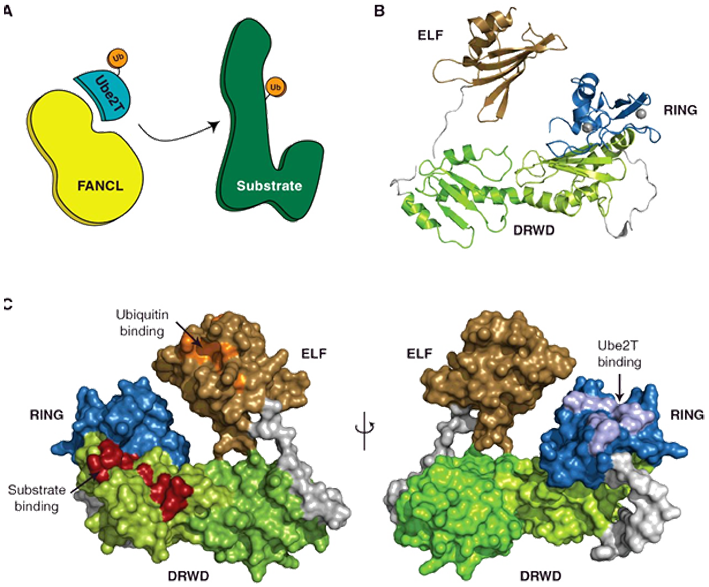
Figure 3: A) Schematic of D2 monoubiquitination by E3 RING ligase FANCL and E2 conjugating enzyme. B) Ribbon diagram of FANCL with ELF domain (brown), DRWD domain (green), and RING domain (green). C) Surface representation of protein binding domains on FANCL. The binding patch for ubiquitin (orange) is within the ELF domain, while the substrate binding domain (red) is in the DRWD domain, and the Ube2t binding domain (light purple) is in the RING domain. Figure from Specificity and disease in the ubiquitin system by Viduth K. Chaugule and Helen Walden in Biochemical Society Transactions Feb 2016, 44 (1) 212-227; DOI: 10.1042/BST20150209.
Function
FANCL the catalytically active part of the 9 protein Fanconi anemia (FA) core complex comprised of FANCB, FAAP100, FANCA, FANCG, FAAP20, FANCC, FANCE and FANCF that forms in response to DNA damage incurred during DNA replication in S-phase, or to detection of interstand cross links (ICL) (Ceccaldi, Sarangi et al., 2016). FANCL is an E3 ubiquitin ligase that specifically monoubiquitinates FANCD2 (at lysine 561) and FANCI (at lysine 523) (ID2; Note the FANCD2-FANCI heterodimer "ID2" must not to be confused with the gene ID2) in the presence ofUBE2T (FANCT) to signal downstream DNA repair proteins. FANCL is comprised of 3 distinct functional domains: the RING domain interacts with the E2 conjugating enzyme UBE2T (FANCT), the central DRWD domain interacts with FANCD2, and the N-terminal E2-like fold domain (ELF) domain interacts with ubiquitin (Hodson et al., 2014, Miles, Frost et al., 2015). Within the core complex, FANCL interacts as a subcomplex with FANCB and FAAP100 (Huang, Leung et al., 2014, van Twest, Murphy et al., 2017); both proteins stabilize FANCL (Rajendra, Oestergaard et al., 2014), and enhance its activity 5-fold in vitro assays (Ling, Ishiai et al., 2007).
Along with FANCA, FANCG, FANCF, FANCL was found to interact directly with hairy enhancer of split 1 ( HES1), which is a part of the NOTCH1 developmental pathway involved hematopoietic stem cell (HSC) self-renewal (Tremblay, Huang et al., 2008). Depletion of HES1 from cells resulted in FA-like phenotype with disrupted interaction between individual core complex proteins, increased cell sensitivity to DNA crosslinking agents, and reduced MMC-induced ID2 monoubiquitination (Tremblay et al., 2008). Finally HES1 did not interact FA-mutated core complex proteins. HSC defects and eventual bone marrow failure in FA patients may be linked to inability of HES1 to interact with a defective core complex (Tremblay et al., 2008, Tremblay, Huang et al., 2018).
Along with FANCA, FANCG, FANCF, FANCL was found to interact directly with hairy enhancer of split 1 ( HES1), which is a part of the NOTCH1 developmental pathway involved hematopoietic stem cell (HSC) self-renewal (Tremblay, Huang et al., 2008). Depletion of HES1 from cells resulted in FA-like phenotype with disrupted interaction between individual core complex proteins, increased cell sensitivity to DNA crosslinking agents, and reduced MMC-induced ID2 monoubiquitination (Tremblay et al., 2008). Finally HES1 did not interact FA-mutated core complex proteins. HSC defects and eventual bone marrow failure in FA patients may be linked to inability of HES1 to interact with a defective core complex (Tremblay et al., 2008, Tremblay, Huang et al., 2018).
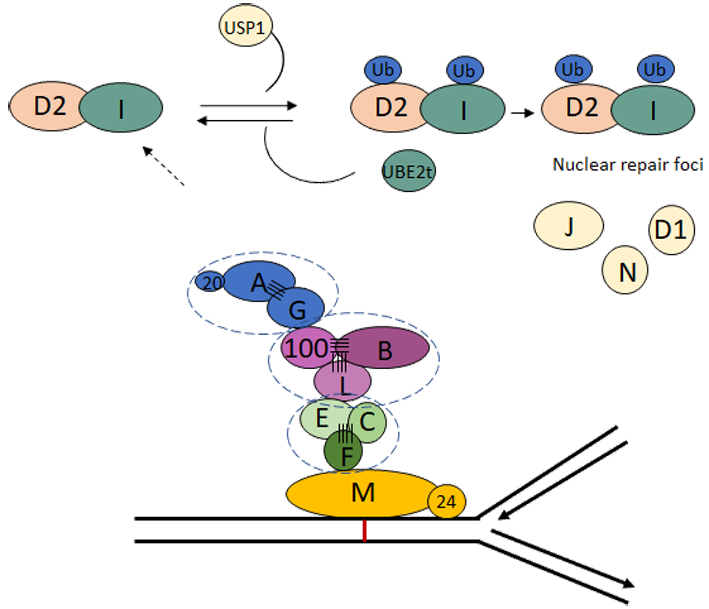
Figure 4: Schematic of Fanconi Anemia DNA damage response pathway. In response to interstrand cross links (ICL), or DNA damage from DNA replication, FANCM recruits the 9 protein core complex to DNA damage sites to monoubiquitinate FANC D2 and I. The core complex is comprised of 3 sub-complexes AG20 (FANC A, G, FAAP20), BL100 (FANC B, L, FAAP100), and CEF (FANC C,E,F). Dashed lines indicate groupings of sub-complexes, while triple lines indicate putative direct protein interactions. Within the core complex, FANCL has a RING E3 domain with ubiquitin ligase activity, but mutation in any one of the FA genes leads to defective DNA repair. Ubiquitinated ID2 is activated, and localized to chromatin in nuclear foci to interact with downstream DNA repair proteins (FANCD1, FANCD1, FANCN) to repair DNA via homologous recombination. Once DNA repair is completed, USP1 deubiquitinates ID2 so that DNA damage response can be reinitiated. Figure adapted from https://www.sciencedirect.com/topics/biochemistry-genetics-and-molecular-biology/fancb
Mutations
Germinal
FANCL-associated Fanconi anemia is inherited in an autosomal recessive manner, and accounts for 0.2% of all FA cases (Wu, Liu et al., 2017). To date, there are only 9 documented cases of FANCL-associated FA (Ali, Kirby et al., 2009, Ameziane, Sie et al., 2012, Chandrasekharappa, Lach et al., 2013, Meetei, de Winter et al., 2003, Vetro, Iascone et al., 2015, Wu et al., 2017).
Of the 5 cases with phenotypic and genotypic data, four were severe, and one was mild. Two severe cases frame shift deletions in exon 4 and 6 that truncated FANC, resulted in postnatal mortality and presented with VACTERL association (vertebral defects, anal atresia, cardiac defects, tracheoesophageal fistula, renal malformations, and limb defects) (Vetro et al., 2015). Another case with homozygous frameshift insertion of exon 9 had a severe phenotype with esophageal atresia (Ameziane et al., 2012). Finally, a novel homozygous mutation c.822_823insCTTTCAGG (p.Asp275LeufsX13) had a typical FA presentation with progression to bone marrow failture and death at age 9 from acute myelomonocytic leukemia (AML-M4) (Wu et al., 2017). The patient with mild FANCL-associated FA had bi-allelic mutation (Ali et al., 2009). One allele had an in-frame 3-bp deletion c.1007_1009delTAT (p.Ile336_Cys337delinsSer) in exon 12 within the PHD/RING-finger domain that resulted in loss of one amino acid, isoleucine-336, and conversion of cysteine-337 to serine null mutation (produces non-function protein). The other mutated allele had a 4-bp duplication (c.1095_1098dupAATT (p.Thr367AsnfsX13) that resulted in a frameshift just outside the RING-finger domain in exon 14. 4-bp duplication mutation is a hypomorphic mutation (produces partially functional protein) (Ali et al., 2009).
Sequencing screen of 27 FA cases with unidentified mutations uncovered 3 FANCL FA associated mutations: c.375-2033C>G (skips exons 4,6,7), c.375-2033 C>G (multiple splicing aberrations), c.1092G>A (skips exon 13), but didnt have corresponding phenotypic data (Chandrasekharappa et al., 2013). There is no phenotypic data for the first FANCL-associated FA patient that had exon 11 deletion and insertion of 177-nt sequence (Meetei et al., 2003) .
Of the 5 cases with phenotypic and genotypic data, four were severe, and one was mild. Two severe cases frame shift deletions in exon 4 and 6 that truncated FANC, resulted in postnatal mortality and presented with VACTERL association (vertebral defects, anal atresia, cardiac defects, tracheoesophageal fistula, renal malformations, and limb defects) (Vetro et al., 2015). Another case with homozygous frameshift insertion of exon 9 had a severe phenotype with esophageal atresia (Ameziane et al., 2012). Finally, a novel homozygous mutation c.822_823insCTTTCAGG (p.Asp275LeufsX13) had a typical FA presentation with progression to bone marrow failture and death at age 9 from acute myelomonocytic leukemia (AML-M4) (Wu et al., 2017). The patient with mild FANCL-associated FA had bi-allelic mutation (Ali et al., 2009). One allele had an in-frame 3-bp deletion c.1007_1009delTAT (p.Ile336_Cys337delinsSer) in exon 12 within the PHD/RING-finger domain that resulted in loss of one amino acid, isoleucine-336, and conversion of cysteine-337 to serine null mutation (produces non-function protein). The other mutated allele had a 4-bp duplication (c.1095_1098dupAATT (p.Thr367AsnfsX13) that resulted in a frameshift just outside the RING-finger domain in exon 14. 4-bp duplication mutation is a hypomorphic mutation (produces partially functional protein) (Ali et al., 2009).
Sequencing screen of 27 FA cases with unidentified mutations uncovered 3 FANCL FA associated mutations: c.375-2033C>G (skips exons 4,6,7), c.375-2033 C>G (multiple splicing aberrations), c.1092G>A (skips exon 13), but didnt have corresponding phenotypic data (Chandrasekharappa et al., 2013). There is no phenotypic data for the first FANCL-associated FA patient that had exon 11 deletion and insertion of 177-nt sequence (Meetei et al., 2003) .
Implicated in
Entity name
Disease
Biallelic mutations in FANCL, or any of the other 21 FA pathway proteins is implicated in Fanconi Anemia (FA), a rare genetic condition that results in progressive bone marrow failure (pancytopenia), congenital malformations in 75% of patients (short stature, urogenital defects, café au lait spots, skeletal malformations), and cancer pre-disposition (primarily acute myeloid leukaemia, and certain solid tumours) (Alter, 2014). Mutations that result in loss-of-function of both FANCL alleles may correlate with more severe phenotypes (Vetro et al., 2015). Hydrocephalus-VACTERL (vertebral, anal, cardiac, tracheo-esophageal fistula, renal, and limb anomalies) syndrome has been reported in two FANCL-linked FA patients that died shortly after birth (Vetro et al., 2015).
Prognosis: The prognosis for FA is poor as there is no cure, and the average lifespan is 20-30 years. If no congenital abnormalities are apparent at birth, patients are often diagnosed with FA when they present with aplastic anemia ages 8-10 (>700 fold risk) (Alter, 2014). Bone marrow transplants are often conducted to correct the haematological issues associated with FA, however due to faulty DNA repair FA patients retain high cancer risk particularly leukaemia, and head and neck squamous cell carcinomas (approximately 500 fold risk) (Shimamura & Alter, 2010).
Diagnosis: Diagnostics for FA is done with a chromosomal breakage test; when treated with interstand crosslinking agents such as mitomycin C (MMC) or diepoxybutane (DEB) FA cells exhibit high number chromosomal breakages, and abnormalities as compared to normal cells.
Prognosis: The prognosis for FA is poor as there is no cure, and the average lifespan is 20-30 years. If no congenital abnormalities are apparent at birth, patients are often diagnosed with FA when they present with aplastic anemia ages 8-10 (>700 fold risk) (Alter, 2014). Bone marrow transplants are often conducted to correct the haematological issues associated with FA, however due to faulty DNA repair FA patients retain high cancer risk particularly leukaemia, and head and neck squamous cell carcinomas (approximately 500 fold risk) (Shimamura & Alter, 2010).
Diagnosis: Diagnostics for FA is done with a chromosomal breakage test; when treated with interstand crosslinking agents such as mitomycin C (MMC) or diepoxybutane (DEB) FA cells exhibit high number chromosomal breakages, and abnormalities as compared to normal cells.
Article Bibliography
| Pubmed ID | Last Year | Title | Authors |
|---|---|---|---|
| 9544909 | 1998 | Presenting signs of retinoblastoma. | Abramson DH et al |
| 16127685 | 2005 | Spectrum of gross deletions and insertions in the RB1 gene in patients with retinoblastoma and association with phenotypic expression. | Albrecht P et al |
| 3502693 | 1987 | De novo t(2;13)(p24.3;q14.2) and retinoblastoma. Mapping of two 13q14 probes by in situ hybridization. | Blanquet V et al |
| 18621794 | 2009 | Incidence of retinoblastoma in the USA: 1975-2004. | Broaddus E et al |
| 17502991 | 2007 | Retinoblastoma and mental retardation microdeletion syndrome: clinical characterization and molecular dissection using array CGH. | Caselli R et al |
| 6633649 | 1983 | Expression of recessive alleles by chromosomal mechanisms in retinoblastoma. | Cavenee WK et al |
| 910860 | 1977 | Retinoblastoma in a patient with a 13qXp translocation. | Cross HE et al |
| 24858910 | 2014 | The survival gene MED4 explains low penetrance retinoblastoma in patients with large RB1 deletion. | Dehainault C et al |
| 27189421 | 2015 | Retinoblastoma. | Dimaras H et al |
| 12868036 | 2003 | Interstitial deletion of 13q and a 13;X chromosome translocation results in partial trisomy 13 and bilateral retinoblastoma. | Dries D et al |
| 27401552 | 2016 | RB1: a prototype tumor suppressor and an enigma. | Dyson NJ et al |
| 26925970 | 2016 | A Parent-of-Origin Effect Impacts the Phenotype in Low Penetrance Retinoblastoma Families Segregating the c.1981C>T/p.Arg661Trp Mutation of RB1. | Eloy P et al |
| 2877398 | 1986 | A human DNA segment with properties of the gene that predisposes to retinoblastoma and osteosarcoma. | Friend SH et al |
| 7959682 | 1994 | Frequency and parental origin of hypermethylated RB1 alleles in retinoblastoma. | Greger V et al |
| 10077618 | 1999 | Mitotic recombination map of 13cen-13q14 derived from an investigation of loss of heterozygosity in retinoblastomas. | Hagstrom SA et al |
| 22924820 | 2013 | A novel translocation t(11;13) (q21;q14.2) in a child with suprasellar primitive neuroectodermal tumor and retinoblastoma. | Huddleston S et al |
| 29662154 | 2018 | Parent-of-origin effect of hypomorphic pathogenic variants and somatic mosaicism impact on phenotypic expression of retinoblastoma. | Imperatore V et al |
| 3879432 | 1985 | Translocation (X;13)(p11.21;q12.3) in a girl with incontinentia pigmenti and bilateral retinoblastoma. | Kajii T et al |
| 4015485 | 1985 | Retinoblastoma and retinoma occurring in a child with a translocation and deletion of the long arm of chromosome 13. | Keith CG et al |
| 2063924 | 1991 | Characterization of deletions at the retinoblastoma locus in patients with bilateral retinoblastoma. | Kloss K et al |
| 9973307 | 1999 | RB1 gene mutations in peripheral blood DNA of patients with isolated unilateral retinoblastoma. | Klutz M et al |
| 5279523 | 1971 | Mutation and cancer: statistical study of retinoblastoma. | Knudson AG Jr et al |
| 11812445 | 2002 | Retinoblastoma in a patient with an X;13 translocation and facial abnormalities consistent with 13q-syndrome. | Laquis SJ et al |
| 9311732 | 1997 | Constitutional RB1-gene mutations in patients with isolated unilateral retinoblastoma. | Lohmann DR et al |
| 9309117 | 1997 | Hypermethylation in the retinoblastoma gene is associated with unilateral, sporadic retinoblastoma. | Ohtani-Fujita N et al |
| 21294621 | 2011 | Selective ophthalmic artery infusion of chemotherapy for advanced intraocular retinoblastoma: initial experience with 17 tumors. | Peterson EC et al |
| 9209465 | 1997 | Characterization by FISH of a t(5;13) in a patient with bilateral retinoblastoma. | Triviño E et al |
| 22268993 | 2013 | Superselective ophthalmic artery infusion of melphalan for intraocular retinoblastoma: preliminary results from 140 treatments. | Venturi C et al |
| 393614 | 1979 | Genetics of retinoblastoma. | Vogel F et al |
| 1544317 | 1992 | Mechanisms of loss of heterozygosity in retinoblastoma. | Zhu X et al |
Other Information
Locus ID:
NCBI: 55120
MIM: 608111
HGNC: 20748
Ensembl: ENSG00000115392
Variants:
dbSNP: 55120
ClinVar: 55120
TCGA: ENSG00000115392
COSMIC: FANCL
RNA/Proteins
Expression (GTEx)
Pathways
Protein levels (Protein atlas)
References
| Pubmed ID | Year | Title | Citations |
|---|---|---|---|
| 37451692 | 2023 | Autosomal recessive systemic microangiopathy associated with FANCL Fanconi anaemia. | 1 |
| 37451692 | 2023 | Autosomal recessive systemic microangiopathy associated with FANCL Fanconi anaemia. | 1 |
| 33394227 | 2021 | Severe telomere shortening in Fanconi anemia complementation group L. | 3 |
| 33394227 | 2021 | Severe telomere shortening in Fanconi anemia complementation group L. | 3 |
| 31513304 | 2020 | A founder variant in the South Asian population leads to a high prevalence of FANCL Fanconi anemia cases in India. | 5 |
| 32048394 | 2020 | FANCL gene mutations in premature ovarian insufficiency. | 15 |
| 32420600 | 2020 | Characterization of FANCL variants observed in patient cancer cells. | 4 |
| 31513304 | 2020 | A founder variant in the South Asian population leads to a high prevalence of FANCL Fanconi anemia cases in India. | 5 |
| 32048394 | 2020 | FANCL gene mutations in premature ovarian insufficiency. | 15 |
| 32420600 | 2020 | Characterization of FANCL variants observed in patient cancer cells. | 4 |
| 28419882 | 2017 | Novel homozygous FANCL mutation and somatic heterozygous SETBP1 mutation in a Chinese girl with Fanconi Anemia. | 2 |
| 28419882 | 2017 | Novel homozygous FANCL mutation and somatic heterozygous SETBP1 mutation in a Chinese girl with Fanconi Anemia. | 2 |
| 25754594 | 2015 | Loss-of-Function FANCL Mutations Associate with Severe Fanconi Anemia Overlapping the VACTERL Association. | 15 |
| 26385482 | 2015 | RNA interferences targeting the Fanconi anemia/BRCA pathway upstream genes reverse cisplatin resistance in drug-resistant lung cancer cells. | 18 |
| 25754594 | 2015 | Loss-of-Function FANCL Mutations Associate with Severe Fanconi Anemia Overlapping the VACTERL Association. | 15 |
Citation
Sylvie van Twest ; Andrew Deans
FANCL (FA complementation group L)
Atlas Genet Cytogenet Oncol Haematol. 2019-06-01
Online version: http://atlasgeneticsoncology.org/gene/40529/fancl-(fa-complementation-group-l)
