MAPKAPK2 (mitogen-activated protein kinase-activated protein kinase 2)
2010-04-01 Roberta Felix , Veruska Alves , Andre Vettore , Gisele Colleoni AffiliationLaboratory of Cancer Molecular Biology, Federal University of Sao Paulo UNIFESP\\\/EPM, Sao Paulo, Brazil
Identity
HGNC
LOCATION
1q32.1
LOCUSID
ALIAS
MAPKAP-K2,MK-2,MK2
FUSION GENES
DNA/RNA
Note
MAPKAPK2 encodes a member of the Ser/Thr protein kinase regulated through direct phosphorylation by p38 MAP kinase. Inhibition of the p38 MAPK pathway could be a possible target to inflammatory diseases therapy. Unfortunately, blocking p38 MAPK activation "in vivo" implies in high toxicity and it does not have oral bioavailability. MAPKAPK2/MK2 inhibitors acting downstream of p38 could be reasonable solutions to overcome this problem (Duraisamy et al., 2008).
Description
Size 49,338 bases, starts at 204924912 and ends at 204974256 bp from pter with plus strand orientation.
Transcription
We found some discordant information regarding MAPKAPK2 splice variants. Kervinen et al. 2006, described that the human MAPKAPK2 gene encodes two alternatively spliced transcripts and also that this gene contains 14 different introns (13 gt-ag, 1 gc-ag). Transcription produces 9 different mRNAs, 8 alternatively spliced variants and 1 unspliced form. There are 5 probable alternative promoters and 3 validated alternative polyadenylation sites. The mRNAs appear to differ by truncation of the 5 end, presence or absence of 7 cassette exons, overlapping exons with different boundaries, alternative splicing or retention of 3 introns.
Pseudogene
ATF4C - Cyclic AMP-dependent transcription factor ATF-4, localized at chromosome 17, location: 17q25.1.
Proteins
Description
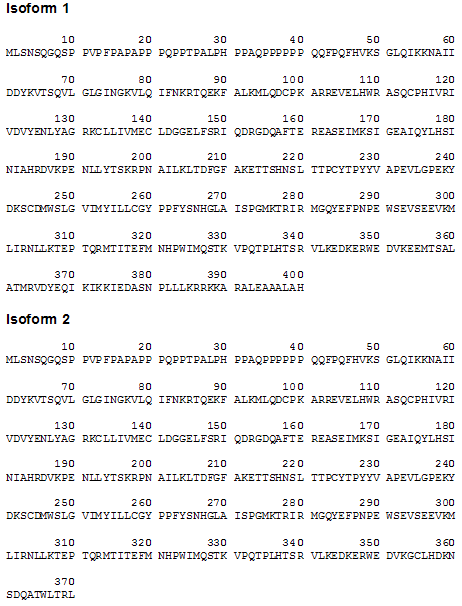
MAPKAPK2 has two alternatively spliced transcripts, encoding 400 and 370 amino acids, with sequence heterogeneity from Lys-353 to the C-terminus. Crystal structure shows: 1) an autoinhibitory domain, consisting of 328-370 residues; 2) a helix-turn-helix structure that occupies the substrate-binding cleft of the kinase domain and inhibits kinase function (ter Haar et al., 2007).
Localisation
The 400-residue MAPKAPK2 (isoform 1) consists of an N-terminal Pro-rich region, a kinase domain, an autoinhibitory domains, and C-terminal nuclear export (NES) and nuclear localization (NLS) signals. The 1-370 isoform (isoform 2) lacks NES and NLS, consistent with its presence only in the cytoplasm. MAPKAPK2 also phosphorylates proteins found in both the nucleus (cAMP-response element-binding protein, or CREB) and cytoplasm (HSP25/27 and LSP-1) (Kervinen et al., 2006).
Function
MAPKAPK2 is required for both cytokines production and cell migration (Kotlyarov et al., 2002).
MAPKAPK2 is activated upon stress by p38 MAPK, which binds C terminus of MAPKAPK2, leading to subsequently phosphorylation of its regulatory sites. After activation, MAPKAPK2 is transferred from nucleus to cytoplasm, and cotransport p38 to the new localization. In murine knockout model, MAPKAPK2 blockage leads to a dramatic reduction of tumor necrosis factor (TNF) production in response to lipopolysaccharide (Kotlyarov et al., 2002). One of the major substrates of MAPKAPK2 is the heat shock protein HSP27, which stimulates actin polymerization in order to facilitate recovery from destruction of cytoskeleton during cellular stresses.
MAPKAPK2 is activated upon stress by p38 MAPK, which binds C terminus of MAPKAPK2, leading to subsequently phosphorylation of its regulatory sites. After activation, MAPKAPK2 is transferred from nucleus to cytoplasm, and cotransport p38 to the new localization. In murine knockout model, MAPKAPK2 blockage leads to a dramatic reduction of tumor necrosis factor (TNF) production in response to lipopolysaccharide (Kotlyarov et al., 2002). One of the major substrates of MAPKAPK2 is the heat shock protein HSP27, which stimulates actin polymerization in order to facilitate recovery from destruction of cytoskeleton during cellular stresses.
Homology
Isoform 1 and 2 see figure below.
Mutations
Note
There is one described mutation: position 804 of mRNA, allele change GCC to GGC. At protein level, residue change A [Ala] to G [Gly].
Implicated in
Entity name
Multiple myeloma (MM)
Note
Hideshima et al. 2004 have shown that overexpression of HSP27 confers resistance to bortezomib, a proteasome inhibitor currently used as front line MM therapy, combined with corticosteroids and immunomodulatory drugs, such as thalidomide and lenalidomide. Therefore, overexpression of MAPKAPK2 could be related to MM resistance to chemotherapy. They hypothesized that inhibition of MAPKAPK2 activity could augment bortezomib cytotoxicity by down regulating HSP27. Felix et al. 2009, at their gene expression studies, supported further exploitation of this pathway as therapeutic target in MM, although immunohistochemistry did not show high frequency of protein expression in MM (21%) (Felix et al., 2009).
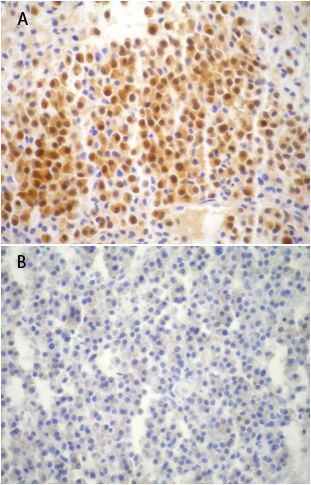
Panel showing bone marrow samples of MM cases: A - plasma cells nuclear and cytoplasmatic positivity for MAPKAPK2; B - sample negative for MAPKAPK2 (400X).
Entity name
Bladder cancer
Note
Kumar et al. 2010, showed that overexpression of the matrix metalloproteinases MMP-2 and MMP-9 have prognostic value in transitional cell carcinoma of bladder. p38 MAPK modulated MMP-2/9 mRNA expression and MMP-2/9 activity as mediators of tumor cells invasive capacity. Therefore, p38 MAPK inhibition blocks MMP-2/9 activities mediated by MAPKAPK2 (Kumar et al., 2010).
Entity name
Skin tumor
Note
Using the two-stage chemical carcinogenesis model, Johansen et al. 2009 studied the effect of MAPKAPK2-deficiency and TNF-alpha-deficiency on skin tumor development in mice. Their findings demonstrate a dual role of MAPKAPK2 in the early stages of tumor promotion through regulation of both the inflammatory response and apoptosis of DNA-damaged cells. These results also identify MAPKAPK2 as a possible target for skin carcinoma therapy (Johansen et al., 2009).
Entity name
Prostate cancer
Note
TGFbeta is an important regulator of cell adhesion and motility in a variety of cell types. p38 MAP kinase is necessary for TGFbeta -mediated up-regulation of matrix metalloproteinase type 2 (MMP-2), as well as TGFbeta -dependent increases in prostate cell invasion. Xu et al. 2006 demonstrated, after transient transfection, that both MAPKAPK2 and HSP27 are necessary for TGFbeta -mediated increases in MMP-2 activity in any cell type, as well as prostate cancer cells (Xu et al., 2006).
Entity name
Alzheimers disease (AD)
Note
Culbert et al. 2006 suggested that MAPKAPK2 plays a role in neuroinflammatory and neurodegenerative diseases, such as AD. The MAPKAPK2 activation and expression were increased in lipopolysaccharide (LPS) + interferon gamma-stimulated microglial cells, demonstrating MAPKAPK2 ability in eliciting a pro-inflammatory response. Again, MAPKAPK2 pathway can be considered a target for control of this degenerative brain disease.
Entity name
Psoriatic skin
Note
Alterations in this specific signal transduction pathway may be involved in increased expression of proinflammatory cytokines in inflammatory diseases (Johansen et al., 2006). The increased activation of MAPKAPK2 is responsible for the elevated TNFalpha protein expression in psoriatic skin, making this pathway a potential target in the treatment of psoriasis (Johansen et al., 2006).
Article Bibliography
| Pubmed ID | Last Year | Title | Authors |
|---|---|---|---|
| 16774924 | 2006 | MAPK-activated protein kinase 2 deficiency in microglia inhibits pro-inflammatory mediator release and resultant neurotoxicity. Relevance to neuroinflammation in a transgenic mouse model of Alzheimer disease. | Culbert AA et al |
| 18620516 | 2008 | MK2: a novel molecular target for anti-inflammatory therapy. | Duraisamy S et al |
| 19171422 | 2009 | SAGE analysis highlights the importance of p53csv, ddx5, mapkapk2 and ranbp2 to multiple myeloma tumorigenesis. | Felix RS et al |
| 15480425 | 2004 | p38 MAPK inhibition enhances PS-341 (bortezomib)-induced cytotoxicity against multiple myeloma cells. | Hideshima T et al |
| 19808857 | 2009 | MK2 regulates the early stages of skin tumor promotion. | Johansen C et al |
| 16620770 | 2006 | Effect of construct design on MAPKAP kinase-2 activity, thermodynamic stability and ligand-binding affinity. | Kervinen J et al |
| 12052889 | 2002 | Distinct cellular functions of MK2. | Kotlyarov A et al |
| 20068172 | 2010 | p38 mitogen-activated protein kinase-driven MAPKAPK2 regulates invasion of bladder cancer by modulation of MMP-2 and MMP-9 activity. | Kumar B et al |
| 16407830 | 2006 | MAPKAPK2 and HSP27 are downstream effectors of p38 MAP kinase-mediated matrix metalloproteinase type 2 activation and cell invasion in human prostate cancer. | Xu L et al |
| 17255097 | 2007 | Crystal structure of the p38 alpha-MAPKAP kinase 2 heterodimer. | Haar ET et al |
Other Information
Locus ID:
NCBI: 9261
MIM: 602006
HGNC: 6887
Ensembl: ENSG00000162889
Variants:
dbSNP: 9261
ClinVar: 9261
TCGA: ENSG00000162889
COSMIC: MAPKAPK2
RNA/Proteins
| Gene ID | Transcript ID | Uniprot |
|---|---|---|
| ENSG00000162889 | ENST00000294981 | P49137 |
| ENSG00000162889 | ENST00000367103 | P49137 |
Expression (GTEx)
Pathways
Protein levels (Protein atlas)
References
| Pubmed ID | Year | Title | Citations |
|---|---|---|---|
| 34559922 | 2022 | Mitogen-activated protein kinase-activated protein kinase-2 (MK2) and its role in cell survival, inflammatory signaling, and migration in promoting cancer. | 6 |
| 35129087 | 2022 | Regulation of CCR4-NOT complex deadenylase activity and cellular responses by MK2-dependent phosphorylation of CNOT2. | 0 |
| 34559922 | 2022 | Mitogen-activated protein kinase-activated protein kinase-2 (MK2) and its role in cell survival, inflammatory signaling, and migration in promoting cancer. | 6 |
| 35129087 | 2022 | Regulation of CCR4-NOT complex deadenylase activity and cellular responses by MK2-dependent phosphorylation of CNOT2. | 0 |
| 34272277 | 2021 | MK2 degradation as a sensor of signal intensity that controls stress-induced cell fate. | 7 |
| 34272277 | 2021 | MK2 degradation as a sensor of signal intensity that controls stress-induced cell fate. | 7 |
| 32649858 | 2020 | MAP Kinase-Mediated Activation of RSK1 and MK2 Substrate Kinases. | 6 |
| 32649858 | 2020 | MAP Kinase-Mediated Activation of RSK1 and MK2 Substrate Kinases. | 6 |
| 30112991 | 2019 | Novel Therapeutic Potential of Mitogen-Activated Protein Kinase Activated Protein Kinase 2 (MK2) in Chronic Airway Inflammatory Disorders. | 8 |
| 30850014 | 2019 | MAPKAPK2: the master regulator of RNA-binding proteins modulates transcript stability and tumor progression. | 59 |
| 31023373 | 2019 | MAPKAPK2 plays a crucial role in the progression of head and neck squamous cell carcinoma by regulating transcript stability. | 11 |
| 31167133 | 2019 | Alternative Translation Initiation Generates a Functionally Distinct Isoform of the Stress-Activated Protein Kinase MK2. | 18 |
| 31575657 | 2019 | Sophoridine Inhibits Human Colorectal Cancer Progression via Targeting MAPKAPK2. | 15 |
| 30112991 | 2019 | Novel Therapeutic Potential of Mitogen-Activated Protein Kinase Activated Protein Kinase 2 (MK2) in Chronic Airway Inflammatory Disorders. | 8 |
| 30850014 | 2019 | MAPKAPK2: the master regulator of RNA-binding proteins modulates transcript stability and tumor progression. | 59 |
Citation
Roberta Felix ; Veruska Alves ; Andre Vettore ; Gisele Colleoni
MAPKAPK2 (mitogen-activated protein kinase-activated protein kinase 2)
Atlas Genet Cytogenet Oncol Haematol. 2010-04-01
Online version: http://atlasgeneticsoncology.org/gene/41295/mapkapk2
