SREBF1 (sterol regulatory element binding transcription factor 1)
2019-02-01 Seher Gök AffiliationScientific and Technological Research Council of Turkey; Ankara-TURKEY\\\/ [email protected]
Identity
HGNC
LOCATION
Located on 17p11.2
IMAGE

LEGEND
Figure 1. Gene neighbours of LIPE on chromosome 17p11.2 (Chromosome 17 - NC_000017.11 Reference: GRCh38.p12 current assembly, NCBI Annotation Release 109).
LOCUSID
ALIAS
HMD,IFAP2,SREBP1,bHLHd1
Abstract
Review on SREBF1, with data on DNA, on the protein encoded and where the gene is implicated.
DNA/RNA

Figure 2. Genomic organization of the SREBF1 gene. Exons are numbered indicating the alternatively spliced a and c variants (adapted from Kedenko et al., 2012).
Description
Orientation: Minus strand; 25669 bp; Exon count: 22; intron count: 20
Transcription
SREBF1 gene has 23 transcripts (Table 1)
Table 1. Transcripts of human SREBF1 gene (Ensembl annotation Release 85).
Table 1. Transcripts of human SREBF1 gene (Ensembl annotation Release 85).
| Name | Transcript ID | bp | Protein | Biotype |
| SREBF1-201 | ENST00000261646.9 | 4178 | 1147 | Protein coding |
| SREBF1-202 | ENST00000355815.8 | 4253 | 1177 | Protein coding |
| SREBF1-203 | ENST00000395751.8 | 4653 | 216 | Nonsense mediated decay |
| SREBF1-204 | ENST00000395756.5 | 3026 | 113 | Nonsense mediated decay |
| SREBF1-205 | ENST00000395757.5 | 3696 | 893 | Protein coding |
| SREBF1-206 | ENST00000423161.3 | 1058 | 325 | Protein coding |
| SREBF1-207 | ENST00000447641.5 | 644 | No protein | Retained intron |
| SREBF1-208 | ENST00000469356.3 | 1323 | No protein | Retained intron |
| SREBF1-209 | ENST00000470247.1 | 374 | No Protein | Retained intron |
| SREBF1-210 | ENST00000471445.5 | 936 | No protein | Retained intron |
| SREBF1-211 | ENST00000476994.1 | 591 | No protein | Retained intron |
| SREBF1-212 | ENST00000478616.1 | 882 | 163 | Protein coding |
| SREBF1-213 | ENST00000485080.6 | 1230 | 110 | Nonsense mediated decay |
| SREBF1-214 | ENST00000486311.5 | 473 | 157 | Protein coding |
| SREBF1-215 | ENST00000487401.1 | 477 | No protein | Retained intron |
| SREBF1-216 | ENST00000490796.1 | 698 | No protein | Retained intron |
| SREBF1-217 | ENST00000577897.1 | 536 | 66 | Protein coding |
| SREBF1-218 | ENST00000578469.1 | 588 | 31 | Protein coding |
| SREBF1-219 | ENST00000580540.1 | 540 | No protein | Retained intron |
| SREBF1-220 | ENST00000581707.1 | 695 | No protein | Retained intron |
| SREBF1-221 | ENST00000583080.1 | 482 | No protein | Retained intron |
| SREBF1-222 | ENST00000583732.1 | 580 | No protein | Processed transcript |
| SREBF1-223 | ENST00000584760.1 | 564 | No protein | Retained intron |
Proteins
Note
SREBF1 gene encodes 1147 amino acid sized protein which has 121675 Da molecular mass. SREBF1 is helix-loop-helix transcriptional activator required for lipid homeostasis (Figure 3). Regulates transcription of the LDL receptor gene as well as the fatty acid and cholesterol synthesis pathways. Binds to the sterol regulatory element 1 (SRE-1) (5-ATCACCCCAC-3). Has dual sequence specificity binding to both an E-box motif (5-ATCACGTGA-3) and to SRE-1 (5-ATCACCCCAC-3).
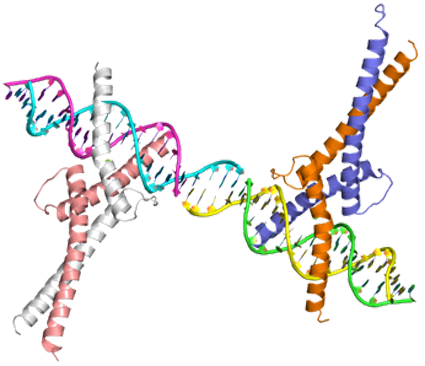
Figure 3. Co-crystal structure of sterol regulatory element binding protein 1a bound to an LDL Receptor promoter at 2.3 A resolution (adapted from Párraga et al., 1998).
Description
The encoded protein is synthesized as a precursor that is initially attached to the nuclear membrane and endoplasmic reticulum. After cleavage, the mature protein translocates to the nucleus and activates transcription. This cleaveage is inhibited by sterols. Alternative promoter usage and splicing result in multiple transcript variants. 6 isoforms are described. Isoform 1A has been choosen as the canonical sequence (provided by RefSeq, Nov 2017). Quaternary structure of protein forms a tight complex with SCAP in the ER membrane. Efficient DNA binding of the soluble transcription factor fragment requires dimerization with another bHLH protein. Interacts with LMNA. Interacts with CEBPA, the interaction produces a transcriptional synergy (By similarity).
Post-translational modifications:
At low cholesterol the SCAP/SREBP complex is recruited into COPII vesicles for export from the ER. In the Golgi complex SREBPs are cleaved sequentially by site-1 and site-2 protease. The first cleavage by site-1 protease occurs within the luminal loop, the second cleavage by site-2 protease occurs within the first transmembrane domain and releases the transcription factor from the Golgi membrane. Apoptosis triggers cleavage by the cysteine proteases CASP3 and CASP7 (caspase-3 and caspase-7).
Phosphorylated by AMPK (P
rotein kinase AMP-activated catalytic subunits), leading to suppress protein processing and nuclear translocation, and repress target gene expression. Phosphorylation at Ser-402 by SIK1 represses activity possibly by inhibiting DNA-binding.
Ubiquitinatylated at Lys347, Lys379, Lys587, Lys675, Lys934, Lys1070.
Post-translational modifications:
At low cholesterol the SCAP/SREBP complex is recruited into COPII vesicles for export from the ER. In the Golgi complex SREBPs are cleaved sequentially by site-1 and site-2 protease. The first cleavage by site-1 protease occurs within the luminal loop, the second cleavage by site-2 protease occurs within the first transmembrane domain and releases the transcription factor from the Golgi membrane. Apoptosis triggers cleavage by the cysteine proteases CASP3 and CASP7 (caspase-3 and caspase-7).
Phosphorylated by AMPK (P
rotein kinase AMP-activated catalytic subunits), leading to suppress protein processing and nuclear translocation, and repress target gene expression. Phosphorylation at Ser-402 by SIK1 represses activity possibly by inhibiting DNA-binding.
Ubiquitinatylated at Lys347, Lys379, Lys587, Lys675, Lys934, Lys1070.
Expression
Expressed in a wide variety of tissues, most abundant in fat and adrenal gland. In fetal tissues, lung and liver shows highest expression. Isoform SREBF-1C predominates in liver, adrenal gland and ovary, whereas isoform SREBF-1A predominates in hepatoma cell lines. Isoform SREBF-1A and isoform SREBF-1C are found in kidney, brain, white fat, and muscle.
Localisation
Endoplasmic reticulum membrane, golgi membrane, nuclear envelope, nucleoplasm, nucleus, COPII - coated vesicle membrane.
Function
SREBF1 Transcription factor binds to the sterol regulatory element-1 (SRE1) (5-ATCACCCCAC-3) which is a motif found in the promoter of the low density lipoprotein receptor genes and other genes that involved in sterol biosynthesis. Depletion of cholesterol leads to intra-membrane proteolysis, releasing the active portion of SREBF1 containing the basic DNA-binding region from the endoplasmic reticulum membrane. After translocation to the nucleus and binding to its specific DNA sequences, SREBF1 dimers induce the expression of target genes involved in adipogenesis and membrane biogenesis (Nohturfft and Zhang, 2009).
Homology
SREBF1 gene is conserved in chimpanzee, Rhesus monkey, dog, cow, mouse, rat, chicken, zebrafish, fruit fly, mosquito and frog (Table 2).
Table 2. Pairwise alignment of SREBF1 gene and protein sequences (in distance from human).
Table 2. Pairwise alignment of SREBF1 gene and protein sequences (in distance from human).
| Gene | Identity %& | ||
| Species | Symbol | Protein | DNA |
| H. Sapiens | SREBF1 | ||
| vs. P.troglodytes | SREBF1 | 98.7 | 99.0 |
| vs. M.mulatta | SREBF1 | 97.5 | 97.1 |
| vs. C.lupus | SREBF1 | 87.9 | 87.2 |
| vs. B.taurus | SREBF1 | 84.5 | 85.8 |
| vs. M.musculus | Srebf1 | 81.2 | 80.9 |
| vs. R.norvegicus | Srebf1 | 81.6 | 82.0 |
| vs. G.gallus | SREBF1 | 65.8 | 69.5 |
| vs. X.tropicalis | srebf1 | 67.0 | 65.9 |
| vs D.reriro | srebf1 | 61.3 | 62.4 |
| vs D.melanogaster | HLH106 | 37.5 | 48.4 |
| vs. A.gambiae | AgaP_AGAP000076 | 39.2 | 49.7 |
Mutations
Note
304 missense, 36 truncating and 3 inframe and 7 other mutations of SREBF1 was identified in 74247 samples from 240 studies (cBioPortal) (Figure 4).
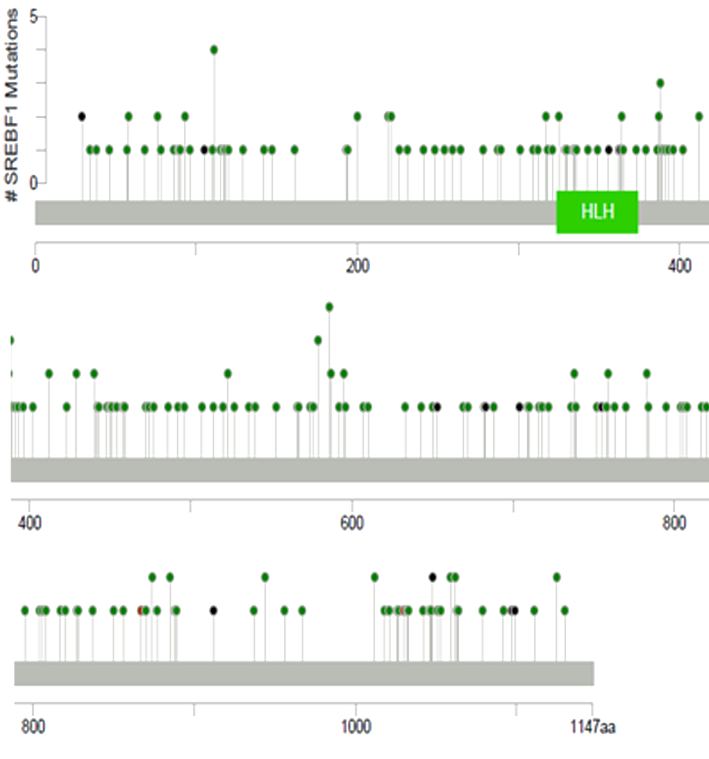
Figure 4. Mutation types observed in SREBF1 expression in literature and corresponding color codes are as follows: Green: Missense Mutations ; Black: Truncating Mutations: Nonsense, Nonstop, Frameshift deletion, Frameshift insertion, Splice site; Beige: In-frame Mutations: In-frame deletion, In-frame insertion ; Purple: Other Mutations: All other types of mutations.
Somatic
4 SNPs were registered for SREBF1 (according to SNPedia and Human Gene Mutation Database).
Implicated in
Entity name
Endometrial Cancer (EC)
Note
Higher level of SREBF1 has been detected in EC cells compared to the normal endometrium, and which was more prominent in higher-grade EC. NP (rs2297508) of SREBF-1 may serve as a genetic predisposition factor for the development of EC Qui et al., 2014).
Entity name
Pancreatic Cancer
Note
SREBF1 is highly expressed in pancreatic ductal cancer. The expression of SREBF1 is an independent risk factor affecting the overall survival of patients with pancreatic cancer (Sun et al., 2015.
Entity name
Hepatocellular Carcinoma (HCC)
Note
SREBF1 expression is activated in HCC. Suppression of SREBF1 induced growth arrest and apoptosis whereas overexpression of SREBF1 enhanced cell proliferation in human HCC cell lines. There are a significant relationship between poor survival and high SREBF1 protein expression and correlation between high SREBF1 protein expression and high risk of mortality with statistical significance (Yamashita et al., 2008).
Entity name
Ovarian Cancer
Note
SREBF1 protein expression was significantly higher in human ovarian cancer compared to benign and borderline ovarian tumors (Nie et al., 2013).
Entity name
Breast cancer
Note
mRNA levels for SREBF-1c increase in a panel of primary human breast cancer samples (Yang et al., 2003).
Entity name
Colorectal Carcinoma
Note
SREBF1 and FAS expression upregulated in colorectal carcinoma cells. It was hypothesized that, tumor cells recognize and respond to a deficiency in endogenous fatty acid synthesis by upregulating both SREBF1 and FAS expression and these findings support the model that SREBF1 participates in the transcriptional regulation of lipogenic genes in colorectal neoplasia (Li et al., 2000).
Entity name
Obesity and Obesity-related metabolic traits; Type 2 diabetes and Dyslipidemia
Note
The SREBF1 molecular screening of 40 unrelated obese patients revealed 19 single nucleotide polymorphisms (SNPs). SNP17 (54G/C, exon 18c) is associated with morbid obesity. SNP3 (-150G/A, exon 1a), SNP5 (-36delG, exon 1a), and SNP17 are found in high linkage disequilibrium (D > 0.8). The haplotype including wild-type alleles of these SNPs (C/G/G/T/C/G, HAP2) is identified as a risk factor for morbid obesity (P = 0.003). In the obese group, SNP3, SNP5, and SNP17 are associated with male-specific hypertriglyceridemia (P = 0.07, P = 0.01, and P = 0.05, respectively). SNP17 is also associated with type 2 diabetes (P = 0.03) (Eberlé et al., 2004).
In addition, it was shown that insulin induces SREBF1 gene expression in isolated human adipocytes and skeletal muscle and also promotes SREBF1 cleavage in human isolated adipocytes. Common insulin-resistant states, such as obesity and type 2 diabetes, are characterized by decreased expression of SREBP1c mRNA (Sewter et al., 2002).
In addition, it was shown that insulin induces SREBF1 gene expression in isolated human adipocytes and skeletal muscle and also promotes SREBF1 cleavage in human isolated adipocytes. Common insulin-resistant states, such as obesity and type 2 diabetes, are characterized by decreased expression of SREBP1c mRNA (Sewter et al., 2002).
Article Bibliography
| Pubmed ID | Last Year | Title | Authors |
|---|---|---|---|
| 15277400 | 2004 | SREBF-1 gene polymorphisms are associated with obesity and type 2 diabetes in French obese and diabetic cohorts. | Eberlé D et al |
| 23285067 | 2012 | Genetic polymorphisms of the main transcription factors for adiponectin gene promoter in regulation of adiponectin levels: association analysis in three European cohorts. | Kedenko L et al |
| 11082286 | 2000 | Sterol regulatory element-binding protein-1 participates in the regulation of fatty acid synthase expression in colorectal neoplasia. | Li JN et al |
| 23818099 | 2013 | Sterol regulatory element-binding protein 1 is required for ovarian tumor growth. | Nie LY et al |
| 19575637 | 2009 | Coordination of lipid metabolism in membrane biogenesis. | Nohturfft A et al |
| 9634703 | 1998 | Co-crystal structure of sterol regulatory element binding protein 1a at 2.3 A resolution. | Párraga A et al |
| 24614076 | 2014 | Single nucleotide polymorphism of SREBF-1 gene associated with an increased risk of endometrial cancer in Chinese women. | Qiu CP et al |
| 11916923 | 2002 | Human obesity and type 2 diabetes are associated with alterations in SREBP1 isoform expression that are reproduced ex vivo by tumor necrosis factor-alpha. | Sewter C et al |
| 25589463 | 2015 | SREBP1 regulates tumorigenesis and prognosis of pancreatic cancer through targeting lipid metabolism. | Sun Y et al |
| 19008011 | 2009 | Activation of lipogenic pathway correlates with cell proliferation and poor prognosis in hepatocellular carcinoma. | Yamashita T et al |
| 12531699 | 2003 | Regulation of fatty acid synthase expression in breast cancer by sterol regulatory element binding protein-1c. | Yang Yu et al |
Other Information
Locus ID:
NCBI: 6720
MIM: 184756
HGNC: 11289
Ensembl: ENSG00000072310
Variants:
dbSNP: 6720
ClinVar: 6720
TCGA: ENSG00000072310
COSMIC: SREBF1
RNA/Proteins
Expression (GTEx)
Pathways
Protein levels (Protein atlas)
PharmGKB
| Entity ID | Name | Type | Evidence | Association | PK | PD | PMIDs |
|---|---|---|---|---|---|---|---|
| PA133950441 | hmg coa reductase inhibitors | Chemical | ClinicalAnnotation | associated | PD | 24329191 | |
| PA33744 | PRKAA1 | Gene | Pathway | associated | 22722338 | ||
| PA33745 | PRKAA2 | Gene | Pathway | associated | 22722338 | ||
| PA33746 | PRKAB1 | Gene | Pathway | associated | 22722338 | ||
| PA33747 | PRKAB2 | Gene | Pathway | associated | 22722338 | ||
| PA33751 | PRKAG1 | Gene | Pathway | associated | 22722338 | ||
| PA33752 | PRKAG2 | Gene | Pathway | associated | 22722338 | ||
| PA33753 | PRKAG3 | Gene | Pathway | associated | 22722338 | ||
| PA37935 | SIRT1 | Gene | Pathway | associated | 22722338 | ||
| PA447216 | Schizophrenia | Disease | ClinicalAnnotation | associated | PD | 24329191 | |
| PA449688 | fluvastatin | Chemical | ClinicalAnnotation | associated | PD |
References
| Pubmed ID | Year | Title | Citations |
|---|---|---|---|
| 37733180 | 2024 | Association of adipocyte size and SREBP-1c in visceral and subcutaneous adipose tissue in non-obese type 2 diabetes mellitus. | 0 |
| 38143182 | 2024 | FAS/SREBP-1c contributes to colorectal carcinogenesis through calcium signaling pathway and cAMP signaling pathway. | 0 |
| 38244769 | 2024 | Active AKT2 stimulation of SREBP1/SCD1-mediated lipid metabolism boosts hepatosteatosis and cancer. | 0 |
| 38256181 | 2024 | The Role of SCAP/SREBP as Central Regulators of Lipid Metabolism in Hepatic Steatosis. | 5 |
| 38279172 | 2024 | EXO1/P53/SREBP1 axis-regulated lipid metabolism promotes prostate cancer progression. | 0 |
| 38326276 | 2024 | Expression and correlation analysis of silent information regulator 1 (SIRT1), sterol regulatory element-binding protein-1 (SREBP1), and pyroptosis factor in gestational diabetes mellitus. | 0 |
| 37733180 | 2024 | Association of adipocyte size and SREBP-1c in visceral and subcutaneous adipose tissue in non-obese type 2 diabetes mellitus. | 0 |
| 38143182 | 2024 | FAS/SREBP-1c contributes to colorectal carcinogenesis through calcium signaling pathway and cAMP signaling pathway. | 0 |
| 38244769 | 2024 | Active AKT2 stimulation of SREBP1/SCD1-mediated lipid metabolism boosts hepatosteatosis and cancer. | 0 |
| 38256181 | 2024 | The Role of SCAP/SREBP as Central Regulators of Lipid Metabolism in Hepatic Steatosis. | 5 |
| 38279172 | 2024 | EXO1/P53/SREBP1 axis-regulated lipid metabolism promotes prostate cancer progression. | 0 |
| 38326276 | 2024 | Expression and correlation analysis of silent information regulator 1 (SIRT1), sterol regulatory element-binding protein-1 (SREBP1), and pyroptosis factor in gestational diabetes mellitus. | 0 |
| 36328485 | 2023 | Insulin Suppresses Ubiquitination via the Deubiquitinating Enzyme Ubiquitin-Specific Protease 14, Independent of Proteasome Activity in H4IIEC3 Hepatocytes. | 2 |
| 36694250 | 2023 | TRIM21 attenuates renal carcinoma lipogenesis and malignancy by regulating SREBF1 protein stability. | 4 |
| 37132394 | 2023 | MIAT shuttled by tumor-secreted exosomes promotes paclitaxel resistance in esophageal cancer cells by activating the TAF1/SREBF1 axis. | 0 |
Citation
Seher Gök
SREBF1 (sterol regulatory element binding transcription factor 1)
Atlas Genet Cytogenet Oncol Haematol. 2019-02-01
Online version: http://atlasgeneticsoncology.org/gene/42386/new-content/haematological-explorer/
