Identity
HGNC
LOCATION
11q14.1
LOCUSID
ALIAS
LPGP1,Lpgp,S14,SPOT14,THRP
FUSION GENES
DNA/RNA
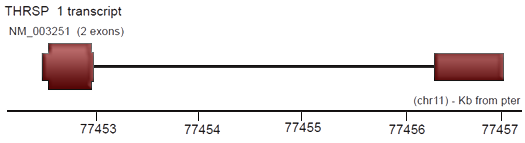
An intron (thin line) connects the two exons of THRSP. Most of the 5 exon (thickest line) is translated.
Description
According to Entrez-Gene, THRSP maps to NC_000011.9 in the region between 77774907 and 77779307 on the plus strand and spans 5.6 kilobases. According to Spidey (mRNA to genomic sequence alignment tool), THRSP has two exons, the sizes being 481 and 603 bp. Only the smaller of these is translated.
Transcription
THRSP mRNA NM_003251.2 has 1084 nt. The coding region of human mRNA for THRSP has 438 nt. Transcription is regulated via thyroid hormone and the SREBP-1c binding sites. Expression can be induced by progestin, glucose, thyroid hormone, and insulin. Antisense RNA knocks down S14 expression in hepatocytes, and this abrogates the induction of genes concerned with fatty acid synthesis by triiodothyronine and glucose.
Pseudogene
The ancestral S14-related protein, also known as Strait 11499 and Mig12, may duplicate the function of S14 in hepatic, but not mammary, tissue.
Proteins
Note
THRSP is primarily a nuclear protein which is important in the regulation of lipid metabolism. It is induced by thyroid hormone, carbohydrate intake, adipose tissue differentiation, and lactation, and is inhibited by glucagon and conjugated linoleic acid. Expression of THRSP (Spot14) parallels that of fatty acid synthase in adipose, liver, and mammary tissue in bovine and murine species. Elevated expression of THRSP in human breast tumors is correlated with poor prognosis, whereas absence of expression is associated with longer survival.
Description
A driver of de novo saturated fatty acid synthesis in normal and malignant tissues, Spot14 (S14, THRSP) was named for its position on two-dimensional gels of in vitro translation products. The gene is rapidly induced by thyroid hormone in rat liver, and it is strongly activated by glucose metabolism. An acidic protein of approximately 16 kD, it is localized primarily in the nucleus; three domains are conserved from its ancestral protein, Strait1499, also known as Mig12 and S14-related protein.
From immunohistochemical studies, the temporal and spatial expression patterns of murine Spot14 and fatty acid synthase (FASN) were regulated in parallel in mammary epithelium during pregnancy, lactation, and involution. In cattle, milk fat depression is associated with production of conjugated linoleic acid (CLA) isomers as intermediates of fatty acid synthesis by rumen bacteria. Ingestion of a low forage, high oil diet leads to increased production of CLA, and this results in low milk fat content, and decreased expression of S14, FASN, sterol response element binding protein (SREBP), and responsive genes INSIG1 and INSIG2 in a coordinate manner. Breast epithelium does not express detectable levels of Spot14 or FASN in the resting state; however, during pregnancy and lactation, Spot14 and enzymes of lipid biosynthesis are expressed at high levels. Spot14 and FASN are expressed in most breast cancers, and high levels of Spot14 expression portend an aggressive course and high risk of recurrence, regardless of nodal status at diagnosis. Thus Spot14 represents a potential target for therapeutic intervention in cancer.
From immunohistochemical studies, the temporal and spatial expression patterns of murine Spot14 and fatty acid synthase (FASN) were regulated in parallel in mammary epithelium during pregnancy, lactation, and involution. In cattle, milk fat depression is associated with production of conjugated linoleic acid (CLA) isomers as intermediates of fatty acid synthesis by rumen bacteria. Ingestion of a low forage, high oil diet leads to increased production of CLA, and this results in low milk fat content, and decreased expression of S14, FASN, sterol response element binding protein (SREBP), and responsive genes INSIG1 and INSIG2 in a coordinate manner. Breast epithelium does not express detectable levels of Spot14 or FASN in the resting state; however, during pregnancy and lactation, Spot14 and enzymes of lipid biosynthesis are expressed at high levels. Spot14 and FASN are expressed in most breast cancers, and high levels of Spot14 expression portend an aggressive course and high risk of recurrence, regardless of nodal status at diagnosis. Thus Spot14 represents a potential target for therapeutic intervention in cancer.
Expression
Spot14 protein is expressed primarily in tissues which synthesize fatty acids. These tissues include white and brown adipose tissue, breast tissue, and liver. Expression is observed in a variety of malignancies, and it is a component of the lipogenic tumor phenotype, e.g., in human breast cancer.
Localisation
By immunohistochemistry, Spot14 is localized primarily in the nucleus of rat liver, human mammary gland, and breast cancer cells.
Function
Spot14 is involved in the regulation of lipid biosynthesis. Its precise function is not known. It exists as a heterodimer in human cells which are actively synthesizing lipids. Triggers for the induction of Spot14, such as hormones or refeeding after fasting, also trigger FASN activity. Furthermore, siRNAs and anti-sense RNAs directed against Spot14 inhibit expression of genes coding the lipid-synthesizing enzymes.
Homology
Homologous proteins are found in cow, rat, mouse, chicken, dog, and chimpanzee, as well as other species. An acidic protein of approximately 16.4 kDa, human THRSP bears 99% homology to its counterpart in Pan troglodytes, 91% to that in Macaca mulatta, 82% to that in Mus musculus, and 80% to that in Rattus norvegicus (data from NCBI BLAST). Three domains are conserved from the ancestral S14-related peptide (Strait 11499, Mig12, S14-related protein).
Mutations
Note
Mutations have been characterized in the chicken. Single-nucleotide polymorphisms (SNPs) have been noted in cow, rat, mouse, and chimpanzee. The SNP database in NCBI lists 63 human SNPs for THRSP.
Implicated in
Entity name
Breast tumors
Note
Along with cyclin D1, which shares the same amplicon at 11q13, S14 is amplified in about 20% of human breast cancers. Although cyclin D1 is a human and murine mammary oncogene, it was the concomitant overexpression of S14 and lipogenic enzymes in aggressive breast tumors that prompted investigation of the role of fatty acid metabolism in metastasis and recurrence of breast tumors. In an immunohistochemical study of invasive breast tumors, high levels of S14 expression correlated with reduced disease-free survival, irrespective of nodal status at diagnosis; there were no recurrences among those whose tumors expressed low levels of S14, even after prolonged follow-up. S14 expression levels did not segregate with cyclin D1, Her-2/neu amplification status, or hormone receptor status. Thus it appears that S14 promotes a virulent, lipogenic phenotype in breast tumors.
Entity name
Aberrant hepatic lipogenesis and hepatic steatosis
Note
The relationship between lipid metabolism and disease is further corroborated by the finding in human hepatocytes that the pregnane X receptor (PXR), which is a nuclear receptor regulating xenobiotic and drug metabolism, upregulates lipogenesis via S14. Stimulation of PXR also enhances expression of the cd36 gene, which permits the uptake of exogenous fatty acids by cells, and also stimulates de novo lipogenesis as well as upregulation of the enzymes involved in lipid synthesis. Knockdown by short interfering RNAs to PXR, S14, or FASN abrogates lipid synthesis. S14-directed fatty acid synthesis has also been implicated in aberrant hepatic lipogenesis and hepatic steatosis.
Entity name
Obesity
Note
It is possible that Spot14 plays a role in the regulation of lipid storage in humans. Whereas nonobese humans downregulate the level of Spot14 in response to fasting, obese subjects do not. Postfasting levels of glucose, insulin, and ketones did not differ between the two groups. The abnormal downregulation of Spot14 in adipose tissue of obese subjects implies that Spot14 may be important to the acquisition or maintenance of obesity in humans.
Article Bibliography
| Pubmed ID | Last Year | Title | Authors |
|---|---|---|---|
| 8999918 | 1997 | "Spot 14" protein functions at the pretranslational level in the regulation of hepatic metabolism by thyroid hormone and glucose. | Brown SB et al |
| 11485565 | 2001 | Spot 14 protein interacts and co-operates with chicken ovalbumin upstream promoter-transcription factor 1 in the transcription of the L-type pyruvate kinase gene through a specificity protein 1 (Sp1) binding site. | Compe E et al |
| 7720042 | 1995 | Amplification of chromosome band 11q13 and a role for cyclin D1 in human breast cancer. | Dickson C et al |
| 16988111 | 2006 | SREBP1 and thyroid hormone responsive spot 14 (S14) are involved in the regulation of bovine mammary lipid synthesis during diet-induced milk fat depression and treatment with CLA. | Harvatine KJ et al |
| 7622469 | 1995 | Direct evidence for a role of the "spot 14" protein in the regulation of lipid synthesis. | Kinlaw WB et al |
| 16809441 | 2006 | Spot 14: A marker of aggressive breast cancer and a potential therapeutic target. | Kinlaw WB et al |
| 8102096 | 1993 | Thyroid hormone and dietary carbohydrate induce different hepatic zonation of both "spot 14" and acetyl-coenzyme-A carboxylase: a novel mechanism of coregulation. | Kinlaw WB et al |
| 10090313 | 1999 | Adipose S14 mRNA is abnormally regulated in obese subjects. | Kirschner LS et al |
| 16300755 | 2006 | S14 protein in breast cancer cells: direct evidence of regulation by SREBP-1c, superinduction with progestin, and effects on cell growth. | Martel PM et al |
| 10551830 | 1999 | Sterol response element-binding protein 1c (SREBP1c) is involved in the polyunsaturated fatty acid suppression of hepatic S14 gene transcription. | Mater MK et al |
| 9371405 | 1997 | Assignment of the "spot 14" gene (THRSP) to human chromosome band 11q13.5 by in situ hybridization. | Moncur JT et al |
| 19437491 | 2009 | A novel pregnane X receptor and S14-mediated lipogenic pathway in human hepatocyte. | Moreau A et al |
| 6946422 | 1981 | Thyroid hormone attenuates and augments hepatic gene expression at a pretranslational level. | Seelig S et al |
| 18556348 | 2008 | Hepatic expression of the SPOT 14 (S14) paralog S14-related (Mid1 interacting protein) is regulated by dietary carbohydrate. | Tsatsos NG et al |
| 15145057 | 2004 | Duplicated Spot 14 genes in the chicken: characterization and identification of polymorphisms associated with abdominal fat traits. | Wang X et al |
| 16552628 | 2006 | Expression of "Spot 14" (THRSP) predicts disease free survival in invasive breast cancer: immunohistochemical analysis of a new molecular marker. | Wells WA et al |
| 12213216 | 2002 | Activation of fatty acid synthesis during neoplastic transformation: role of mitogen-activated protein kinase and phosphatidylinositol 3-kinase. | Yang YA et al |
Other Information
Locus ID:
NCBI: 7069
MIM: 601926
HGNC: 11800
Ensembl: ENSG00000151365
Variants:
dbSNP: 7069
ClinVar: 7069
TCGA: ENSG00000151365
COSMIC: THRSP
RNA/Proteins
| Gene ID | Transcript ID | Uniprot |
|---|---|---|
| ENSG00000151365 | ENST00000281030 | Q92748 |
Expression (GTEx)
Pathways
Protein levels (Protein atlas)
References
| Pubmed ID | Year | Title | Citations |
|---|---|---|---|
| 35196258 | 2022 | THRSP identified as a potential hepatocellular carcinoma marker by integrated bioinformatics analysis and experimental validation. | 1 |
| 35715726 | 2022 | Insulin-inducible THRSP maintains mitochondrial function and regulates sphingolipid metabolism in human adipocytes. | 6 |
| 35196258 | 2022 | THRSP identified as a potential hepatocellular carcinoma marker by integrated bioinformatics analysis and experimental validation. | 1 |
| 35715726 | 2022 | Insulin-inducible THRSP maintains mitochondrial function and regulates sphingolipid metabolism in human adipocytes. | 6 |
| 29604329 | 2018 | MiR-451a attenuates free fatty acids-mediated hepatocyte steatosis by targeting the thyroid hormone responsive spot 14 gene. | 17 |
| 29604329 | 2018 | MiR-451a attenuates free fatty acids-mediated hepatocyte steatosis by targeting the thyroid hormone responsive spot 14 gene. | 17 |
| 27082501 | 2016 | Spot14/Spot14R expression may be involved in MSC adipogenic differentiation in patients with adolescent idiopathic scoliosis. | 4 |
| 27082501 | 2016 | Spot14/Spot14R expression may be involved in MSC adipogenic differentiation in patients with adolescent idiopathic scoliosis. | 4 |
| 25472762 | 2014 | Modulation of tumor fatty acids, through overexpression or loss of thyroid hormone responsive protein spot 14 is associated with altered growth and metastasis. | 14 |
| 25472762 | 2014 | Modulation of tumor fatty acids, through overexpression or loss of thyroid hormone responsive protein spot 14 is associated with altered growth and metastasis. | 14 |
| 21821901 | 2011 | Expression, purification and preliminary crystallographic analysis of human thyroid hormone responsive protein. | 1 |
| 21821901 | 2011 | Expression, purification and preliminary crystallographic analysis of human thyroid hormone responsive protein. | 1 |
| 20628086 | 2010 | Variation at the NFATC2 locus increases the risk of thiazolidinedione-induced edema in the Diabetes REduction Assessment with ramipril and rosiglitazone Medication (DREAM) study. | 15 |
| 20628086 | 2010 | Variation at the NFATC2 locus increases the risk of thiazolidinedione-induced edema in the Diabetes REduction Assessment with ramipril and rosiglitazone Medication (DREAM) study. | 15 |
| 19913121 | 2009 | Gene-centric association signals for lipids and apolipoproteins identified via the HumanCVD BeadChip. | 105 |
Citation
Nancy B Kuemmerle ; William B Kinlaw
THRSP (thyroid hormone responsive)
Atlas Genet Cytogenet Oncol Haematol. 2010-09-01
Online version: http://atlasgeneticsoncology.org/gene/42555/thrsp-(thyroid-hormone-responsive)
