AKT1S1 (AKT1 substrate 1 (proline-rich))
2014-11-01 Claudia Wiza , Emmani BM Nascimento , D Margriet Ouwens AffiliationIdentity

Abstract
Review on AKT1S1, with data on DNA\/RNA, on the protein encoded and where the gene is implicated.
DNA/RNA
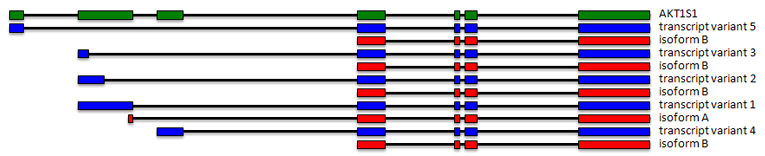
Description
Transcription
Proteins
Note
Description

Expression
Localisation
Function
AKT1S1 acts as an inhibitor of mTORC1 activity (Wiza et al., 2012). Phosphorylation of AKT1S1 results in the dissociation of the AKT1S1 from raptor within the mTORC1 complex thereby promoting the activity of mTORC1 (Oshiro et al., 2007; Sancak et al., 2007; Vander Haar et al., 2007). However, knock-down of AKT1S1 impairs the phosphorylation of mTORC1-substrates in certain cell types, suggesting that AKT1S1 is also important for mTORC1 signaling via mechanisms which are still incompletely understood (Fonseca et al., 2007; Hong-Brown et al., 2010; Wiza et al., 2013a).
Nucleolar stress response
Nuclear AKT1S1 binds to the ribosomal protein L11 (RPL11) (Havel et al., 2014). This interaction is dependent on the phosphorylation of Ser221 and Thr246 within AKT1S1 (Havel et al., 2014). RPL11 has been linked to the inhibition of the E3 ubiquitin ligase HDM2. This results in increased p53 protein stability and activation of the nucleolar stress response pathway, which is defined as the activation of a specific transcriptional program resulting in cell cycle arrest, apoptosis or senescence. The activation of this pathway is prevented when RPL11 is bound to AKT1S1 (Havel et al., 2014).
Cell survival
Akt1S1 protects neurons against cell death following spinal cord injury (Saito et al., 2004). Overexpression of AKT1S1 in rats reduces infarct size following cerebral ischemia (Saito et al., 2006; Yu et al., 2008).
Proteasome activity and insulin sensitivity
The silencing of AKT1S1 promotes the degradation of insulin receptor substrate 1 (IRS1) in skeletal muscle through activation of the proteasome (Wiza et al., 2013a). As a consequence, the insulin-mediated activation of IRS1/Akt signaling pathway regulating glucose uptake is impaired (Wiza et al., 2013a). Conversely, overexpression of AKT1S1 inhibits proteasome activation and increases IRS1 stability (Wiza et al., 2014). This results in increased insulin sensitivity even under conditions of insulin resistance. Overexpression of AKT1S1 improves insulin signaling via the IRS1/Akt-axis in the heart and liver of a high-fat diet mouse model for insulin resistance (Völkers et al., 2014).
Homology
Mutations
Note
Implicated in
Article Bibliography
| Pubmed ID | Last Year | Title | Authors |
|---|---|---|---|
| 20686178 | 2010 | Pathway-based identification of biomarkers for targeted therapeutics: personalized oncology with PI3K pathway inhibitors. | Andersen JN et al |
| 15302935 | 2004 | Large-scale characterization of HeLa cell nuclear phosphoproteins. | Beausoleil SA et al |
| 20629086 | 2010 | PRAS40 acts as a nodal regulator of high glucose-induced TORC1 activation in glomerular mesangial cell hypertrophy. | Dey N et al |
| 17604271 | 2007 | PRAS40 is a target for mammalian target of rapamycin complex 1 and is required for signaling downstream of this complex. | Fonseca BD et al |
| 24347388 | 2014 | Phosphorylation of PRAS40-Thr246 involved in renal lipid accumulation of diabetes. | Hao J et al |
| 12217078 | 2002 | Regulation of the 14-3-3-binding protein p39 by growth factors and nutrients in rat PC12 pheochromocytoma cells. | Harthill JE et al |
| 24704832 | 2015 | Nuclear PRAS40 couples the Akt/mTORC1 signaling axis to the RPL11-HDM2-p53 nucleolar stress response pathway. | Havel JJ et al |
| 20127721 | 2010 | Alcohol and PRAS40 knockdown decrease mTOR activity and protein synthesis via AMPK signaling and changes in mTORC1 interaction. | Hong-Brown LQ et al |
| 16174443 | 2005 | Expression of proline-rich Akt-substrate PRAS40 in cell survival pathway and carcinogenesis. | Huang B et al |
| 18080107 | 2008 | Loss of 50% of excess weight using a very low energy diet improves insulin-stimulated glucose disposal and skeletal muscle insulin signalling in obese insulin-treated type 2 diabetic patients. | Jazet IM et al |
| 25065596 | 2015 | In vivo quantitative phosphoproteomic profiling identifies novel regulators of castration-resistant prostate cancer growth. | Jiang N et al |
| 19034385 | 2009 | Increased STAT-3 and synchronous activation of Raf-1-MEK-1-MAPK, and phosphatidylinositol 3-Kinase-Akt-mTOR pathways in atypical and anaplastic meningiomas. | Johnson MD et al |
| 23352980 | 2013 | PIM1 kinase inhibitors induce radiosensitization in non-small cell lung cancer cells. | Kim W et al |
| 12524439 | 2003 | Identification of a proline-rich Akt substrate as a 14-3-3 binding partner. | Kovacina KS et al |
| 24701227 | 2014 | Prognostic role of phospho-PRAS40 (Thr246) expression in gastric cancer. | Lu YZ et al |
| 22157148 | 2011 | The Akt signaling pathway: an emerging therapeutic target in malignant melanoma. | Madhunapantula SV et al |
| 20138985 | 2010 | Phosphorylation of PRAS40 on Thr246 by PKB/AKT facilitates efficient phosphorylation of Ser183 by mTORC1. | Nascimento EB et al |
| 17517883 | 2007 | The proline-rich Akt substrate of 40 kDa (PRAS40) is a physiological substrate of mammalian target of rapamycin complex 1. | Oshiro N et al |
| 22264732 | 2012 | Tissue-specific coupling between insulin/IGF and TORC1 signaling via PRAS40 in Drosophila. | Pallares-Cartes C et al |
| 16397181 | 2006 | Modulation of proline-rich akt substrate survival signaling pathways by oxidative stress in mouse brains after transient focal cerebral ischemia. | Saito A et al |
| 14973226 | 2004 | Neuroprotective role of a proline-rich Akt substrate in apoptotic neuronal cell death after stroke: relationships with nerve growth factor. | Saito A et al |
| 17386266 | 2007 | PRAS40 is an insulin-regulated inhibitor of the mTORC1 protein kinase. | Sancak Y et al |
| 18030348 | 2007 | PRAS40 and PRR5-like protein are new mTOR interactors that regulate apoptosis. | Thedieck K et al |
| 17277771 | 2007 | Insulin signalling to mTOR mediated by the Akt/PKB substrate PRAS40. | Vander Haar E et al |
| 24408966 | 2014 | PRAS40 prevents development of diabetic cardiomyopathy and improves hepatic insulin sensitivity in obesity. | Völkers M et al |
| 21906675 | 2012 | Proline-rich Akt substrate of 40kDa (PRAS40): a novel downstream target of PI3k/Akt signaling pathway. | Wang H et al |
| 17510057 | 2007 | PRAS40 regulates mTORC1 kinase activity by functioning as a direct inhibitor of substrate binding. | Wang L et al |
| 24576065 | 2014 | Over-expression of PRAS40 enhances insulin sensitivity in skeletal muscle. | Wiza C et al |
| 23460019 | 2013 | Knockdown of PRAS40 inhibits insulin action via proteasome-mediated degradation of IRS1 in primary human skeletal muscle cells. | Wiza C et al |
| 23712034 | 2013 | Proline-rich Akt substrate of 40-kDa contains a nuclear export signal. | Wiza C et al |
| 17457363 | 2008 | Increased expression of a proline-rich Akt substrate (PRAS40) in human copper/zinc-superoxide dismutase transgenic rats protects motor neurons from death after spinal cord injury. | Yu F et al |
Other Information
Locus ID:
NCBI: 84335
MIM: 610221
HGNC: 28426
Ensembl: ENSG00000204673
Variants:
dbSNP: 84335
ClinVar: 84335
TCGA: ENSG00000204673
COSMIC: AKT1S1
RNA/Proteins
Expression (GTEx)
Pathways
Protein levels (Protein atlas)
References
| Pubmed ID | Year | Title | Citations |
|---|---|---|---|
| 35058442 | 2022 | PGK1 represses autophagy-mediated cell death to promote the proliferation of liver cancer cells by phosphorylating PRAS40. | 8 |
| 35058442 | 2022 | PGK1 represses autophagy-mediated cell death to promote the proliferation of liver cancer cells by phosphorylating PRAS40. | 8 |
| 33804169 | 2021 | Dual Specificity Kinase DYRK3 Promotes Aggressiveness of Glioblastoma by Altering Mitochondrial Morphology and Function. | 14 |
| 33804169 | 2021 | Dual Specificity Kinase DYRK3 Promotes Aggressiveness of Glioblastoma by Altering Mitochondrial Morphology and Function. | 14 |
| 31692069 | 2020 | M2-polarized tumor-associated macrophages promote epithelial-mesenchymal transition via activation of the AKT3/PRAS40 signaling pathway in intrahepatic cholangiocarcinoma. | 25 |
| 31740404 | 2020 | PF4 antagonizes retinal neovascularization via inhibiting PRAS40 phosphorylation in a mouse model of oxygen-induced retinopathy. | 4 |
| 31901857 | 2020 | PRAS40 hyperexpression promotes hepatocarcinogenesis. | 9 |
| 32467173 | 2020 | PRAS40 Phosphorylation Correlates with Insulin-Like Growth Factor-1 Receptor-Induced Resistance to Epidermal Growth Factor Receptor Inhibition in Head and Neck Cancer Cells. | 6 |
| 31692069 | 2020 | M2-polarized tumor-associated macrophages promote epithelial-mesenchymal transition via activation of the AKT3/PRAS40 signaling pathway in intrahepatic cholangiocarcinoma. | 25 |
| 31740404 | 2020 | PF4 antagonizes retinal neovascularization via inhibiting PRAS40 phosphorylation in a mouse model of oxygen-induced retinopathy. | 4 |
| 31901857 | 2020 | PRAS40 hyperexpression promotes hepatocarcinogenesis. | 9 |
| 32467173 | 2020 | PRAS40 Phosphorylation Correlates with Insulin-Like Growth Factor-1 Receptor-Induced Resistance to Epidermal Growth Factor Receptor Inhibition in Head and Neck Cancer Cells. | 6 |
| 31210839 | 2019 | Bloom Syndrome Protein Activates AKT and PRAS40 in Prostate Cancer Cells. | 14 |
| 31728028 | 2019 | PRAS40 suppresses atherogenesis through inhibition of mTORC1-dependent pro-inflammatory signaling in endothelial cells. | 9 |
| 31813279 | 2019 | MELK is Upregulated in Advanced Clear Cell Renal Cell Carcinoma and Promotes Disease Progression by Phosphorylating PRAS40. | 10 |
Citation
Claudia Wiza ; Emmani BM Nascimento ; D Margriet Ouwens
AKT1S1 (AKT1 substrate 1 (proline-rich))
Atlas Genet Cytogenet Oncol Haematol. 2014-11-01
Online version: http://atlasgeneticsoncology.org/gene/44289
