FOXQ1 (forkhead box Q1)
2014-04-01 Jon Christensen , Pascale Anderle AffiliationInstitute for Macromolecular Chemistry, Alber-Ludwigs-University of Freiburg, Freiburg, Germany (JC); Swiss Institute of Bioinformatics, Lausanne, Switzerland (PA)
DNA/RNA
Description
The FOXQ1 gene is 2338 base pairs in length and is intronless.
Transcription
In mouse Foxq1 has been reported to be regulated by Hoxa1 (Martinez-Ceballos et al., 2005), Hoxc13 (Potter et al., 2006) and Tgfβ (Zhang et al., 2011). In human FOXQ1 has been shown to be a target of the Wnt pathway (Christensen et al., 2013; Xia et al., 2014).
Proteins
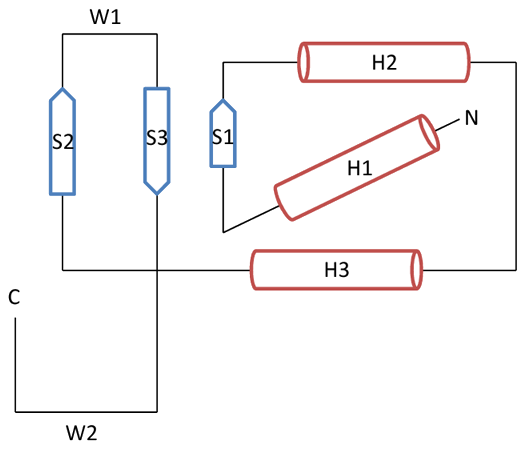
Figure 1. Structure of the winged helix domain. α-helices are shown as red cylinders (H1, H2 and H3), β-strands as blue arrows and W1 and W2 denote the wings (Clark et al., 1993; Gajiwala and Burley, 2000).
Description
The forkhead box Q1 gene codes for a 403 amino acid long protein with a size of 41.5 kDa. FOXQ1 is a member of the Forkhead box (Fox) superfamily. The family members share a conserved DNA-binding domain named forkhead box or winged helix domain. The domain consists of three a-helices, three β-sheets and two loops termed wings.
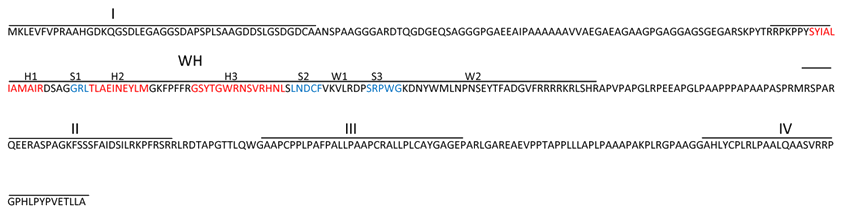
Figure 2. Graphical illustration of the FOXQ1 amino acid sequence and domains. (I) Acid and serine-rich domain. (WH) winged helix domain. (II) Serin-rich domain. (III) Proline-rich domain. (IV) Functional conserved domain (Hong et al., 2001; Wu et al., 2013).
Expression
Predominantly in the stomach, trachea, bladder and salivary gland (Bieller et al., 2001).
Function
In mice Foxq1 is involved in hair follicle differentiation (Hong et al., 2001; Potter et al., 2006). A mutation in the Foxq1 gene is responsible for an impaired differentiation of the hair shaft in the satin mice (Hong et al., 2001). In the digestive system Foxq1 has been shown to regulate acid secretion and expression of Muc5ac (Goering et al., 2008; Verzi et al., 2008).
Homology
According to NCBI the following genes have been suggested to be putative homologues: FOXQ1 (H. sapiens), Foxq1 (M. musculus), Foxq1 (R. norvegicus), Foxq1a (D. rerio) and Foxq1b (D. rerio). Conserved domains from CDD found in protein sequences by rpsblast searching was FH (cl00061).
Mutations
Note
Mutations in the Foxq1 gene is responsible for the hair follicle defects seen in the satin mouse mutant. Three mutations have been described leading to similar phenotypes of the animals. Foxq1sa has a 67 bp deletion from 686-752 and a base pair change CA-AT at position 766-767. Foxq1sa-el has a point mutation a position 383 changing T to G thus replacing isoleucine with serin at position 128 in the protein. Foxq1sa-J has C to T mutation in position 490 changing the amino acide arginine to cysteine at position 164 in the protein (Hong et al., 2001; Wu et al., 2013).
Implicated in
Entity name
Bladder cancer
Oncogenesis
FOXQ1 was overexpressed in bladder cancer samples. Depletion of FOXQ1 expression in bladder cancer cell lines reduced invasiveness and EMT markers (Zhu et al., 2013).
Entity name
Breast cancer
Prognosis
FOXQ1 expression in breast cancer patients is associated with poor survival, high grade, metastatic status and basal-like phenotype (Qiao et al., 2011).
Oncogenesis
FOXQ1 overexpression was observed in invasive breast cancer cell lines compared to non-invasive. FOXQ1 expression increases breast cancer cell proliferation, migration and invasion in vitro and metastasis in vivo (Zhang et al., 2011). FOXQ1 promotes an EMT phenotype through transcriptional regulation of CDH1 (Qiao et al., 2011; Zhang et al., 2011).
Entity name
Colorectal cancer
Oncogenesis
Several studies have shown FOXQ1 to be overexpressed in colorectal tumor samples compared to healthy colonocytes (Bieller et al., 2001; Sabates-Bellver et al., 2007; Kaneda et al., 2010; Christensen et al., 2013). The increased expression of FOXQ1 could be due to a hyperactive Wnt pathway in these tumors. Wnt activity directly correlates with FOXQ1 expression in colorectal cancer cell lines and β-catenin can bind to the promoter of FOXQ1 and increase transcription (Christensen et al., 2013). FOXQ1 expression can induce an EMT phenotype (Qiao et al., 2011; Abba et al., 2013). FOXQ1 does not increase growth but seems to protect from apoptosis (Kaneda et al., 2010; Qiao et al., 2011; Abba et al., 2013). The anti-apoptotic effect was mediated through FOXQ1 regulation of p21 (Kaneda et al., 2010).
Entity name
Gastric cancer
Prognosis
The expression of FOXQ1 was a prognostic factor for overall survival and correlated with tumor size, grade and tumor-node metastasis stage (Liang et al., 2013).
Oncogenesis
FOXQ1 increases migration and proliferation by downregulating NRXN3.
Entity name
Glioma
Disease
Tumors that arise from the glial cells, the most common site is the brain.
Oncogenesis
FOXQ1 increased migration and proliferation by downregulating NRXN3 (Sun et al., 2013).
Entity name
Hepatocarcinoma
Cytogenetics
FOXQ1 correlated with overall worse survival and higher recurrence (Wang et al., 2013; Xia et al., 2014).
Oncogenesis
In hepatocarcinoma FOXQ1 directly activated the EMT transcription factor ZEB2. This led to an EMT phenotype and increased lung metastasis. FOXQ1 and ZEB2 expression correlated positively in hepatocarcinoma samples but inversely with CDH1. FOXQ1 induced metastasis through regulation of VersicanV1, which promoted tumor-associated-macrophages attraction. Also, similarly to colorectal cancer expression of FOXQ1 was regulated by the Wnt pathway in hepatocarcinoma (Xia et al., 2014).
Entity name
Non-small-cell lung carcinoma
Prognosis
FOXQ1 expression was associated with poor prognosis and EMT (Feng et al., 2012).
Entity name
Ovarian cancer
Oncogenesis
FOXQ1 expression increased ovarian cancer cell proliferation, invasion and induced an EMT phenotype (Gao et al., 2012).
Article Bibliography
| Pubmed ID | Last Year | Title | Authors |
|---|---|---|---|
| 23723077 | 2013 | Unraveling the role of FOXQ1 in colorectal cancer metastasis. | Abba M et al |
| 11747606 | 2001 | Isolation and characterization of the human forkhead gene FOXQ1. | Bieller A et al |
| 23555880 | 2013 | FOXQ1, a novel target of the Wnt pathway and a new marker for activation of Wnt signaling in solid tumors. | Christensen J et al |
| 8332212 | 1993 | Co-crystal structure of the HNF-3/fork head DNA-recognition motif resembles histone H5. | Clark KL et al |
| 22761930 | 2012 | FoxQ1 overexpression influences poor prognosis in non-small cell lung cancer, associates with the phenomenon of EMT. | Feng J et al |
| 20717954 | 2011 | The Forkhead factor FoxQ1 influences epithelial differentiation. | Feuerborn A et al |
| 10679470 | 2000 | Winged helix proteins. | Gajiwala KS et al |
| 23203039 | 2012 | The role of forkhead box Q1 transcription factor in ovarian epithelial carcinomas. | Gao M et al |
| 18544931 | 2008 | Impairment of gastric acid secretion and increase of embryonic lethality in Foxq1-deficient mice. | Goering W et al |
| 11309849 | 2001 | The winged helix/forkhead transcription factor Foxq1 regulates differentiation of hair in satin mice. | Hong HK et al |
| 20145154 | 2010 | FOXQ1 is overexpressed in colorectal cancer and enhances tumorigenicity and tumor growth. | Kaneda H et al |
| 23609035 | 2013 | Increased expression of FOXQ1 is a prognostic marker for patients with gastric cancer. | Liang SH et al |
| 15722554 | 2005 | Differences in gene expression between wild type and Hoxa1 knockout embryonic stem cells after retinoic acid treatment or leukemia inhibitory factor (LIF) removal. | Martinez-Ceballos E et al |
| 16835220 | 2006 | Evidence that the satin hair mutant gene Foxq1 is among multiple and functionally diverse regulatory targets for Hoxc13 during hair follicle differentiation. | Potter CS et al |
| 21346143 | 2011 | FOXQ1 regulates epithelial-mesenchymal transition in human cancers. | Qiao Y et al |
| 18171984 | 2007 | Transcriptome profile of human colorectal adenomas. | Sabates-Bellver J et al |
| 23383267 | 2013 | FoxQ1 promotes glioma cells proliferation and migration by regulating NRXN3 expression. | Sun HT et al |
| 18558092 | 2008 | Transcription factor foxq1 controls mucin gene expression and granule content in mouse stomach surface mucous cells. | Verzi MP et al |
| 23623360 | 2013 | The prognostic significance of FOXQ1 oncogene overexpression in human hepatocellular carcinoma. | Wang W et al |
| 23489430 | 2013 | R164C mutation in FOXQ1 H3 domain affects formation of the hair medulla. | Wu B et al |
| 24005989 | 2014 | Forkhead box Q1 promotes hepatocellular carcinoma metastasis by transactivating ZEB2 and VersicanV1 expression. | Xia L et al |
| 21285253 | 2011 | Forkhead transcription factor foxq1 promotes epithelial-mesenchymal transition and breast cancer metastasis. | Zhang H et al |
| 23403865 | 2013 | Short hairpin RNA targeting FOXQ1 inhibits invasion and metastasis via the reversal of epithelial-mesenchymal transition in bladder cancer. | Zhu Z et al |
Other Information
Locus ID:
NCBI: 94234
MIM: 612788
HGNC: 20951
Ensembl: ENSG00000164379
Variants:
dbSNP: 94234
ClinVar: 94234
TCGA: ENSG00000164379
COSMIC: FOXQ1
RNA/Proteins
| Gene ID | Transcript ID | Uniprot |
|---|---|---|
| ENSG00000164379 | ENST00000296839 | Q9C009 |
Expression (GTEx)
References
| Pubmed ID | Year | Title | Citations |
|---|---|---|---|
| 38297082 | 2024 | PARP1-stabilised FOXQ1 promotes ovarian cancer progression by activating the LAMB3/WNT/β-catenin signalling pathway. | 0 |
| 38432629 | 2024 | The tumor suppressor p53 is a negative regulator of the carcinoma-associated transcription factor FOXQ1. | 0 |
| 38608123 | 2024 | The role of transcription factor FOXA1/C2/M1/O3/P1/Q1 in breast cancer. | 0 |
| 38297082 | 2024 | PARP1-stabilised FOXQ1 promotes ovarian cancer progression by activating the LAMB3/WNT/β-catenin signalling pathway. | 0 |
| 38432629 | 2024 | The tumor suppressor p53 is a negative regulator of the carcinoma-associated transcription factor FOXQ1. | 0 |
| 38608123 | 2024 | The role of transcription factor FOXA1/C2/M1/O3/P1/Q1 in breast cancer. | 0 |
| 36778115 | 2023 | The FGFR1 Signaling Pathway Upregulates the Oncogenic Transcription Factor FOXQ1 to Promote Breast Cancer Cell Growth. | 3 |
| 36815831 | 2023 | Kaposi's Sarcoma-Associated Herpesvirus Immediate Early Proteins Trigger FOXQ1 Expression in Oral Epithelial Cells, Engaging in a Novel Lytic Cycle-Sustaining Positive Feedback Loop. | 2 |
| 37265428 | 2023 | Forkhead Box Q1 is a novel regulator of autophagy in breast cancer cells. | 1 |
| 37870056 | 2023 | Hsa_circ_0001687 Function as a ceRNA to Facilitate Hepatocellular Carcinoma Progression via miR-140- 3p/FOXQ1 Axis. | 0 |
| 37875474 | 2023 | FOXQ1 promotes pancreatic cancer cell proliferation, tumor stemness, invasion and metastasis through regulation of LDHA-mediated aerobic glycolysis. | 3 |
| 38062011 | 2023 | Nuclear isoform of RAPH1 interacts with FOXQ1 to promote aggressiveness and radioresistance in breast cancer. | 0 |
| 36778115 | 2023 | The FGFR1 Signaling Pathway Upregulates the Oncogenic Transcription Factor FOXQ1 to Promote Breast Cancer Cell Growth. | 3 |
| 36815831 | 2023 | Kaposi's Sarcoma-Associated Herpesvirus Immediate Early Proteins Trigger FOXQ1 Expression in Oral Epithelial Cells, Engaging in a Novel Lytic Cycle-Sustaining Positive Feedback Loop. | 2 |
| 37265428 | 2023 | Forkhead Box Q1 is a novel regulator of autophagy in breast cancer cells. | 1 |
Citation
Jon Christensen ; Pascale Anderle
FOXQ1 (forkhead box Q1)
Atlas Genet Cytogenet Oncol Haematol. 2014-04-01
Online version: http://atlasgeneticsoncology.org/gene/45906/foxq1-(forkhead-box-q1)
