WNT1 (wingless-type MMTV integration site family, member 1)
2013-12-01 Irini Theohari , Lydia Nakopoulou Affiliation1st Department of Pathology, Medical School, University of Athens, Athens, Greece
Identity
HGNC
LOCATION
12q13.12
IMAGE

LEGEND
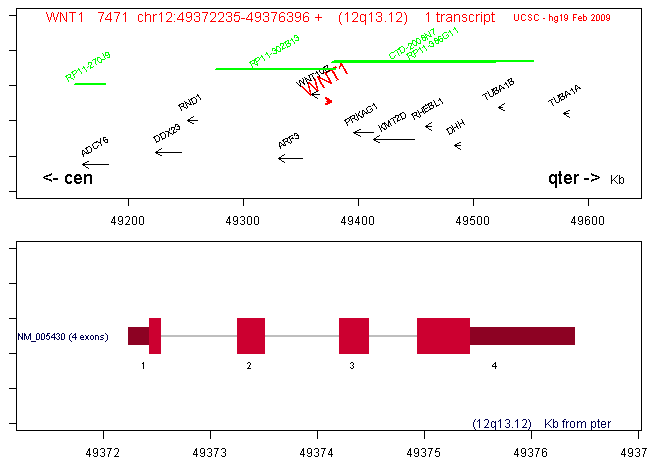
Genomic location of WNT1 gene at chromosome 12 (plus strand).
LOCUSID
ALIAS
BMND16,INT1,OI15
DNA/RNA
Description
The WNT1 gene spans a genomic region of 4161 bases on plus strand. The DNA of WNT1 consists of 4 exons and the coding sequence starts in the first exon.
Transcription
The WNT1 gene has one protein coding transcript which consists of 370 amino acids.
Proteins
Description
Ligand for members of the frizzled family of seven transmembrane receptors. In some developmental processes, is also a ligand for the coreceptor RYK, thus triggering Wnt signaling.
Localisation
Secreted, extracellular space, extracellular matrix.
Function
Probable developmental protein. May be a signaling molecule important in CNS (central nervous system) development. Is likely to signal over only few cell diameters. Has a role in osteoblast function and bone development.
Mutations
Somatic
There are several WNT1 mutations identified related with osteogenesis imperfecta. Several confirmed somatic mutations of the WNT1 gene have also been reported, according to COSMIC, which are associated with carcinomas of the endometrium, lung, large intestine, prostate and kidney.
Implicated in
Entity name
Esophageal cancer
Note
It has been shown, in cell cultures of esophageal cancer, that WNT1 results in cytoplasmic accumulation of beta-catenin and activates TCF-dependent transcription (Mizushima et al., 2002). Overexpression of mRNA and protein levels of WNT1 have been positively associated with lymph node metastasis, advanced pathological stage and prognosis of patients with esophageal squamous cell carcinoma (Lv et al., 2012).
Entity name
Breast cancer
Note
WNT1 has been shown to be markedly elevated in grade I tumors, but declined as tumor grade declined (Wong et al., 2002). Ectopic expression of WNT1, triggers the DNA damage response (DDR) and an ensuing cascade of events resulting in tumorigenic conversion of primary human mammary epithelial cells. WNT1-transformed cells have high telomerase activity and compromised p53 and Rb function, grow as spheres in suspension, and in mice form tumors that closely resemble medullary carcinomas of the breast (Ayyanan et al., 2006). siRNA anti-WNT1 has been shown to induce apoptosis in human breast cancer cell lines (Wieczorek et al., 2008). WNT1 immunoreactivity has been found to be inversely related to histological grade, Ki-67 and p53, positively to , HER-2 and caspase-3 and has been correlated with favorable prognosis of patients with stage II breast cancer (Mylona et al., 2013).
Entity name
Basal cell carcinoma of head and neck
Note
Overexpression of WNT1 has been positively associated with cytoplasmic beta-catenin (Lo Muzio et al., 2002).
Entity name
Sarcoma
Note
WNT1 blockade by either monoclonal antibody or siRNA induces cell death in sarcoma cells (Mikami et al., 2005).
Entity name
Non-small cell lung cancer (NSCLC)
Note
The expression of WNT1 has been positively correlated with c-Myc, cyclin D1, VEGF-A, MMP-7, Ki-67 and intratumoral microvessel density and has been found to negatively influence patients survival (Huang et al., 2008). WNT1 overexpression has been positively associated with the Ki-67 proliferation index and c-Myc and has been found to exert an unfavorable impact on patients survival (Nakashima et al., 2008). WNT1 expression has been found to be an independent prognostic factor of poor survival (Xu et al., 2011).
Entity name
Gastric cancer
Note
The expression levels of WNT1 are positively correlated with tumor size, tumor invasive depth, lymph node metastasis, pTNM stage and negatively influences patients 5-year survival rate (Zhang and Xue, 2008).
Entity name
Neuroblastoma
Note
Knockdown of endogenous WNT1 expression results in cell death and inhibits cell growth (Zhang et al., 2009).
Entity name
Osteogenesis imperfecta (OI)
Note
This disease is a heritable bone fragiility disorder that is usually due to dominant mutations in COL1A1 or COL1A2 and is characterized by reduced bone mass and recurrent fractures. Genetic variations in WNT1 define the bone mineral density quantitative trait locus 16 (BMND16) [MIM:615221]. Variance in bone mineral density influences bone mass, contributes to size determination in the general population, and is a susceptibility factor for osteoporotic fractures. The disease is caused by mutations affecting the gene of WNT1 (Fahiminiya et al., 2013; Faqeih et al., 2013; Laine et al., 2013; Pyott et al., 2013).
Entity name
Osteoporosis (OSTEOP)
Note
A systemic skeletal disorder characterized by decreased bone mass and deterioration of bone microarchitecture without alteration in the composition of bone. The result is fragile bones and an increased risk of fractures, even after minimal trauma. Osteoporosis is a chronic condition of multifactorial etiology and is usually clinically silent until a fracture occurs. Disease susceptibility is associated with variations affecting the gene of WNT1 (Keupp et al., 2013; Laine et al., 2013).
Article Bibliography
| Pubmed ID | Last Year | Title | Authors |
|---|---|---|---|
| 16501043 | 2006 | Increased Wnt signaling triggers oncogenic conversion of human breast epithelial cells by a Notch-dependent mechanism. | Ayyanan A et al |
| 23434763 | 2013 | Mutations in WNT1 are a cause of osteogenesis imperfecta. | Fahiminiya S et al |
| 23709755 | 2013 | WNT1 mutation with recessive osteogenesis imperfecta and profound neurological phenotype. | Faqeih E et al |
| 18790633 | 2008 | Wnt1 overexpression promotes tumour progression in non-small cell lung cancer. | Huang CL et al |
| 23499309 | 2013 | Mutations in WNT1 cause different forms of bone fragility. | Keupp K et al |
| 23656646 | 2013 | WNT1 mutations in early-onset osteoporosis and osteogenesis imperfecta. | Laine CM et al |
| 12014624 | 2002 | WNT-1 expression in basal cell carcinoma of head and neck. An immunohistochemical and confocal study with regard to the intracellular distribution of beta-catenin. | Lo Muzio L et al |
| 21259057 | 2012 | Association of β-catenin, Wnt1, Smad4, Hoxa9, and Bmi-1 with the prognosis of esophageal squamous cell carcinoma. | Lv J et al |
| 15913453 | 2005 | Efficacy of Wnt-1 monoclonal antibody in sarcoma cells. | Mikami I et al |
| 11782388 | 2002 | Wnt-1 but not epidermal growth factor induces beta-catenin/T-cell factor-dependent transcription in esophageal cancer cells. | Mizushima T et al |
| 23551536 | 2013 | An immunohistochemical evaluation of the proteins Wnt1 and glycogen synthase kinase (GSK)-3β in invasive breast carcinomas. | Mylona E et al |
| 18097596 | 2008 | Wnt1 overexpression associated with tumor proliferation and a poor prognosis in non-small cell lung cancer patients. | Nakashima T et al |
| 23499310 | 2013 | WNT1 mutations in families affected by moderately severe and progressive recessive osteogenesis imperfecta. | Pyott SM et al |
| 18059186 | 2008 | Silencing of Wnt-1 by siRNA induces apoptosis of MCF-7 human breast cancer cells. | Wieczorek M et al |
| 11793365 | 2002 | Expression of frizzled-related protein and Wnt-signalling molecules in invasive human breast tumours. | Wong SC et al |
| 21336184 | 2011 | Aberrant Wnt1/β-catenin expression is an independent poor prognostic marker of non-small cell lung cancer after surgery. | Xu X et al |
| 18705344 | 2008 | Wnt pathway is involved in advanced gastric carcinoma. | Zhang H et al |
| 19756656 | 2009 | The effect on cell growth by Wnt1 RNAi in human neuroblastoma SH-SY5Y cell line. | Zhang L et al |
Other Information
Locus ID:
NCBI: 7471
MIM: 164820
HGNC: 12774
Ensembl: ENSG00000125084
Variants:
dbSNP: 7471
ClinVar: 7471
TCGA: ENSG00000125084
COSMIC: WNT1
RNA/Proteins
| Gene ID | Transcript ID | Uniprot |
|---|---|---|
| ENSG00000125084 | ENST00000293549 | P04628 |
| ENSG00000125084 | ENST00000613114 | A0A087WXR9 |
Expression (GTEx)
Pathways
References
| Pubmed ID | Year | Title | Citations |
|---|---|---|---|
| 38536562 | 2024 | Exome sequencing identified mutations in the WNT1 and COL1A2 genes in osteogenesis imperfecta cases. | 0 |
| 38536562 | 2024 | Exome sequencing identified mutations in the WNT1 and COL1A2 genes in osteogenesis imperfecta cases. | 0 |
| 36215026 | 2023 | Suppression of Wnt/β-Catenin Signaling Is Associated with Downregulation of Wnt1, PORCN, and Rspo2 in Alzheimer's Disease. | 3 |
| 36396825 | 2023 | Osteoporosis related to WNT1 variants: a not infrequent cause of osteoporosis. | 3 |
| 36448560 | 2023 | Wnt/beta-catenin signaling and its modulators in nonalcoholic fatty liver diseases. | 8 |
| 36595228 | 2023 | Genotypic and Phenotypic Spectrum and Pathogenesis of WNT1 Variants in a Large Cohort of Patients With OI/Osteoporosis. | 7 |
| 36827869 | 2023 | KLF3 Transcription Activates WNT1 and Promotes the Growth and Metastasis of Gastric Cancer via Activation of the WNT/β-Catenin Signaling Pathway. | 3 |
| 37176048 | 2023 | Association of Membranous WNT-1 and Nuclear mTOR with Endometrial Cancer Grade. | 0 |
| 36215026 | 2023 | Suppression of Wnt/β-Catenin Signaling Is Associated with Downregulation of Wnt1, PORCN, and Rspo2 in Alzheimer's Disease. | 3 |
| 36396825 | 2023 | Osteoporosis related to WNT1 variants: a not infrequent cause of osteoporosis. | 3 |
| 36448560 | 2023 | Wnt/beta-catenin signaling and its modulators in nonalcoholic fatty liver diseases. | 8 |
| 36595228 | 2023 | Genotypic and Phenotypic Spectrum and Pathogenesis of WNT1 Variants in a Large Cohort of Patients With OI/Osteoporosis. | 7 |
| 36827869 | 2023 | KLF3 Transcription Activates WNT1 and Promotes the Growth and Metastasis of Gastric Cancer via Activation of the WNT/β-Catenin Signaling Pathway. | 3 |
| 37176048 | 2023 | Association of Membranous WNT-1 and Nuclear mTOR with Endometrial Cancer Grade. | 0 |
| 34890713 | 2022 | Wnt/β-catenin signaling and p68 conjointly regulate CHIP in colorectal carcinoma. | 6 |
Citation
Irini Theohari ; Lydia Nakopoulou
WNT1 (wingless-type MMTV integration site family, member 1)
Atlas Genet Cytogenet Oncol Haematol. 2013-12-01
Online version: http://atlasgeneticsoncology.org/gene/462/chromosome-explorer/teaching-explorer/
