PFKFB4 (6-phosphofructo-2-kinase/fructose-2,6-biphosphatase 4)
2013-04-01 Alexandra Ouertani , Violaine Goidts AffiliationGerman Cancer Research Center (DKFZ), Department of Molecular Genetics, Heidelberg, Germany
DNA/RNA
Description
PFKFB4 is composed of 14 exons and spans 44332 bp on the minus strand.
Transcription
PFKFB4 NM_004567.2 contains 3586 bases and the open reading starts at 114 bases to finish at 1410 bases.
There are nine putative splice variants that are protein coding, as reported in the Ensembl database. Moreover, several splice variants have been reported in rat tissues, as well as in DB-1 melanoma cells. Notably, the PFK-2 core domain is conserved among all splice variants (Minchenko et al., 2005b; Minchenko et al., 2008; Ros and Schulze, 2013).
There are nine putative splice variants that are protein coding, as reported in the Ensembl database. Moreover, several splice variants have been reported in rat tissues, as well as in DB-1 melanoma cells. Notably, the PFK-2 core domain is conserved among all splice variants (Minchenko et al., 2005b; Minchenko et al., 2008; Ros and Schulze, 2013).
Proteins
Description
PFKFB4 consists of 469 residues and has a molecular weight of 54040 Da.
PFKFB4 is one of the four isoforms (PFKFB1-PFKFB2-PFKFB3-PFKFB4) of the bifunctional enzyme PFK2 (6-phosphofructo-2-kinase/fructose-2,6-bisphosphatase), differing in their kinetic and regulatory properties.
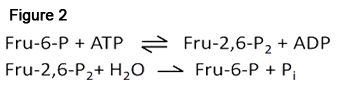
The PFK2 enzyme has both kinase and phosphatase activities, producing or degrading fructose-2,6-bisphosphate (Fru-2,6-P2). 6-Phosphofructo-2-kinase (6-PF-2-K) synthesizes Fru-2,6-P2 from fructose-6-phosphate (F6P) and ATP, while fructose-2,6-bisphosphatase (Fru-2,6-P2ase) hydrolyzes Fru-2,6-P2 to form F6P and inorganic phosphate (Pi). Fru-2,6-P2 is a rate-limiting enzyme product and an important control point in glycolysis and gluconeogenesis via its stimulatory effect on phosphofructokinase 1 (PFK1) activity and its inhibitory effect on fructose-1,6-bisphosphatase (Fru-1,6-P2ase) (Pilkis et al., 1996).
The mammalian PFKFB4 gene encodes an isozyme originally identified as a homodimer in the testis (Sakata et al., 1991; Manzano et al., 1999; Gomez et al., 2005).
The enzyme is divided into two functional domains (Figure 1): the N-terminal catalytic domain in which the 6-PF-2-K activity is found, and the C-terminal domain that houses the Fru-2,6-P2ase activity.
PFKFB4 is one of the four isoforms (PFKFB1-PFKFB2-PFKFB3-PFKFB4) of the bifunctional enzyme PFK2 (6-phosphofructo-2-kinase/fructose-2,6-bisphosphatase), differing in their kinetic and regulatory properties.
The PFK2 enzyme has both kinase and phosphatase activities, producing or degrading fructose-2,6-bisphosphate (Fru-2,6-P2). 6-Phosphofructo-2-kinase (6-PF-2-K) synthesizes Fru-2,6-P2 from fructose-6-phosphate (F6P) and ATP, while fructose-2,6-bisphosphatase (Fru-2,6-P2ase) hydrolyzes Fru-2,6-P2 to form F6P and inorganic phosphate (Pi). Fru-2,6-P2 is a rate-limiting enzyme product and an important control point in glycolysis and gluconeogenesis via its stimulatory effect on phosphofructokinase 1 (PFK1) activity and its inhibitory effect on fructose-1,6-bisphosphatase (Fru-1,6-P2ase) (Pilkis et al., 1996).
The mammalian PFKFB4 gene encodes an isozyme originally identified as a homodimer in the testis (Sakata et al., 1991; Manzano et al., 1999; Gomez et al., 2005).
The enzyme is divided into two functional domains (Figure 1): the N-terminal catalytic domain in which the 6-PF-2-K activity is found, and the C-terminal domain that houses the Fru-2,6-P2ase activity.
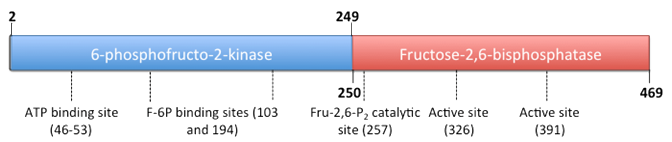
Figure 1: Schematic representation of the structure of the bifunctional isozyme PFKFB4. The different potential sites were defined by mutagenesis or by structural similarity to other mononucleotide binding proteins and phosphoglucomutases (Hasemann et al., 1996; Yuen et al., 1999a; Yuen et al., 1999b; Tominaga et al., 1993; Uyeda et al., 1997).
Expression
PFKFB4 is expressed in testis and at specific times during sperm maturation (Gomez et al., 2009). A recent report showed that 5α-androstan-17β-ol-3-one, inducing the paracrine secretion of FGF-2 by Sertoli cells could modulate the expression of PFKFB isozymes during spermatogenesis (Gomez et al., 2012). Moreover, it was demonstrated that hypoxia, as well as glucose level, strongly regulate PFKFB4 mRNA and protein expression levels in different cancer cell lines from prostate and liver (Minchenko et al., 2004; Li et al., 2012; Ros et al., 2012). Recent studies have showed the cancer-specific overexpression of PFKFB4 in astrocytoma (Goidts et al., 2012).
Localisation
PFKFB4 is found in the cytosol.
Function
PFKFB4 is a bifunctional isozyme harboring two domains that function within a homodimeric protein complex. It synthesizes and degrades Fru-2,6-P2 as described in the equations above (Figure 2) (Sakata et al., 1991).
The first reaction (kinase) taking place at the N-terminal side of the protein transfers the phosphate from ATP to F-6-P by a sequential-ordered mechanism. The biphosphatase reaction, which is located in the C-terminal domain, proceeds via a covalent phosphohistidine intermediate at position H257 (Figure 1) formed upon reaction with F-2,6-P2. The steady state concentration of F-2,6-P2 is determined by the balance between these opposing reactions. The kinase:biphosphatase activity ratio is different for all four isoforms (Okar et al., 2001). Indeed, the K:B ratio of the human PFKFB4 is approximately of 1 while PFKFB3 harbors a significantly higher ratio (740:1). These differences mainly reside on the effect of several glycolytic metabolites or post-translational modifications.
Fru-2,6-P2 is a powerful allosteric activator of phosphofructokinase 1 (PFK-1), the enzyme that controls one of the most critical steps of glycolysis (Wu et al., 2006). However, Fru-2,6-P2 not only controls the PFK-1 reaction but also the reverse reaction in the gluconeogenic pathway by inhibiting fructose 1,6-bisphosphatase (FBPase-1) (Figure 3).
The first reaction (kinase) taking place at the N-terminal side of the protein transfers the phosphate from ATP to F-6-P by a sequential-ordered mechanism. The biphosphatase reaction, which is located in the C-terminal domain, proceeds via a covalent phosphohistidine intermediate at position H257 (Figure 1) formed upon reaction with F-2,6-P2. The steady state concentration of F-2,6-P2 is determined by the balance between these opposing reactions. The kinase:biphosphatase activity ratio is different for all four isoforms (Okar et al., 2001). Indeed, the K:B ratio of the human PFKFB4 is approximately of 1 while PFKFB3 harbors a significantly higher ratio (740:1). These differences mainly reside on the effect of several glycolytic metabolites or post-translational modifications.
Fru-2,6-P2 is a powerful allosteric activator of phosphofructokinase 1 (PFK-1), the enzyme that controls one of the most critical steps of glycolysis (Wu et al., 2006). However, Fru-2,6-P2 not only controls the PFK-1 reaction but also the reverse reaction in the gluconeogenic pathway by inhibiting fructose 1,6-bisphosphatase (FBPase-1) (Figure 3).
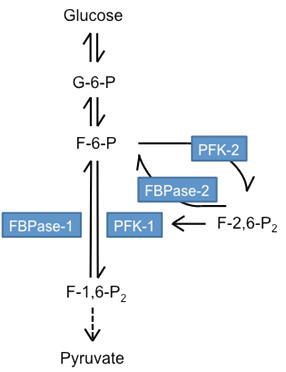
Figure 3: Overview of the function of PFK2. 6-phosphofructo-2-kinase/fructose 2,6-bisphosphatases (PFK-2/FBPase-2) regulates the production of F-2,6-P2 which controls the production of F-1,6-P2 by activating or inhibiting PFK1.
Homology
There are four PFK2 isoenzymes in mammals encoded by four different genes (PFKFB1-PFKFB4). Although the different isoforms present a high sequence homology of their core domain, there are differences in their regulatory and kinetic properties, probably due to the structural variations in the N- and C-terminal regions (Ros and Schulze, 2013).
From protein sequence alignments, it appears that the bisphosphatase activity is homologous to the phosphoglycerate mutases (PGMs) and the acid phosphatase family. The N-terminal PFK-2 domain is homologous to several nucleotide binding proteins, such as the NMP kinase (nucleoside-monophosphate kinase) (Bazan et al., 1989; Hasemann et al., 1996; Okar et al., 2001).
From protein sequence alignments, it appears that the bisphosphatase activity is homologous to the phosphoglycerate mutases (PGMs) and the acid phosphatase family. The N-terminal PFK-2 domain is homologous to several nucleotide binding proteins, such as the NMP kinase (nucleoside-monophosphate kinase) (Bazan et al., 1989; Hasemann et al., 1996; Okar et al., 2001).
Mutations
Somatic
18 different missense somatic mutations have been reported in different tumor samples, such as lung, liver, colon or breast cancer (Sjoeblom et al., 2006; Forbes et al., 2011).
Implicated in
Entity name
Non-muscle invasive bladder cancer (NMIBC)
Note
PFKFB4 mRNA and protein expression was investigated in NMBIC samples.
Prognosis
Recurrence free survival time was significantly reduced in patients with elevated PFKFB4 mRNA levels, whereas PFKFB4 protein levels did not correlate with differences in time to tumor recurrence. The time of progression free survival was significantly shorter in patients with increased PFKFB4 mRNA or protein expression levels (Yun et al., 2012).
Entity name
Breast cancer
Note
PFKFB4 was showed to be highly expressed in solid malignant tumors of the breast compared to non-malignant tissue (Minchenko et al., 2005a).
In several breast cancer cell lines (BT549, MCF7, MDA-MB468, SKBR3, TD47), PFKFB4 expression was increased upon exposure to hypoxia (Minchenko et al., 2005a, Minchenko et al., 2005c).
In several breast cancer cell lines (BT549, MCF7, MDA-MB468, SKBR3, TD47), PFKFB4 expression was increased upon exposure to hypoxia (Minchenko et al., 2005a, Minchenko et al., 2005c).
Entity name
Glioma
Note
PFKFB4 mRNA and protein expression was showed to be increased in three different glioblastoma stem-like cell lines, but not in normal brain cells. shRNA mediated knockdown of PFKFB4 in glioma stem-like cell lines led to increased apoptosis (Goidts et al., 2012), while no phenotypic effect could be seen in PFKFB4-silenced normal neural stem cells. These results suggested a cancer-specific function of PFKFB4 in glioblastoma.
Prognosis
Glioblastoma patients with tumors with higher than average PFKFB4 expression showed a significantly shorter overall survival time, compared to patients with lower than average PFKFB4 expression. Furthermore, PFKFB4 mRNA expression correlated with glioma tumors grade (Goidts et al., 2012).
Oncogenesis
Glioblastoma stem-like cells, thought to be responsible for chemo- and radiotherapy resistance, are resilient against hypoxic conditions in the tumor microenvironment under which the hypoxia inducible factor 1α (HIF1α), a transcription factor, is triggered. HIF1α activates transcription of PFKFB4 leading to higher glycolysis and production rates of lactate and ATP, essential for the survival of these cells. Silencing of PFKFB4 was showed to decrease significantly ATP and lactate levels, leading to the phosphorylation/activation of the AMPK (adenosine monophosphate-activated protein kinase).
Entity name
Colon cancer
Note
mRNA expression of PFKFB4 was significantly increased in colon solid malignant tumors in comparison to non-malignant tissue (Minchenko et al., 2005a).
Entity name
Gastric cancer
Note
In gastric cancer tissue, PFKFB4 mRNA expression was increased compared to the nonmalignant counterpart (Bobarykina et al., 2006).
PFKFB4 mRNA expression was found to be low in the gastric cancer cell lines MKN45 and NUGC3. Protein expression levels differed from low to highly expressed, but low protein levels were increased under hypoxic conditions (Bobarykina et al., 2006).
PFKFB4 mRNA expression was found to be low in the gastric cancer cell lines MKN45 and NUGC3. Protein expression levels differed from low to highly expressed, but low protein levels were increased under hypoxic conditions (Bobarykina et al., 2006).
Entity name
Liver cancer
Note
In a hepatic cancer cell line (huh-7), sulforaphane-induced apoptosis resulted in decreased PFKFB4 protein expression and glucose consumption. PFKFB4 expression was increased again under hypoxic conditions, due to the HIF1α transcription factor being induced and activating PFKFB4 transcription (Jeon et al., 2011).
Moreover, PFKFB4 expression was suggested to be controlled by HO-2 (Heme oxygenase 2) in the hepatic cancer cell line HepG2 (Li et al., 2012).
Moreover, PFKFB4 expression was suggested to be controlled by HO-2 (Heme oxygenase 2) in the hepatic cancer cell line HepG2 (Li et al., 2012).
Entity name
Pancreatic cancer
Note
Low levels of PFKFB4 mRNA and protein expression were found in the pancreatic cancer cell line Pank1, but expression was induced on both levels under hypoxia (Bobarykina et al., 2006).
Entity name
Prostate cancer
Note
In 3 different prostate cancer cell lines (DU145, LNCaP, PC3), PFKFB4 expression was higher than in the noncancer cell line RWPE1 (Ros et al., 2012).
Silencing of PFKFB4 in xenografted prostate cancer tumors in vivo (60% reduction in PFKFB4 mRNA levels) resulted in significant reduction of the tumor size and an increased number of cells with apoptotic morphology. Tumor growth was positively correlated to PFKFB4 mRNA expression (Ros et al., 2012).
Silencing of PFKFB4 in xenografted prostate cancer tumors in vivo (60% reduction in PFKFB4 mRNA levels) resulted in significant reduction of the tumor size and an increased number of cells with apoptotic morphology. Tumor growth was positively correlated to PFKFB4 mRNA expression (Ros et al., 2012).
Oncogenesis
PFKFB4 was accumulated upon siRNA mediated silencing of PFKFB4 in prostate cancer cell lines, leading to reduced cell survival. These findings suggest an enhanced phosphatase activity in prostate cancer cells, important for their survival. Additionally, depletion of PFKFB4 decreased the concentration of NADPH, a pentose phosphate pathway metabolite required for de novo synthesis of fatty acids and the maintenance of the antioxidant GSH, leading to increased levels of reactive oxygen species (Ros et al., 2012).
Article Bibliography
| Pubmed ID | Last Year | Title | Authors |
|---|---|---|---|
| 2557623 | 1989 | Evolution of a bifunctional enzyme: 6-phosphofructo-2-kinase/fructose-2,6-bisphosphatase. | Bazan JF et al |
| 17143338 | 2006 | Hypoxic regulation of PFKFB-3 and PFKFB-4 gene expression in gastric and pancreatic cancer cell lines and expression of PFKFB genes in gastric cancers. | Bobarykina AY et al |
| 20952405 | 2011 | COSMIC: mining complete cancer genomes in the Catalogue of Somatic Mutations in Cancer. | Forbes SA et al |
| 22056879 | 2012 | RNAi screening in glioma stem-like cells identifies PFKFB4 as a key molecule important for cancer cell survival. | Goidts V et al |
| 22811469 | 2012 | Sertoli-secreted FGF-2 induces PFKFB4 isozyme expression in mouse spermatogenic cells by activation of the MEK/ERK/CREB pathway. | Gómez M et al |
| 19595670 | 2009 | Switches in 6-phosphofructo-2-kinase isoenzyme expression during rat sperm maturation. | Gómez M et al |
| 8805587 | 1996 | The crystal structure of the bifunctional enzyme 6-phosphofructo-2-kinase/fructose-2,6-bisphosphatase reveals distinct domain homologies. | Hasemann CA et al |
| 21640852 | 2011 | Sulforaphane induces apoptosis in human hepatic cancer cells through inhibition of 6-phosphofructo-2-kinase/fructose-2,6-biphosphatase4, mediated by hypoxia inducible factor-1-dependent pathway. | Jeon YK et al |
| 22892400 | 2012 | Coordinated expression of 6-phosphofructo-2-kinase/fructose-2,6-bisphosphatase 4 and heme oxygenase 2: evidence for a regulatory link between glycolysis and heme catabolism. | Li B et al |
| 10095107 | 1999 | Cloning, expression and chromosomal localization of a human testis 6-phosphofructo-2-kinase/fructose-2,6-bisphosphatase gene. | Manzano A et al |
| 19140452 | 2008 | Alternative splice variants of rat 6-phosphofructo-2-kinase/ fructose-2,6-bisphosphatase-4 mRNA. | Minchenko DO et al |
| 15474002 | 2004 | Hypoxia induces transcription of 6-phosphofructo-2-kinase/fructose-2,6-biphosphatase-4 gene via hypoxia-inducible factor-1alpha activation. | Minchenko O et al |
| 16025159 | 2005 | Expression and hypoxia-responsiveness of 6-phosphofructo-2-kinase/fructose-2,6-bisphosphatase 4 in mammary gland malignant cell lines. | Minchenko OH et al |
| 11165514 | 2001 | PFK-2/FBPase-2: maker and breaker of the essential biofactor fructose-2,6-bisphosphate. | Okar DA et al |
| 7574501 | 1995 | 6-Phosphofructo-2-kinase/fructose-2,6-bisphosphatase: a metabolic signaling enzyme. | Pilkis SJ et al |
| 22576210 | 2012 | Functional metabolic screen identifies 6-phosphofructo-2-kinase/fructose-2,6-biphosphatase 4 as an important regulator of prostate cancer cell survival. | Ros S et al |
| 1651918 | 1991 | Molecular cloning of the DNA and expression and characterization of rat testes fructose-6-phosphate,2-kinase:fructose-2,6-bisphosphatase. | Sakata J et al |
| 16959974 | 2006 | The consensus coding sequences of human breast and colorectal cancers. | Sjöblom T et al |
| 8393455 | 1993 | Significance of the amino terminus of rat testis fructose-6-phosphate, 2-kinase:fructose-2,6-bisphosphatase. | Tominaga N et al |
| 9065453 | 1997 | The active sites of fructose 6-phosphate,2-kinase: fructose-2, 6-bisphosphatase from rat testis. Roles of Asp-128, Thr-52, Thr-130, Asn-73, and Tyr-197. | Uyeda K et al |
| 16860376 | 2006 | Roles for fructose-2,6-bisphosphate in the control of fuel metabolism: beyond its allosteric effects on glycolytic and gluconeogenic enzymes. | Wu C et al |
| 9890980 | 1999 | Crystal structure of the H256A mutant of rat testis fructose-6-phosphate,2-kinase/fructose-2,6-bisphosphatase. Fructose 6-phosphate in the active site leads to mechanisms for both mutant and wild type bisphosphatase activities. | Yuen MH et al |
| 10493801 | 1999 | A switch in the kinase domain of rat testis 6-phosphofructo-2-kinase/fructose-2,6-bisphosphatase. | Yuen MH et al |
| 21396842 | 2012 | PFKFB4 as a prognostic marker in non-muscle-invasive bladder cancer. | Yun SJ et al |
Other Information
Locus ID:
NCBI: 5210
MIM: 605320
HGNC: 8875
Ensembl: ENSG00000114268
Variants:
dbSNP: 5210
ClinVar: 5210
TCGA: ENSG00000114268
COSMIC: PFKFB4
RNA/Proteins
Expression (GTEx)
Pathways
Protein levels (Protein atlas)
References
| Pubmed ID | Year | Title | Citations |
|---|---|---|---|
| 36806581 | 2023 | PFKFB4 Drives the Oncogenicity in TP53-Mutated Hepatocellular Carcinoma in a Phosphatase-Dependent Manner. | 3 |
| 36963434 | 2023 | PFKFB4 Is a Metabolic Driver of HCC Progression and Chemoresistance Through ROS Mitigation. | 1 |
| 37500615 | 2023 | THOC3 interacts with YBX1 to promote lung squamous cell carcinoma progression through PFKFB4 mRNA modification. | 3 |
| 37707291 | 2023 | Transforming growth factor β1 upregulates 6-phosphofructo-2-kinase/fructose 2,6-bisphosphatase-4 expression in A549 and MCF-10A cells. | 0 |
| 36806581 | 2023 | PFKFB4 Drives the Oncogenicity in TP53-Mutated Hepatocellular Carcinoma in a Phosphatase-Dependent Manner. | 3 |
| 36963434 | 2023 | PFKFB4 Is a Metabolic Driver of HCC Progression and Chemoresistance Through ROS Mitigation. | 1 |
| 37500615 | 2023 | THOC3 interacts with YBX1 to promote lung squamous cell carcinoma progression through PFKFB4 mRNA modification. | 3 |
| 37707291 | 2023 | Transforming growth factor β1 upregulates 6-phosphofructo-2-kinase/fructose 2,6-bisphosphatase-4 expression in A549 and MCF-10A cells. | 0 |
| 35659173 | 2022 | Loss of PFKFB4 induces cell cycle arrest and glucose metabolism inhibition by inactivating MEK/ERK/c-Myc pathway in cervical cancer cells. | 3 |
| 35813480 | 2022 | Hypoxia-inducible CircPFKFB4 Promotes Breast Cancer Progression by Facilitating the CRL4(DDB2) E3 Ubiquitin Ligase-mediated p27 Degradation. | 4 |
| 35914811 | 2022 | PFKFB4 interacts with ICMT and activates RAS/AKT signaling-dependent cell migration in melanoma. | 6 |
| 35926796 | 2022 | PFKFB4 modulated by miR-195-5p can boost the malignant progression of cervical cancer cells. | 2 |
| 36109523 | 2022 | Phosphorylation of PFKFB4 by PIM2 promotes anaerobic glycolysis and cell proliferation in endometriosis. | 10 |
| 35659173 | 2022 | Loss of PFKFB4 induces cell cycle arrest and glucose metabolism inhibition by inactivating MEK/ERK/c-Myc pathway in cervical cancer cells. | 3 |
| 35813480 | 2022 | Hypoxia-inducible CircPFKFB4 Promotes Breast Cancer Progression by Facilitating the CRL4(DDB2) E3 Ubiquitin Ligase-mediated p27 Degradation. | 4 |
Citation
Alexandra Ouertani ; Violaine Goidts
PFKFB4 (6-phosphofructo-2-kinase/fructose-2,6-biphosphatase 4)
Atlas Genet Cytogenet Oncol Haematol. 2013-04-01
Online version: http://atlasgeneticsoncology.org/gene/46519/pfkfb4-%286-phosphofructo-2-kinase-fructose-2-6-biphosphatase-4%29
