AFAP1L2 (actin filament associated protein 1-like 2)
2014-01-01 Xiaohui Bai , Serisha Moodley , Hae-Ra Cho , Mingyao Liu AffiliationLatner Thoracic Surgery Research Laboratoires, University Health Network, Toronto General Research Institute, University of Toronto, Toronto, Ontario, Canada
Identity
HGNC
LOCATION
10q25.3
IMAGE

LEGEND
Figure 1. XB130 chromosomal location and neighbour genes. A. xb130 gene is located on chromosome 10, at 10q25.3 by fluorescence in situ hybridization (FISH). B. Diagram of xb130 neighbour genes between 115939029 and 116450393.
LOCUSID
ALIAS
CTB-1144G6.4,KIAA1914,XB130
FUSION GENES
DNA/RNA
Note
Human XB130 was discovered in Dr. Mingyao Lius laboratory (University of Toronto) in the process of cloning human actin filament associated protein (afap) gene. Using chicken AFAP protein sequence to search human cDNA library in GenBank, XB130 was found as an EST clone (GenBank accession number 1154093) with 34% sequence similarity to chicken AFAP protein. The clone contains partial coding sequence and 3 UTR. The upstream sequence was obtained using 5 rapid amplification of cDNA ends (RACE) from human lung alveolar epithelial cell mRNA. Western blot shows the protein molecular weight is 130 kD (Xu et al., 2007).
In 2003, the XB130 knockout mice were established through the collaboration of Drs. Mingyao Liu and Tak W. Mak at the University of Toronto.
In 2003, the XB130 knockout mice were established through the collaboration of Drs. Mingyao Liu and Tak W. Mak at the University of Toronto.
Description
Human xb130 genes contains 19 exons, which are covering the whole coding sequence.
Transcription
The transcript size of xb130 is 3751 bp. There may be 7 splicing variants based on Ensembl data (www.ensembl.org). XB130 mRNA is highly expressed in the thyroid, parathyroid and spleen; moderately expressed in brain, pancreas, lung and kidney.
Proteins
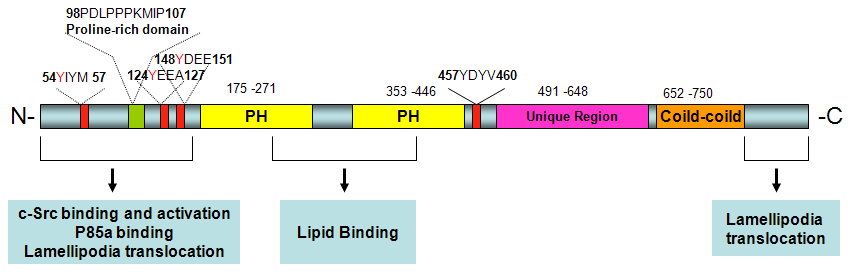
Figure 2. XB130 functional domains and motifs. Human XB130 has 818 amino acids. It contains the following motif/domains: proline-rich region: residues 98-107; tyrosine phosphorylation motif: residues 54-57, 124-127; 148-151; 457-460; PH domain: residues 175-272; 353-445; coiled-coil region: residues 652-749.
Description
XB130 is a novel adaptor protein, member of the actin filament associated protein (AFAP) family (Snyder et al., 2011). Accordingly, it is also known as AFAP1L2. The full length protein consists of 818 amino acids with a molecular weight of approximately 130 kDa by western blotting (Xu et al., 2007). As an adaptor protein, XB130 has no enzymatic domains or activity. Sequence structure analysis has revealed 23 putative tyrosine phosphorylation sites and 27 putative phosphorylation sites for serine/threonine kinases (Xu et al., 2007). The N-terminal of XB130 contains a proline rich, SH3 domain binding motif, three tyrosine containing SH2 domain binding sites (Xu et al., 2007), of which a YXXM motif is for PI3 kinase subunit p85 binding (Lodyga et al., 2009). In the middle region, there are two pleckstrin homology domains and another tyrosine binding motif (Xu et al., 2007). The C-terminal contains a coiled-coil region, which may be important for molecular trafficking or dimerization (Xu et al., 2007).
Expression
In normal human tissue, the 4 kb mRNA transcript of XB130 is expressed highly in spleen and thyroid with lower expression in kidney, brain, lung and pancreas (Xu et al., 2007). Newer RNA sequencing by Illumina body map using RNA obtained from 16 normal human tissues shows high expression of XB130 in thyroid with lower expression in lymph nodes, brain, colon, adipocytes, kidney, lung, adrenal glands, breast, ovary, prostate and testis followed by whole blood, heart, skeletal muscles and liver (www.genecards.org).
XB130 protein is detected in normal tissues of thyroid, parathyroid, brain, kidney, skin and GI-tracks (www.proteinatlas.org).
XB130 protein expresses in human thyroid, colorectal, gastric and hepatocellular carcinomas (Shi et al., 2012; Shiozaki et al., 2013; Shiozaki et al., 2011; Zuo et al., 2012). Expression of XB130 has also been observed in a variety of cancer cell lines, including thyroid, lung, esophageal, pancreatic and colon cancers (Shi et al., 2012; Shiozaki et al., 2013; Zuo et al., 2012).
XB130 protein is detected in normal tissues of thyroid, parathyroid, brain, kidney, skin and GI-tracks (www.proteinatlas.org).
XB130 protein expresses in human thyroid, colorectal, gastric and hepatocellular carcinomas (Shi et al., 2012; Shiozaki et al., 2013; Shiozaki et al., 2011; Zuo et al., 2012). Expression of XB130 has also been observed in a variety of cancer cell lines, including thyroid, lung, esophageal, pancreatic and colon cancers (Shi et al., 2012; Shiozaki et al., 2013; Zuo et al., 2012).
Localisation
XB130 is distributed mainly in the cytoplasm and perinuclear region of lung epithelial BEAS-2B cells and several other cell types (Xu et al., 2007). Unlike AFAP, XB130 does not associate or co-localize with actin filament stress fibler (Lodyga et al., 2010). Stimulation of cells with EGF, PMA, or overexpression of constitutive Rac results in a translocation of XB130 to the cell periphery and leading edge of migrating cells (Lodyga et al., 2010).
Function
XB130 is an adaptor protein that acts as a key mediator to drive signal transduction pathways. XB130 has been shown to bind to tyrosine kinase c-Src to enhance kinase activity and subsequently regulates Src-mediated AP-1/SRE transcription activation (Xu et al., 2007). XB130 is also highly involved in the PI3K/Akt pathway and effects cell proliferation, cell cycle progression and cell survival through binding to p85 alpha subunit of PI3K (Lodyga et al., 2009). XB130 may also play a role in the innate immune response, where knockdown of XB130 was shown to decrease IL-6 and IL-8 cytokine levels in human lung epithelial cells (Xu et al., 2007). XB130 is also involved in cell migration via association with Rac-GTPase and plays a significant role in lateral cell migration and cell invasion in both normal and cancer cell lines (Lodyga et al., 2010).
Yamanaka et al. reported phosphorylated XB130 affects cAMP-dependent DNA synthesis in rat thyroid cells (Yamanaka et al., 2012).
XB130 is aberrantly expressed in human cancers and has been shown to control tumour growth in vivo (Shiozaki et al., 2011). XB130 regulates thyroid cancer cell proliferation by controlling microRNA miR-33a, 149a and 193a expression to alter oncogenes Myc, FosL1, and SCL7A5 protein levels (Takeshita et al., 2013).
Yamanaka et al. reported phosphorylated XB130 affects cAMP-dependent DNA synthesis in rat thyroid cells (Yamanaka et al., 2012).
XB130 is aberrantly expressed in human cancers and has been shown to control tumour growth in vivo (Shiozaki et al., 2011). XB130 regulates thyroid cancer cell proliferation by controlling microRNA miR-33a, 149a and 193a expression to alter oncogenes Myc, FosL1, and SCL7A5 protein levels (Takeshita et al., 2013).
Homology
XB130 shares similar sequence and domain structure cellular as AFAP and AFAP1L1 (Snyder et al., 2011).
Mutations
Somatic
Somatic mutations of XB130 are reported in a variety of cancer tissues. Based on the data of Sanger Institute database (www.sanger.ac.uk), XB130 mutation sites have been identified in multiple tumor tissues, including lung, large intestine, ovary, skin, prostate, endometrium. Among these samples, 70% of identified cases are XB130 substitution missense mutation.
Implicated in
Entity name
Various cancers
Note
XB130 plays important roles in tumor progression by promoting cell proliferation, survival, motility and invasion in various cancer cells. Recently, XB130 has been identified in thyroid carcinoma (Shiozaki et al., 2011), esophageal squamous cell carcinoma (Shiozaki et al., 2013), and gastric cancer (Shi et al., 2012).
Entity name
Colorectal cancer
Note
Tyrosine phosphorylated XB130 in colorectal cancer.
Prognosis
Using mass spectrometry, Emaduddin et al. reported several proteins as tyrosine phosphorylated form are maintained at high level in colorectal cancer cells isolated from patients. XB130 is identified as one of these proteins. Therefore, tyrosine phosphorylated XB130 has a potential to be a biomarker of colorectal cancer (Emaduddin et al., 2008).
Entity name
Gastric cancer (GC)
Note
XB130 expression level associates with the prognosis of gastric cancer.
Prognosis
Based on the anlysis GC tissue samples from 411 patients with various stages, lower expression of XB130 mRNA as well as protein is significantly correlated with reduced patient survival time and shorter disease-free period (Shi et al., 2012).
Entity name
Thyroid cancer
Note
XB130 as a tumor promoting gene, enhancing thyroid cancer cell growth.
Oncogenesis
Knockdown XB130 using siRNA in thyroid cancer cell (WRO) is accompanied with an inhibition of G1-S phase cell cycle progression and enhanced apoptosis. The volume of tumors generated in nude mice after injecting these cells are smaller than those formed from cells with a normal XB130 expression (Shiozaki et al., 2011).
Entity name
Esophageal squamous cell carcinoma (ESCC)
Note
XB130 protein is identified in ESCC primary cell lines and tumor samples.
Oncogenesis
XB130 protein is highly expression in ESCC primary cells. XB130 protein is examined by immunohistochemistry staining from ESCC tissues collected from 52 patients. Positive XB130 staining is observed in 71% of ESCC samples, which indicates the association of XB130 protein and ESCC (Shiozaki et al., 2013).
Entity name
Soft tissue tumor
Note
Decreased XB130 expression leads to a local aggressiveness of soft tissue tumor.
Oncogenesis
Analysis of gene expression profile of 102 tumor samples with varying stages of soft tissue tumor shows a decreased XB130 expression in malignant mesenchymal tumors (Cunha et al., 2010).
Article Bibliography
| Pubmed ID | Last Year | Title | Authors |
|---|---|---|---|
| 20165692 | 2010 | Identification of genes associated with local aggressiveness and metastatic behavior in soft tissue tumors. | Cunha IW et al |
| 18844995 | 2008 | Odin (ANKS1A) is a Src family kinase target in colorectal cancer cells. | Emaduddin M et al |
| 21084565 | 2010 | Adaptor protein XB130 is a Rac-controlled component of lamellipodia that regulates cell motility and invasion. | Lodyga M et al |
| 19060924 | 2009 | XB130, a tissue-specific adaptor protein that couples the RET/PTC oncogenic kinase to PI 3-kinase pathway. | Lodyga M et al |
| 22927913 | 2012 | Silencing of XB130 is associated with both the prognosis and chemosensitivity of gastric cancer. | Shi M et al |
| 22805860 | 2013 | XB130 as an independent prognostic factor in human esophageal squamous cell carcinoma. | Shiozaki A et al |
| 21333378 | 2011 | AFAP1L1 is a novel adaptor protein of the AFAP family that interacts with cortactin and localizes to invadosomes. | Snyder BN et al |
| 23527086 | 2013 | XB130, a new adaptor protein, regulates expression of tumor suppressive microRNAs in cancer cells. | Takeshita H et al |
| 17412687 | 2007 | XB130, a novel adaptor protein for signal transduction. | Xu J et al |
| 22496359 | 2012 | Phosphatidylinositol 3-kinase-binding protein, PI3KAP/XB130, is required for cAMP-induced amplification of IGF mitogenic activity in FRTL-5 thyroid cells. | Yamanaka D et al |
| 22190283 | 2012 | Multivariate analysis of several molecular markers and clinicopathological features in postoperative prognosis of hepatocellular carcinoma. | Zuo Q et al |
Other Information
Locus ID:
NCBI: 84632
MIM: 612420
HGNC: 25901
Ensembl: ENSG00000169129
Variants:
dbSNP: 84632
ClinVar: 84632
TCGA: ENSG00000169129
COSMIC: AFAP1L2
RNA/Proteins
| Gene ID | Transcript ID | Uniprot |
|---|---|---|
| ENSG00000169129 | ENST00000304129 | Q8N4X5 |
| ENSG00000169129 | ENST00000369271 | Q8N4X5 |
| ENSG00000169129 | ENST00000419268 | F6QUH3 |
Expression (GTEx)
Protein levels (Protein atlas)
References
| Pubmed ID | Year | Title | Citations |
|---|---|---|---|
| 36284062 | 2023 | Molecular mechanism of XB130 adaptor protein mediates trastuzumab resistance in gastric cancer. | 2 |
| 37729738 | 2023 | High XB130 expression in renal cell carcinoma is strongly associated with poor prognosis. | 0 |
| 36284062 | 2023 | Molecular mechanism of XB130 adaptor protein mediates trastuzumab resistance in gastric cancer. | 2 |
| 37729738 | 2023 | High XB130 expression in renal cell carcinoma is strongly associated with poor prognosis. | 0 |
| 34780466 | 2021 | Adaptor protein XB130 regulates the aggressiveness of cholangiocarcinoma. | 4 |
| 34780466 | 2021 | Adaptor protein XB130 regulates the aggressiveness of cholangiocarcinoma. | 4 |
| 32159887 | 2020 | XB130, regulated by miR-203, miR-219, and miR-4782-3p, mediates the proliferation and metastasis of non-small-cell lung cancer cells. | 11 |
| 32159887 | 2020 | XB130, regulated by miR-203, miR-219, and miR-4782-3p, mediates the proliferation and metastasis of non-small-cell lung cancer cells. | 11 |
| 31219645 | 2019 | Knockdown of XB130 restrains cancer stem cell-like phenotype through inhibition of Wnt/β-Catenin signaling in breast cancer. | 9 |
| 31219645 | 2019 | Knockdown of XB130 restrains cancer stem cell-like phenotype through inhibition of Wnt/β-Catenin signaling in breast cancer. | 9 |
| 28849225 | 2017 | XB130 enhances invasion and migration of human colorectal cancer cells by promoting epithelial‑mesenchymal transition. | 5 |
| 28849225 | 2017 | XB130 enhances invasion and migration of human colorectal cancer cells by promoting epithelial‑mesenchymal transition. | 5 |
| 27509056 | 2016 | XB130 is overexpressed in prostate cancer and involved in cell growth and invasion. | 10 |
| 27835612 | 2016 | Stimulus-dependent dissociation between XB130 and Tks5 scaffold proteins promotes airway epithelial cell migration. | 6 |
| 27509056 | 2016 | XB130 is overexpressed in prostate cancer and involved in cell growth and invasion. | 10 |
Citation
Xiaohui Bai ; Serisha Moodley ; Hae-Ra Cho ; Mingyao Liu
AFAP1L2 (actin filament associated protein 1-like 2)
Atlas Genet Cytogenet Oncol Haematol. 2014-01-01
Online version: http://atlasgeneticsoncology.org/gene/52197/afap1l2-(actin-filament-associated-protein-1-like-2)
