STAG2 (Stromal Antigen 2)
2013-09-01 Suning Chen , Stefan Nagel , Hans G Drexler , Roderick AF MacLeod AffiliationIdentity
HGNC
LOCATION
Xq25
LOCUSID
ALIAS
SA-2,SA2,SCC3B,bA517O1.1
FUSION GENES
DNA/RNA

Figure 1. Clustering of GATA3 TFBS in STAG2 regulatory region. Schema showing multiple GATA3 TFBS present in the regulatory intron of STAG2. For additional TFBS see: SABiosciences
Description
The STAG2 gene consists of 35 exons spanning 142 Kbp, located at chromosome Xq25.
Transcription
Transcription takes place in a centromere --> telomere orientation (plus strand). Transcription of STAG2 gene generates 19 different mRNA transcripts, the longest is 6045 bp containing 34 exons (ENST00000371160).
There are multiple transcription factor binding sites (TFBS) for GATA3 present in the regulatory first intron of STAG2 summarized above (Fig. 1).
There are multiple transcription factor binding sites (TFBS) for GATA3 present in the regulatory first intron of STAG2 summarized above (Fig. 1).
Pseudogene
There are no known pseudogenes.
Proteins
Description
The STAG2 gene encodes two alternative isoforms:
- A: Q8N3U4-1, 1231 aa, 141.3 KDa
- B: Q8N3U4-2, 1268 aa, 145.7 KDa
- A: Q8N3U4-1, 1231 aa, 141.3 KDa
- B: Q8N3U4-2, 1268 aa, 145.7 KDa
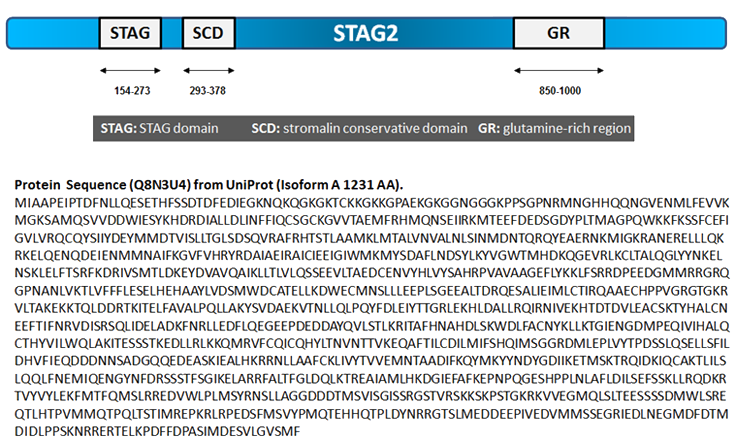
Figure 2. Domain structure of STAG2 and amino acid sequence.
Expression
STAG2 mRNA is expressed in cells from most tissues. Peak expression occurs in T-cell and early erythroid compartments, and in the uterus. Lowest expression is found in brain, heart, liver, lung and testis. STAG2 is also overexpressed in T-/B-cell acute lymphoblastic leukemia (ALL) and in other hematopoietic neoplasias, followed by small cell lung cancer, neuroblastoma and medulloblastoma.
It has been reported that the expression of STAG2 protein is lost in some cancer types such as glioblastoma, Ewings sarcoma, and melanoma (Solomon et al., 2011), colorectal carcinomas, gastric carcinomas and prostate carcinomas (Kim et al., 2012).
It has been reported that the expression of STAG2 protein is lost in some cancer types such as glioblastoma, Ewings sarcoma, and melanoma (Solomon et al., 2011), colorectal carcinomas, gastric carcinomas and prostate carcinomas (Kim et al., 2012).
Localisation
Nucleus albeit reportedly with transmembrane potential.
Function
STAG2 forms the cohesin complex together with SMC1, SMC3, and SCC1. The cohesin complex is a ring-like structure and is required for cohesion of sister chromatids after DNA replication. The complex is cleaved at the metaphase-anaphase transition and dissociates from chromatin for separation of sister chromatids (Xiao et al., 2011). While STAG2 mediates centromere cohesion, that of telomeres is mediated by the homologous STAG1 (Canudas et al., 2009; Remeseiro et al., 2012).
Cohesin also plays a major part in the organization of interphase chromatin, including the orchestration of gene expression in relation to cell cycle where STAG2 also plays a key role along with the universal transcriptional repressor CCCTC-binding factor (CTCF). CTCF-cohesin interactions require contact between STAG2 and C-terminal CTCF which facilitate recruitment of other cohesion complex proteins and formation of the cohesion ring. This interaction is also needed for CTCF to function as a transcriptional insulator.
Cohesin also plays a major part in the organization of interphase chromatin, including the orchestration of gene expression in relation to cell cycle where STAG2 also plays a key role along with the universal transcriptional repressor CCCTC-binding factor (CTCF). CTCF-cohesin interactions require contact between STAG2 and C-terminal CTCF which facilitate recruitment of other cohesion complex proteins and formation of the cohesion ring. This interaction is also needed for CTCF to function as a transcriptional insulator.
Homology
Two paralogs are known: STAG1 and STAG3 which can replace STAG2 in the cohesion complex.
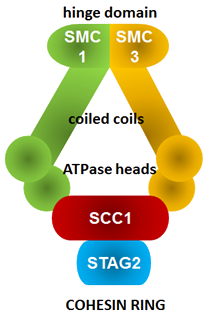
Figure 3. Cohesin complex showing ring structure. Diagram showing ring structure of cohesin complex (modified from Hagstrom and Meyer, 2003, and Remeseiro and Losada, 2013).
Mutations
Note
Recurrent STAG2 gene mutations were reported in glioblastoma, melanoma and Ewings sarcoma (Solomon et al., 2011). Recently, STAG2 gene was found frequently mutated in myeloid neoplasms, including acute myeloid leukemia (AML), myelodysplastic syndromes (MDS), chronic myelomonocytic leukemia (CMML), chronic myelogenous leukemia (CML) and classical myeloproliferative neoplasms (MPN) (Kon et al., 2013). Other studies observed lower frequencies of STAG2 mutation (Chung et al., 2012; Kim et al., 2012).
It remains unclear whether mutations affecting STAG2 operate to induce aneuploidy (Solomon et al., 2011; Kolodner et al., 2011), or simply to abrogate expression (Rocquain et al., 2010; Kon et al., 2013).
It remains unclear whether mutations affecting STAG2 operate to induce aneuploidy (Solomon et al., 2011; Kolodner et al., 2011), or simply to abrogate expression (Rocquain et al., 2010; Kon et al., 2013).
Implicated in
Entity name
Myeloid neoplasms
Note
Mutation and deletion of the STAG2 gene was identified in 5.8% (13/224) of MDS, 10.2% (9/88) of CMML, 6.4% (10/157) of AML, 3.1% (2/64) of CML, and 1.3% (1/77) of MPN: the STAG2 alterations were mostly exclusive with alterations involving other components of cohesin complex (SMC1, SMC3, and RAD21) and were significantly associated with mutations in TET2, ASXL1, and EZH2 (Kon et al., 2013).
Entity name
t(X;11)(q25;p13)
Disease
T-ALL: only two T-ALL cell lines described so far.
Cytogenetics
t(X;11)(q25;p13) in MOLT-14 cells and t(X;1;11)(q25;p13;p13) in PER-117 cells. The rearrangement is fully cryptic (see below).
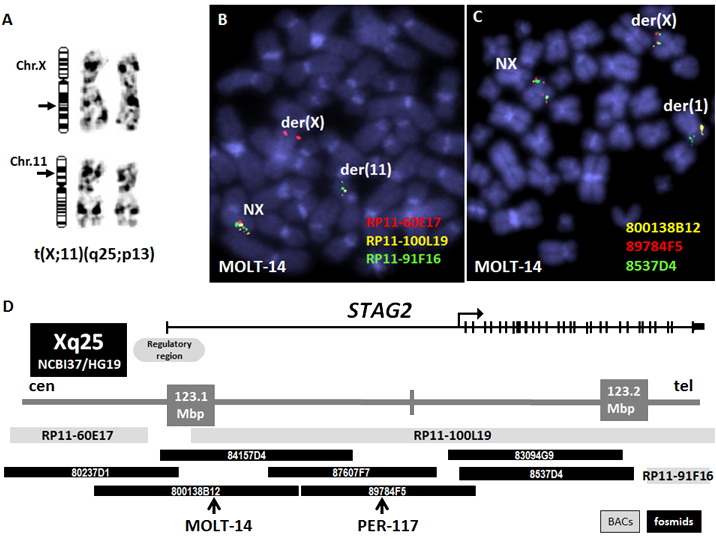
Figure 4. Cytogenetic analysis of t(X;11) effecting juxtaposition of STAG2 and LMO2. Image shows FISH analysis of t(X;11)(q25;p13) in a T-ALL cell line (DSM ACC 437). Note that this translocation is cryptic in G-banding (Fig. A). FISH using BAC and fosmid clones (Fig. B, C) places breakpoints in MOLT-14 and another T-ALL cell line PER-117, both inside the first (regulatory) intron of STAG2. In both cell lines expression of STAG2 is lost, attributable to divestment of this region which includes a deeply conserved cluster of regulatory motifs, including transcription factor binding sites and DNaseI sensitive sites. Upregulation of LMO2 in both cell lines occurred, concomitant with acquisition of the upstream STAG2 region. Fig. D: Genomic map of Xq25 showing breakpoints in regulatory region in relation to clones used for FISH. Figure redrawn and updated from Chen et al. (2011).
Oncogenesis
t(X;11)(q25;p13) results in simultaneous upregulation of LMO2 and silencing of STAG2 by juxtaposition of the far upstream region of LMO2 with the first regulatory intron of STAG2 (Chen et al., 2011).
Article Bibliography
| Pubmed ID | Last Year | Title | Authors |
|---|---|---|---|
| 19822671 | 2009 | Differential regulation of telomere and centromere cohesion by the Scc3 homologues SA1 and SA2, respectively, in human cells. | Canudas S et al |
| 21647158 | 2011 | Novel non-TCR chromosome translocations t(3;11)(q25;p13) and t(X;11)(q25;p13) activating LMO2 by juxtaposition with MBNL1 and STAG2. | Chen S et al |
| 22132872 | 2012 | Somatic mutation of STAG2, an aneuploidy-related gene, is rare in acute leukemias. | Chung NG et al |
| 12838344 | 2003 | Condensin and cohesin: more than chromosome compactor and glue. | Hagstrom KA et al |
| 22668012 | 2012 | Mutational and expressional analyses of STAG2 gene in solid cancers. | Kim MS et al |
| 21852477 | 2011 | Cancer. Aneuploidy drives a mutator phenotype in cancer. | Kolodner RD et al |
| 23955599 | 2013 | Recurrent mutations in multiple components of the cohesin complex in myeloid neoplasms. | Kon A et al |
| 23219370 | 2013 | Cohesin, a chromatin engagement ring. | Remeseiro S et al |
| 20687102 | 2010 | Alteration of cohesin genes in myeloid diseases. | Rocquain J et al |
| 21852505 | 2011 | Mutational inactivation of STAG2 causes aneuploidy in human cancer. | Solomon DA et al |
| 21444719 | 2011 | Specific sites in the C terminus of CTCF interact with the SA2 subunit of the cohesin complex and are required for cohesin-dependent insulation activity. | Xiao T et al |
Other Information
Locus ID:
NCBI: 10735
MIM: 300826
HGNC: 11355
Ensembl: ENSG00000101972
Variants:
dbSNP: 10735
ClinVar: 10735
TCGA: ENSG00000101972
COSMIC: STAG2
RNA/Proteins
Expression (GTEx)
Pathways
Protein levels (Protein atlas)
References
| Pubmed ID | Year | Title | Citations |
|---|---|---|---|
| 38279279 | 2024 | STAG2: Computational Analysis of Missense Variants Involved in Disease. | 0 |
| 38705393 | 2024 | STAG2 mutations regulate 3D genome organization, chromatin loops, and Polycomb signaling in glioblastoma multiforme. | 0 |
| 38742641 | 2024 | Single-molecule imaging reveals a direct role of CTCF's zinc fingers in SA interaction and cluster-dependent RNA recruitment. | 0 |
| 38279279 | 2024 | STAG2: Computational Analysis of Missense Variants Involved in Disease. | 0 |
| 38705393 | 2024 | STAG2 mutations regulate 3D genome organization, chromatin loops, and Polycomb signaling in glioblastoma multiforme. | 0 |
| 38742641 | 2024 | Single-molecule imaging reveals a direct role of CTCF's zinc fingers in SA interaction and cluster-dependent RNA recruitment. | 0 |
| 36477202 | 2023 | Clinical and prognostic impact of STAG2 mutations in myeloid neoplasms: the Mayo Clinic experience. | 3 |
| 36693840 | 2023 | Alterations of cohesin complex genes in acute myeloid leukemia: differential co-mutations, clinical presentation and impact on outcome. | 7 |
| 36898992 | 2023 | Different NIPBL requirements of cohesin-STAG1 and cohesin-STAG2. | 5 |
| 37985839 | 2023 | STAG2 Regulates Homologous Recombination Repair and Sensitivity to ATM Inhibition. | 1 |
| 36477202 | 2023 | Clinical and prognostic impact of STAG2 mutations in myeloid neoplasms: the Mayo Clinic experience. | 3 |
| 36693840 | 2023 | Alterations of cohesin complex genes in acute myeloid leukemia: differential co-mutations, clinical presentation and impact on outcome. | 7 |
| 36898992 | 2023 | Different NIPBL requirements of cohesin-STAG1 and cohesin-STAG2. | 5 |
| 37985839 | 2023 | STAG2 Regulates Homologous Recombination Repair and Sensitivity to ATM Inhibition. | 1 |
| 34529785 | 2022 | ASXL1 and STAG2 are common mutations in GATA2 deficiency patients with bone marrow disease and myelodysplastic syndrome. | 20 |
Citation
Suning Chen ; Stefan Nagel ; Hans G Drexler ; Roderick AF MacLeod
STAG2 (Stromal Antigen 2)
Atlas Genet Cytogenet Oncol Haematol. 2013-09-01
Online version: http://atlasgeneticsoncology.org/gene/52377
