AGER (advanced glycosylation end product-specific receptor)
2010-06-01 Geetha Srikrishna , Barry Hudson AffiliationSanford-Burnham Medical Research Institute, 10901 North Torrey Pines Road, La Jolla, California 92037, USA (GS); Columbia University Medical Center, 630 West 168th St. New York, NY 10032, USA (BH)
Identity
HGNC
LOCATION
6p21.32
IMAGE

LEGEND
Figure 1. Schematic of human chromosome 6.
LOCUSID
ALIAS
RAGE,SCARJ1,sRAGE
FUSION GENES
DNA/RNA

Table 1. Alternative splice variants human RAGE (From Hudson B et al. FASEB J. 2008;22:1572-80).
Description
The human AGER (RAGE) gene lies within the major histocompatibility complex class III region on chromosome 6, which contains genes involved in immune responses, such as TNFalpha, lymphotoxin, complement components and homeobox gene HOX12. It comprises 11 exons and 10 introns, and a 5 flanking region that regulates its transcription. The resulting transcribed mRNA of ~1.4 kb with a short 3UTR is alternatively spliced, and nearly twenty isoforms have been identified in different tissues such as lung, liver, kidney, smooth muscle, endothelial cells and brain. The different RAGE gene splice variants have been named RAGE, RAGE_v1 to RAGE_v19 according to the Human Gene Nomenclature Committee. RAGE is composed of a number of distinct protein domains; an extracellular region (aa 1-342) composed of a signal peptide (aa 1-22), followed by three immunoglobulin-like domains, a V-type domain, (aa 23-116) and two C type domains (C1: aa 124-221 and C2: 227-317), a single transmembrane domain (aa 343-363), and a short cytoplasmic domain (aa 364-404) necessary for signaling. The prevalent isoforms of RAGE are full length RAGE, RAGE_v1 or endogenous secretory (es RAGE) which lacks the cytosolic and transmembrane domains and therefore can be secreted into the extracellular space, and N-terminal truncated RAGE (RAGE_v2) which lacks N-terminal V domain and therefore cannot bind ligands. RAGE_v2 does not form mature protein. Through its ability to scavenge RAGE ligands, soluble RAGE isoforms (sRAGE) are believed to act a decoy receptor by regulating signaling mediated by activation of full length RAGE. Expression of isoforms is tissue specific, suggesting tight tissue-specific regulation of expression. sRAGE can also be formed by ectodomain cleavage by ADAM10/MMP9.
A number of NF-kappaB sites have been identified in the RAGE 5 regulatory region. In addition, transcription is also controlled by other pro-inflammatory transcription factors such as SP-1 and AP-2.
At least 30 polymorphisms are known, most of which are single nucleotide polymorphisms (SNP). A Gly to Ser change at an N-glycosylation sequon at position 82, and two 5 flanking polymorphisms at position -374 and -429 lead to altered function and expression of RAGE.
A number of NF-kappaB sites have been identified in the RAGE 5 regulatory region. In addition, transcription is also controlled by other pro-inflammatory transcription factors such as SP-1 and AP-2.
At least 30 polymorphisms are known, most of which are single nucleotide polymorphisms (SNP). A Gly to Ser change at an N-glycosylation sequon at position 82, and two 5 flanking polymorphisms at position -374 and -429 lead to altered function and expression of RAGE.
Proteins
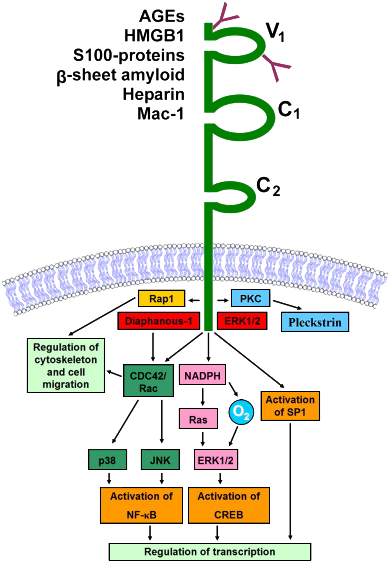
Figure 2. Schematic of RAGE protein and its domains. RAGE is a multi-ligand receptor consisting of three Ig-domains (V, C1 and C2), a transmembrane domain and a cytosolic tail required for RAGE-mediated intracellular signaling. The V and C1 domains in the extracellular region of RAGE form an integrated structural unit, while C2 is fully independent, attached to VC1 through a flexible linker. Many ligands bind to the V domain, while some also interact with the V-C1 or V-C2 domains. The V domain has N-glycosylation sites both of which are modified. Ligand binding activates multiple signaling pathways and regulates gene expression through the transcription factors NF-kappaB, CREB and SP1 (From Rauvala H, Rouhiainen A. Biochim Biophys Acta. 2010 Jan-Feb;1799(1-2):164-70. Reproduced with permission from publishers).
Expression
RAGE is highly expressed during embryonic development, especially in the brain, but levels decrease in adult tissues. RAGE is found at low levels in neurons, endothelial cells, mononuclear phagocytes, smooth muscle cells, and constitutively expressed at high levels in the lung.
Localisation
- Full length: membrane: single pass type I membrane protein.
- Isoforms: secreted.
- Isoforms: secreted.
Function
Normal physiological functions of RAGE include embryonal neuronal growth, myogenesis, mobilization of dendritic cells, activation and differentiation of T cells, stem cell migration and osteoclast maturation. HMGB1 interaction of RAGE results in stimulation of myogenesis. RAGE mediates trophic and toxic effects of S100B on embryonal neurons, and promotes neurite outgrowth and neuronal regeneration promoted by HMGB1. RAGE also plays an important role in the regulation of osteoclast maturation and function, and bone remodeling.
Ligand interaction promotes activation of intracellular signaling pathways including the MAPK pathway, RAC-1 and CDC42, NADPH oxidase, PI3 kinase and JAK/STAT pathway, and activation of NF-kappaB. RAGE expression is induced in inflammatory settings, since its transcription is controlled by several transcription factors as mentioned above. Thus a positive feed-forward loop evolves in ligand rich inflammatory settings, perpetuating the pathology. sRAGE is believed to regulate signaling mediated by activation of full length RAGE. Binding of RAGE to HMGB1 induces RAGE shedding by ADAM10 metalloprotease, thus possibly representing another pathway for negatively regulating RAGE mediated cellular activation.
Ligand interaction promotes activation of intracellular signaling pathways including the MAPK pathway, RAC-1 and CDC42, NADPH oxidase, PI3 kinase and JAK/STAT pathway, and activation of NF-kappaB. RAGE expression is induced in inflammatory settings, since its transcription is controlled by several transcription factors as mentioned above. Thus a positive feed-forward loop evolves in ligand rich inflammatory settings, perpetuating the pathology. sRAGE is believed to regulate signaling mediated by activation of full length RAGE. Binding of RAGE to HMGB1 induces RAGE shedding by ADAM10 metalloprotease, thus possibly representing another pathway for negatively regulating RAGE mediated cellular activation.
Implicated in
Entity name
Gastric cancer
Note
RAGE is constitutively expressed in human gastric carcinoma cell lines, and poorly differentiated human gastric carcinomas preferentially express RAGE. Strong RAGE expression is seen in cells at the invasive edge of tumors and correlates with invasion and lymph node metastasis. Studies in Chinese population show that Gly82Ser polymorphism on RAGE is associated with increased risk for gastric cancer.
Entity name
Colon cancer
Note
RAGE expression is increased in advanced colon tumors. Co-expression of RAGE and its ligands HMGB1 and S100P is strongly associated with invasion and metastasis of human colorectal cancer. RAGE appears to be at the interface of inflammation and colon cancer, since RAGE deficient mice are resistant to the onset of colitis associated colon cancer.
Entity name
Pancreatic cancer
Note
Expression of RAGE is strongest in pancreatic cancer cells with high metastatic ability, and RAGE may play an important role in the viability of pancreatic tumor cells against stress-induced apoptosis. RAGE ligand S100P is overexpressed in pancreatic cancer.
Entity name
Prostate cancer
Note
RAGE and ligands are highly expressed on prostate cancer cell lines, untreated prostate cancer tissue and hormone-refractory prostate cancer tissue, and RAGE promotes growth and invasion of prostate cancer cells in response to ligand activation.
Entity name
Oral squamous cell cancer
Note
RAGE expression closely associates with histologic differentiation, invasiveness, angiogenesis and recurrence of oral squamous cell carcinoma.
Entity name
Common bile duct cancer
Note
RAGE is expressed on human biliary cancer cells, and expression correlates with their invasive ability.
Entity name
Glioma
Note
HMGB1/RAGE signaling pathways promote the growth and migration of human glioblastoma cells. Inhibition of RAGE-HMGB1 interactions decreases growth and metastases of gliomas in mice.
Entity name
Skin cancer
Note
RAGE is expressed in human melanoma cells and promotes ligand-dependent growth and invasion. RAGE null mice are resistant to the onset of inflammation mediated skin tumors in mice.
Entity name
Lung cancer
Note
RAGE, as well as its ligands, is highly expressed in normal lung, but unlike other cancers, RAGE is markedly reduced in human lung carcinomas. Down-regulation correlates with advanced tumor stages, suggesting that RAGE may have tumor suppressive functions in lung cancer.
Entity name
Tumor microenvironment
Note
Many RAGE ligands are expressed and secreted not only by cancer cells but also by cells within the tumor microenvironment, including myeloid derived cells and vascular cells. These ligands interact with the receptor in both autocrine and paracrine manners, promoting tumor growth, invasion, angiogenesis and metastasis.
Entity name
Inflammation and immune responses
Note
RAGE and its ligands are highly enriched in immune and inflammatory foci and their interaction promotes upregulation of inflammatory cytokines, adhesion molecules and matrix metalloproteinases. They are therefore implicated in many inflammatory conditions including colitis and arthritis. RAGE is upregulated in synovial tissue macrophages and its ligands are abundant in inflamed synovial tissue. Activation leads to increased stimulation of chondrocytes and synoviocytes, promoting ongoing inflammation and autoimmunity in arthritis. RAGE mediates HMGB1 activation of dendritic cells in response to DNA containing immune complexes, contributing to autoimmune pathogenesis. Blockade of RAGE interactions suppresses myelin basic protein induced experimental autoimmune encephalomyelitis. Inhibition of RAGE-ligand interactions or RAGE deletion protects mice from septic shock induced by caecal ligation and puncture. RAGE null mice are also resistant to skin and colon inflammation and inflammation-based tumorigenesis.
Entity name
Diabetes
Note
RAGE, as a receptor for advanced glycation end products and other pro-inflammatory ligands, contributes to micro and macrovascular changes in diabetes. RAGE over-expression in transgenic mice is associated with increased vascular injury, diabetic nephropathy and neuropathy, while RAGE deletion confers partial protection from these diabetes-associated changes.
Entity name
Atherosclerosis and ischemia
Note
Increased RAGE expression is found in endothelial cells in non-diabetic patients with peripheral occlusive vascular disease. sRAGE reduces atherosclerotic lesions and inflammation in normoglycemic Apo E null mice, and reduced neointima expansion in wild type mice following femoral artery injury. Studies on ischemia-reperfusion injury of the heart in wild type and RAGE null mice show that infarct size and severity of tissue damage is dependent on HMGB1-RAGE interactions following necrotic cell death.
Entity name
Neuronal degeneration
Note
RAGE is expressed on neurons, microglia and endothelial cells in the brain, and binds the multimeric form of amyloid-beta peptide. Binding leads to activation of NADPH oxidase, generation of reactive oxygen species, activation of NF-kappaB and CREB, and upregulation of cytokines and chemokines, thus promoting neuroinflammation. The associated up-regulation and release of other RAGE ligands such as HMGB1 and S100 proteins further amplifies this cascade, leading to neuronal degeneration. sRAGE has been shown to be beneficial in animal models of Alzheimers disease. RAGE null mice are also partially protected from diabetes-induced loss of neuronal function.
Article Bibliography
| Pubmed ID | Last Year | Title | Authors |
|---|---|---|---|
| 17003481 | 2006 | Posttranslationally modified proteins as mediators of sustained intestinal inflammation. | Andrassy M et al |
| 19636529 | 2009 | Multiple levels of regulation determine the role of the receptor for AGE (RAGE) as common soil in inflammation, immune responses and diabetes mellitus and its complications. | Bierhaus A et al |
| 17508727 | 2007 | The extracellular region of the receptor for advanced glycation end products is composed of two independent structural units. | Dattilo BM et al |
| 15555779 | 2005 | Splice variants of the receptor for advanced glycosylation end products (RAGE) in human brain. | Ding Q et al |
| 18331229 | 2007 | RAGE: a single receptor for several ligands and different cellular responses: the case of certain S100 proteins. | Donato R et al |
| 18208974 | 2008 | RAGE signaling sustains inflammation and promotes tumor development. | Gebhardt C et al |
| 18089847 | 2008 | Identification, classification, and expression of RAGE gene splice variants. | Hudson BI et al |
| 19275767 | 2009 | RAGE: a novel biological and genetic marker for vascular disease. | Kalea AZ et al |
| 19121341 | 2009 | Binding of S100 proteins to RAGE: an update. | Leclerc E et al |
| 19273137 | 2009 | RAGE signaling in inflammation and arterial aging. | Lin L et al |
| 18331236 | 2007 | RAGE and RAGE ligands in cancer. | Logsdon CD et al |
| 19589888 | 2009 | Soluble receptor for advanced glycation end products: a new biomarker in diagnosis and prognosis of chronic inflammatory diseases. | Maillard-Lefebvre H et al |
| 17660747 | 2007 | Structural and functional insights into RAGE activation by multimeric S100B. | Ostendorp T et al |
| 19477910 | 2009 | RAGE: therapeutic target and biomarker of the inflammatory response--the evidence mounts. | Ramasamy R et al |
| 19914413 | 2010 | Physiological and pathophysiological outcomes of the interactions of HMGB1 with cell surface receptors. | Rauvala H et al |
| 19426472 | 2009 | The receptor RAGE: Bridging inflammation and cancer. | Riehl A et al |
| 20028726 | 2010 | Fueling inflammation at tumor microenvironment: the role of multiligand/RAGE axis. | Rojas A et al |
| 19579173 | 2009 | The role of RAGE in amyloid-beta peptide-mediated pathology in Alzheimer's disease. | Schmidt AM et al |
| 20192808 | 2010 | HMGB1 and RAGE in inflammation and cancer. | Sims GP et al |
| 19292913 | 2009 | RAGE (Receptor for Advanced Glycation Endproducts), RAGE ligands, and their role in cancer and inflammation. | Sparvero LJ et al |
| 20512925 | 2010 | Carboxylated N-glycans on RAGE promote S100A12 binding and signaling. | Srikrishna G et al |
| 18689872 | 2008 | RAGE, carboxylated glycans and S100A8/A9 play essential roles in colitis-associated carcinogenesis. | Turovskaya O et al |
| 17158877 | 2007 | Hexameric calgranulin C (S100A12) binds to the receptor for advanced glycated end products (RAGE) using symmetric hydrophobic target-binding patches. | Xie J et al |
| 18667420 | 2008 | Structural basis for pattern recognition by the receptor for advanced glycation end products (RAGE). | Xie J et al |
| 19387116 | 2009 | RAGE and Alzheimer's disease: a progression factor for amyloid-beta-induced cellular perturbation? | Yan SD et al |
| 19322705 | 2009 | Tempering the wrath of RAGE: an emerging therapeutic strategy against diabetic complications, neurodegeneration, and inflammation. | Yan SF et al |
| 20096667 | 2010 | Soluble RAGE: therapy and biomarker in unraveling the RAGE axis in chronic disease and aging. | Yan SF et al |
| 19672558 | 2009 | Ectodomain shedding of the receptor for advanced glycation end products: a novel therapeutic target for Alzheimer's disease. | Zhang L et al |
| 16606672 | 2006 | Regulation of osteoclast function and bone mass by RAGE. | Zhou Z et al |
Other Information
Locus ID:
NCBI: 177
MIM: 600214
HGNC: 320
Ensembl: ENSG00000204305
Variants:
dbSNP: 177
ClinVar: 177
TCGA: ENSG00000204305
COSMIC: AGER
RNA/Proteins
Expression (GTEx)
Pathways
Protein levels (Protein atlas)
References
| Pubmed ID | Year | Title | Citations |
|---|---|---|---|
| 36448548 | 2024 | The RAGE/DIAPH1 axis: mediator of obesity and proposed biomarker of human cardiometabolic disease. | 2 |
| 37902913 | 2024 | The Association of HMGB1 and RAGE Gene Polymorphisms with IgA Vasculitis. | 0 |
| 38142917 | 2024 | RAGE in circulating immune cells is fundamental for hippocampal inflammation and cognitive decline in a mouse model of latent chronic inflammation. | 1 |
| 38250151 | 2024 | Nε-(1-Carboxymethyl)-L-lysine/RAGE Signaling Drives Metastasis and Cancer Stemness through ERK/NFκB axis in Osteosarcoma. | 0 |
| 38350547 | 2024 | S100A6 drives lymphatic metastasis of liver cancer via activation of the RAGE/NF-kB/VEGF-D pathway. | 0 |
| 38460892 | 2024 | The critical role of RAGE in severe influenza infection: A target for control of inflammatory response in the disease. | 0 |
| 38626647 | 2024 | Targeting TNF-α-induced expression of TTR and RAGE in rheumatoid arthritis: Apigenin's mediated therapeutic approach. | 0 |
| 38673968 | 2024 | Insight into the Interplay of Gd-IgA1, HMGB1, RAGE and PCDH1 in IgA Vasculitis (IgAV). | 0 |
| 38904338 | 2024 | Association Between the G82S Polymorphism of the Receptor Gene for Advanced Glycation End-products and Soluble Serum Levels RAGE with Diabetic Nephropathy in the White (Asian) Race. | 0 |
| 36448548 | 2024 | The RAGE/DIAPH1 axis: mediator of obesity and proposed biomarker of human cardiometabolic disease. | 2 |
| 37902913 | 2024 | The Association of HMGB1 and RAGE Gene Polymorphisms with IgA Vasculitis. | 0 |
| 38142917 | 2024 | RAGE in circulating immune cells is fundamental for hippocampal inflammation and cognitive decline in a mouse model of latent chronic inflammation. | 1 |
| 38250151 | 2024 | Nε-(1-Carboxymethyl)-L-lysine/RAGE Signaling Drives Metastasis and Cancer Stemness through ERK/NFκB axis in Osteosarcoma. | 0 |
| 38350547 | 2024 | S100A6 drives lymphatic metastasis of liver cancer via activation of the RAGE/NF-kB/VEGF-D pathway. | 0 |
| 38460892 | 2024 | The critical role of RAGE in severe influenza infection: A target for control of inflammatory response in the disease. | 0 |
Citation
Geetha Srikrishna ; Barry Hudson
AGER (advanced glycosylation end product-specific receptor)
Atlas Genet Cytogenet Oncol Haematol. 2010-06-01
Online version: http://atlasgeneticsoncology.org/gene/594/ager-%28advanced-glycosylation-end-product-specific-receptor%29
