EEF1DP3 (Eukaryotic translation elongation factor 1 delta pseudogene 3)
2019-06-01 Luigi Cristiano, MSc AffiliationAesthetic and medical biotechnologies research unit, Prestige, Terranuova Bracciolini, Italy. [email protected] - [email protected]
Identity
HGNC
LOCATION
13q13.1
LOCUSID
ALIAS
EEF1DP3-201,MGC149669,MGC149670,Putative Elongation Factor 1-Delta-Like Protein,Putative EF-1-Delta-Like Pseudogene 3 Protein
FUSION GENES
Abstract
Eukaryotic translation elongation factor 1 delta pseudogene 3, alias EEF1DP3, is a pseudogene. This review collects the data about its DNA\/RNA and on the diseases where it is involved.
DNA/RNA
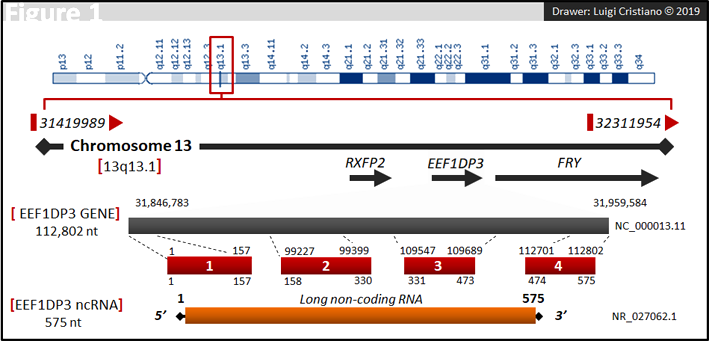
Figure. 1. EEF1DP3 gene. The figure shows the locus on chromosome 13 of the EEF1DP3 gene (reworked from https://www.ncbi.nlm.nih.gov/gene; http://grch37.ensembl.org; www.genecards.org)
Description
EEF1DP3, alias eukaryotic translation elongation factor 1 delta pseudogene 3, is a pseudogene and it is located on chromosome 13 that is known to bring some putative oncogenes involved in cancer including the breast cancer type 2 (BRCA2) and the retinoblastoma (RB1) genes (Dunham et al., 2004). The related functional gene is the "eukaryotic translation elongation factor 1 delta" (EEF1D) that is located on chromosome 8 (8q24.3).
EEF1DP3 starts at 31,846,783 nt and ends at 31,959,584 from pter. It has a length of 112,802 bp and the current reference sequence is NC_000013.11 (Dunham et al., 2004). It is proximal to the relaxin family peptide receptor 2 (RXFP2) gene and FRY microtubule binding protein (FRY) gene. Curiously, closer to the genomic sequence of EEF1DP3 there is a promoter element that is located at -0.1 kb. This promoter element exercises its influence also on genes closer to EEF1DP3, i.e. FRY and RXFP2.
EEF1DP3 is classified as a transcribed unprocessed pseudogene. In the genomic sequence there are 4 non-coding exons.
EEF1DP3 starts at 31,846,783 nt and ends at 31,959,584 from pter. It has a length of 112,802 bp and the current reference sequence is NC_000013.11 (Dunham et al., 2004). It is proximal to the relaxin family peptide receptor 2 (RXFP2) gene and FRY microtubule binding protein (FRY) gene. Curiously, closer to the genomic sequence of EEF1DP3 there is a promoter element that is located at -0.1 kb. This promoter element exercises its influence also on genes closer to EEF1DP3, i.e. FRY and RXFP2.
EEF1DP3 is classified as a transcribed unprocessed pseudogene. In the genomic sequence there are 4 non-coding exons.
Transcription
EEF1DP3 pseudogene is transcribed and produces a long non-coding RNA (lncRNA) of 575 nt (Kimura et al., 2006) with a reference sequence NR_027062.1. It is still unknown if it is subjected to post-transcriptional modifications, such as 5-capping, 3-polyadenylation or splicing. However, other alternative transcripts are reported: EEF1DP3-001, a processed transcript of 1309 nt, EEF1DP3-002, a retained intron of 3283 nt and EEF1DP3-003, a transcribed unprocessed pseudogene of 782 nt (http://phase3browser.1000genomes.org). It seems that EEF1DP3 is overexpressed in heart, in particular in the left ventricle (https://www.genecards.org) and also expressed in normal trachea, liver, testis, kidney, bladder and brain (http://source-search.princeton.edu/). On the contrary, a low expression is detected in adrenal gland, colon and pituitary gland (https://amp.pharm.mssm.edu/Harmonizome/gene/EEF1DP3). It is known that lncRNAs, as pseudogenes as well as the others ncRNAs, may modulate the gene expression both at the transcriptional level, interacting with the promotor of parental gene o other genes, and post-transcriptional level, acting as microRNA decoys and so they may play key roles in cellular biological processes (Chan and Tay, 2018; Hu et al., 2018; Kovalenko and Patrushev, 2018). Nowadays, is still unknown the exact role of EEF1DP3 in healthy tissues.
Proteins
Note
EEF1DP3 seems to be able to produce a lncRNA but there are no proofs about the existence of a codified protein. However, is reported in some databases (UniProtKB; InterPro) a protein product also for this pseudogene, called "putative elongation factor 1-delta-like protein", alias EF1DL (accession number: Q658K8).
Until recently, it was believed that pseudogenes were not able to encode a protein, but recent transcriptomic and proteomic analyses seem to demonstrate not only the presence of pseudogene-derived transcripts but also of pseudogene-derived proteins (Chan and Tay, 2018; Kim et al., 2014; Djebali et al., 2012). Although it is still unclear if the protein EF1DL can be displayed or not, its presence should be not excluded. This protein should be 133 amino acids long and should have a molecular weight of 14,137 kDa and a theoretical pI of 5.94. Curiously, EF1DL shows 90% of identity with an uncharacterized protein (H2NJJ9_PONAB) of similar mass and length present in Sumatran orangutan (Pongo pygmaeus abelii) and linked to its chromosome 13.
Bioinformatic analysis of the comparison between EF1DL protein and eEF1D isoforms (pblast) revealed that there is an 85% of identity between EF1DL (1-90 aa) and a fragment of the long isoform of eEF1D (367-458 aa) and that is included a little portion of the second leucine-zipper domain of eEF1D. A similar result is obtained between EF1DL (1-90 aa) and the short form of eEF1D (1-92 aa) with the inclusion of a little portion of the unique leucine-zipper domain of the short form of eEF1D.
EF1DL could take a significant aspect in relation to cellular alterations observed in cancer that frequently juxtapose genomic elements next to strong promotor elements to produce unusual proteins that contribute to its malignant behavior and its aggressiveness. In fact, it is reported the involvement of EEF1DP3 in some genomic rearrangements and although there are no sufficient data yet to clarify these phenomena it cannot be excluded that EEF1DP3 can bring to a protein product after significative genomic alterations.
Until recently, it was believed that pseudogenes were not able to encode a protein, but recent transcriptomic and proteomic analyses seem to demonstrate not only the presence of pseudogene-derived transcripts but also of pseudogene-derived proteins (Chan and Tay, 2018; Kim et al., 2014; Djebali et al., 2012). Although it is still unclear if the protein EF1DL can be displayed or not, its presence should be not excluded. This protein should be 133 amino acids long and should have a molecular weight of 14,137 kDa and a theoretical pI of 5.94. Curiously, EF1DL shows 90% of identity with an uncharacterized protein (H2NJJ9_PONAB) of similar mass and length present in Sumatran orangutan (Pongo pygmaeus abelii) and linked to its chromosome 13.
Bioinformatic analysis of the comparison between EF1DL protein and eEF1D isoforms (pblast) revealed that there is an 85% of identity between EF1DL (1-90 aa) and a fragment of the long isoform of eEF1D (367-458 aa) and that is included a little portion of the second leucine-zipper domain of eEF1D. A similar result is obtained between EF1DL (1-90 aa) and the short form of eEF1D (1-92 aa) with the inclusion of a little portion of the unique leucine-zipper domain of the short form of eEF1D.
EF1DL could take a significant aspect in relation to cellular alterations observed in cancer that frequently juxtapose genomic elements next to strong promotor elements to produce unusual proteins that contribute to its malignant behavior and its aggressiveness. In fact, it is reported the involvement of EEF1DP3 in some genomic rearrangements and although there are no sufficient data yet to clarify these phenomena it cannot be excluded that EEF1DP3 can bring to a protein product after significative genomic alterations.
Mutations
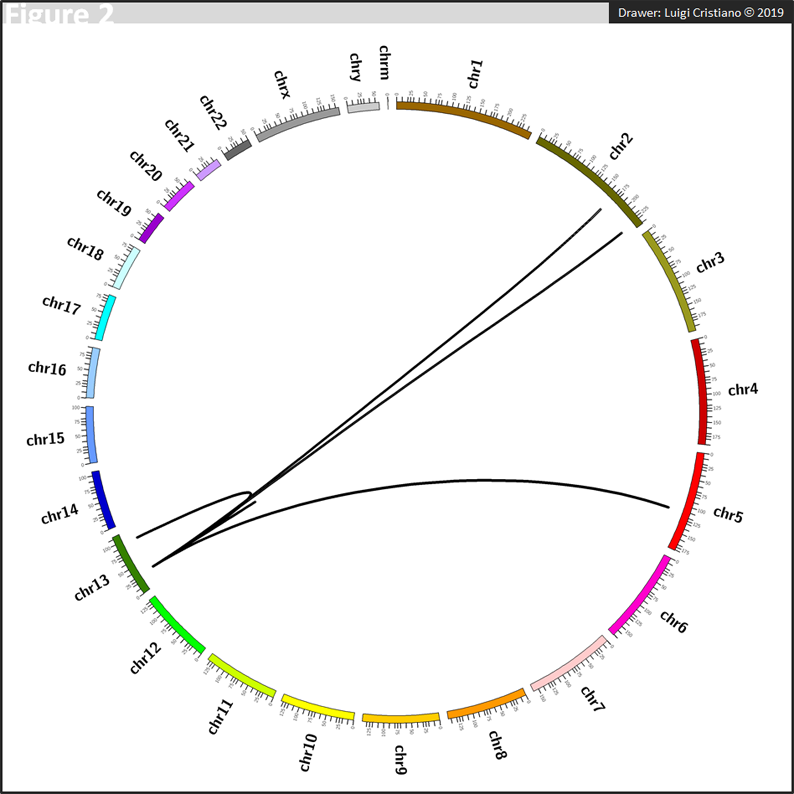
Figure.2 Circos plot for fusion events involving EEF1DP3. The picture summarizes all fusion events concerning EEF1DP3 and its fusion partners (from https://fusionhub.persistent.co.in/search_genewise.html).
Implicated in
Top note
It is known that the aberrant expression of lncRNAs, as pseudogenes as well as the others ncRNAs, could have an important role in cancer development and progression (Chan and Tay, 2018; An et al., 2017). EEF1DP3 was found highly expressed in some healthy tissue types and also in many cancer types and this suggests that it could act as a positive regulator of gene expression, with high probability for its parental gene EEF1D and maybe also for other genes. In fact, it is known that the pseudogenes may act as positive regulators or negative regulators of gene expression (Hu et al., 2008). However, its role is still to be determined.
| Name | 5 end | 3 end | Loc1 | Loc2 | Description | Type | Disease | Organ | Code | Ref. Entity name EEF1DP3/FRY read-through fusion Note EEF1DP3/FRY is a recurrent read-through fusion transcript that is found in some types of nonneoplastic disorders and in some types of tumors such as malignant melanoma, Burkitt lymphoma, lung cancer and breast cancer (Babiceanu et al., 2016; Kim et al., 2015; Kim et al., 2011; https://fusionhub.persistent.co.in/home.html; https://ccsm.uth.edu/FusionGDB/index.html). The off-frame fusion of these two adjacent genes brings to the formation of a novel transcript formed by the 1 and 2 exons of EEF1DP3 joined with the exons from 2 to 61 of FRY. This results in an insertion of a stop codon in the nucleotidic sequence with an early truncation with loss-of-function of the FRY gene (Kim et al., 2015). Entity name Adrenal carcinoma Note EEF1DP3 is reported to be highly expressed inadrenocortical carcinoma (ACC) and pheochromocytoma and other paraganglioma (PCPG) samples (Cancer Genome Atlas Research Network et al., 2013; https://amp.pharm.mssm.edu/Harmonizome/gene/EEF1DP3). Entity name Ankylosing Spondylitis Note EEF1DP3 seems to be involved in some variants associated with ankylosing spondylitis (AS), a chronic and complex autoimmune disorder. In particular, it was found a loss in EEF1DP3 due to its deletion and this has been associated with an increased risk and predisposition for AS (Shahba et al., 2018; Yim et al., 2015; Jung et al., 2014). Entity name Brain and central nervous system (CNS) cancers Note EEF1DP3 is reported to be highly expressed in brain lower grade glioma (LGG) (Cancer Genome Atlas Research Network et al., 2013; https://amp.pharm.mssm.edu/Harmonizome/gene/EEF1DP3). Entity name Breast Cancer Note Some fusion genes caused by intrachromosomal translocations were reported for EEFDP3 in breast cancer (Alaei-Mahabadi et al., 2016; Babiceanu et al., 2016; Kim et al., 2015; https://fusionhub.persistent.co.in/home.html). Hybrid gene All fusion genes reported until now between EEF1DP3 and other partner genes are due to intrachromosomal translocations except the more known fusion gene EEF1DP3/FRY that is the result of a fusion between EEF1DP3 at 5-end and "FRY microtubule binding protein" ( FRY) gene at 3-end (Kim et al., 2015) and it is due to a readthrough transcription. This fusion gene was found also in nonneoplastic epithelial disorders or in healthy tissues, so its presence in the cell seems to be not only linked with neoplastic transformation. Its biological significance needs to be clarified as well as its role in the cells and in cancer cells. Other fusion genes are reported such as EEF1DP3/CLDN10 that is originated by fusion of EEF1DP3 at 5-end with "claudin 10" ( CLDN10) gene at 3-end (Alaei-Mahabadi et al., 2016), EEF1DP3/N4BP2L1 that is originated by fusion of EEF1DP3 at 5-end with "NEDD4 binding protein 2 like 1" ( N4BP2L1) gene at 3-end and finally EEF1DP3/TEX26 that is originated by fusion of EEF1DP3 at 5-end with "testis expressed 26" ( TEX26) gene at 3-end. The significance of these genomic alterations is still poorly understood. Entity name Colorectal cancer Note EEF1DP3 is reported to be highly expressed in rectum adenocarcinoma (READ) samples (Cancer Genome Atlas Research Network et al., 2013; https://amp.pharm.mssm.edu/Harmonizome/gene/EEF1DP3). Entity name Gynaecological cancers Note EEF1DP3 is reported to be highly expressed in cervical squamous cell carcinoma and endocervical adenocarcinoma (CESC) samples and also in uterine carcinosarcoma (UCS) (Cancer Genome Atlas Research Network et al., 2013; https://amp.pharm.mssm.edu/Harmonizome/gene/EEF1DP3). Entity name Head and neck squamous cell carcinoma (HNSC) Note EEF1DP3 is reported to be highly expressed in head and neck squamous cell carcinoma (HNSC) samples (Cancer Genome Atlas Research Network et al., 2013; https://amp.pharm.mssm.edu/Harmonizome/gene/EEF1DP3). Entity name Liver cancer Note EEF1DP3 is reported to be highly expressed in liver hepatocellular carcinoma samples (LIHC) (Cancer Genome Atlas Research Network et al., 2013; https://amp.pharm.mssm.edu/Harmonizome/gene/EEF1DP3). Entity name Lung cancer Note EEF1DP3 is reported to be highly expressed in lung adenocarcinoma (LUAD), lung squamous cell carcinoma (LUSC) and mesothelioma (MESO) samples (Cancer Genome Atlas Research Network et al., 2013; https://amp.pharm.mssm.edu/Harmonizome/gene/EEF1DP3). Entity name Lymphoma, leukaemia and other blood cancers Note EEF1DP3 is reported to be highly expressed in acute myeloid leukemia (AML) and lymphoid neoplasm diffuse large B-cell lymphoma (DLBC) (Cancer Genome Atlas Research Network et al., 2013; https://amp.pharm.mssm.edu/Harmonizome/gene/EEF1DP3) and are reported the fusion gene EEF1DP3 /FRY and the translocation t(2;13)(q31;q13) EEF1DP3/TLK1 in Burkitt lymphoma (https://fusionhub.persistent.co.in/home.html). Hybrid gene The t(2;13)(q31;q13) EEF1DP3/TLK1 and EEF1DP3/FRY fusion gene were found in Burkitt lymphoma. The first rearrangement is originated by the fusion of EEF1D gene at 5-end with "tousled like kinase 1" (TLK1) gene at 3 end while the EEF1DP3/FRY fusion gene is originated by the fusion of EEF1D gene at 5-end with "FRY microtubule binding protein" (FRY) gene at 3 end and it is probably due to readthrough transcription. In fact, EEF1D and FRY are two neighboring genes on the same chromosome. There are no data about the chimeric transcripts or proteins and the role of these genomic alterations are still unknown. Entity name Melanoma Note EEF1DP3 is reported to be highly expressed in skin cutaneous melanoma (SKCM) samples (Cancer Genome Atlas Research Network et al., 2013; https://amp.pharm.mssm.edu/Harmonizome/gene/EEF1DP3). Entity name Neurodegenerative disorders Note EEF1DP3 seems to be related to various neurodegenerative disorders as synucleinopathy and Parkinsons disease (https://amp.pharm.mssm.edu/Harmonizome/gene/EEF1DP3). Entity name Pancreatic cancer Note EEF1DP3 is reported to be highly expressed in pancreatic adenocarcinoma (PAAD) samples (Cancer Genome Atlas Research Network et al., 2013; https://amp.pharm.mssm.edu/Harmonizome/gene/EEF1DP3). Entity name Prostate Cancer Note Erho and colleagues found that EEF1DP3 is differentially expressed between normal prostate tissues and primary and metastatic prostate cancer samples (Erho et al., 2012) and other authors confirm this overexpression in prostate adenocarcinoma (PRAD) (Cancer Genome Atlas Research Network et al., 2013; https://amp.pharm.mssm.edu/Harmonizome/gene/EEF1DP3). Entity name Sarcoma Note EEF1DP3 is revealed to be highly expressed in sarcoma (SARC) samples (Cancer Genome Atlas Research Network et al., 2013; https://amp.pharm.mssm.edu/Harmonizome/gene/EEF1DP3) and was reported the translocation t(13;19)(q13;q13) EEF1DP3/BLVRB (https://fusionhub.persistent.co.in/home.html). Hybrid gene The t(13;19)(q13;q13) EEF1DP3/BLVRB was found in sarcoma. This rearrangement is originated by the fusion of EEF1D gene at 5-end with biliverdin reductase B (BLVRB) gene at 3 end. There are no data about the respective chimeric transcript or protein and the role of this genomic alteration is unknown. Entity name Urinary tract cancers Note EEF1DP3 is reported to be highly expressed in bladder urothelial carcinoma (BLCA) samples and also in chromophobe renal cell carcinoma (KICH), clear cell renal cell carcinoma (KIRC) and papillary renal cell carcinoma (KIRP) (Cancer Genome Atlas Research Network et al., 2013; https://amp.pharm.mssm.edu/Harmonizome/gene/EEF1DP3). Article Bibliography
Other InformationLocus ID:Variants:
dbSNP: 196549 Expression (GTEx)CitationLuigi Cristiano, MSc EEF1DP3 (Eukaryotic translation elongation factor 1 delta pseudogene 3) Atlas Genet Cytogenet Oncol Haematol. 2019-06-01 Online version: http://atlasgeneticsoncology.org/gene/62732/eef1dp3-(eukaryotic-translation-elongation-factor-1-delta-pseudogene-3) |
