AR (Androgen Receptor (dihydrotestosterone receptor; testicular feminization; spinal and bulbar muscular atrophy; Kennedy disease))
2008-01-01 Jason DAntonio AffiliationThe Johns Hopkins School of Medicine, Laboratory of John T. Isaacs, PhD, Cancer Research, Bldg 1, 1650 Orleans St., Rm 1M40, Baltimore, MD 21231, USA
Identity
HGNC
LOCATION
Xq12
IMAGE

LEGEND
Probe(s) - Courtesy Mariano Rocchi, Resources for Molecular Cytogenetics
LOCUSID
ALIAS
AIS,DHTR,HUMARA,KD,NR3C4,RP11-383C12.1,SBMA,SMAX1,TFM
FUSION GENES
DNA/RNA
Description
180 kb gene consisting of 8 exons
Transcription
4,314 bp mRNA, 2,762 bp open reading frame
Proteins
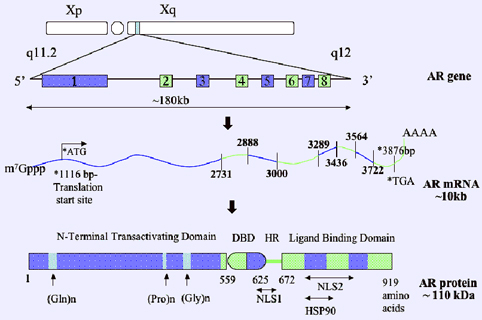
Layout of the AR gene, mRNA and protein with indicated regulatory regions. Borrowed from Litvinov, et al. 2003, with permission.
Description
919 amino acids (NCBI: P10275), MW = 99,187.57 daltons; -1.5 charge with an isoelectric pt = 6.3797; 10.6 kb AR transcript (NCBI: NM_000044 - partial sequence): 1.1kb 5 Untranslated Region (UTR) followed by the 2.7 kb Open Reading Frame (ORF) followed by the 6.8kb 3 UTR.
AR: AR isoform 1 [Homo sapiens] NP_000035 920 aa
AR45: AR isoform 2 [Homo sapiens] NP_001011645 388 aa
The AR coding sequence contains variable poly-aminoacid repeats in the amino-terminal domain:
1. poly-glutamine (CAG: Glu-Q): avg 22 repeats with normal polymorphic range from 8 to 35, shorter (<18) associated with increased AR transactivation and prostate cancer risk. CAG repeats in spinal and bulbar muscular atrophy patients range from 38 to 62.
2. poly-proline (Pro-P): avg 8.
3. poly-glycine (GGC: Gly-G): avg 23, with normal range from 10 to 31.
AR: AR isoform 1 [Homo sapiens] NP_000035 920 aa
AR45: AR isoform 2 [Homo sapiens] NP_001011645 388 aa
The AR coding sequence contains variable poly-aminoacid repeats in the amino-terminal domain:
1. poly-glutamine (CAG: Glu-Q): avg 22 repeats with normal polymorphic range from 8 to 35, shorter (<18) associated with increased AR transactivation and prostate cancer risk. CAG repeats in spinal and bulbar muscular atrophy patients range from 38 to 62.
2. poly-proline (Pro-P): avg 8.
3. poly-glycine (GGC: Gly-G): avg 23, with normal range from 10 to 31.
Expression
Embryonic tissue, prostate, testis, liver, eye, kidney, adrenal glands, thyroid, heart, breast/mammary gland, uterus, skeletal muscle, specific regions of the brain (CNS) including spinal and bulbar motor neurons.
Localisation
Cytoplasm and nucleus
Function
AR is a member of the steroid hormone receptor family of ligand-dependent nuclear receptors. AR functions include gene expression via actions as a DNA-binding transcription factor, cell cycle/proliferation regulation, cell-to-cell signaling, and intracellular signal transduction, leading to the regulation of biological processes such as development, cellular proliferation, differentiation and apoptosis. Some of the main target genes transcriptionally regulated by AR include AR, prostate specific antigen (PSA/hKlk3), hKlk2, hKlk4, prostate specific membrane antigen (PSMA), prostate stem cell antigen (PSCA), cell cycle regulator p27, vascular endothelial growth factor (VEGF), TMPRSS2, and Nkx3.1.
Prostate organogenesis: The presence of AR is required in the mesodermal-derived embryonic urogenital sinus mesenchyme to trigger branching morphogenesis of endodermal-derived epithelial cells in the presence of androgens; subsequent AR expression in the developing epithelium drives secretory protein production. AR also plays an important role in the development of primary and secondary sexual characteristics, spermatogenesis, hormonal regulation of sexual drive, muscle growth, and male patterning of the brain.
Recent identification of the gene fusion between the 5 end of the AR-regulated serine protease TMPRSS2 (21q22.2) and the 3 end of ETS family of transcription factors ETV1 (7p21.3) and ERG (21q22.3) in a large frequency of prostate cancer cases raises new questions regarding AR function in prostate cancer. The gene rearrangement is thought to result in AR-induced expression of the suspected ETV1 or ERG oncogenes.
Prostate organogenesis: The presence of AR is required in the mesodermal-derived embryonic urogenital sinus mesenchyme to trigger branching morphogenesis of endodermal-derived epithelial cells in the presence of androgens; subsequent AR expression in the developing epithelium drives secretory protein production. AR also plays an important role in the development of primary and secondary sexual characteristics, spermatogenesis, hormonal regulation of sexual drive, muscle growth, and male patterning of the brain.
Recent identification of the gene fusion between the 5 end of the AR-regulated serine protease TMPRSS2 (21q22.2) and the 3 end of ETS family of transcription factors ETV1 (7p21.3) and ERG (21q22.3) in a large frequency of prostate cancer cases raises new questions regarding AR function in prostate cancer. The gene rearrangement is thought to result in AR-induced expression of the suspected ETV1 or ERG oncogenes.
Homology
zebrafish (Danio rerio), dog (Canis familiaris), African clawed frog (Xenopus laevis), chimpanzee (Pan troglodytes), mouse (Mus musculus), chicken (Gallus gallus), rat (Rattus norvegicus), rainbow trout (Oncorhynchus mykiss).
No similarity-to-human data found for AR for:
pig (Sus scrofa), cow (Bos taurus), fruit fly (Drosophila melanogaster), worm (Caenorhabditis elegans), bakers yeast (Saccharomyces cerevisiae), tropical clawed frog (Silurana tropicalis), African malaria mosquito (Anopheles gambiae), thale cress (Arabidopsis thaliana), green algae (Chlamydomonas reinhardtii), soybean (Glycine max), barley (Hordeum vulgare), tomato (Lycopersicon esculentum), rice blast fungus (Magnaporthe grisea), rice (Oryza sativa), sugarcane (Saccharum officinarum), loblolly pine (Pinus taeda), corn (Zea mays), wheat (Triticum aestivum), Alicante grape (Vitis vinifera), bread mold (Neurospora crassa), fission yeast (Schizosaccharomyces pombe), sea squirt (Ciona intestinalis), amoeba (Dictyostelium discoideum), A. gosspyii yeast (Ashbya gossypii), K. lactis yeast (Kluyveromyces lactis), medicago trunc (Medicago truncatula), malaria parasite (Plasmodium falciparum), schistosome parasite (Schistosoma mansoni), sorghum (Sorghum bicolor), toxoplasmosis (Toxoplasma gondii).
No similarity-to-human data found for AR for:
pig (Sus scrofa), cow (Bos taurus), fruit fly (Drosophila melanogaster), worm (Caenorhabditis elegans), bakers yeast (Saccharomyces cerevisiae), tropical clawed frog (Silurana tropicalis), African malaria mosquito (Anopheles gambiae), thale cress (Arabidopsis thaliana), green algae (Chlamydomonas reinhardtii), soybean (Glycine max), barley (Hordeum vulgare), tomato (Lycopersicon esculentum), rice blast fungus (Magnaporthe grisea), rice (Oryza sativa), sugarcane (Saccharum officinarum), loblolly pine (Pinus taeda), corn (Zea mays), wheat (Triticum aestivum), Alicante grape (Vitis vinifera), bread mold (Neurospora crassa), fission yeast (Schizosaccharomyces pombe), sea squirt (Ciona intestinalis), amoeba (Dictyostelium discoideum), A. gosspyii yeast (Ashbya gossypii), K. lactis yeast (Kluyveromyces lactis), medicago trunc (Medicago truncatula), malaria parasite (Plasmodium falciparum), schistosome parasite (Schistosoma mansoni), sorghum (Sorghum bicolor), toxoplasmosis (Toxoplasma gondii).
Mutations
Germinal
Germ-line loss of function mutations in AR result in non-lethal loss of AR expression, a hallmark of androgen insensitivity syndrome. Individuals with AIS have a Y chromosome and functional testes, which produce high levels of testosterone; however, they lack male sex accessory organs, such as seminal vesicles and prostate, and are thus phenotypically female in both behavior and appearance.
Somatic
Various somatic AR mutations have been identified, some of which are associated with prostate cancer, including the T877A mutation in the prostate cancer LNCaP cell line, which permits AR activation by progestins, estrogen, adrenal androgens, and anti-androgen hydroxyflutamide; however, the overall frequency of AR mutations in early, primary prostate cancer is <10%.
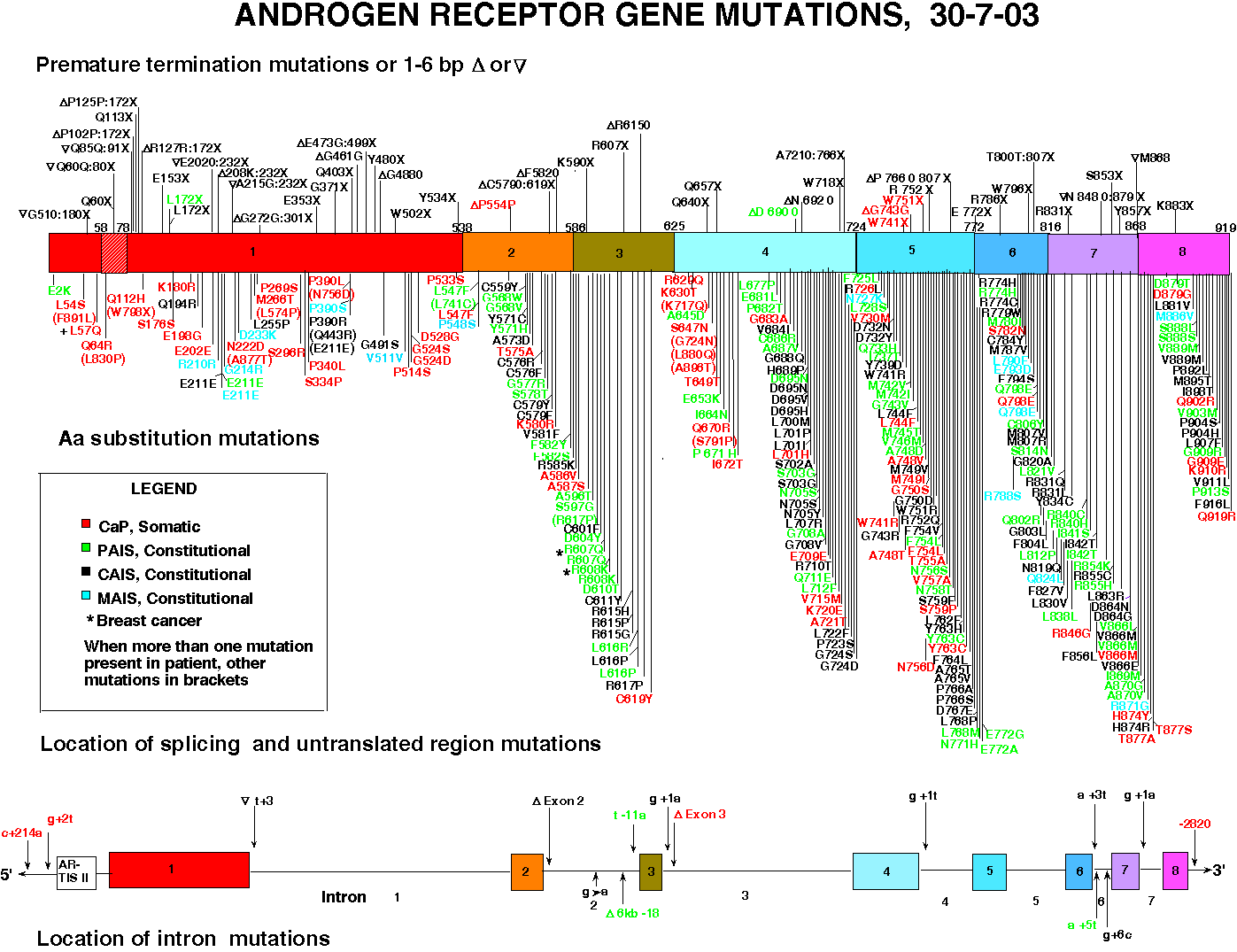
Polymorphic CAG repeats in exon 1 encoding a polyglutamine tract of variable length give rise to AR peptides of varying lengths: Shorter length (fewer CAG repeats) is associated with increased prostate cancer risk; increased length (greater CAG repeats) is associated with spinal and bulbar muscular atrophy and androgen insensitivity syndrome. For a more complete list of identified mutations, please visit http://androgendb.mcgill.ca/map.gif.
Polymorphic CAG repeats in exon 1 encoding a polyglutamine tract of variable length give rise to AR peptides of varying lengths: Shorter length (fewer CAG repeats) is associated with increased prostate cancer risk; increased length (greater CAG repeats) is associated with spinal and bulbar muscular atrophy and androgen insensitivity syndrome. For a more complete list of identified mutations, please visit http://androgendb.mcgill.ca/map.gif.
Implicated in
Disease
Androgenic alopecia, spinal and bulbar muscular dystrophy, androgen insensitivity syndrome due to AR mutations, benign prostatic hyperplasia, prostate adenocarcinoma
Entity name
Prostate adenocarcinoma (PCa)
Disease
PCa is the most commonly diagnosed cancer in American men and the second leading cause of cancer-related deaths. PCa predominantly occurs in the peripheral zone of the human prostate, with roughly 5 to 10% of cases found in the central zone. Disease development involves the temporal and spatial loss of the basal epithelial compartment accompanied by increased proliferation and de-differentiation of the luminal (secretory) epithelial cells. PCa is a slow developing disease that is typically found in men greater than 40 years of age, with an increasing rate of occurrence with increasing age.
Prognosis
Serum PSA testing combined with digital-rectal exams (DRE) are used to screen for the presence of disease. Given a positive DRE exam, additional tests including needle core biopsies are taken to histologically assess disease stage and grade. Localized, prostate-restricted disease is theoretically curable with complete removal of the prostate (radical prostatectomy). Patients with extra-prostatic disease are treated with chemotherapy, hormone (androgen ablation) therapy, radiation, and/or antiandrogens; however, no curative treatments are available for non-organ confined, metastatic disease.
Cytogenetics
Various forms of aneuploidy.
Fusion protein
Unknown.
Oncogenesis
Alterations in AR function are associated with the development of PCa due to a transition from paracrine AR signaling, traditionally involving the supporting mesenchyme instructing the terminal differentiation of the luminal epithelial cells, to autocrine AR signaling in luminal epithelial cells that promotes cell proliferation. Roughly 10% of PCa patients harbor AR mutations, suggesting that the prevalence of AR mutations, clinically, is low. Mutations that increase the signaling promiscuity of AR, AR gene amplification, as well as alterations in proteins that regulate AR levels/function contribute to de-regulated AR signaling.
Entity name
Benign Prostatic Hyperplasia (BPH)
Disease
Benign growth of the prostate, primarily occurring in the transitional zone of the prostate, results in urinary obstruction and lower urinary tract symptoms. AR function is associated with increased rates of epithelial cell proliferation, leading to increased size of the prostate gland. Originally thought of as benign prostatic hypertrophy, BPH has since been correctly characterized as a hyperplastic condition.
Prognosis
Patients with BPH are primarily treated with 2 types of agents to help reduce the size of the prostate, including Alpha-blockers: Flomax (tamsulosin), Uroxatral (alfuzosin), Hytrin (terazosin), Cardura (doxazosin); and 5-Alpha Reductase Inhibitors: Avodart (dutasteride), Proscar (finasteride). For symptoms unabated by medications, minimally invasive procedures: Transurethral microwave therapy (TUMT) and Transurethral needle ablation (TUNA) exist. More invasive surgeries: Transurethral resection of the prostate (TURP), Open prostatectomy (open surgery), Laser surgery, Transurethral incision of the prostate (TUIP) are available.
Oncogenesis
Occurring in the transitional zone of the prostate, it is currently believed that BPH does not lead to or initiate the development of PCa.
Entity name
Spinal and bulbar muscular atrophy
Note
X-linked recessive form of spinal muscular atrophy
Disease
Spinal and bulbar muscular atrophy (SBMA, SMAX1), which is also known as Kennedy disease (KD), is caused by a trinucleotide CAG repeat expansion in exon 1 of the AR gene, resulting in decreased AR mRNA and protein levels. SBMA patients carry 38 to 62 CAG repeats; healthy individuals have 10 to 36.
Prognosis
SBMA is a neurodegenerative disease resulting in slow, progressive limb and bulbar muscle weakness, characterized by muscle atrophy due to neuron dysfunction. Also can cause gynecomastia. Current therapies include androgen deprivation therapy to curb the effects of pathologic AR signaling.
Entity name
Androgen insensitivity syndrome (AIS)
Note
X-linked recessive disorder
Disease
Androgen insensitivity syndrome (AIS), Testicular feminization syndrome (TFM). Affected males have female external genitalia, female breast development, blind vagina, absent uterus and female adnexa, and abdominal or inguinal testes, despite a normal male (2A + XY) karyotype. Caused by mutations in the gene for the androgen receptor.
Article Bibliography
| Pubmed ID | Last Year | Title | Authors |
|---|---|---|---|
| 11018010 | 2000 | Molecular genetics of prostate cancer. | Abate-Shen C et al |
| 15663986 | 2004 | Hormonal, cellular, and molecular regulation of normal and neoplastic prostatic development. | Cunha GR et al |
| 9890064 | 1998 | Physiology and pathophysiology of androgen action. | Hiort O et al |
| 12429819 | 2002 | Pattern of somatic androgen receptor gene mutations in patients with hormone-refractory prostate cancer. | Hyytinen ER et al |
| 17447523 | 2007 | [Paradigm shift in clinical trials for neurodegenerative diseases]. | Katsuno M et al |
| 12843129 | 2003 | Is the Achilles' heel for prostate cancer therapy a gain of function in androgen receptor signaling? | Litvinov IV et al |
| 11931767 | 2002 | Formation of the androgen receptor transcription complex. | Shang Y et al |
Other Information
Locus ID:
NCBI: 367
MIM: 313700
HGNC: 644
Ensembl: ENSG00000169083
Variants:
dbSNP: 367
ClinVar: 367
TCGA: ENSG00000169083
COSMIC: AR
RNA/Proteins
Expression (GTEx)
Pathways
Protein levels (Protein atlas)
References
| Pubmed ID | Year | Title | Citations |
|---|---|---|---|
| 37144757 | 2024 | Structural insights into the mechanism of resistance to bicalutamide by the clinical mutations in androgen receptor in chemo-treatment resistant prostate cancer. | 0 |
| 37377277 | 2024 | CAG and GGN repeat polymorphisms in the androgen receptor gene of a Chilean pediatric cohort with idiopathic inguinal cryptorchidism. | 0 |
| 37824367 | 2024 | The Mutational and Transcriptional Landscapes of Speckle-Type POZ Protein (SPOP) and Androgen Receptor (AR) in a Single-Center pT3 Prostatectomy Cohort. | 0 |
| 37847647 | 2024 | Loss of feedback regulation between FAM3B and androgen receptor driving prostate cancer progression. | 1 |
| 38182647 | 2024 | Two somatic mutations in the androgen receptor N-terminal domain are oncogenic drivers in hepatocellular carcinoma. | 0 |
| 38197270 | 2024 | Regulation of androgen receptor stability by the β(1) Pix/STUB1 complex. | 0 |
| 38289986 | 2024 | A plasma membrane-associated form of the androgen receptor enhances nuclear androgen signaling in osteoblasts and prostate cancer cells. | 0 |
| 38295708 | 2024 | Implication of androgen receptor gene dysfunction in human Müllerian duct anomalies. | 0 |
| 38310103 | 2024 | ANKRD1 is a mesenchymal-specific driver of cancer-associated fibroblast activation bridging androgen receptor loss to AP-1 activation. | 1 |
| 38317241 | 2024 | The androgen receptor interacts with GATA3 to transcriptionally regulate a luminal epithelial cell phenotype in breast cancer. | 1 |
| 38554103 | 2024 | The RNA secondary structure of androgen receptor-FL and V7 transcripts reveals novel regulatory regions. | 0 |
| 38604522 | 2024 | AR-V7 expression facilitates accelerated G2/M phase transition in castration-resistant prostate cancer. | 0 |
| 38687617 | 2024 | Androgen receptor splice variants drive castration-resistant prostate cancer metastasis by activating distinct transcriptional programs. | 0 |
| 38745948 | 2024 | Homeobox regulator Wilms Tumour 1 is displaced by androgen receptor at cis-regulatory elements in the endometrium of PCOS patients. | 0 |
| 38769192 | 2024 | AR loss in prostate cancer stroma mediated by NF-κB and p38-MAPK signaling disrupts stromal morphogen production. | 0 |
Citation
Jason DAntonio
AR (Androgen Receptor (dihydrotestosterone receptor; testicular feminization; spinal and bulbar muscular atrophy; Kennedy disease))
Atlas Genet Cytogenet Oncol Haematol. 2008-01-01
Online version: http://atlasgeneticsoncology.org/gene/685/ar