CASP8 (Caspase 8, Apoptosis-Related Cysteine Peptidase)
2013-11-01 Selcen Öztürk , Kolja Schleich , Inna N Lavrik AffiliationIdentity
HGNC
LOCATION
2q33.1
IMAGE

LEGEND
Chromosomal location of CASP8 and nearby genes
LOCUSID
ALIAS
ALPS2B,CAP4,Casp-8,FLICE,MACH,MCH5
FUSION GENES
DNA/RNA
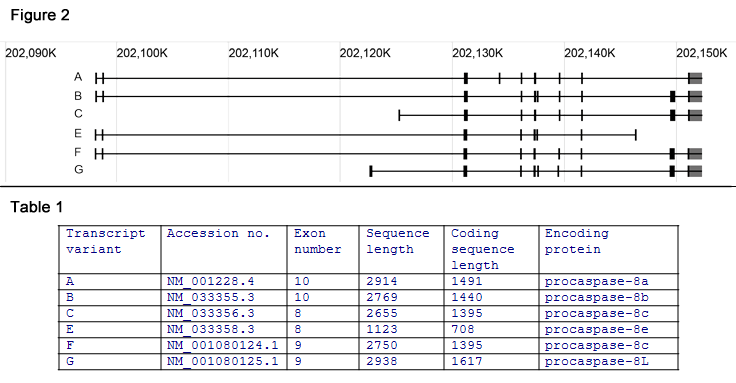
Schematic representation of the structure of the 54kb CASP8 gene, which contains 10 exons and can be transcribed into 6 alternative splice variants.
Description
54269 bases with 11 exons.
Transcription
There are 6 transcriptional variants of CASP8 and they are described in Table 1.
Proteins
Note
Caspases are a family of cysteinyl aspartate specific proteases which are synthesized as zymogens. Caspase-8 was discovered as a component of the CD95 (Fas/APO-1) death-inducing signaling complex (DISC) (Muzio et al., 1996).
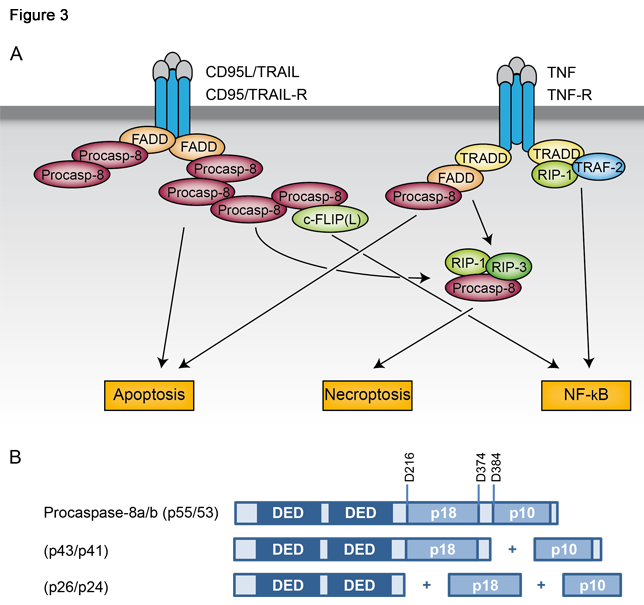
Involvement of procaspase-8 in death-receptor signaling. (A) Procaspase-8 is recruited to the CD95 or TRAIL DISC through the adaptor protein FADD. Upon activation of TNF, procaspase-8 is recruited through FADD and TRADD. For activation, procaspase-8 requires dimerization and internal cleavage. The major function of procaspase-8 in DR signaling is induction of apoptosis, but it also regulates necroptosis or NF-kB via RIP1/RIP3 and c-FLIP(L). (B) Procaspase-8 consists of a prodomain harboring tandem death effector domains (DED) followed by one large (p18) and one small (p10) catalytic subunit. Cleavage between p18 and p10 generates the intermediate p43/p41 which is further processed to the fully active form by cleavage between the prodomain and p18.
Description
Caspase-8 has a number of isoforms, including procaspase-8a (496 aa), procaspase-8b (479 aa), procaspase-8c (464 aa), procaspase-8e (235 aa), procaspase-8g or caspase-8L (538 aa) and caspase-8 short (108 aa).
Only two isoforms are predominantly expressed in many different tissues and cell lines: procaspase-8a and procaspase-8b (Scaffidi et al., 1997). They act as the main initiator caspases in death receptor-induced apoptosis.
Caspase-8L was reported to be expressed in human peripheral blood lymphocytes as a truncated protein, which lacks the C-terminal protease domain (Horiuchi et al., 2000). Therefore, it is suggested that caspase-8L is recruited into the DISC but remains proteolytically inert, interfering with the transduction of the signal from the DISC (Himeji et al., 2002).
An isoform that is detected in bone marrow mononuclear cells is named caspase-8 short. Although it only contains the first DED and a part of the second DED, overexpression of caspase-8 short is reported to increase sensitivity to apoptosis (Xu et al., 2009).
In addition to caspase-8 isoforms, there is a number of cleavage products described, which are formed in the course of apoptosis. Apoptotic processing of procaspase-8a/b involves generation of the cleavage products p43/p41, p30, the prodomains p26/p24, p18 and p10 (Hoffmann et al., 2009). The latter two cleavage products form the active caspase-8 heterotetramer p102-p182 that triggers apoptosis (Lavrik and Krammer, 2012).
Only two isoforms are predominantly expressed in many different tissues and cell lines: procaspase-8a and procaspase-8b (Scaffidi et al., 1997). They act as the main initiator caspases in death receptor-induced apoptosis.
Caspase-8L was reported to be expressed in human peripheral blood lymphocytes as a truncated protein, which lacks the C-terminal protease domain (Horiuchi et al., 2000). Therefore, it is suggested that caspase-8L is recruited into the DISC but remains proteolytically inert, interfering with the transduction of the signal from the DISC (Himeji et al., 2002).
An isoform that is detected in bone marrow mononuclear cells is named caspase-8 short. Although it only contains the first DED and a part of the second DED, overexpression of caspase-8 short is reported to increase sensitivity to apoptosis (Xu et al., 2009).
In addition to caspase-8 isoforms, there is a number of cleavage products described, which are formed in the course of apoptosis. Apoptotic processing of procaspase-8a/b involves generation of the cleavage products p43/p41, p30, the prodomains p26/p24, p18 and p10 (Hoffmann et al., 2009). The latter two cleavage products form the active caspase-8 heterotetramer p102-p182 that triggers apoptosis (Lavrik and Krammer, 2012).
Expression
Caspase-8 is expressed in almost all kind of tissues, with the highest expression in the immune system and lowest in the nervous system (McCall et al., 2011).
Localisation
Procaspase-8 mainly localizes to the cytosol, in close proximity to the membrane (Medema et al., 1997). It may also localize to mitochondria (Qin et al., 2001, Chandra et al., 2004) or centrosomes (Mielgo et al., 2009). Caspase-8 cleavage products are reported to localize to the nucleus as well as the cytosol (Benchoua et al., 2002, Yao et al., 2007).
Function
Caspase-8 is the main initiator caspase in death receptor-induced apoptosis. Upon stimulation, procaspase-8 is recruited to the CD95 or TRAIL DISC, or TNF complex II. Procaspase-8 activation involves dimerization, oligomerization and cleavage (Schleich et al., 2012). The cleavage of procaspase-8 involves several steps, leading to the generation of the active caspase-8 heterotetramer p102-p182 (Lavrik and Krammer, 2012). Depending on the cell type, active caspase-8 either directly cleaves effector caspases (caspase-3 and caspase-7) or cleaves Bid, which eventually leads to release of cytochrome C and apoptosome formation followed by cleavage of effector caspase-3, caspase-6 and caspase-7 by procaspase-9 (Scaffidi et al., 1998; Scaffidi et al., 1999).
In addition to apoptosis, caspase-8 has a role in programmed necrosis (necroptosis) as well. Caspase-8 can be recruited to the necroptotic complexes (necrosome or ripoptosome) together with RIP1, RIP3 and FADD. It would then cleave RIP1 and RIP3, and therefore block necroptosis (Stupack et al., 2006, Feoktistova et al., 2011; Tenev et al., 2011).
Caspase-8 also has an essential role for NF-kB signaling via many different stimuli including CD95, TRAIL, TCR and TLR stimulations (Kataoka and Tschopp, 2004; Dohrman et al., 2005; Su et al., 2005; Lemmers et al., 2007; Grunert et al., 2012). Interestingly, although the activation of procaspase-8 to p102-p182 heterotetramer is necessary for MAPK signaling (Kober et al., 2011), it is not necessary for NF-kB signaling upon CD95 stimulation (Neumann et al., 2010).
Caspase-8 has been also reported to affect metastasis. Interestingly, although loss of caspase-8 potentiates metastasis, under conditions where apoptosis is compromised, caspase-8 can promote tumor cell migration and metastasis (Stupack et al., 2006, Barbero et al., 2009).
In addition to apoptosis, caspase-8 has a role in programmed necrosis (necroptosis) as well. Caspase-8 can be recruited to the necroptotic complexes (necrosome or ripoptosome) together with RIP1, RIP3 and FADD. It would then cleave RIP1 and RIP3, and therefore block necroptosis (Stupack et al., 2006, Feoktistova et al., 2011; Tenev et al., 2011).
Caspase-8 also has an essential role for NF-kB signaling via many different stimuli including CD95, TRAIL, TCR and TLR stimulations (Kataoka and Tschopp, 2004; Dohrman et al., 2005; Su et al., 2005; Lemmers et al., 2007; Grunert et al., 2012). Interestingly, although the activation of procaspase-8 to p102-p182 heterotetramer is necessary for MAPK signaling (Kober et al., 2011), it is not necessary for NF-kB signaling upon CD95 stimulation (Neumann et al., 2010).
Caspase-8 has been also reported to affect metastasis. Interestingly, although loss of caspase-8 potentiates metastasis, under conditions where apoptosis is compromised, caspase-8 can promote tumor cell migration and metastasis (Stupack et al., 2006, Barbero et al., 2009).
Homology
Caspase-10, FADD, c-FLIP.
Mutations
Germinal
A homozygous C to T mutation at residue 248 leads to familial autoimmune lymphoproliferative syndrome type 2B.
Somatic
Various somatic mutations of CASP8 are identified in different carcinomas. Mutations are observed at different parts of caspase-8, but they all lead to a catalytically inactive form.
- Hepatocellular carcinoma: CASP8 is frequently inactivated by the frameshift somatic mutation 1225-1226delTG in hepatocellular carcinomas, resulting in a premature termination of amino-acid synthesis in the p10 protease subunit (Soung et al., 2005b).
- Gastric carcinoma: Inactivating CASP8 mutations are detected at different sites in about 10% of advanced gastric carcinomas (Soung et al., 2005a).
- Colorectal carcinoma: Inactivating CASP8 mutations are detected at different sites in about 5% of invasive colorectal carcinomas (Kim et al., 2003).
- Vulvar squamous carcinoma: Deletion of leucine 62 (ΔLeu62casp-8) is detected in A431 human vulvar squamous carcinoma cells. ΔLeu62casp-8 has a shorter half-life than wild-type caspase-8 and cannot interact with caspase-8 or FADD; therefore lost its proapoptotic activity (Liu et al., 2002).
- Head and neck carcinoma: A mutation was detected in the tumor cells from head and neck carcinoma that modifies the stop codon and lengthening the protein by 88 amino acids (Mandruzzato et al., 1997).
- Neuroblastoma : An Alanine to Valine missense mutation was detected at codon 96 in a neuroblastoma sample which lacks CASP8 mRNA expression (Takita et al., 2001).
- Hepatocellular carcinoma: CASP8 is frequently inactivated by the frameshift somatic mutation 1225-1226delTG in hepatocellular carcinomas, resulting in a premature termination of amino-acid synthesis in the p10 protease subunit (Soung et al., 2005b).
- Gastric carcinoma: Inactivating CASP8 mutations are detected at different sites in about 10% of advanced gastric carcinomas (Soung et al., 2005a).
- Colorectal carcinoma: Inactivating CASP8 mutations are detected at different sites in about 5% of invasive colorectal carcinomas (Kim et al., 2003).
- Vulvar squamous carcinoma: Deletion of leucine 62 (ΔLeu62casp-8) is detected in A431 human vulvar squamous carcinoma cells. ΔLeu62casp-8 has a shorter half-life than wild-type caspase-8 and cannot interact with caspase-8 or FADD; therefore lost its proapoptotic activity (Liu et al., 2002).
- Head and neck carcinoma: A mutation was detected in the tumor cells from head and neck carcinoma that modifies the stop codon and lengthening the protein by 88 amino acids (Mandruzzato et al., 1997).
- Neuroblastoma : An Alanine to Valine missense mutation was detected at codon 96 in a neuroblastoma sample which lacks CASP8 mRNA expression (Takita et al., 2001).
Implicated in
Entity name
Hepatocellular carcinoma
Disease
Hepatocellular carcinoma accounts for the majority of liver cancers. Mostly, it is secondary to cirrhosis, which is caused mainly by alcohol abuse or hepatitis B/C infections. A somatic mutation in CASP8 leading to deletion of the bases 1225-1226 was detected in 9 out of 69 hepatocellular carcinoma samples from unrelated patients. This deletion results in a frameshift and therefore premature termination of amino-acid synthesis in the p10 protease subunit, consequently inactivating caspase-8 (Soung et al., 2005b).
Entity name
Gastric carcinoma
Disease
Gastric carcinomas arise from the epithelium of the stomach. In a study by Soung and colleagues (Soung et al., 2005a), 122 advanced gastric carcinoma samples were analyzed for mutations in the coding region and the exon-intron junctions of CASP8 gene by PCR-SSCP analysis. In 13 samples, mutations in caspase-8 were found. All mutants were still expressed at a similar level compared to wild-type caspase-8, however, when transfected into cell lines, all mutants except one showed defects in apoptosis.
Entity name
Colorectal carcinoma
Disease
Colorectal cancer arises from colon, rectum or appendix. In the analysis of 82 colorectal adenomas and 98 invasive colorectal carcinomas, 5 mutations were detected only in the colorectal carcinomas but not in the adenomas. 3 out of 5 of these mutations acted in a dominant negative manner and suppressed apoptosis (Kim et al., 2003).
Entity name
Vulvar squamous carcinoma
Disease
In the analysis of A431 human vulvar squamous carcinoma cells, a mutation in CASP8 leading to deletion of leucine 62 was detected. This mutant version of caspase-8 retained its enzymatic activity, however, it lost the ability to interact with itself, wild-type caspase-8 or FADD and therefore lost its proapoptotic activity (Liu et al., 2002).
Entity name
Head and neck carcinoma
Disease
Head and neck carcinomas start in the lip, oral cavity, nasal cavity, paranasal sinuses, pharynx, or larynx and the majority (90%) originates from the epithelium, therefore named squamous cell carcinomas. A mutation in CASP8 was detected in the cells from a tumor relapse resected from the oral cavity of a late-stage squamous cell carcinoma patient. This mutation was found to modify the stop codon and add an Alu repeat to the coding region. Therefore, the mutant protein is 88 amino acids longer than the wild type and cannot efficiently act as an apoptotic protein (Mandruzzato et al., 1997).
Entity name
Neuroblastoma
Disease
Neuroblastoma arises from immature nerve cells. It is mainly localized to adrenal medulla. In a study where human neuroblastoma cells were transferred to chick chorioallantoic membrane, tumor development was monitored. Although presence or lack of caspase-8 did not change primary tumor growth, metastasis was highly promoted in the tumors lacking caspase-8 due to impaired programmed cell death (Stupack et al., 2006). In a similar study, tumor cells additionally lacking caspase-3 were used to test non-apoptotic effects of caspase-8 on neuroblastoma metastasis. Interestingly, tumors lacking only caspase-3 metastasized more efficiently than tumors lacking both caspases, pointing out that caspase-8 also shows non-apoptotic properties such as enhancing cell migration (Barbero et al., 2009).
Silencing of caspase-8 was also observed in human neuroblastoma samples. In two studies by Takita and colleagues, 11 out of 15 and 19 out of 27 neuroblastoma samples did not express caspase-8, detected by real-time PCR (Takita et al., 2000; Takita et al., 2001). Furthermore, a missense mutation was detected at codon 96 in one of the samples lacking caspase-8 expression (Takita et al., 2000).
Furthermore, silencing of CASP8 in neuroblastoma was found to be associated with MYCN amplification. 10 out of 16 patients with MYCN amplification had completely methylated CASP8 alleles opposed to only 1 out of 26 patients without MYCN amplification. Interestingly, one patient among these 42 patients had a deletion of the CASP8 gene (Teitz et al., 2000).
Silencing of caspase-8 was also observed in human neuroblastoma samples. In two studies by Takita and colleagues, 11 out of 15 and 19 out of 27 neuroblastoma samples did not express caspase-8, detected by real-time PCR (Takita et al., 2000; Takita et al., 2001). Furthermore, a missense mutation was detected at codon 96 in one of the samples lacking caspase-8 expression (Takita et al., 2000).
Furthermore, silencing of CASP8 in neuroblastoma was found to be associated with MYCN amplification. 10 out of 16 patients with MYCN amplification had completely methylated CASP8 alleles opposed to only 1 out of 26 patients without MYCN amplification. Interestingly, one patient among these 42 patients had a deletion of the CASP8 gene (Teitz et al., 2000).
Entity name
Medulloblastoma
Disease
Medulloblastoma is a tumor of the brain that originates in the cerebellum or posterior fossa. In one study of medulloblastoma, 14 out of 27 tumors were identified to have lost CASP8 mRNA expression (Zuzak et al., 2002). Furthermore, another study showed that CASP8 expression was reversely correlating with the disease. The 5-year cumulative progression-free survival rate of the patients with weak CASP8 expression was 31%, and with moderate/strong caspase-8 expression 73% (Pingoud-Meier et al., 2003).
Entity name
Small cell lung carcinoma
Disease
Small cell lung carcinomas commonly originate from the lung, although rarely can originate also from cervix, prostate or gastrointesinal tract. In this carcinoma, tumor cells are much smaller than normal cells with almost no cytoplasm. In one study, 13 out of 25 small cell lung carcinoma samples showed silencing of CASP8 due to methylation (Hopkins-Donaldson et al., 2003).
Entity name
Autoimmune lymphoproliferative syndrome type 2B
Disease
A homozygous C to T mutation in caspase-8 at residue 248 in the p18 protease subunit leads to autoimmune lymphoproliferative syndrome type 2B (Chun et al., 2002).
Autoimmune Lymphoproliferative Syndrome Type 2B is an autosomal dominant disease where there are defects in activation of T cells, B cells, and natural killer cells of the patients as well as in CD95-mediated apoptosis. Patients have lymphoproliferation and thus lymphadenopathy, splenomegaly and autoimmunity.
Autoimmune Lymphoproliferative Syndrome Type 2B is an autosomal dominant disease where there are defects in activation of T cells, B cells, and natural killer cells of the patients as well as in CD95-mediated apoptosis. Patients have lymphoproliferation and thus lymphadenopathy, splenomegaly and autoimmunity.
Article Bibliography
| Pubmed ID | Last Year | Title | Authors |
|---|---|---|---|
| 19383910 | 2009 | Caspase-8 association with the focal adhesion complex promotes tumor cell migration and metastasis. | Barbero S et al |
| 12065591 | 2002 | Active caspase-8 translocates into the nucleus of apoptotic cells to inactivate poly(ADP-ribose) polymerase-2. | Benchoua A et al |
| 15254227 | 2004 | Association of active caspase 8 with the mitochondrial membrane during apoptosis: potential roles in cleaving BAP31 and caspase 3 and mediating mitochondrion-endoplasmic reticulum cross talk in etoposide-induced cell death. | Chandra D et al |
| 12353035 | 2002 | Pleiotropic defects in lymphocyte activation caused by caspase-8 mutations lead to human immunodeficiency. | Chun HJ et al |
| 15843523 | 2005 | Cellular FLIP (long form) regulates CD8+ T cell activation through caspase-8-dependent NF-kappa B activation. | Dohrman A et al |
| 21737330 | 2011 | cIAPs block Ripoptosome formation, a RIP1/caspase-8 containing intracellular cell death complex differentially regulated by cFLIP isoforms. | Feoktistova M et al |
| 23096115 | 2012 | The adaptor protein FADD and the initiator caspase-8 mediate activation of NF-κB by TRAIL. | Grunert M et al |
| 12010809 | 2002 | Characterization of caspase-8L: a novel isoform of caspase-8 that behaves as an inhibitor of the caspase cascade. | Himeji D et al |
| 19528225 | 2009 | A new C-terminal cleavage product of procaspase-8, p30, defines an alternative pathway of procaspase-8 activation. | Hoffmann JC et al |
| 12700635 | 2003 | Silencing of death receptor and caspase-8 expression in small cell lung carcinoma cell lines and tumors by DNA methylation. | Hopkins-Donaldson S et al |
| 10860845 | 2000 | Dominant expression of a novel splice variant of caspase-8 in human peripheral blood lymphocytes. | Horiuchi T et al |
| 15024054 | 2004 | N-terminal fragment of c-FLIP(L) processed by caspase 8 specifically interacts with TRAF2 and induces activation of the NF-kappaB signaling pathway. | Kataoka T et al |
| 12949717 | 2003 | Inactivating mutations of caspase-8 gene in colorectal carcinomas. | Kim HS et al |
| 21975294 | 2011 | Caspase-8 activity has an essential role in CD95/Fas-mediated MAPK activation. | Kober AM et al |
| 22075988 | 2012 | Regulation of CD95/Fas signaling at the DISC. | Lavrik IN et al |
| 17213198 | 2007 | Essential role for caspase-8 in Toll-like receptors and NFkappaB signaling. | Lemmers B et al |
| 12055196 | 2002 | A novel single amino acid deletion caspase-8 mutant in cancer cells that lost proapoptotic activity. | Liu B et al |
| 9271594 | 1997 | A CASP-8 mutation recognized by cytolytic T lymphocytes on a human head and neck carcinoma. | Mandruzzato S et al |
| 21177656 | 2011 | The Gene Expression Barcode: leveraging public data repositories to begin cataloging the human and murine transcriptomes. | McCall MN et al |
| 9184224 | 1997 | FLICE is activated by association with the CD95 death-inducing signaling complex (DISC). | Medema JP et al |
| 19668227 | 2009 | Paclitaxel promotes a caspase 8-mediated apoptosis through death effector domain association with microtubules. | Mielgo A et al |
| 8681377 | 1996 | FLICE, a novel FADD-homologous ICE/CED-3-like protease, is recruited to the CD95 (Fas/APO-1) death--inducing signaling complex. | Muzio M et al |
| 20212524 | 2010 | Dynamics within the CD95 death-inducing signaling complex decide life and death of cells. | Neumann L et al |
| 14695141 | 2003 | Loss of caspase-8 protein expression correlates with unfavorable survival outcome in childhood medulloblastoma. | Pingoud-Meier C et al |
| 11102441 | 2001 | Pro-caspase-8 is predominantly localized in mitochondria and released into cytoplasm upon apoptotic stimulation. | Qin ZH et al |
| 10428830 | 1999 | Differential modulation of apoptosis sensitivity in CD95 type I and type II cells. | Scaffidi C et al |
| 22683265 | 2012 | Stoichiometry of the CD95 death-inducing signaling complex: experimental and modeling evidence for a death effector domain chain model. | Schleich K et al |
| 15531912 | 2005 | Caspase-8 gene is frequently inactivated by the frameshift somatic mutation 1225_1226delTG in hepatocellular carcinomas. | Soung YH et al |
| 16397500 | 2006 | Potentiation of neuroblastoma metastasis by loss of caspase-8. | Stupack DG et al |
| 15746428 | 2005 | Requirement for caspase-8 in NF-kappaB activation by antigen receptor. | Su H et al |
| 11466626 | 2001 | Allelic imbalance on chromosome 2q and alterations of the caspase 8 gene in neuroblastoma. | Takita J et al |
| 10802708 | 2000 | Caspase 8 is deleted or silenced preferentially in childhood neuroblastomas with amplification of MYCN. | Teitz T et al |
| 21737329 | 2011 | The Ripoptosome, a signaling platform that assembles in response to genotoxic stress and loss of IAPs. | Tenev T et al |
| 20150972 | 2009 | A new caspase-8 isoform caspase-8s increased sensitivity to apoptosis in Jurkat cells. | Xu Z et al |
| 17290218 | 2007 | Death effector domain DEDa, a self-cleaved product of caspase-8/Mch5, translocates to the nucleus by binding to ERK1/2 and upregulates procaspase-8 expression via a p53-dependent mechanism. | Yao Z et al |
| 11750844 | 2002 | Loss of caspase-8 mRNA expression is common in childhood primitive neuroectodermal brain tumour/medulloblastoma. | Zuzak TJ et al |
Other Information
Locus ID:
NCBI: 841
MIM: 601763
HGNC: 1509
Ensembl: ENSG00000064012
Variants:
dbSNP: 841
ClinVar: 841
TCGA: ENSG00000064012
COSMIC: CASP8
RNA/Proteins
Expression (GTEx)
Pathways
Protein levels (Protein atlas)
References
| Pubmed ID | Year | Title | Citations |
|---|---|---|---|
| 38319288 | 2024 | TNF and IFNγ-induced cell death requires IRF1 and ELAVL1 to promote CASP8 expression. | 0 |
| 38372637 | 2024 | Role for Caspase-8 in the Release of IL-1β and Active Caspase-1 from Viable Human Monocytes during Toxoplasma gondii Infection. | 0 |
| 38678786 | 2024 | NBR1-mediated autophagic degradation of caspase 8 protects vascular endothelial cells against arsenite-induced apoptotic cell death. | 0 |
| 38710704 | 2024 | Deciphering DED assembly mechanisms in FADD-procaspase-8-cFLIP complexes regulating apoptosis. | 0 |
| 38319288 | 2024 | TNF and IFNγ-induced cell death requires IRF1 and ELAVL1 to promote CASP8 expression. | 0 |
| 38372637 | 2024 | Role for Caspase-8 in the Release of IL-1β and Active Caspase-1 from Viable Human Monocytes during Toxoplasma gondii Infection. | 0 |
| 38678786 | 2024 | NBR1-mediated autophagic degradation of caspase 8 protects vascular endothelial cells against arsenite-induced apoptotic cell death. | 0 |
| 38710704 | 2024 | Deciphering DED assembly mechanisms in FADD-procaspase-8-cFLIP complexes regulating apoptosis. | 0 |
| 36460775 | 2023 | Caspase-8 as a novel mediator linking Src kinase signaling to enhanced glioblastoma malignancy. | 6 |
| 36576886 | 2023 | Bidirectional Mendelian Randomisation Analysis Provides Evidence for the Causal Involvement of Dysregulation of CXCL9, CCL11 and CASP8 in the Pathogenesis of Ulcerative Colitis. | 4 |
| 36593108 | 2023 | Triglyceride induces DNA damage leading to monocyte death by activating caspase-2 and caspase-8. | 2 |
| 36647737 | 2023 | Caspase-8-driven apoptotic and pyroptotic crosstalk causes cell death and IL-1β release in X-linked inhibitor of apoptosis (XIAP) deficiency. | 9 |
| 36675207 | 2023 | Caspase-3, Caspase-8 and XIAP Gene Expression in the Placenta: Exploring the Causes of Spontaneous Preterm Labour. | 4 |
| 36708447 | 2023 | Evaluation of both expression and serum protein levels of caspase-8 and mitogen-activated protein kinase 1 genes in patients with different severities of COVID-19 infection. | 1 |
| 36852999 | 2023 | MLKL-Driven Inflammasome Activation and Caspase-8 Mediate Inflammatory Cell Death in Influenza A Virus Infection. | 10 |
Citation
Selcen Öztürk ; Kolja Schleich ; Inna N Lavrik
CASP8 (Caspase 8, Apoptosis-Related Cysteine Peptidase)
Atlas Genet Cytogenet Oncol Haematol. 2013-11-01
Online version: http://atlasgeneticsoncology.org/gene/925/casp8-%28caspase-8-apoptosis-related-cysteine-peptidase%29
