t(6;9)(p22;q34) DEK/NUP214
2013-04-01 Jean-Loup Huret Affiliation1.Genetics, Dept Medical Information, University of Poitiers, CHU Poitiers Hospital, F-86021 Poitiers, France
Clinics and Pathology
Disease
Acute myeloid leukemias (AML) and myelodysplastic syndromes (MDS)
Phenotype stem cell origin
Altogether, 191 cases are available: 110 cases extracted from the Mitelman database (Cases quick searcher + Molecular biology associations searcher), cases from Garçon et al., 2005, and cases from the largest study to date (69 cases) (Slovak et al., 2006).
The WHO/FAB classification was: M1-AML: 13% (25/191 cases), M2-AML: 34% (64/191), M1/M2-AML: 1% (2 cases), M4-AML: 24% (45/191), M5-AML: 2% (4 cases), M6-AML: 2% (3 cases), AML not otherwise specified (26 cases), refractory anemia with excess of blasts (RAEB): 7% (13/191), chronic myelogenous leukemia (CML): 2% (3 cases), other myelodysplastic and/or myeloproliferative syndrome: 2% (3 cases), acute basophilic leukemia: 1 case, unknown: 2 cases. Acute myeloid leukemia is often preceded by an episode of myelodysplastic syndrome. The t(6;9) may be secondary to toxic exposure; in some instances.
In the t(6;9), long-term (Sca1+/c-Kit+/lin- /Flk2-) hematopoietic stem cells (LT-HSC) appear to be the leukemia-initiating cells, while leukemia-maintaining cells represent a larger and phenotypically heterogeneous cell population (Oancea et al., 2010).
The WHO/FAB classification was: M1-AML: 13% (25/191 cases), M2-AML: 34% (64/191), M1/M2-AML: 1% (2 cases), M4-AML: 24% (45/191), M5-AML: 2% (4 cases), M6-AML: 2% (3 cases), AML not otherwise specified (26 cases), refractory anemia with excess of blasts (RAEB): 7% (13/191), chronic myelogenous leukemia (CML): 2% (3 cases), other myelodysplastic and/or myeloproliferative syndrome: 2% (3 cases), acute basophilic leukemia: 1 case, unknown: 2 cases. Acute myeloid leukemia is often preceded by an episode of myelodysplastic syndrome. The t(6;9) may be secondary to toxic exposure; in some instances.
In the t(6;9), long-term (Sca1+/c-Kit+/lin- /Flk2-) hematopoietic stem cells (LT-HSC) appear to be the leukemia-initiating cells, while leukemia-maintaining cells represent a larger and phenotypically heterogeneous cell population (Oancea et al., 2010).
Epidemiology
The t(6;9) is found in about 1% of AMLs (0.9% in the series of 69 cases, with a repartition of 1.4% in children AMLs, and 0.7% in adult cases (Slovak et al., 2006)); from this study, median age was 23 years (range 2-66 years), with 30 children out of 69 cases (43%), a younger age than in AML in general. From 199 cases herein reviewed, the sex ratio is balanced: 1M/1F (100 male patients and 99 female patients).
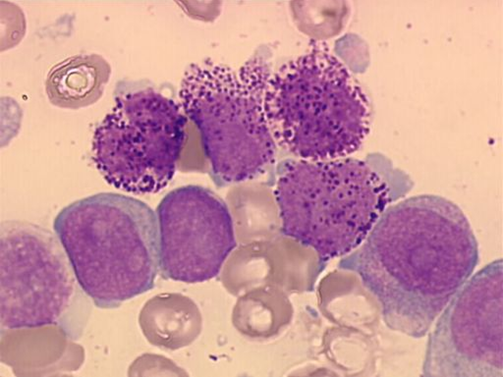
The translocation t(6;9)(p23;q34) results in the formation of a chimeric fusion gene: DEK (6p23) and CAN (9q34). CAN is a putative oncogene which may be activated by fusion of its 3 end to other genes than DEK. One such recently reported gene is called SET and leads to expression of a SET/CAN fusion RNA. The t(6;9)(p21-22;q34) may be seen in either AML M2 or less frequently in M4 or MDS and acute myelofibrosis often in association with excessz basophils. The t(6;9) is reported mostly in young adults. The prognosis of patients carrying the t(6;9) is unfavorable - Text and iconography Courtesy Georges Flandrin 2005.
Cytology
TdT +, HLA-DR, CD13, CD33, CD38, CD45 and CD117; frequent expression of CD9, CD15, CD34 Auer rods are frequently observed. Blood data: a marked basophilia is frequent (found in 44% of the patients in Slovak et al., 2006). Granulocytic, megakaryocytic, or multilineage dysplasia was found in two third of adult cases in the same report.
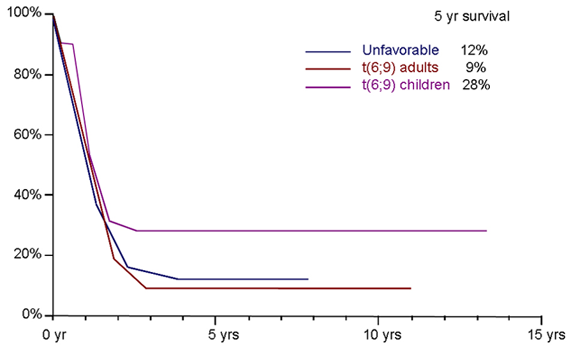
Overall survival in patients with t(6;9)(p23;q34) (adapted from Slovak et al., 2006): 31 children cases, 32 adult cases, compared with 174 young adult AML in the unfavorable risk cytogenetics subgroup.
Treatment
Allogeneic stem cell transplantation might be associated with better outcome (Slovak et al., 2006).
Prognosis
Overall, 65% of patients, 71% of pediatric cases and 58% of adults, achieved complete remission (CR) (Slovak et al., 2006). Median survival is around 1 year (12.5 months in children, 14.4 months in adults, 13.5 months altogether). The 5 year overall survival was 28% in children and 9% in adults (see figure) (Slovak et al., 2006). Patients who achieved prolonged molecular remission had better outcome than patients with persistent DEK/NUP214 positivity (Garçon et al., 2005).
Note
FLT3 internal tandem duplications was found in 69% of children cases and 73% of adult cases in one study (Slovak et al., 2006), and in 88% of adults cases in another study (Oyarzo et al., 2004). A third study grossly confirm this high incidence (Garçon et al., 2005).
Cytogenetics
Cytogenetics morphological
The t(6;9) may be over loocked.
Additional anomalies
The t(6;9) is the sole anomaly in 85% of 195 cases with available data, and in 83% of cases in the largest study (Slovak et al., 2006); recurrent, although rare, additional anomalies are the following: +8 (in 6 of 126 cases, 5%), +13 (in 3 of 126 cases, 2%), +21. A -7/del(7q) was found once, a t(9;22)(q24;q11) once.
Variants
A three way complex t(6;9;Var) has been found in 3 instances.
Genes Involved and Proteins
Gene name
DEK (DEK proto-oncogene)
Location
6p22.3
Protein description
375 amino-acids; DEK contains acidic domains (Asp/Glu-rich), a SAF/SAP box, a nuclear localisation signal; and other DNA binding domains. Highly conserved nuclear factor; chromatin remodeling protein, essential for heterochromatin integrity; DEK localizes preferentially at sites proximal to the promoters of expressed genes; acts as a repressor of transcription by interfering with histone acetyl-transferases and as an activator of transcription by stimulating the binding of TFAP2A (the activator protein AP2-alpha) to its target DNA sequences; DEK introduces super-coils into circular DNA (in Oancea et al., 2010). DEK is a regulator of stem and progenitor cells and is upregulated in a number of neoplasms (breast cancer, chronic lymphocytic leukemia, small cell lung carcinoma, Merkel cell carcinoma, melanoma, glioblastoma, retinoblastoma, cervical, and bladder cancers) (review in Riveiro-Falkenbach and Soengas, 2010); CEBPA and DEK coordinately activate myeloid gene expression (Koleva et al., 2012); DEK is an estrogen receptor alpha (ESR1) target gene (Privette Vinnedge et al., 2012). DEK expression modulates ATM and DNA-dependent protein kinase signaling, and contributes to DNA repair (Kavanaugh et al., 2011).
Gene name
NUP214 (nucleoporin 214kDa)
Location
9q34.13
Note
The previous name of NUP214 was CAN.
Protein description
2090 amino acids; contains dimerization domains (2 leucine zippers) and FG repeats; forms homodimers; the C-terminus is essential; the N-terminus is involved in mRNA export (Köser et al., 2005). Nuclear membrane localisation (cytoplasmic face of nucleopore); component of the nuclear pore complex; involved in nucleo-cytoplasmic transport.
Result of the Chromosomal Anomaly
Description
5 DEK - 3 NUP214 on der(6); head to tail DEK/NUP214 fusion gene (SET/NUP214 exceptional); breakpoint clusters in a single intron of 8 kb (ICB9: intron containing breakpoint 9) in NUP214, and in a single intron (of 12 kb) as well (ICB6) in DEK.
Transcript
5.5 kb RNA; no NUP214-DEK reciprocal transcript on chromosome 9.
Detection protocole
RNA-PCR.
Description
165 kDa; N-term with almost the entire DEK protein fused to the C-terminal two-thirds of the NUP214 protein.
Expression localisation
Nuclear localisation.
Highly cited references
| Pubmed ID | Year | Title | Citations |
|---|---|---|---|
| 35682627 | 2022 | Molecular Classification and Overcoming Therapy Resistance for Acute Myeloid Leukemia with Adverse Genetic Factors. | 169 |
| 30669574 | 2019 | NUP214 in Leukemia: It's More than Transport. | 148 |
| 37172756 | 2023 | The impact of the chromatin binding DEK protein in hematopoiesis and acute myeloid leukemia. | 105 |
| 33439382 | 2021 | Acute Myeloid Leukemia in Children: Emerging Paradigms in Genetics and New Approaches to Therapy. | 101 |
| 27114368 | 2016 | Leukemia-Associated Nup214 Fusion Proteins Disturb the XPO1-Mediated Nuclear-Cytoplasmic Transport Pathway and Thereby the NF-κB Signaling Pathway. | 82 |
| 32934780 | 2020 | Targeted CRM1-inhibition perturbs leukemogenic NUP214 fusion proteins and exerts anti-cancer effects in leukemia cell lines with NUP214 rearrangements. | 72 |
| 33755722 | 2021 | Nuclear DEK preserves hematopoietic stem cells potential via NCoR1/HDAC3-Akt1/2-mTOR axis. | 59 |
| 32656741 | 2020 | Role of the DEK oncogene in the development of squamous cell carcinoma. | 55 |
| 25120641 | 2014 | NUP214 fusion genes in acute leukemia (Review). | 52 |
| 36288392 | 2022 | Understanding a high-risk acute myeloid leukemia by analyzing the interactome of its major driver mutation. | 50 |
| 25568664 | 2014 | STAT activation status differentiates leukemogenic from non-leukemogenic stem cells in AML and is suppressed by arsenic in t(6;9)-positive AML. | 46 |
| 24441146 | 2014 | t(6;9)(p22;q34)/DEK-NUP214-rearranged pediatric myeloid leukemia: an international study of 62 patients. | 42 |
| 35941390 | 2022 | Activation of signaling pathways in models of t(6;9)-acute myeloid leukemia. | 42 |
| 38571499 | 2024 | NUP214 fusion genes in acute leukemias: genetic characterization of rare cases. | 41 |
| 38145892 | 2024 | NUP214 Rearrangements in Leukemia Patients: A Case Series From a Single Institution. | 36 |
| 24073922 | 2013 | Forced expression of the DEK-NUP214 fusion protein promotes proliferation dependent on upregulation of mTOR. | 36 |
| 29109093 | 2017 | DEK-NUP214-Fusion Identified by RNA-Sequencing of an Acute Myeloid Leukemia with t(9;12)(q34;q15). | 34 |
| 34572762 | 2021 | Advances in the First Line Treatment of Pediatric Acute Myeloid Leukemia in the Polish Pediatric Leukemia and Lymphoma Study Group from 1983 to 2019. | 33 |
| 23091311 | 2012 | Rapid detection of prognostically significant fusion transcripts in acute leukemia using simplified multiplex reverse transcription polymerase chain reaction. | 28 |
| 27065320 | 2016 | Transformation of human CD34+ hematopoietic progenitor cells with DEK-NUP214 induces AML in an immunocompromised mouse model. | 27 |
| 29344131 | 2017 | A novel variant translocation (1;9)(p22;q34) resulting in a DEK/NUP214 fusion gene in a patient with acute myeloid leukemia: A case report. | 24 |
| 28318095 | 2017 | Clinicopathologic and molecular characterization of myeloid neoplasms with isolated t(6;9)(p23;q34). | 23 |
| 38951067 | 2024 | [Analysis of therapeutic effects of allogeneic hematopoietic stem cell transplantation in 12 patients with DEK-NUP214 fusion gene positive acute myeloid leukemia]. | 20 |
| 32269633 | 2020 | Imatinib therapy in acute myeloid leukemia with DEK-NUP214 and FIP1L1-PDGFRA rearrangement: A case report. | 19 |
| 31938438 | 2018 | Secondary mixed phenotype acute leukemia following chemotherapy for diffuse large B-cell lymphoma: a case report and review of the literature. | 19 |
| 38172329 | 2024 | Gene regulation in t(6;9) DEK::NUP214 Acute Myeloid Leukemia resembles that of FLT3-ITD/NPM1 Acute Myeloid Leukemia but with an altered HOX/MEIS axis. | 15 |
| 38899336 | 2024 | FLT3 inhibitors potentially improve response rates in acute myeloid leukemia harboring t(6;9)(DEK::NUP214): the Mayo Clinic experience. | 15 |
| 38503531 | 2023 | [Clinical observation on 16 cases of DEK-NUP214 fusion gene positive acute myeloid leukemia treated with allogeneic hematopoietic stem cell transplantation]. | 15 |
| 35845276 | 2021 | Volunteer unrelated donor cell-derived acute myeloid leukemia with RUNX1-RUNX1T1. | 15 |
| 35198371 | 2022 | Gilteritinib monotherapy as a transplant bridging option for high risk FLT3-mutated AML with t(6;9)(p23;q34.1);DEK-NUP214 in morphological but not cytogenetic or molecular remission following standard induction chemotherapy. | 8 |
| 38175403 | 2023 | Iron-laden blasts in refractory acute myeloid leukemia. | 2 |
| 25765544 | 2015 | The DEK oncoprotein and its emerging roles in gene regulation. | 0 |
| 24657637 | 2014 | Nucleoporins and nucleocytoplasmic transport in hematologic malignancies. | 0 |
| 34551474 | 2021 | [Prognostic significance of DEK-NUP214 fusion gene in patients with acute myeloid leukemia after allogeneic hematopoietic stem cell transplantation]. | 0 |
| 33558656 | 2021 | Myelodysplastic syndrome with t(6;9)(p22;q34.1)/DEK-NUP214 better classified as acute myeloid leukemia? A multicenter study of 107 cases. | 0 |
| 37643244 | 2023 | IL-33-ST2 signaling promotes stemness in subtypes of myeloid leukemia cells through the Wnt and Notch pathways. | 0 |
| 25605311 | 2015 | The kinetics of relapse in DEK-NUP214-positive acute myeloid leukemia patients. | 0 |
| 18181180 | 2008 | Identification of a novel and myeloid specific role of the leukemia-associated fusion protein DEK-NUP214 leading to increased protein synthesis. | 0 |
| 37011983 | 2023 | [Analysis of 7 cases of pediatric acute myeloid leukemia with DEK-NUP214 fusion gene]. | 0 |
| 32526729 | 2020 | Acute Myeloid Leukemia with t(6;9)(p23;q34.1); DEK-NUP214: The Pathogenesis and Potential. | 0 |
| 33676766 | 2021 | Diagnosis of rare subtypes of acute myeloid leukaemia and related neoplasms. | 0 |
| 19860179 | 2009 | [Classification of myeloid leukemias]. | 0 |
| 26517539 | 2015 | NUP214-RAC1 and RAC1-COL12A1 Fusion in Complex Variant Translocations Involving Chromosomes 6, 7 and 9 in an Acute Myeloid Leukemia Case with DEK-NUP214. | 0 |
| 32020596 | 2020 | Allogeneic stem cell transplantation in AML with t(6;9)(p23;q34);DEK-NUP214 shows a favourable outcome when performed in first complete remission. | 0 |
| 34979355 | 2022 | t(5;12)(q31;p13)/ETV6::ACSL6 and t(6;9)(p23;q34)/DEK::NUP214 concurrence in acute myeloid leukemia: an unusual association of two rare abnormalities. | 0 |
| 39361146 | 2024 | Clinical features and long-term outcomes of pediatric patients with de novo acute myeloid leukemia in China with or without specific gene abnormalities: a cohort study of patients treated with BCH-AML 2005. | 0 |
| 38964929 | 2024 | [High-risk acute myeloid leukemia with DEK-NUP214 rearrangement and eyelid infiltration: a case report]. | 0 |
| 28509585 | 2017 | Identification of a novel fusion TBL1XR1-PDGFRB in a patient with acute myeloid leukemia harboring the DEK-NUP214 fusion and clinical response to dasatinib. | 0 |
| 27734129 | 2017 | Identification of a potential topoisomerase II "hotspot" DNA region in the DEK gene in two t(6;9)-positive therapy-related myeloid neoplasms. | 0 |
| 26193901 | 2015 | Eosinophil chimerism in the differential diagnosis between DEK-NUP214-positive acute myeloid leukaemia relapse and chronic graft-versus-host disease. | 0 |
| 23630019 | 2013 | NUP98-NSD1 gene fusion and its related gene expression signature are strongly associated with a poor prognosis in pediatric acute myeloid leukemia. | 0 |
| 30442503 | 2018 | Measurable residual disease-guided treatment with azacitidine to prevent haematological relapse in patients with myelodysplastic syndrome and acute myeloid leukaemia (RELAZA2): an open-label, multicentre, phase 2 trial. | 0 |
Article Bibliography
| Pubmed ID | Last Year | Title | Authors |
|---|---|---|---|
| 8895527 | 1996 | Interaction of cellular proteins with the leukemia specific fusion proteins DEK-CAN and SET-CAN and their normal counterpart, the nucleoporin CAN. | Fornerod M et al |
| 15973457 | 2005 | DEK-CAN molecular monitoring of myeloid malignancies could aid therapeutic stratification. | Garçon L et al |
| 21653549 | 2011 | The human DEK oncogene regulates DNA damage response signaling and repair. | Kavanaugh GM et al |
| 22474248 | 2012 | C/EBPα and DEK coordinately regulate myeloid differentiation. | Koleva RI et al |
| 8464230 | 1993 | Translocation t(6;9)(p23;q34) in acute myeloid leukemia without myelodysplasia or basophilia: two cases and a review of the literature. | Lillington DM et al |
| 20827285 | 2010 | The t(6;9) associated DEK/CAN fusion protein targets a population of long-term repopulating hematopoietic stem cells for leukemogenic transformation. | Oancea C et al |
| 15362364 | 2004 | Acute myeloid leukemia with t(6;9)(p23;q34) is associated with dysplasia and a high frequency of flt3 gene mutations. | Oyarzo MP et al |
| 3976650 | 1985 | Increased numbers of marrow basophils may be associated with a t(6;9) in ANLL. | Pearson MG et al |
| 23071688 | 2012 | The DEK oncogene is a target of steroid hormone receptor signaling in breast cancer. | Privette Vinnedge LM et al |
| 20501624 | 2010 | Control of tumorigenesis and chemoresistance by the DEK oncogene. | Riveiro-Falkenbach E et al |
| 16628187 | 2006 | A retrospective study of 69 patients with t(6;9)(p23;q34) AML emphasizes the need for a prospective, multicenter initiative for rare 'poor prognosis' myeloid malignancies. | Slovak ML et al |
| 1602786 | 1992 | Dek-can rearrangement in translocation (6;9)(p23;q34). | Soekarman D et al |
| 1308167 | 1992 | Translocation t(6;9) in acute non-lymphocytic leukaemia results in the formation of a DEK-CAN fusion gene. | von Lindern M et al |
Summary
Fusion gene
DEK/NUP214 DEK (6p22.3) NUP214 (9q34.13) M|DEK/NUP214 DEK (6p22.3) NUP214 (9q34.13) M t(6;9)(p22;q34)
Note
The translocation, known as t(6;9)(p23;q34), has been renamed t(6;9)(p22;q34), since DEK sits in 6p22.3
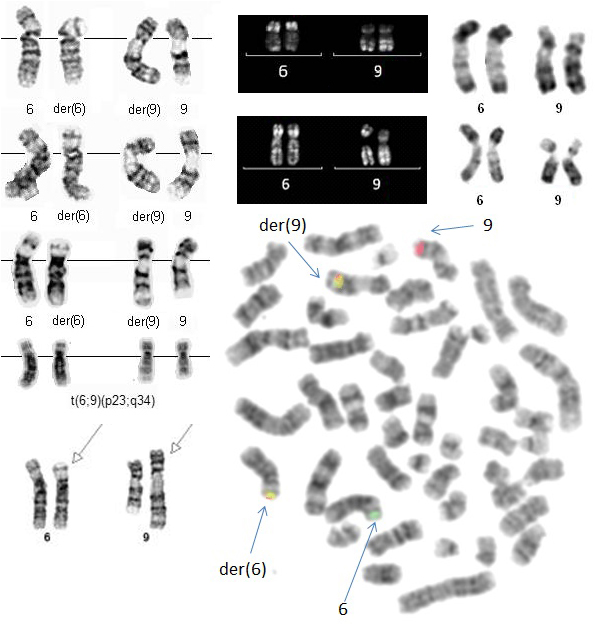
t(6;9)(p23;q34) Left: G- banding- Courtesy Diane H. Norback, Eric B. Johnson, Sara Morrison-Delap Cytogenetics at the Waisman Center (top first two rows), Jean-Luc Lai (third row), and Roland Berger (fourth row); and R- banding - Middle Courtesy Lucienne Michaux; and Right: Courtesy Christine Pérot Bottom: Left: GTW banding. Arrows point to the abnormal chromosomes. Right: Metaphase FISH (reverse DAPI) showing the DEK-NUP214 and the NUP214-DEK fusions on the der(6) and der(9), respectively. DEK (6p22.3) is in SpectrumGreen and NUP214 (9q34) is in SpectrumOrange. Courtesy Aurelia Meloni-Ehrig, Christine A. Curtis, Nathan Bohls, Claudia R. Kraemer, Sean Mahoney, Hui Huang, Alvin W. Martin, Lawrence Hertzberg
Citation
Jean-Loup Huret
t(6;9)(p22;q34) DEK/NUP214
Atlas Genet Cytogenet Oncol Haematol. 2013-04-01
Online version: http://atlasgeneticsoncology.org/haematological/1014/t(6
Historical Card
1998-01-01 t(6;9)(p22;q34) DEK/NUP214 by Jean-Loup Huret Affiliation
Genetics, Dept Medical Information, University of Poitiers, CHU Poitiers Hospital, F-86021 Poitiers, France
