t(6;11)(q27;q23) KMT2A/AFDN
2017-07-01 Jean-Loup Huret Affiliation1.Genetics, Dept Medical Information, University of Poitiers, CHU Poitiers Hospital, F-86021 Poitiers, France
Abstract
Review on the t(6;11)(q27;q23) involving KMT2A (better known as MLL), and AFDN (Afadin), also known as AF6 or MLLT4. It occurs in acute myeloid leukemia, at times treatment-related leukemia, B lymphoblastic leukemia, and T-cell lymphoblastic leukemia. It carries a poor prognosis.
Clinics and Pathology
Noted
The incidence of 11q23 abnormalities in infants with acute lymphoblastic leukemia (ALL) ranges from 60% to 80%., and from 4.5% to 5.7% among children who are older than 1 year and have ALL. The t(4;11)(q21;q23) MLL / AFF1, one of the most common 11q23 abnormalities, occurs in 2% of children and adults with ALL (Raimondi 2004).
The incidence of 11q23 abnormalities in children with acute myeloid leukemia (AML) ranges from 15% to 25%. In children younger than 2 years, the peak incidence of 11q23/MLL gene rearrangements is 50%-60%.
The incidence of 11q23 abnormalities in adults with AML is approximately 5% (Coenen et al., 2012).
The incidence of 11q23 abnormalities among adult ALL cases is about 10% (Pui et al., 2004).
The incidence of 11q23 abnormalities in children with acute myeloid leukemia (AML) ranges from 15% to 25%. In children younger than 2 years, the peak incidence of 11q23/MLL gene rearrangements is 50%-60%.
The incidence of 11q23 abnormalities in adults with AML is approximately 5% (Coenen et al., 2012).
The incidence of 11q23 abnormalities among adult ALL cases is about 10% (Pui et al., 2004).
Disease
Translocation t(6;11) represent about 5% of acute leukemia with 11q23/MLL rearrangement and is more frequent in AML than in ALL. Different studies are available, each involving specific groups of patients, and they cannot be pooled in one meta-analysis:
In a large study on 2,345 acute leukemia patients with 11q23/MLL rearrangement, there were 1,420 patients diagnosed with ALL (61%), 872 diagnosed with AML (37%) and 7 with MDS; 38 were mixed lineage leukemia (1.6%), 4 lymphomas, and 4 other. Of these 2,345 patients with MLL rearrangements, there was 95 cases of t(6;11). They represented 4% of the cases. Of these 95 cases, there were 26 ALL, 68 AML, and 1 "other"; two of them were 2 treatment related leukemia. Translocation t(6;11) was found in 7.8% of AML with MLL rearrangements and 1.8% of ALL with MLL rearrangements. There were 59 cases of T-cell ALL in this series of 2,345 acute leukemia patients. T-ALL was mainly composed of AFDN (AF6, MLLT4) and MLLT1 (ENL) gene fusions: there were 23 AFDN (AF6, MLLT4) cases and 22 MLLT1 (ENL) cases (Meyer et al., 2017).
In a series of 550 cases with an 11q23 rearrangement, 30 cases (5.5%) were shown to have a t(6;11)(q27;q23) There were 27 AMLs (26 de novo and 1 secondary, 3 M1, 2 M2, 8 M4, 1 M4/5, 13 M5) and 3 infant/childhood ALL, 1 being a T-ALL (Martineau et al., 1998).
In a study of 756 childhood AML with 11q23 rearrangement, 35 (5%) showed a t(6;11). The disease was an AML-M1 in 15%, AML-M2 in 6%, AML-M4 in 35%, AML-M5 in 41% (Balgobind et al., 2009).
In a study of 415 adult AML cases (389 de novo and 26 treatment-related AML), 54 were rearranged for MLL (31 MLL-fusions and 23 MLL partial tandem duplications (PTD)), 8 of which (26% of 11q23 rearrangements, 1,9% of adult AML cases) were t(6;11) cases. There was 2 AML-M1, 1 AML-M2, 2 AML-M4, 3 AML-M5 (Lavallee et al 2015). 11q23 rearrangements were identified in 118 adult AML cases (85 de novo and 33 t-AML). A t(6;11) (n=17) was found in 14% of 11q23 rearrangements (Grossmann). Out of 2667 adults with de novo AML, 16 patients (0.6%) were identified with t(6;11). there was 3 M1, 7 M4, 5 M5 (Blum et al., 2004).
In a large study on 2,345 acute leukemia patients with 11q23/MLL rearrangement, there were 1,420 patients diagnosed with ALL (61%), 872 diagnosed with AML (37%) and 7 with MDS; 38 were mixed lineage leukemia (1.6%), 4 lymphomas, and 4 other. Of these 2,345 patients with MLL rearrangements, there was 95 cases of t(6;11). They represented 4% of the cases. Of these 95 cases, there were 26 ALL, 68 AML, and 1 "other"; two of them were 2 treatment related leukemia. Translocation t(6;11) was found in 7.8% of AML with MLL rearrangements and 1.8% of ALL with MLL rearrangements. There were 59 cases of T-cell ALL in this series of 2,345 acute leukemia patients. T-ALL was mainly composed of AFDN (AF6, MLLT4) and MLLT1 (ENL) gene fusions: there were 23 AFDN (AF6, MLLT4) cases and 22 MLLT1 (ENL) cases (Meyer et al., 2017).
In a series of 550 cases with an 11q23 rearrangement, 30 cases (5.5%) were shown to have a t(6;11)(q27;q23) There were 27 AMLs (26 de novo and 1 secondary, 3 M1, 2 M2, 8 M4, 1 M4/5, 13 M5) and 3 infant/childhood ALL, 1 being a T-ALL (Martineau et al., 1998).
In a study of 756 childhood AML with 11q23 rearrangement, 35 (5%) showed a t(6;11). The disease was an AML-M1 in 15%, AML-M2 in 6%, AML-M4 in 35%, AML-M5 in 41% (Balgobind et al., 2009).
In a study of 415 adult AML cases (389 de novo and 26 treatment-related AML), 54 were rearranged for MLL (31 MLL-fusions and 23 MLL partial tandem duplications (PTD)), 8 of which (26% of 11q23 rearrangements, 1,9% of adult AML cases) were t(6;11) cases. There was 2 AML-M1, 1 AML-M2, 2 AML-M4, 3 AML-M5 (Lavallee et al 2015). 11q23 rearrangements were identified in 118 adult AML cases (85 de novo and 33 t-AML). A t(6;11) (n=17) was found in 14% of 11q23 rearrangements (Grossmann). Out of 2667 adults with de novo AML, 16 patients (0.6%) were identified with t(6;11). there was 3 M1, 7 M4, 5 M5 (Blum et al., 2004).
Clinics
Central nervous system involvement was found in 15% of 35 cases of childhood 11q23/MLL-rearranged acute myeloid leukemia (Balgobind et al., 2009)
Epidemiology
In the large study of 2,345 acute leukemia patients with 11q23-MLL-rearrangement, there was 876 infants, 671 "pediatric" cases (infants excluded), and 798 adults. Of the the 95 cases with t(6;11) in this study, median age was 19 years, with 3 infant, 44 pediatric, and 48 adult cases; this abnormality is rare in infants (0,3%) and more frequent in children and adults: 6,6 and 6% respectively. Sex ratio was 45M/50F. Mean age of T-cell ALL cases with t(6;11) was 17 years, with 14 pediatric and 9 adult cases. Sex ratio was 11M/12F (Meyer et al., 2017). In another study of t(6;11)(q27;q23) acute leukemia, median age was 30-35 years (range 0.5-72, with 2 infant cases and 6 other children under 16). Sex ratio was 17M/13F (57%) (Martineau et al., 1998).
In a study of 35 childhood AMLs, median age 12 years (8% were infant cases, 34% were aged 2-9 yrs, and 57% were older children). M/F was 19/16 (54%) (Balgobind et al., 2009).
On 8 adult AML cases : age were 22-58 years, and sex ratio was 3M/5F (Lavallee et al 2015). Median age of adults with de novo AML was 45 years (range 22-65) in another study and sex ratio was 7M/8F (Blum et al., 2004).
In a study of 35 childhood AMLs, median age 12 years (8% were infant cases, 34% were aged 2-9 yrs, and 57% were older children). M/F was 19/16 (54%) (Balgobind et al., 2009).
On 8 adult AML cases : age were 22-58 years, and sex ratio was 3M/5F (Lavallee et al 2015). Median age of adults with de novo AML was 45 years (range 22-65) in another study and sex ratio was 7M/8F (Blum et al., 2004).
Prognosis
Complete remission (CR) was obtained in 23 of 26 AML cases, but median survival was only 12 months (Martineau et al., 1998). The 35 patients with a t(6;11)(q27;q23) had the worst outcome compared to other childhood 11q23/MLL-rearranged acute myeloid leukemia groups: 5-year event free survival (EFS) was 11% (± 5%) and 5-year overall survival (OS) was 22% (Balgobind et al., 2009). CR was achieved in 69% of adults with de novo AML (11 of 16 patients), but CR duration was short (median 9 months). The estimated probability of 2-year survival was 13%. Both long-term survivors received allogeneic stem cell transplantation. The estimated probability of 2-year survival of patients reported in the literature was 15% (Blum et al., 2004). However, as there are many progresses in therapy, one cannot rely on survival studies made 10 or 20 years ago.
Cytogenetics
Cytogenetics morphological
In a series of 30 cases with t(6;11)(q27;q23), (27 AMLs and 3 ALLs). The t(6;11) was the sole abnormality in 24 cases (at least in a subclone), +der(6)t(6;11), +8, +19 and +21 were found in 10% (3 times) each. All three patients with AML-M1 had additional abnormalities. (Martineau et al., 1998). In a series of adults with de novo AML, the t(6;11) was the sole abnormality in 12/15 cases; der(6)t(6;11) and +8 were found in one case each (Blum et al., 2004)
Cytogenetics molecular
The t(6;11) translocation can escape recognition: chromosome 6 involvement may be overlooked and the abnormality may be missinterpreted as a del(11q), with conventional banding techniques; FISH techniques necessary.
Genes Involved and Proteins
Note
Frequent KRAS and NRAS mutations were found (30% and 18% respectively) in AML adult cases and there was MECOM overexpression in 100% (Grossmann et al., 2013).There was high expression levels of NKX2-3 and MECOM in AML adult cases. (Lavallee et al 2015). Methylation of lysine79 of histone H3 (H3K79) is a prerequisite for maintenance of RNA transcription. MLL/AFF1 (AF4), MLL/ MLLT3 (AF9), MLL/MLLT1 (ENL), MLL/MLLT10 (AF10) and MLL/AFDN (AF6, MLLT4), result in an increased and extended H3K79 methylation (Meyer et al., 2017).
Gene name
KMT2A
Location
11q23.3
Note
Better known as MLL
Dna rna description
37 exons, spanning about 120 kb; 13-15 mRNA
Protein description
3969 amino acids, 431 kDa; Transcriptional regulatory factor. MLL is known to be associated with more than 30 proteins, including the core components of the SWI/SNF chromatin remodeling complex and the transcription complex TFIID. MLL binds promotors of HOX genes through acetylation and methylation of histones. MLL is a major regulator of hematopoesis and embryonic development, through regulation of HOX genes expression regulation (HOXA9 in particular).
Gene name
AFDN
Location
6q27
Note
AFDN was previously called MLLT4 (myeloid/lymphoid or mixed-lineage leukemia; translocated to, 4) or AF6 (ALL1 fused gene from chromosome 6)
Protein description
The protein, called afadin, is a scaffolding protein with a role in cell-cell junctional complexes (adherens junctions and in tight junctions). The transmembrane proteins cadherins and nectins interact with other proteins through their cytoplasmic domain to form adherens junctions. CTNNA1, CTNNA2 or CTNNA3 (α-catenins) /CTNNB1 (β-catenin) links cadherins to the actin cytoskeleton and afadin links nectins to the actin cytoskeleton (Boettner et al., 2000; Tachibana et al., 2000; Bégay-Müller et al., 2002). Afadin plays an essential role in regulating apical-basal polarity and adherens junction integrity (Rakotomamonjy et al., 2017).
Protein description
Loss of expression or lower expression of afadin is found in pancreatic cancer, and is correlated with poor prognosis in colon cancer and breast cancer, induces cell migration and cell invasion of myometrium in endometrial cancer, where it is associated with high histological grades (Fournier et al., 2011; Sun et al., 2014; Xu et al., 2015; Yamamoto et al., 2015a).
Result of the Chromosomal Anomaly
Description
The breakpoint in AFDN (AF6, MLLT4) was determined from two AML, one T-ALL, and one cell line. It was found between exons 1 and 2, corresponding to the junction of amino acid 35 and 36 (Tanabe et al., 1996); i.e.
MSAGGRDEERRKLADIIHHWNANRLDLFEISQPTE/DLEFHGVMRFYFQDKAAGNFATKCIRVSSTATTQD
In 8 of 8 AML adult cases, MLL exon/intron 8 was fused to AFDN (AF6, MLLT4) exon/intron 1 (Lavallee et al 2015).
In the large study of 95 cases of acute leukemia with t(6;11); the breakpoint in MLL was more often in intron 9 (65% on cases) than it was in other fusions (e.g. AFF1 (AF4): 33%, MLLT3 (AF9): 38%, MLLT1 (ENL): 23%, where intron 11 is equally or more frequent). The breakpoint was in: intron 9: 62 cases, exon 10: 4 cases, intron 10: 15 cases, exon 11: 4 cases, intron 11: 3 cases, exon 12: 2 cases. Only in MLL/AFDN cases were observed very unusual MLL breakpoints (n=4), within intron 21 and 23. The authors pointed out that "This is quite important because such a far away downstream breakpoint includes the complete PHD1-3, the BD domain as well as the complete ePHD4 domain of MLL into the fusion protein with AFDN (AF6, MLLT4). These additional 581 amino acids could be an important hint for the importance of these MLL domains in T-ALL. The PHD1-3 and bromodomain exert important regulatory functions to the MLL N-terminus, like chromatin reading, protein stability or PPIE (CYP33) binding. In the latter case, binding of the BMI1 repressor complex will reverse the function of the MLL/AFDN fusion by repressing gene transcription" (Meyer et al., 2017).
MSAGGRDEERRKLADIIHHWNANRLDLFEISQPTE/DLEFHGVMRFYFQDKAAGNFATKCIRVSSTATTQD
In 8 of 8 AML adult cases, MLL exon/intron 8 was fused to AFDN (AF6, MLLT4) exon/intron 1 (Lavallee et al 2015).
In the large study of 95 cases of acute leukemia with t(6;11); the breakpoint in MLL was more often in intron 9 (65% on cases) than it was in other fusions (e.g. AFF1 (AF4): 33%, MLLT3 (AF9): 38%, MLLT1 (ENL): 23%, where intron 11 is equally or more frequent). The breakpoint was in: intron 9: 62 cases, exon 10: 4 cases, intron 10: 15 cases, exon 11: 4 cases, intron 11: 3 cases, exon 12: 2 cases. Only in MLL/AFDN cases were observed very unusual MLL breakpoints (n=4), within intron 21 and 23. The authors pointed out that "This is quite important because such a far away downstream breakpoint includes the complete PHD1-3, the BD domain as well as the complete ePHD4 domain of MLL into the fusion protein with AFDN (AF6, MLLT4). These additional 581 amino acids could be an important hint for the importance of these MLL domains in T-ALL. The PHD1-3 and bromodomain exert important regulatory functions to the MLL N-terminus, like chromatin reading, protein stability or PPIE (CYP33) binding. In the latter case, binding of the BMI1 repressor complex will reverse the function of the MLL/AFDN fusion by repressing gene transcription" (Meyer et al., 2017).
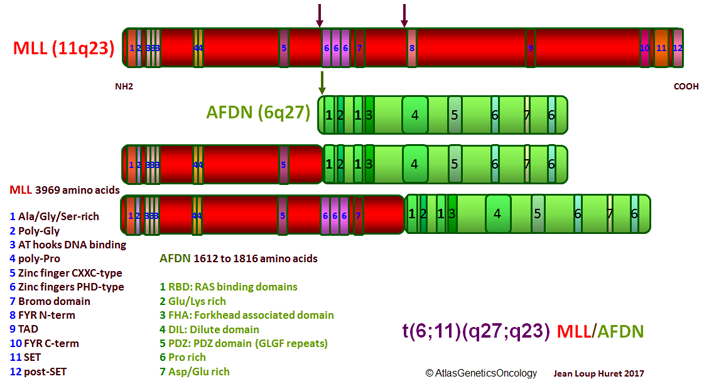
t(6;11)(q27;q23) MLL/AFDN
Oncogenesis
While AFDN localizes in the cytoplasm, MLL/AFDN localizes in the nucleus, leading to aberrant activation of RAS and of its downstream targets (Deshpande et al., 2013; Manara et al. 2014).
Highly cited references
| Pubmed ID | Year | Title | Citations |
|---|---|---|---|
| 37019972 | 2023 | Etiology of oncogenic fusions in 5,190 childhood cancers and its clinical and therapeutic implication. | 71 |
| 35153769 | 2021 | Novel Compounds Synergize With Venetoclax to Target KMT2A-Rearranged Pediatric Acute Myeloid Leukemia. | 60 |
| 33020282 | 2020 | Mutational landscape and clinical outcome of patients with de novo acute myeloid leukemia and rearrangements involving 11q23/KMT2A. | 50 |
| 38621200 | 2024 | Optimized cytogenetic risk-group stratification of KMT2A-rearranged pediatric acute myeloid leukemia. | 35 |
| 34638301 | 2021 | Impact of KMT2A Rearrangement and CSPG4 Expression in Pediatric Acute Myeloid Leukemia. | 35 |
| 39572436 | 2024 | A rare case of pediatric T-cell acute lymphoblastic leukemia with myeloid mimicry. | 34 |
| 34894139 | 2022 | Detection of a Cryptic KMT2A/AFDN Gene Fusion [ins(6;11)(q27;q23q23)] in a Pediatric Patient with Newly Diagnosed Acute Myeloid Leukemia. | 0 |
| 36966725 | 2023 | Mitotic recombinatory evolution in acute leukemia. | 0 |
| 34864370 | 2022 | Lineage switch to acute myeloid leukemia during induction chemotherapy for early T-cell precursor acute lymphoblastic leukemia with the translocation t(6;11)(q27;q23)/KMT2A-AFDN: A case report. | 0 |
| 30203571 | 2018 | KMT2A (MLL) rearrangements observed in pediatric/young adult T-lymphoblastic leukemia/lymphoma: A 10-year review from a single cytogenetic laboratory. | 0 |
| 39823827 | 2025 | Exploring treatment-driven subclonal evolution of prognostic triple biomarkers: Dual gene fusions and chimeric RNA variants in novel subtypes of acute myeloid leukemia patients with KMT2A rearrangement. | 0 |
| 38879649 | 2024 | Co-occurrence of Erdheim-Chester disease and clonally evolving acute myeloid leukemia with FLT3-ITD and PTPN11 mutations. | 0 |
Bibliography
No bibliography items were found for this article.
Summary
Fusion gene
KMT2A/MLLT4 KMT2A (11q23.3) MLLT4 (6q27) COF 1806 1807 1808 1810 1811 1812 1826 2009 2010 2012 2013 2014|KMT2A/MLLT4 KMT2A (11q23.3) MLLT4 (6q27) TIC
Note
Herein below, the well-known term "MLL" will be used, instead of the poorly known term "KMT2A"
A total of 135 different MLL rearrangements have been identified so far (Meyer et al., 2017).
A total of 135 different MLL rearrangements have been identified so far (Meyer et al., 2017).
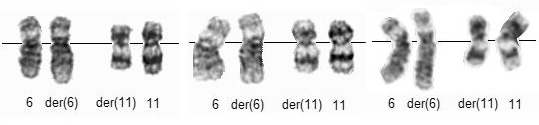
t(6;11)(q27;q23) G- banding - Courtesy Diane H. Norback, Eric B. Johnson, Sara Morrison-Delap Cytogenetics at theWaisman Center (left and middle), and Jean-Luc Lai (right).
Citation
Jean-Loup Huret
t(6;11)(q27;q23) KMT2A/AFDN
Atlas Genet Cytogenet Oncol Haematol. 2017-07-01
Online version: http://atlasgeneticsoncology.org/haematological/1015/t(6
Historical Card
1997-11-01 t(6;11)(q27;q23) KMT2A/AFDN by Jean-Loup Huret,Jean-Loup Huret Affiliation
Genetics, Dept Medical Information, University of Poitiers, CHU Poitiers Hospital, F-86021 Poitiers, France
