t(15;17)(q24;q21) PML/RARA
2016-03-01 Pino J. Poddighe , Pino J. Poddighe Affiliation1.Department of Clinical Genetics, VU University Medical Center, Amsterdam (PJP); Department of Human Genetics, Radboud University Nijmegen Medical Centre (DOW), The Netherlands. [email protected]; [email protected]
2.Laboratoire de Biologie Cellulaire Hématopoïétique, EP-107 CNRS, Institut d Hématologie, Hôpital Saint Louis, Centre Hayem, Paris, France
3.Laboratoire de Biologie Cellulaire Hématopoïétique, EP-107 CNRS, Institut dHématologie, Hôpital Saint Louis, Centre Hayem, Paris, France
Abstract
Review on t(15;17)(q24;q21), with data on clinics, and the genes involved.
Clinics and Pathology
Disease
In sporadic cases the t(15;17) can be present in chronic myelogenous leukemia (CML) in myeloid blast crisis as an additional abnormality to the t(9;22)(q34;q11.2).
Phenotype stem cell origin
Epidemiology
Clinics
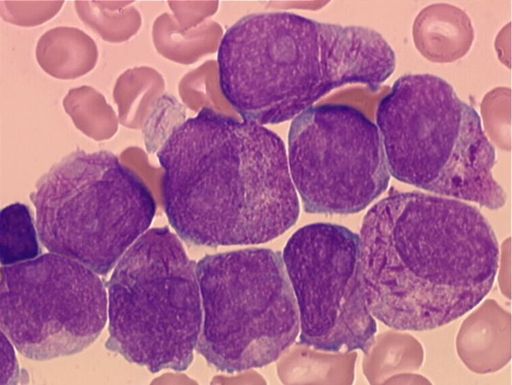
Cytology
Treatment
With the recent differentiation therapy using all-trans retinoic acid ATRA (with combined cytotoxic chemotherapy or arsenic trioxide (ATO)), complete remission (CR) is obtained in more than 90% of cases; this is the only cancer which, to date, can be treated by differentiation therapy.
Prognosis
Cytogenetics
Cytogenetics morphological
Although primary anomaly in most cases, t(15;17) can also occur in rare occurrences at acutisation (of promyelocytic type, of course) of a CML with the usual t(9;22).
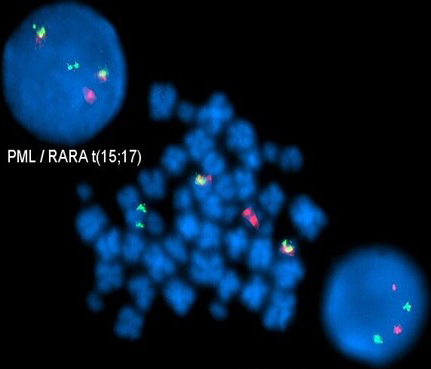
Genes Involved and Proteins
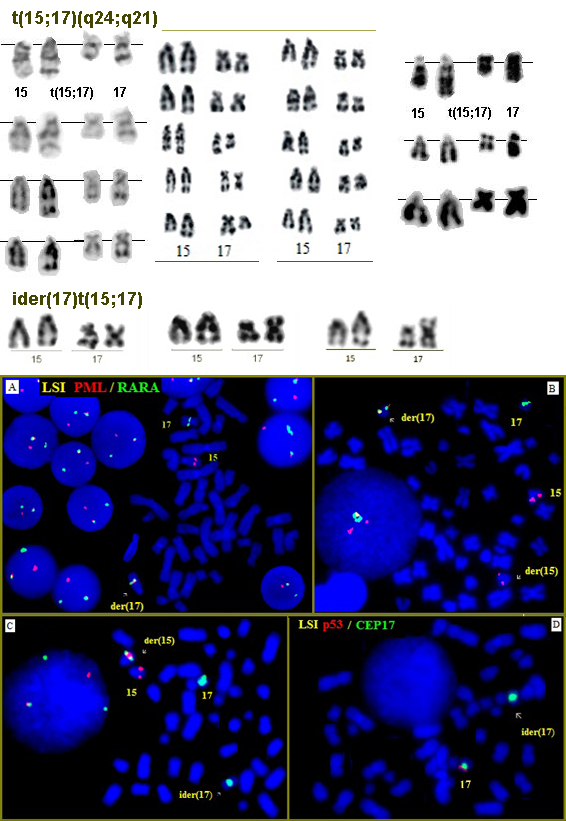
Rare cases of APL lacking the classic translocation in routine cytogenetic studies have been described with complex variant translocations (true variants) involving both chromosomes 15 and 17 with an additional chromosome (three way translocations) or with submicroscopic insertion of RARA into PML leading to the expression of the PML-RARA transcript; these latter cases are considered as cryptic or masked t(15;17)(q24;q21). Morphological analysis shows no major differences between the t(15;17)(q24;q21) positive group and the PML-RARA positive patients without t(15;17)(q24;q21). Three way translocations demonstrated that the crucial event lies on der(15), which receives the end part of chromosome 17.
A subset of patients, often with morphological features resembling APL, show variant translocations involving RARA (17q21). These variant fusion partners include ZBTB16 (previously known as PLZF at 11q23) in t(11;17)(q23;q21), NPM1 at 5q35 in t(5;17)(q32;q12), and NUMA1 at 11q13 in t(11;17)(q13;q21) ID: 1126> and STAT5B at 17q11.2 in dup(17)(q12q21). Some APL variants, including t(11;17)(q23;q12) with ZBTB16-RARA and cases with STAT5B-RARA fusions are resistant to ATRA.
Mutations involving FLT3 occur in 34-45% of APL.
Result of the Chromosomal Anomaly
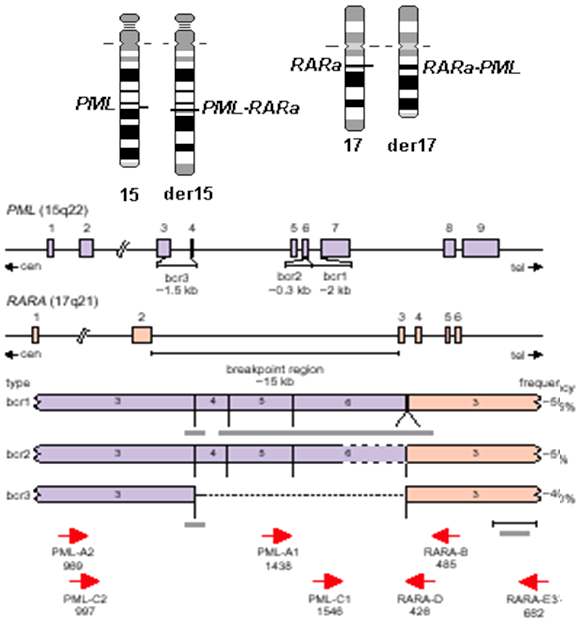
Description
Transcript
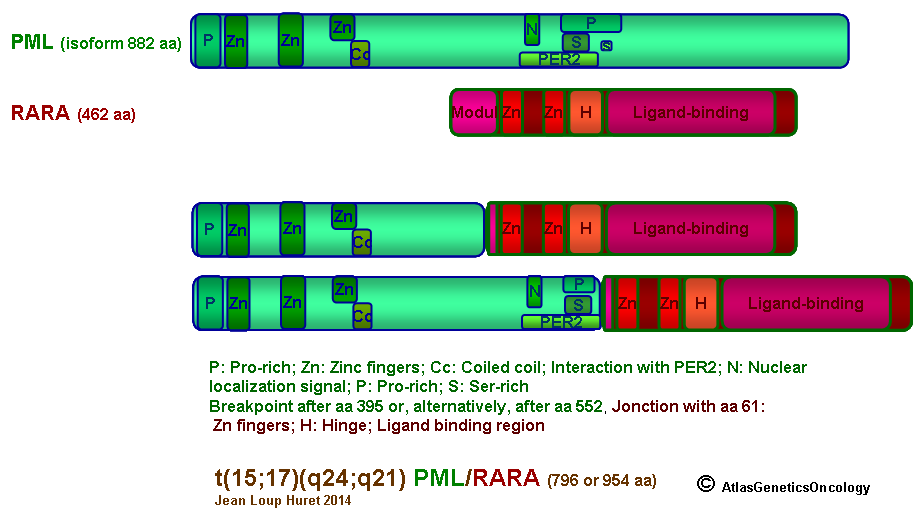
Description
Oncogenesis
Highly cited references
| Pubmed ID | Year | Title | Citations |
|---|---|---|---|
| 32295268 | 2020 | Classic and Variants APLs, as Viewed from a Therapy Response. | 173 |
| 32182684 | 2020 | Acute Promyelocytic Leukemia: A Constellation of Molecular Events around a Single PML-RARA Fusion Gene. | 172 |
| 38503502 | 2024 | Acute Promyelocytic Leukemia, Retinoic Acid, and Arsenic: A Tale of Dualities. | 144 |
| 36145693 | 2022 | The Development and Clinical Applications of Oral Arsenic Trioxide for Acute Promyelocytic Leukaemia and Other Diseases. | 135 |
| 37388925 | 2023 | Biomolecular Condensates in Myeloid Leukemia: What Do They Tell Us? | 131 |
| 38061017 | 2023 | Proteogenomic analysis reveals cytoplasmic sequestration of RUNX1 by the acute myeloid leukemia-initiating CBFB::MYH11 oncofusion protein. | 112 |
| 21258047 | 2011 | Dynamics of epigenetic modifications in leukemia. | 104 |
| 23847762 | 2013 | PML, SUMOylation, and Senescence. | 100 |
| 41168841 | 2025 | Disease-specific epigenetic deregulation of enhancers, transposons, and polycomb targets in acute promyelocytic leukemia. | 95 |
| 34795215 | 2021 | Genetic fusions favor tumorigenesis through degron loss in oncogenes. | 95 |
| 38098967 | 2023 | Different Isoforms of PML-RARA Chimeric Protein in Patients with Acute Promyelocytic Leukemia: Survival Analysis per Demographic Characteristics, Clinicohematological Parameters, and Cytogenetic Findings. | 90 |
| 32215187 | 2020 | Acute promyelocytic leukemia (APL): a review of the literature. | 84 |
| 39766302 | 2024 | Rapid Detection of PML::RARA Fusions in Acute Promyelocytic Leukemia: CRISPR/Cas9 Nanopore Sequencing with Adaptive Sampling. | 83 |
| 40773291 | 2025 | Overexpression of the signaling coordinator GAB2 can play an important role in acute myeloid leukemia progression. | 80 |
| 37655965 | 2023 | Structural Basis of PML-RARA Oncoprotein Targeting by Arsenic Unravels a Cysteine Rheostat Controlling PML Body Assembly and Function. | 78 |
| 34193815 | 2021 | Acute promyelocytic leukemia current treatment algorithms. | 77 |
| 28017614 | 2017 | FTO Plays an Oncogenic Role in Acute Myeloid Leukemia as a N(6)-Methyladenosine RNA Demethylase. | 74 |
| 32024232 | 2020 | Advances in Pediatric Acute Promyelocytic Leukemia. | 73 |
| 28794865 | 2017 | Recent advances in acute promyelocytic leukaemia. | 71 |
| 29795382 | 2018 | Dual origin of relapses in retinoic-acid resistant acute promyelocytic leukemia. | 68 |
| 31431473 | 2019 | A molecule inducing androgen receptor degradation and selectively targeting prostate cancer cells. | 67 |
| 25750172 | 2015 | PU.1 downregulation in murine radiation-induced acute myeloid leukaemia (AML): from molecular mechanism to human AML. | 66 |
| 21059853 | 2010 | Gain of MYC underlies recurrent trisomy of the MYC chromosome in acute promyelocytic leukemia. | 65 |
| 24449212 | 2014 | Immune evasion by oncogenic proteins of acute myeloid leukemia. | 61 |
| 42663568 | 2026 | PML-driven sumoylation of PML::RARA-bound repressors drives hematopoietic progenitor immortalization. | 60 |
| 26997274 | 2016 | NPM and BRG1 Mediate Transcriptional Resistance to Retinoic Acid in Acute Promyelocytic Leukemia. | 56 |
| 37593318 | 2023 | Therapy-Related Acute Promyelocytic Leukemia: A Case Report and a Review of Literature. | 53 |
| 26595813 | 2016 | PML-RARA requires DNA methyltransferase 3A to initiate acute promyelocytic leukemia. | 51 |
| 41440764 | 2025 | Acute Promyelocytic Leukemia: Pathophysiology, Diagnosis and Clinical Management. | 48 |
| 29772692 | 2018 | Insurance Coverage Policies for Pharmacogenomic and Multi-Gene Testing for Cancer. | 45 |
| 38304177 | 2024 | Acute promyelocytic leukemia with PML/RARA (bcr1, bcr2 and bcr3) transcripts in a pediatric patient. | 41 |
| 40421449 | 2025 | What Is Acute Myeloid Leukemia? | 37 |
| 35692786 | 2022 | Case Report: Extramedullary Acute Promyelocytic Leukemia: An Unusual Case and Mini-Review of the Literature. | 34 |
| 33257864 | 2021 | Readfish enables targeted nanopore sequencing of gigabase-sized genomes. | 33 |
| 39807666 | 2024 | Predictive modelling of acute Promyelocytic leukaemia resistance to retinoic acid therapy. | 31 |
| 33614484 | 2020 | Oral Realgar-Indigo Naturalis Formula Plus Retinoic Acid for Acute Promyelocytic Leukemia. | 31 |
| 28101221 | 2016 | A complex translocation (3;17;15) in acute promyelocytic leukemia confirmed by fluorescence in situ hybridization. | 31 |
| 38921185 | 2024 | Three-Way Translocation t(12;15;17) (p13;q24;q21) Found in Acute Promyelocytic Leukemia with Basophilic Differentiation. | 26 |
| 36672788 | 2022 | Acute Promyelocytic Leukemia with Rare Genetic Aberrations: A Report of Three Cases. | 26 |
| 41718414 | 2026 | Primary Indolent Acute Promyelocytic Leukemia. | 22 |
| 37685882 | 2023 | Cytogenetically Cryptic Acute Promyelocytic Leukemia: A Diagnostic Challenge. | 20 |
| 34668451 | 2022 | Value of measurable residual disease monitoring in patients with acute promyelocytic leukemia in the era of frontline 'chemotherapy-free' therapy. | 19 |
| 39469370 | 2024 | Cytogenetic and Molecular Characteristics in Adult Hispanic Acute Myeloid Leukemia Patients From Puerto Rico. | 15 |
| 34673934 | 2022 | A novel NUP98-JADE2 fusion in a patient with acute myeloid leukemia resembling acute promyelocytic leukemia. | 15 |
| 28028657 | 2017 | PML-RARA mutations confer varying arsenic trioxide resistance. | 14 |
| 36465368 | 2022 | Case report: A rare case of TBL1XR1-RARB positive acute promyelocytic leukemia in child and review of the literature. | 13 |
| 41377785 | 2025 | Coexistence of Philadelphia Chromosome in Acute Promyelocytic Leukaemia: Two Rare Cases, with A Literature Review. | 11 |
| 34230915 | 2021 | PML/RARA destabilization by hyperthermia: a new model for oncogenic fusion protein degradation? | 10 |
| 33650061 | 2022 | The PML-RARA fusion is not detectable in historical blood samples of acute promyelocytic leukaemia patients. | 10 |
| 38800206 | 2024 | Double Emergency: A Case of Concurrent Heparin-Induced Thrombocytopenia and Acute Promyelocytic Leukemia. | 10 |
| 35572917 | 2022 | Cytogenetically cryptic PML::RARA fusion in acute promyelocytic leukemia: Testing strategies in the modern era. | 10 |
| 38979565 | 2024 | Identification of a Novel MAPK1::BCR Fusion Gene/t(9;22) (q34;q11) in a Case of Acute Promyelocytic Leukemia. | 10 |
| 29245895 | 2017 | Progress and criticalities in the management of acute promyelocytic leukemia. | 7 |
| 37766564 | 2023 | Acute promyelocytic leukemia masquerading as myeloid maturation arrest- A Case report. | 7 |
| 31555723 | 2019 | Educational Case: Acute Promyelocytic Leukemia With PML-RARA. | 6 |
| 39397152 | 2025 | Therapy-Related Acute Promyelocytic Leukemia: Case Series and Current Insights. | 5 |
| 32185069 | 2020 | Acute promyelocytic leukemia presenting with atypical basophils. | 2 |
| 39017850 | 2024 | Function of PML-RARA in Acute Promyelocytic Leukemia. | 0 |
| 29083825 | 2023 | Acute Promyelocytic Leukemia (Archived). | 0 |
| 35854096 | 2022 | A novel RARA-SNX15 fusion in PML-RARA-positive acute promyelocytic leukemia with t(11;17;15)(q13;q21.2;q24.1). | 0 |
| 30536958 | 2019 | PML/RARA inhibits expression of HSP90 and its target AKT. | 0 |
| 30305503 | 2018 | [State-of-the-art treatment of acute promyelocytic leukemia]. | 0 |
| 35882408 | 2022 | MicroRNA-125b Accelerates and Promotes PML-RARa-driven Murine Acute Promyelocytic Leukemia. | 0 |
| 31281149 | 2019 | [Genetic abnormalities in AML]. | 0 |
| 37598913 | 2023 | PML/RARa leukemia induced murine model for immunotherapy evaluation. | 0 |
| 19215983 | 2009 | Aleukemic bcr-abl positive granulocytic sarcoma. | 0 |
| 32473106 | 2020 | Genotypic and Phenotypic Characteristics of Acute Promyelocytic Leukemia Translocation Variants. | 0 |
| 33983418 | 2021 | bcr3 PML-RARA: short fusion, small blasts! | 0 |
| 29136503 | 2017 | Acute Promyelocytic Leukemia: A Paradigm for Oncoprotein-Targeted Cure. | 0 |
| 33162510 | 2020 | [Clinical significance of MRD in AML]. | 0 |
| 38303649 | 2024 | High-Fat Diet Induced PPARδ Promotes Self-renewal of Preleukemic Progenitors in Development of Acute Promyelocytic Leukemia. | 0 |
| 24907017 | 2014 | Can we say farewell to monitoring minimal residual disease in acute promyelocytic leukaemia? | 0 |
| 37726492 | 2023 | miR-603 promotes cell proliferation and differentiation by targeting TrkB in acute promyelocytic leukemia. | 0 |
| 36112505 | 2022 | How retinoic acid and arsenic transformed acute promyelocytic leukemia therapy. | 0 |
| 35963522 | 2022 | Fusion Gene Detection and Quantification by Asymmetric Capture Sequencing (aCAP-Seq). | 0 |
| 34405393 | 2021 | PML-RARA transcript levels at the end of induction therapy are associated with prognosis in non-high-risk acute promyelocytic leukaemia with all-trans retinoic acid plus arsenic in front-line therapy: long-term follow-up of a single-centre cohort study. | 0 |
| 34725711 | 2022 | Acute Promyelocytic Leukemia with a BCR-ABL1 Rearrangement in a Minor Clone. | 0 |
| 34310740 | 2021 | RBCK1-TRIB3 decelerated the progression of acute promyelocytic leukemia. | 0 |
| 1337847 | 1992 | RARA and PML genes in acute promyelocytic leukemia. | 0 |
| 30421475 | 2019 | Identification and monitoring of atypical PML/RARA fusion transcripts in acute promyelocytic leukemia. | 0 |
| 38153216 | 2024 | Identification of concurrent STAT3::RARA and RARA::STAT5b fusions in a variant APL case. | 0 |
| 17134965 | 2006 | Gene expression regulation and cancer. | 0 |
| 26374632 | 2016 | PML-RARa modulates the vascular signature of extracellular vesicles released by acute promyelocytic leukemia cells. | 0 |
| 21078537 | 2011 | Independent prognostic variables in acute myeloid leukaemia. | 0 |
| 24720386 | 2014 | RARA fusion genes in acute promyelocytic leukemia: a review. | 0 |
| 32016577 | 2020 | Chemogenomics analysis of drug targets for the treatment of acute promyelocytic leukemia. | 0 |
| 28025581 | 2017 | PML-RARA-associated cooperating mutations belong to a transcriptional network that is deregulated in myeloid leukemias. | 0 |
| 22056243 | 2012 | Curing APL through PML/RARA degradation by As2O3. | 0 |
| 35544458 | 2022 | A short report of novel RARG-HNRNPM fusion gene in resembling acute promyelocytic leukemia. | 0 |
| 25530565 | 2015 | Correlation between FLT3-ITD status and clinical, cellular and molecular profiles in promyelocytic acute leukemias. | 0 |
| 36476791 | 2022 | [Diagnostic efficacy of WT1 expression in asymptomatic acute promyelocytic leukemia]. | 0 |
| 33428799 | 2021 | Identification of a novel TNRC18-RARA fusion in acute promyelocytic leukemia lacking t(15;17)(q24;q12)/PML-RARA. | 0 |
| 19808868 | 2009 | Therapy-induced PML/RARA proteolysis and acute promyelocytic leukemia cure. | 0 |
| 38294534 | 2024 | Identification of a novel fusion gene, RARA::ANKRD34C, in acute promyelocytic leukemia. | 0 |
| 20805746 | 2010 | Assessment of minimal residual disease in acute myeloid leukemia. | 0 |
| 42660706 | 2026 | Advances in differentiation syndrome in acute promyelocytic leukemia: From mechanisms to management. | 0 |
| 33851647 | 2021 | Cytogenetics and FISH negative cryptic acute promyelocytic leukemia with CD56 expression. | 0 |
| 24596215 | 2014 | PML nuclear bodies mediate the therapeutic response of APL cells. | 0 |
| 42770952 | 2026 | Correction: PML-driven sumoylation of PML::RARA-bound repressors drives hematopoietic progenitor immortalization. | 0 |
| 22586354 | 2011 | The drug-induced degradation of oncoproteins: an unexpected Achilles' heel of cancer cells? | 0 |
Article Bibliography
| Pubmed ID | Last Year | Title | Authors |
|---|---|---|---|
| 1848017 | 1991 | Translocation breakpoint of acute promyelocytic leukemia lies within the retinoic acid receptor alpha locus. | Alcalay M et al |
| 1797083 | 1991 | Cytogenetic studies in acute promyelocytic leukemia: a survey of secondary chromosomal abnormalities. | Berger R et al |
| 2218500 | 1990 | Molecular analysis of acute promyelocytic leukemia breakpoint cluster region on chromosome 17. | Borrow J et al |
| 7787753 | 1995 | Treatment of newly diagnosed acute promyelocytic leukemia (APL) by all transretinoic acid (ATRA) combined with chemotherapy: The European experience. European APL Group. | Fenaux P et al |
| 17217041 | 2007 | Treatment of acute promyelocytic leukemia by retinoids. | Fenaux P et al |
| 1314166 | 1992 | Genomic variability and alternative splicing generate multiple PML/RAR alpha transcripts that encode aberrant PML proteins and PML/RAR alpha isoforms in acute promyelocytic leukaemia. | Pandolfi PP et al |
| 8515790 | 1993 | Acute promyelocytic leukemia. | Warrell RP Jr et al |
| 2170850 | 1990 | The t(15;17) translocation of acute promyelocytic leukaemia fuses the retinoic acid receptor alpha gene to a novel transcribed locus. | de Thé H et al |
Summary
Fusion gene
Note
Citation
Pino J. Poddighe ; Pino J. Poddighe
t(15;17)(q24;q21) PML/RARA
Atlas Genet Cytogenet Oncol Haematol. 2016-03-01
Online version: http://atlasgeneticsoncology.org/haematological/1035
Historical Card
1998-04-01 t(15;17)(q24;q21) PML/RARA by Christine Chomienne,Jean-Loup Huret Affiliation