t(2;11)(p21;q23) without KMT2A (MLL) rearrangement
2016-08-01 Ana L. Ruano , Shashirekha Shetty Affiliation1.Robert J. Tomisch Pathology, Laboratory Medicine Institute, Cleveland Clinic, Cleveland, Ohio (ALR, SS), and University Hospitals, Case Western Reserve University, Cleveland, Ohio (SS), USA; [email protected] and [email protected]
Abstract
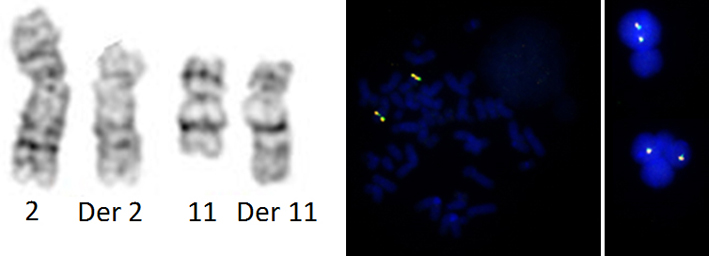
Forty five cases carrying the t(2;11)(p21;q23) have been reported in the literature, mostly in myelodysplastic syndromes (MDS) and acute myeloid leukemia (AML). Some of these cases involve rearrangements of the the MLL gene (also known as KMT2A), on 11q23, which confers a more aggressive behavior in myeloid neoplasms. Several individual case reports, as well as series such as 19 cases reported by Bousquet et al., 2008 and 7 cases by Dvorak et al., 2014, describe myeloid neoplasms carrying the t(2;11)(p21;q23) without an MLL gene rearrangement, with possible prognostic implications. The authors of this paper describe two additional cases from their institution.
Clinics and Pathology
Phenotype stem cell origin
Thirty two case are available: 2 chronic myeloproliferative cases, 18 myelodysplastic syndromes (MDS), and 12 cases of acute myeloid leukemia (AML). Diagnoses were: chronic myelogenous leukemia harbouring the t(9;22)(q34;q11) (CML, 1 case), polycythemia vera (PV, 1 case), myelodysplastic/myeloproliferative overlap syndrome (MDS/MPN, 1 case), refractory anemia (RA, 1 case), refractory anemia with excess blasts (RAEB, RAEB-I, RAEB-II, 5 cases), refractory cytopenia with multilineage dysplasia (RCMD, 2 cases), RCMD with ring sideroblasts (RCMD-RS, 1 case), unclassifiable MDS (MDS-U, 1 case), low grade MDS NOS (7 cases); AML NOS (3 cases), AML-M0 (1 case), AML-M1 (1 case), AML-M2 (3 cases), AML-M4 (2 cases) and AML- M5 (2 cases). Ten of the twelve AML cases were classified either as having multilineage dysplasia or as arising from MDS (chronic myelomonocytic leukemia , refractory anemia). In two cases, dysplasia could not be assessed (Harrison et al., 1998; Gozzetti et al., 2003; Royer-Pekora et al., 2003; Bousquet et al., 2008; Dvorak et al., 2014; McCormick et al., 2014; Ruano and Shetty, unpublished observation)
The authors of this paper describe two additional cases, above included (Ruano and Shetty, unpublished observation): one in a patient diagnosed with myelodysplastic/myeloproliferative (MDS/MPN) overlap syndrome best classified as atypical chronic myeloid leukemia (CML), BCR/ABL negative; another patient presented with acute monoblastic leukemia, later classified as AML with myelodysplasia-related changes after obtaining knowledge on the cytogenetic findings.
Epidemiology
Clinics
Pathology
The case described by McCormick et al., 2014 showed a hypercellular bone marrow (95%) with increased megakaryoctyes ranging from small hypolobated forms to large and normally lobated.
From the cases reported by the authors of this paper, the bone marrow aspirate and biopsy from the 54 year old patient with atypical CML, BCR/ABL negative showed granulocytic hyperplasia with left shift with occasional dyserythropoiesis and dysgranulopoiesis. There was more prominent dysmegakaryopoiesis consisting of small, hypolobated forms with occasional micromegakaryocytes. Blasts represented 3% of bone marrow elements. One year later, the patient presented with acute myeloid leukemia with 40% circulating blasts expressing CD5, CD7, CD13, CD33, CD34, CD117, and HLA-DR, with dim expression of CD56. Two follow-up bone marrows showed persistent involvement by AML.
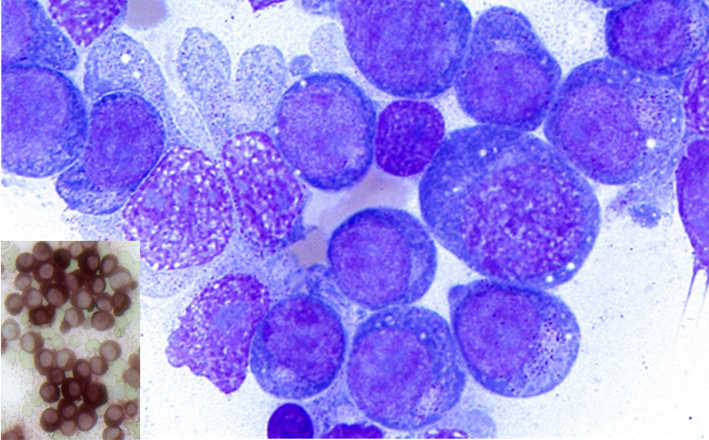
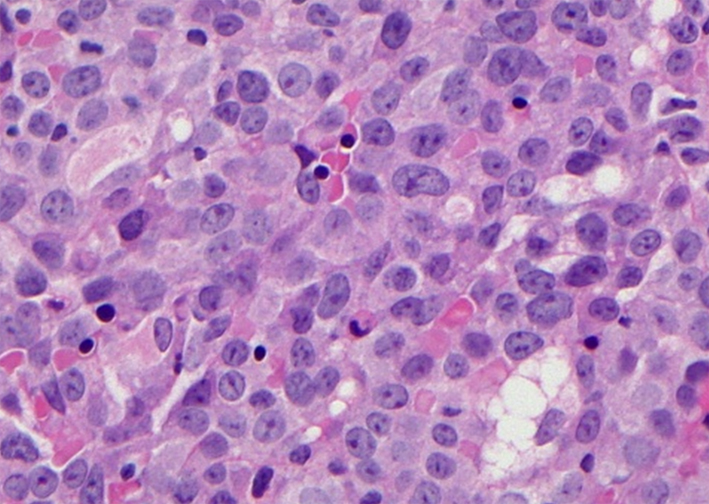
The bone marrow aspirate and biopsy from the 44 year old female with AML showed 89% blasts expressing CD13 (dim), CD33, CD38, CD45 (dim), CD56, CD64, CD65 (bright), HLA-DR, and CD117 (on a subset). performed on the bone marrow aspirate shows 69% blasts which are positive for CD4, CD13 (dim), CD33, CD38, CD45 (dim), CD56, CD64, CD65 (bright), HLA-DR, and CD117 (subset). Cytochemical stains showed that the blasts were negative for myeloperoxidase and positive for alpha-naphthyl butyrate esterase. See Figure 2 and 3.
Treatment
The seven patients reported by Dvorak et al., 2014 were treated either with symptomatic or cytoreductive therapy. One patient with deletion 5q was treated with lenalidomide but had only a partial response to treatment. Two patients underwent peripheral stem cell transplantation, after which one had stable disease but the other transformed to AML. The median overall survival for this small cohort was 72 months and at the time of publication, 2 patients were alive and 5 had died.
The patient reported by McCormick et al., 2014 remained clinically stable 70 months after initial diagnosis, requiring only periodic phlebotomies.
The 54 year old patient described by this pages authors was initially treated with hydroxyurea after being diagnosed with atypical CML. He transformed to AML 14 months later and was treated with 7+3, ara-C and idarubicin. Due to persistent disease he was started on a new cycle of chemotherapy which was complicated by fever and altered mental status eventually leading to patients death approximately 1 month later. The 44 year old patient diagnosed with AML with myelodysplasia related changes was treated with 7+3 regimen, with cytarabine and daunorubicin and had 2 negative bone marrows at 14 days and 1 month after treatment was started. She remained clinically stable but was lost to follow-up 1 year after diagnosis.
Prognosis
Genes Involved and Proteins
miR-125b originates from chromosomes 11q24 (MIR125B1 ) and 21q21 (MIR125B2 ) It is a regulator of normal hematopoiesis and exerts its oncogenic effect through several mechanisms including arrest of myeloid/monocytic differentiation, promoting stem cell renewal and targeting intermediaries in the TP53 pathway. Besides AML/MDS with t(2;11)(p21;q23), miR-125b has also found to play a role in pediatric acutepromyelocytic leukemia , acute megakaryoblastic leukemia of trisomy 21, and precursor B-cell acute lymphoblastic leukemia (B-ALL) (McCormick et al., 2014).
Article Bibliography
| Pubmed ID | Last Year | Title | Authors |
|---|---|---|---|
| 18936236 | 2008 | Myeloid cell differentiation arrest by miR-125b-1 in myelodysplastic syndrome and acute myeloid leukemia with the t(2;11)(p21;q23) translocation. | Bousquet M et al |
| 23949951 | 2014 | The translocation t(2;11)(p21;q23) without MLL gene rearrangement--a possible marker of good prognosis in myelodysplastic syndrome patients. | Dvorak P et al |
| 9885982 | 1999 | MLL is involved in a t(2;11)(p21;q23) in a patient with acute myeloblastic leukemia. | Fleischman EW et al |
| 12850382 | 2003 | A case of acute myelogenous leukemia: myelodysplastic syndrome with t(2;11)(p21;q23) without MLL rearrangement. | Gozzetti A et al |
| 9593286 | 1998 | Ten novel 11q23 chromosomal partner sites. European 11q23 Workshop participants. | Harrison CJ et al |
| 25316507 | 2015 | Myeloid neoplasm with translocation t(2;11)(p21;q23-24), elevated microRNA 125b-1, and JAK2 exon 12 mutation. | McCormick SR et al |
| 12682644 | 2003 | Simultaneous occurrence of a t(9;22) (Ph) with a t(2;11) in a patient with CML and emergence of a new clone with the t(2;11) alone after imatinib mesylate treatment. | Royer-Pokora B et al |
Summary
Citation
Ana L. Ruano ; Shashirekha Shetty
t(2;11)(p21;q23) without KMT2A (MLL) rearrangement
Atlas Genet Cytogenet Oncol Haematol. 2016-08-01
Online version: http://atlasgeneticsoncology.org/haematological/1333/t(2
