t(9;17)(p13;p12) PAX5/NCOR1
2014-07-01 Jean-Loup Huret Affiliation1.Genetics, Dept Medical Information, University of Poitiers, CHU Poitiers Hospital, F-86021 Poitiers, France
Clinics and Pathology
Disease
B-cell acute lymphoblastic leukemia (B-ALL)
Epidemiology
One case to date, a 2-year-old boy with a CD10+ (B-II, common) ALL (Coyaud et al., 2010).
Prognosis
No data.
Genes Involved and Proteins
Gene name
PAX5 (paired box gene 5)
Location
9p13.2
Protein description
391 amino acids; from N-term to C-term, PAX5 contains: a paired domain (aa: 16-142); an octapeptide (aa: 179-186); a partial homeodomain (aa: 228-254); a transactivation domain (aa: 304-359); and an inhibitory domain (aa: 359-391). Lineage-specific transcription factor; recognizes the concensus recognition sequence GNCCANTGAAGCGTGAC, where N is any nucleotide. Involved in B-cell differentiation. Entry of common lymphoid progenitors into the B cell lineage depends on E2A, EBF1, and PAX5; activates B-cell specific genes and repress genes involved in other lineage commitments. Activates the surface cell receptor CD19 and repress FLT3. Pax5 physically interacts with the RAG1/RAG2 complex, and removes the inhibitory signal of the lysine-9-methylated histone H3, and induces V-to-DJ rearrangements. Genes repressed by PAX5 expression in early B cells are restored in their function in mature B cells and plasma cells, and PAX5 repressed (Fuxa et al., 2004; Johnson et al., 2004; Zhang et al., 2006; Cobaleda et al., 2007; Medvedovic et al., 2011).
Gene name
NCOR1 (nuclear receptor corepressor 1)
Location
17p12
Protein description
2440 amino acids; from N-term to C-term, NCOR1 contains: a repression domains (responsible for the repressive activity of the corepressor) (aa 1-312); a poly-Gln stretch (aa 58-64), two coiled coil domains (aa 174-216 and aa 299-328); a SANT (Swi3, Ada2, NCoR1, TFIIB) domain (deacetylase activation domain (DAD)) (aa 435-486); a coiled coil domain (aa 501-557); a poly-Ala stretch (aa 593-603); a Pro-rich stretch (aa 607-617); a SANT domain (histone interaction domain (HID)) (aa 623-674); a poly-Pro stretch (aa 1032-1035); a poly-Ala stretch (aa 1707-1712); a CoRNR box motif (Leu-x-x-Leu-Leu motifs) (aa 1933-1937); a poly-Ser stretch (aa 1952-1963); a nuclear receptor-interacting domain ID1 (aa 2032-2115); a CoRNR box motif (aa 2055-2059); another nuclear receptor-interacting domain ID2 (aa 2212-2273); and a CoRNR box motif (aa 2263-2267).
Protein description
NCOR1 and NCOR2 (12q24, also called SMRT) are transcriptional corepressors that associate with nuclear hormone receptors (thyroid hormone receptors and retinoic acid receptors) in the absence of ligand. Thyroid hormone receptors interact specifically with the ID3 and ID2 domains of NCOR1 (ID domains contain an isoleucine-rich domain, named the CoRNR box, this CoRNR box is required for nuclear hormone receptors interaction). SANT-like domains promote histone deacetylation. Repression is mediated by formation of a large corepressor complex that contains SIN3A/B (15q24 and 19p13), recruiting multiple histone deacetylase enzymes such as HDAC1 (1p35), HDAC2 (6q21), HDAC3 (5q31), HDAC4 (2q37), HDAC7 (12q13), and SIRT1 (10q21), resulting in the formation of repressive chromatin structures. This complex associates with the thyroid hormone receptor and the retinoic acid receptor.
Protein description
NCOR1 and NCOR2 also interact with many other transcription factors including: BCL6 (3q27), RUNX1T1 (8q21, also called ETO), SPEN (1p36, also called SHARP), ZBTB33 (Xq24), HEXIM1 (17q21), TBL1XR1 (3q26), MEF2C (5q14), CNOT2 (12q15), and RBJP (4p15), Jun proteins and the NFKB pathway (Li et al., 1997; Watson et al., 2012; Mottis et al., 2013).
Result of the Chromosomal Anomaly
Description
Fusion of PAX5 exon 5 to NCOR1 exon 43.
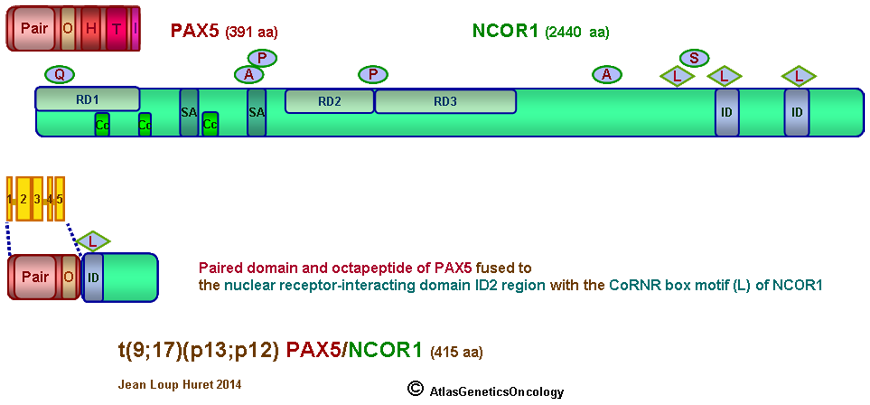
PAX5-NCOR1 fusion protein.
Description
415 amino acids. The predicted fusion protein contains the DNA binding paired domain, and the octapeptide of PAX5 (201 aa), and most the ID2 region (containing the CoRNR box motif) of NCOR1 (214 aa).
Article Bibliography
| Pubmed ID | Last Year | Title | Authors |
|---|---|---|---|
| 17440452 | 2007 | Pax5: the guardian of B cell identity and function. | Cobaleda C et al |
| 20160164 | 2010 | Wide diversity of PAX5 alterations in B-ALL: a Groupe Francophone de Cytogenetique Hematologique study. | Coyaud E et al |
| 15004008 | 2004 | Pax5 induces V-to-DJ rearrangements and locus contraction of the immunoglobulin heavy-chain gene. | Fuxa M et al |
| 15258579 | 2004 | B cell-specific loss of histone 3 lysine 9 methylation in the V(H) locus depends on Pax5. | Johnson K et al |
| 9415406 | 1997 | Characterization of receptor interaction and transcriptional repression by the corepressor SMRT. | Li H et al |
| 21970955 | 2011 | Pax5: a master regulator of B cell development and leukemogenesis. | Medvedovic J et al |
| 23630073 | 2013 | Emerging roles of the corepressors NCoR1 and SMRT in homeostasis. | Mottis A et al |
| 21925568 | 2012 | Nuclear hormone receptor co-repressors: structure and function. | Watson PJ et al |
| 16680144 | 2006 | Transcription factor Pax5 (BSAP) transactivates the RAG-mediated V(H)-to-DJ(H) rearrangement of immunoglobulin genes. | Zhang Z et al |
Citation
Jean-Loup Huret
t(9;17)(p13;p12) PAX5/NCOR1
Atlas Genet Cytogenet Oncol Haematol. 2014-07-01
Online version: http://atlasgeneticsoncology.org/haematological/1597/status/gene-explorer/cancer-prone-explorer/tumors-explorer/
